
How to Document a Car Build the Right Way
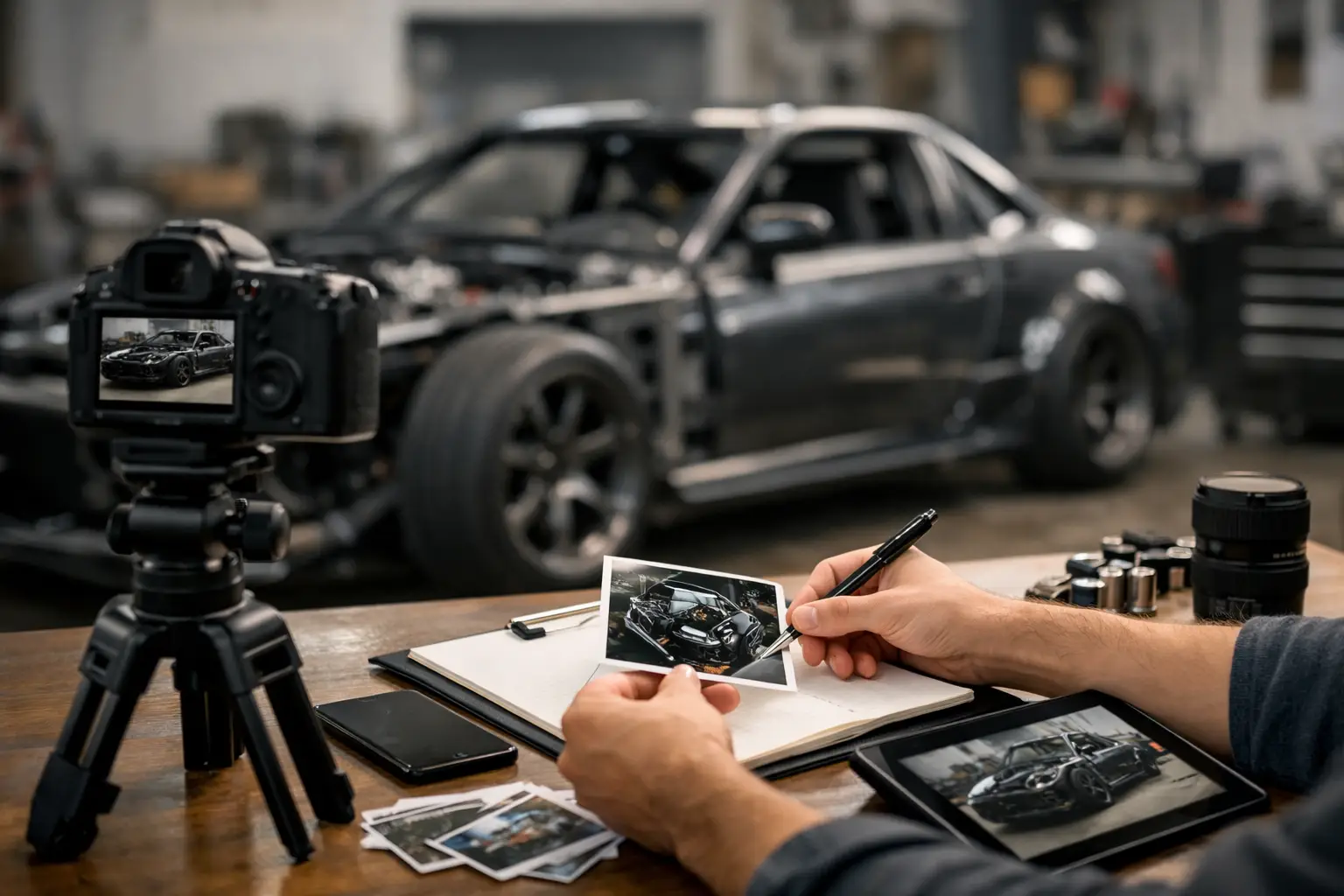
A clean engine bay gets attention. A clean build history earns trust.
If you're figuring out how to document a car build, the goal is not just to post a few progress photos and call it done. A real build record helps you track parts, prove maintenance, remember what was done and when, and show buyers or followers that your car's story is organized instead of vague. That matters whether you're building a weekend track car, restoring an old truck, or slowly modifying your daily.
Why documenting a car build actually pays off
Most owners start documenting when the car begins to look good. The smarter move is to start when the first part is ordered or the first bolt is removed. Once the build gets moving, details disappear fast. You forget exact install dates, lose a receipt in the garage, or mix up which revision of a part ended up on the car.
Good documentation gives you control. It helps you track spending without guessing, keeps warranty records where you can find them, and makes future maintenance easier because you know what changed from stock. It also protects resale value. Buyers trust a car with dates, invoices, part numbers, and photos far more than a car with a caption that says "built, no expense spared."
There is a trade-off, though. If you try to document everything perfectly from day one, you'll probably stop after a week. The better approach is consistent, not obsessive. Capture the details that matter, and use a system you'll actually keep using.
How to document a car build from day one
The best build records follow the life of the car in a simple order. You want a starting point, a running timeline, and a place for all the proof behind the work.
Start with a baseline
Before the first modification, record the car as it sits. Note the year, make, model, trim, VIN, mileage, and any existing upgrades or issues. Take a full photo set of the exterior, interior, engine bay, trunk, underbody if possible, and problem areas like rust, paint defects, or worn trim.
This baseline matters more than people think. It gives you a clear before-and-after record, and it can save you from future confusion when trying to remember whether a leak, scratch, or wiring change existed before the project started.
Build a timeline, not a pile of notes
A lot of people document builds in fragments - some receipts in a glove box, some photos on a phone, some part numbers buried in email. That works until you need one answer fast.
Instead, keep every update tied to a date and mileage. Each entry should say what was done, why it was done, which parts were used, who did the work, and what it cost. If the install revealed something unexpected, log that too. For example, if coilovers went on but the top hats were worn and replaced at the same time, that detail belongs in the record.
This timeline becomes the backbone of your build history. It also makes future troubleshooting much easier because you can trace when a noise, tune, alignment change, or drivability issue first appeared.
What to record for every modification
Not every mod needs a novel, but every mod should have enough detail to stand on its own.
At minimum, record the part name, brand, part number, purchase date, install date, mileage at install, total cost, and whether it was DIY or shop-installed. Add notes on fitment, supporting mods, tuning requirements, and any changes from the original plan. If you bought used parts, mention condition and source. If something required fabrication or custom wiring, say exactly what changed.
Photos help fill the gaps that text misses. Take a few clear shots before installation, during the process, and after completion. If there was a hidden area that changed - wiring, brackets, fuel system routing, suspension settings - document that too. Those are the details people forget first.
There is some judgment involved here. Cosmetic mods usually need lighter notes than engine or suspension work. A shift knob swap is simple. A turbo setup with fueling, cooling, and tuning changes needs a much deeper record because future reliability and diagnostics depend on it.
Don't separate mods from maintenance
One of the biggest mistakes in learning how to document a car build is treating modifications and maintenance like two different worlds. On a real project car, they overlap constantly.
A brake upgrade still needs fluid details and service dates. Lowering the car means alignment specs matter. Engine mods affect spark plug intervals, oil choices, cooling system stress, and inspection routines. If you only track the exciting parts, you'll end up with a build story that looks good online but falls apart in ownership.
The better system keeps service records and modifications in one place. That way you can see the full history of the vehicle - not just what was added, but how the car was cared for after the parts went on. That's also what buyers want to see. A tasteful mod list is nice. A documented mod list backed by maintenance records is far more convincing.
Organize your receipts, warranties, and proof
Receipts are boring until they save you. Every invoice, order confirmation, alignment sheet, dyno chart, and warranty document should be stored with the build record.
Paper copies are better than nothing, but physical folders get messy fast, especially if you own more than one vehicle or buy parts from multiple shops and marketplaces. Digital storage is easier to search, easier to back up, and easier to share when needed.
If you use a platform like CarJourney, this is where it starts to make real sense. You can keep service logs, modification entries, photos, costs, and supporting documents attached to the vehicle itself instead of scattered across apps, camera rolls, and email threads. That gives you one home base for the car's history, which is exactly what most builders are missing.
Take photos like they need to prove something
Build photos are not just for social posts. They are evidence.
Take wide shots so the context is clear, then close-ups that show part labels, condition, routing, hardware, and workmanship. Good lighting matters. So does consistency. If you photograph the car from similar angles throughout the project, the progress is easier to understand later.
Try to capture four types of images: baseline condition, work in progress, completed install, and any issue that came up along the way. That last category is often the most useful. A photo of a cracked bushing, damaged connector, or metal shavings in a drain pan tells a much stronger story than a vague note.
Video can help too, especially for cold starts, idle quality, exhaust tone, drivetrain noises, and dashboard warnings. Just don't let raw media become clutter. Label it and attach it to the right entry while the work is still fresh.
Track costs honestly
Every build is cheaper in memory than it was in real life.
If you want a useful record, log actual costs as they happen. Include taxes, shipping, hardware, fabrication, tuning, fluids, labor, and the little extras that usually get ignored. Those small charges add up fast, and they matter when you're trying to budget the next phase or explain the car's value later.
There is one nuance here. Not every owner wants a public-facing total tied to the build. That's fair. You may want private cost tracking for your own planning while keeping a cleaner shareable version for the community or a future sale listing. The key is to have the numbers somewhere, even if they are not visible to everyone.
Make your record useful to future you
The best build documentation is practical six months later.
That means writing notes you can actually use. Instead of saying "installed exhaust," note whether it drone-tested well on the highway, whether it needed trimming to clear the diff, or whether certain clamps loosened after heat cycles. Instead of saying "tuned," record the tuner, fuel type, map version, target boost, and any maintenance recommendations that came with it.
Future you will care less about hype and more about specifics. So will the next owner, if the car ever changes hands.
Share the build without losing the record
A public build page, forum thread, or social feed is great for community. It is not a complete ownership record.
Social platforms reward highlights, not structure. They bury updates, compress context, and make it hard to find exact dates, costs, or documents later. That's why the strongest setup is two-layered: one organized private or semi-private record for the full history, and one shareable version for the parts of the story you want people to follow.
That balance gives you both pride and protection. You get to showcase the car while keeping a detailed, trustworthy history behind it.
If you start simple, stay consistent, and record both the exciting upgrades and the unglamorous service work, your build history becomes more than content. It becomes proof that the car was built with intention, and that's something people can see long after the final part goes on.