 carjourney
From the CarJourney journal
Why Track Oil Changes: Protect Your Car and Wallet

Most drivers know they need to change their oil. Far fewer actually know when their last one happened, what oil was used, or how many miles were on the clock. Understanding why track oil changes matters goes well beyond remembering a service date. It affects your engine’s lifespan, your warranty coverage, your car’s resale value, and your ability to catch problems before they turn expensive. This article breaks down exactly what you gain from keeping solid oil change records, and what you risk when you don’t.
Table of Contents
- Key takeaways
- Why track oil changes: the real cost of skipping records
- Oil life monitors vs. mileage intervals
- The real benefits of oil change records
- Common oil change tracking mistakes to avoid
- How to track oil changes effectively
- My take on why this habit pays for itself
- Keep your oil change history where you can use it
- FAQ
Key takeaways
| Point | Details |
|---|---|
| Tracking prevents costly repairs | Skipping oil change records can turn a $75 service into a $5,000 engine repair. |
| Oil life monitors have limits | Algorithms estimate oil health but cannot replace physical checks and manual logs. |
| Records protect your warranty | Documented service history is your proof during warranty disputes or manufacturer claims. |
| Logs increase resale value | A complete oil change history can raise your vehicle’s appraisal by 10 to 20 percent. |
| Specifics matter in your log | Recording oil brand, filter number, and mileage creates leverage for repairs and resale. |
Why track oil changes: the real cost of skipping records
The biggest misconception in car maintenance is that oil changes are just a calendar reminder. They’re not. Each service is a data point that tells a story about how your engine was treated over time.
Neglected oil changes cause sludge buildup and irreversible internal damage that can escalate a routine $75 service into a $5,000 engine replacement. When you have no record of when oil was last changed, you’re essentially flying blind. You can’t adjust intervals based on driving conditions. You can’t verify work that was done. You can’t defend yourself in a warranty dispute.

Oil degrades over time through both use and simply sitting in your engine, accumulating contaminants and losing its protective chemical properties. A car that sits for several months without being driven still needs fresh oil. Without tracking, that kind of quiet degradation goes unnoticed until it causes damage.
The importance of tracking oil changes only grows as vehicles age. Patterns become visible in a log that are invisible in your head. A record showing oil being changed every 4,000 miles for eight years is a maintenance story that protects your engine and your investment.
Oil life monitors vs. mileage intervals
Modern vehicles have moved well past the old 3,000-mile rule. Synthetic oils and advanced engine technology have pushed typical change intervals to 7,500 to 15,000 miles for most drivers today. Many cars now come with oil life monitoring systems that tell you when to change the oil based on real driving data. But these systems are frequently misunderstood.
How oil life monitors actually work
Most oil life monitors use probability-based algorithms that track engine revolutions, operating temperature, load cycles, and idle time. They estimate oil degradation rather than measure it directly. There is no physical sensor dipping into your crankcase to check oil quality. The system makes an educated calculation based on how you’ve been driving.
Here’s what that means in practice. If you make a lot of short trips, the monitor may still show 40% oil life while your oil is actually degraded because the engine never fully warmed up. Drivers who don’t drive frequently should still change oil every 12 months regardless of monitor readings, due to oxidation and moisture buildup.
Mileage intervals vs. oil life monitors at a glance
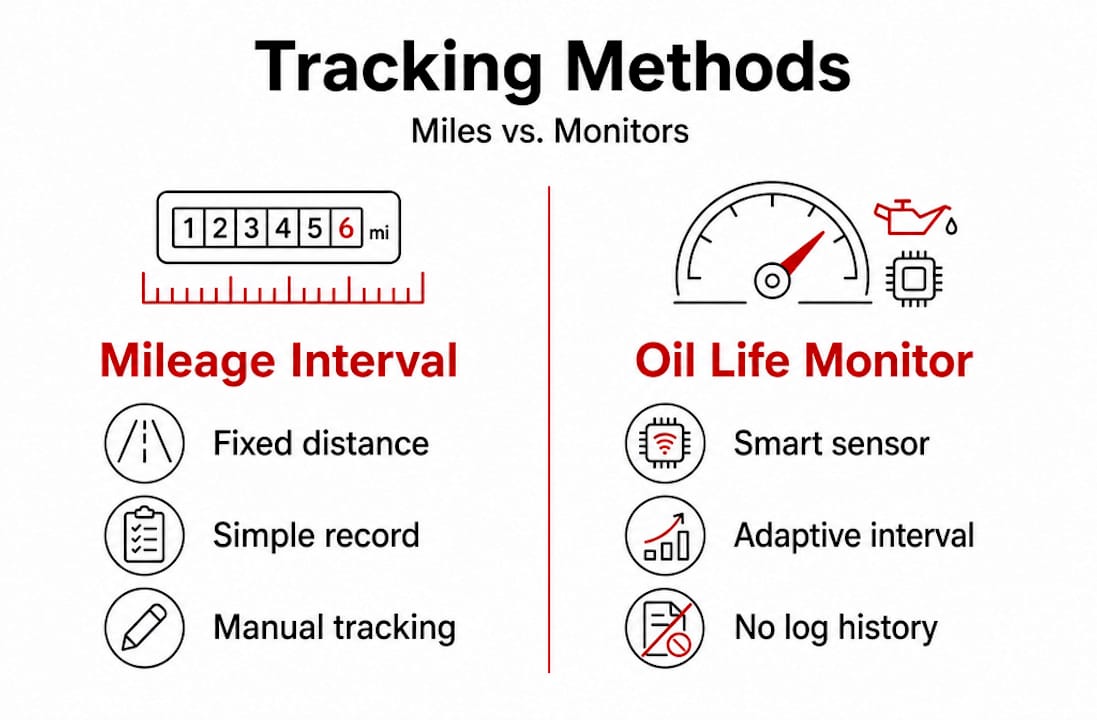
| Factor | Mileage-based intervals | Oil life monitor |
|---|---|---|
| Basis | Fixed distance (e.g., every 5,000 miles) | Algorithm using driving behavior data |
| Flexibility | Low — same interval regardless of conditions | High — adjusts to actual usage patterns |
| Reliability | Predictable but may be too frequent or too infrequent | Smart but not based on physical oil testing |
| Manual checks needed? | Yes | Yes |
| Best used for | Older vehicles, high-mileage drivers | Modern vehicles with varied driving patterns |
Neither system removes the need to keep records. The monitor resets after every oil change, but it doesn’t store your history. Under severe driving conditions like frequent short trips or heavy towing, intervals should be shortened by 25 to 50 percent. Without a log, you won’t remember which conditions applied when, or whether you adjusted accordingly.
Pro Tip: Pull your dipstick between oil changes even if your monitor looks fine. If the oil is black, gritty, or the level has dropped significantly, change it regardless of what the monitor shows.
The real benefits of oil change records
Keeping a detailed maintenance log is one of the highest-return habits a vehicle owner can build. Here’s exactly what you gain.
-
Engine protection through awareness. When you log each oil change, you know precisely when the next one is due. You also catch patterns, like oil levels dropping between changes, that could signal a leak or burning issue before it becomes serious damage.
-
Warranty protection with proof. Manufacturers can deny warranty claims if you cannot show evidence of proper maintenance. Documented service records are key evidence during warranty disputes, converting your verbal claims into verifiable proof. A simple log could be the difference between a covered repair and a $3,000 out-of-pocket bill.
-
Higher resale value. A complete service history can increase resale value by 10 to 20 percent. Buyers pay a premium for certainty. They want to know the car was cared for, and a log gives them that certainty in writing.
-
Better diagnostics when something goes wrong. A mechanic diagnosing an engine knock or oil consumption issue can work far more accurately with context. Knowing the oil type used, the filter brand, and the mileage at each change narrows down the possible causes quickly.
“A 120,000-mile car with full records can appraise better than a 90,000-mile car without them. Maintenance history outweighs mileage in the eyes of buyers and appraisers alike.”
The benefits of oil change records compound over time. A year of logging feels minor. Five years of logging becomes a documented asset that adds real dollar value to your vehicle.
Common oil change tracking mistakes to avoid
Even drivers who try to stay on top of oil changes make errors that undermine the whole effort. These are the most common ones.
-
Relying only on the windshield sticker. That little sticker from the quick-lube shop is a reminder, not a record. It doesn’t capture oil type, filter brand, who did the work, or what the mileage was at the time of service. It fades, falls off, and tells you nothing useful when you’re selling the car or making a warranty claim.
-
Skipping the physical oil check. No vehicle has a physical sensor measuring oil quality, so the monitor can be wrong. Check your dipstick regularly between service intervals.
-
Using cheap oil filters. Poor-quality oil filters have inadequate filtration that causes premature engine wear, even when you’re changing oil on schedule. Your log entry means nothing if the filter wasn’t doing its job.
-
The double gasket error. This is one of the most catastrophic and completely preventable mistakes in oil change service. Not removing the old filter gasket before installing a new one creates double gasketing, which leads to an oil seal failure and can result in a $10,000 repair. Always verify the old gasket came off with the old filter.
-
Not recording enough detail. Writing down “oil changed” with a date is better than nothing, but it’s not enough. The oil brand, viscosity, filter part number, mileage, and who performed the service all matter.
Pro Tip: When tracking oil changes, photograph the receipt and the odometer at the time of service. Two seconds of effort creates permanent, verifiable documentation.
How to track oil changes effectively
The best tracking system is the one you’ll actually use. Here’s what works across different types of drivers.
- Keep a small notebook in your glove box dedicated only to maintenance. Record the date, mileage, oil brand and viscosity, filter brand, and who performed the service (you or a shop name).
- Use a spreadsheet if you prefer digital records. A simple table with columns for date, mileage, oil type, filter, cost, and notes covers everything you need.
- Consider a dedicated oil change tracker that sends reminders and stores your full service history. This removes the “I’ll remember it later” problem entirely.
- Scan and save receipts from shops. Most modern shops provide itemized receipts that include oil type and filter used. Store these in a cloud folder or app linked to your vehicle.
What every oil change log entry should include
| Field | Why it matters |
|---|---|
| Date | Tracks time-based degradation, especially for low-mileage drivers |
| Odometer reading | Calculates exact interval since last service |
| Oil brand and viscosity | Confirms spec compliance and helps diagnose future issues |
| Filter brand and part number | Documents quality and enables comparison if problems arise |
| Who performed the service | Creates accountability and supports warranty or repair disputes |
| Cost | Useful for budgeting and comparing shop pricing over time |
A maintenance log with this level of detail creates leverage for warranty claims, private sales, and repair diagnostics that a windshield sticker simply cannot provide. The oil change history significance only grows with each entry you add.
Learning how to track oil changes without guessing takes about 15 minutes to set up. After that, each entry takes under two minutes. That’s a genuinely small investment for what it protects.
My take on why this habit pays for itself
I’ve talked with a lot of vehicle owners over the years, and the ones who skip tracking almost always share the same story. They think it won’t matter until it suddenly does. A denied warranty claim. A buyer who walked away because there were no records. An engine diagnosis that cost twice as much because the mechanic had no service history to work from.
What I find most interesting is that people invest thousands in the vehicle itself but won’t spend two minutes logging an oil change. The record isn’t just paperwork. It’s proof that you were a responsible owner. It’s a document that tells the next buyer or the dealership service department that this car was cared for.
I’ve also seen how quickly tracking reveals problems. A log that shows oil level consistently dropping between changes is a red flag for a seal or consumption issue. Without the log, you’d never notice the pattern until the damage is done.
My honest advice: don’t wait until you’re selling the car or fighting a warranty claim to wish you had records. Start the log today. Even if your last entry is from six months ago, start now. An incomplete record is still far more useful than no record at all.
— Chally
Keep your oil change history where you can use it
Knowing the reasons to track oil changes is one thing. Having a system that actually does it for you is another.
Carjourney was built specifically for vehicle owners who want to stop losing receipts and guessing at service intervals. The oil change tracker logs your full service history, stores oil type and filter details, sends you reminders before you’re overdue, and gives you a complete maintenance record you can use for warranty claims or when it’s time to sell. Visit CarJourney to set up your vehicle profile and start building the maintenance record your car actually deserves.
FAQ
Why does tracking oil changes matter for engine health?
Oil degrades through use and time, and without a log you have no reliable way to know when it was last changed or whether the interval was appropriate for your driving conditions. Consistent tracking prevents the sludge buildup and wear that leads to expensive engine damage.
Should I trust my oil life monitor instead of keeping records?
Your oil life monitor is a useful tool, but it relies on algorithms and resets completely after every service with no stored history. Manual records give you a long-term picture the monitor simply cannot provide, especially for warranty protection and resale purposes.
How much can oil change records increase resale value?
A complete, verifiable service history including oil changes can increase a vehicle’s resale value by 10 to 20 percent. Buyers and appraisers place significant weight on documented maintenance because it reduces their risk when purchasing a used vehicle.
What details should I record at every oil change?
At minimum, record the date, odometer reading, oil brand and viscosity, filter brand and part number, and who performed the service. These details support warranty claims, improve diagnostic accuracy, and build buyer confidence at resale.
How often should I change my oil if I drive infrequently?
Even if your mileage is low, change your oil at least once a year. Oil oxidizes and absorbs moisture over time regardless of how few miles you drive, and a time-based interval protects your engine when mileage-based tracking would otherwise suggest you’re fine.