 carjourney
From the CarJourney journal
How to Write Compelling Descriptions for Modified Vehicles
Table of Contents
- Why Modified Vehicle Descriptions Matter
- Understanding What Makes a Modified Vehicle Description Effective
- Modified Car Description Examples That Convert
- How to Document Project Car Builds with Complete Records
- Using a Modified Car Listing Template for Consistency
- Organizing Vehicle Modification Records for Resale and Insurance
- Step-by-Step: Writing Your First Modified Vehicle Description
- Common Mistakes to Avoid When Describing Modified Vehicles
- Frequently Asked Questions
Last Updated: October 10, 2026
Why Modified Vehicle Descriptions Matter
A well-written modified vehicle description does more than list upgrades. It tells the story of your project, builds buyer confidence, and protects your investment when it's time to sell.
A buyer scrolling through listings makes snap decisions. Poor descriptions get skipped. Clear, honest ones get serious inquiries.
Modified vehicles demand proof that work was done right. Buyers need to understand what they're getting. Insurance companies want documentation. Show judges want specifics.
This guide covers how to write compelling descriptions for modified vehicles that convert interest into offers, satisfy insurance requirements, and document your build for posterity.
Understanding What Makes a Modified Vehicle Description Effective
An effective modified vehicle description balances enthusiasm with accuracy, answers buyer questions before they ask them, and shows respect for the work that went into the build.
Balancing Persuasion with Accuracy
The best descriptions persuade without exaggerating. Honesty builds trust, buyers can smell overstatement from a mile away. When you claim a suspension lift improves handling but don't mention the tradeoffs, you lose credibility immediately.
A strong approach:
- State what was installed (the fact)
- Explain why it matters (the benefit)
- Acknowledge any tradeoffs (the honesty)
Example: "We added a 2-inch lift kit with adjustable coilovers. This raises ground clearance for light off-roading and improves approach angles on rough terrain. The tradeoff is a slightly stiffer ride on highway pavement."
That's persuasive and truthful. A buyer knows what to expect.
Audience-Specific Approaches
Different audiences care about different things. A performance enthusiast wants dyno numbers. An off-road buyer wants ground clearance specs. A daily driver owner wants reliability and warranty information.
Tailor your language to match:
- Performance buyers: Focus on power gains, dyno results, throttle response, acceleration times
- Off-road enthusiasts: Emphasize ground clearance, approach/departure angles, tire grip, terrain capability
- Daily driver buyers: Highlight reliability, fuel economy impact, comfort, ease of maintenance
- Show and display buyers: Detail aesthetic choices, paint quality, interior refinement, originality of design
- Insurance companies: Provide part numbers, installation dates, professional certification, safety compliance
Modified Car Description Examples That Convert
Real examples show what effective descriptions look like across different modification types.
Performance-Focused Modifications
"Engine: Stock 5.0L V8 upgraded with a Vortech V7 supercharger, Holley EFI tuning, and supporting modifications. Dyno-tested at 487 hp and 485 lb-ft torque (up from 385 hp stock). Includes new fuel injectors, custom intake manifold, and reinforced engine bay cooling. All work completed by certified technicians with full documentation. Daily driven for 8,000 miles post-installation with zero issues."
This works because it names the specific supercharger model, provides dyno numbers as proof, lists supporting modifications, mentions professional installation, and discloses real-world use to prove reliability.
Cosmetic and Visual Upgrades
"Exterior: Custom two-tone paint (Midnight Blue base with Pearl White racing stripes). Professional ceramic coating applied. Aftermarket front grille with integrated LED lighting. Lowered 1.2 inches on adjustable coilovers for aggressive stance. Wrapped in 20-inch forged aluminum wheels with all-season performance tires. Includes original wheels and tires with full documentation of paint work."
This works because it describes the visual result clearly, names specific products and measurements, mentions paint protection, notes original parts are available, and includes tire specifications.
Off-Road and Suspension Modifications
"Suspension: ARB Old Man Emu lift kit (2.5-inch height with nitrogen shocks). Adds 2.8 inches ground clearance and improves approach angle by 6 degrees. Paired with all-terrain tires rated for rocky terrain. Includes skid plate protection for transfer case and fuel tank. Professionally installed and aligned. Vehicle tested on moderate trails with no issues. All receipts and installation documentation included."
This works because it names the specific lift kit brand and height, quantifies ground clearance improvement, specifies tire type and capability, details protective modifications, mentions real-world testing, and promises documentation.
How to Document Project Car Builds with Complete Records
Most enthusiasts fall short on documentation. Start from day one, it takes minutes now and saves hours when you sell.
Organizing Receipts and Installation Records
Keep every receipt.
Create a folder system (digital or physical):
- Parts purchased (receipts, invoices, part numbers)
- Labor documentation (shop invoices, certification, dates)
- Warranty information (manufacturer cards, registration details)
- Technical specifications (product manuals, installation guides)
- Inspection reports (dyno sheets, alignment reports, safety checks)
For each major modification, record the date installed, part name and manufacturer, part number, cost, installer name and shop (if professional), and warranty coverage period.
Digital tools let you upload photos of receipts and organize everything by modification type, eliminating the need to hunt through a shoebox.
Capturing Before-and-After Documentation
Before photos prove the work was actually done. They show the starting point. After photos show the result.
Take before photos: wide shot of the entire vehicle, close-up of the specific area being modified, and detail shots of any damage or wear. Take after photos at the same angles as before shots, plus wide shots showing the full result and detail shots highlighting upgrade quality. Consistent visual documentation provides a clear baseline for evaluating how various vehicle customization options influence the overall aesthetic and structural integrity of your build.
Label each photo with the date and modification type. Store them organized by year and project phase.
Using a Modified Car Listing Template for Consistency
A template keeps descriptions consistent across platforms and saves time writing from scratch every time.
Template Structure for Online Listings
Use this structure for online classifieds and marketplace listings:
Headline: [Year] [Make] [Model] - [Primary Modification Type] Build
Opening paragraph: One sentence hook that captures attention.
Modifications section: List by category (engine, suspension, exterior, interior). Include specific products, dates, and supporting facts.
Maintenance history: "All service performed by [shop name or owner]. Full documentation available. Last service: [date]. Next recommended service: [date]."
Condition statement: Be honest about wear. "Paint is original except for custom hood wrap. Interior shows normal wear from 45,000 miles of driving."
Documentation: "Complete receipts for all modifications. Original factory parts available. All warranty information included."
Contact and next steps: "Available for inspection. Can arrange pre-purchase inspection by independent mechanic."
Adapting Your Template for Social Posts and Show Entries
Social media posts need shorter, punchier versions. Show entries need technical specifications.
Social media version: Keep it to 2-3 sentences, lead with the most impressive modification, and use hashtags. "Just finished documenting the full suspension upgrade on this build. 2.5-inch lift, all-terrain tires, and skid plate protection. #ProjectCar #SuspensionUpgrade #OffRoad"
Show entry version: "2015 Mustang GT. Engine: Vortech supercharger (487 hp dyno-verified). Suspension: 1.2-inch lowering kit. Exterior: Custom paint, forged wheels. All modifications professionally installed with full documentation. Vehicle maintained to show standards."
Organizing Vehicle Modification Records for Resale and Insurance
Documentation serves two masters: buyers and insurance companies. Each needs different information organized differently.
What Documentation Buyers and Insurers Actually Want
Buyers expect part names and manufacturers, installation dates, professional certification, before-and-after photos, and maintenance records. Insurance companies require an itemized list of modifications with part numbers, installation dates, total value of upgrades, safety compliance information, and professional installation certification.
Create a summary document that lists all modifications with dates and costs. This becomes your proof of value for insurance claims. It also becomes your selling document when you list the vehicle.
Disclosure Best Practices
Transparency builds trust. Disclose everything that affects performance, appearance, safety, reliability, or warranty coverage.
Include a statement like: "All modifications documented and disclosed. No hidden work. Vehicle available for independent pre-purchase inspection." Serious buyers appreciate honesty and are less likely to walk away over a disclosed modification than to discover a hidden one later.
Step-by-Step: Writing Your First Modified Vehicle Description
Follow this process to write a complete, compelling description for your modified vehicle.
Step 1: List All Modifications and Upgrades
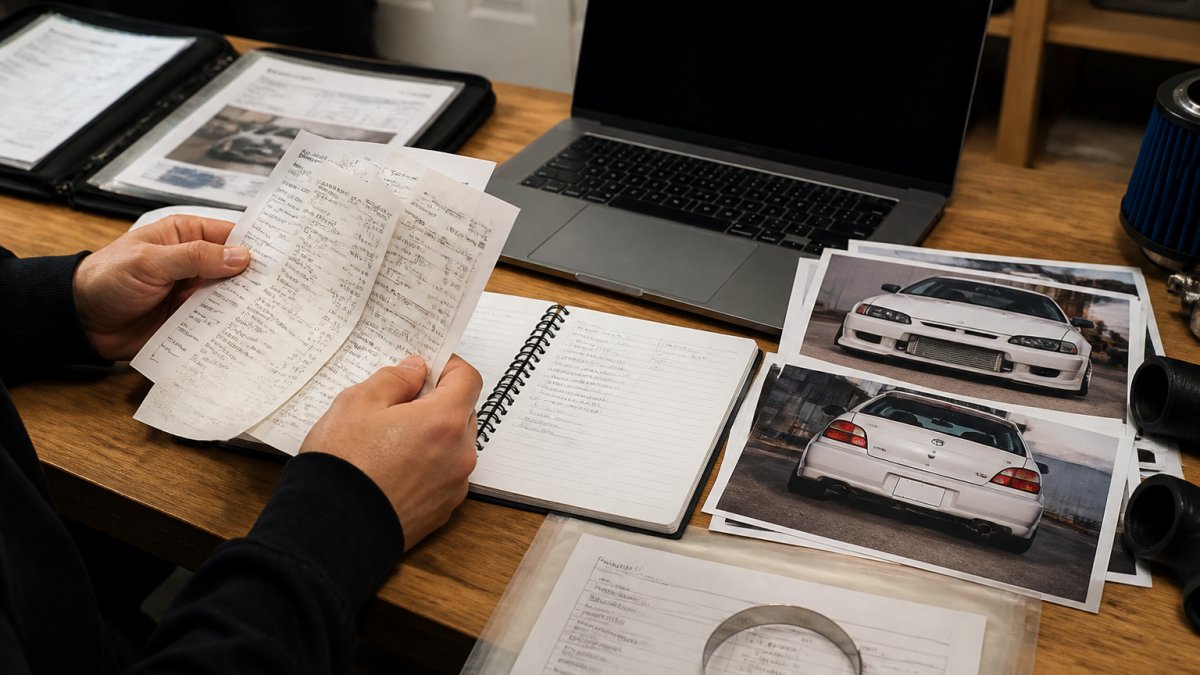
Write everything down: engine modifications, suspension changes, exterior upgrades, interior improvements, safety additions, and maintenance items.
Next to each modification, write the product name and manufacturer, installation date, cost, and whether work was professional or DIY. This becomes your raw material.
Step 2: Prioritize by Impact and Audience Interest
Rank modifications by impact: Tier 1 (engine work, suspension, major aesthetic upgrades), Tier 2 (wheels, paint, interior), and Tier 3 (accessories, maintenance). Lead with Tier 1 modifications. Consider your target audience, performance buyers care about engine specs, off-road buyers care about suspension and tires, show buyers care about paint and detail work.
Step 3: Write the Opening Hook
Your opening sentence determines whether someone reads the rest. Lead with the most impressive modification, quantify the improvement if you have numbers, and promise documentation. "This 2015 Mustang combines a supercharger that adds 100 hp with a custom suspension setup and professional paint work, all documented with complete receipts."
Step 4: Detail Each Modification with Supporting Facts
For each major modification, write 1-2 sentences that include:
- The specific product name
- Why it matters (the benefit)
- Proof that it works (numbers, testing, professional installation)
Example: "Engine: Vortech V7 supercharger with professional tuning. Dyno-tested at 487 hp (up from 385 hp stock). All supporting modifications completed by certified technicians. Full documentation and warranty information included."
This tells the complete story. A buyer knows exactly what was done, by whom, and what it achieved.
Step 5: Close with Maintenance and Transparency
End with information about reliability and honesty.
"All modifications installed by [shop name] with full warranty coverage. Vehicle maintained on regular service schedule with documented maintenance. Available for independent pre-purchase inspection. Original factory parts available. No hidden work."
This closes the sale. A buyer feels confident they're getting what they're paying for.
Common Mistakes to Avoid When Describing Modified Vehicles
Most descriptions fail for the same reasons. Avoid these traps.
Exaggeration without proof. "Massive power gains" means nothing without dyno numbers.
Missing product names. "High-quality suspension upgrade" could be anything.
No documentation mentioned. Buyers assume undocumented work was done poorly.
Vague timeline. "Recently upgraded" doesn't tell a buyer when work was done.
Omitting tradeoffs. A 2-inch lift kit affects highway ride quality.
Poor organization. Rambling descriptions lose readers. Use categories (Engine, Suspension, Exterior). Use short paragraphs.
No photos. Words alone don't sell. Include clear before-and-after photos.
The best modified vehicle descriptions tell a complete story.
Start documenting now.
Frequently Asked Questions
How do you describe a modified vehicle to a potential buyer?
Start with the vehicle's base model and year, then list modifications in order of impact: performance upgrades first, followed by cosmetic and visual changes. Include specific part names, installation dates, and supporting documentation like receipts. Be honest about any wear or maintenance needs. Use clear, factual language that emphasizes how each modification improves performance, style, or functionality without overstating value. End with maintenance records to prove the vehicle has been properly cared for.
What details should a modified car listing include?
A complete modified car listing should include the original vehicle specifications, a comprehensive list of aftermarket parts and performance upgrades, cosmetic and visual modifications (wheels, tires, paint, body enhancements), suspension changes, engine tuning details, and any safety upgrades. Include installation dates, parts manufacturers, and whether modifications are bolt-on or permanent. Disclose any modifications that affect warranty coverage or insurance. Provide photos showing before-and-after changes and close-ups of key upgrades.
How can you document modifications to a project car?
Create a centralized system to track all modifications, receipts, and installation records. Photograph each step of the build process, capturing before-and-after shots of major upgrades. Maintain organized records of parts purchased, installation dates, labor costs, and any professional work completed. Store digital copies of receipts and warranty information. Use a maintenance tracker to log when modifications were installed and any adjustments made afterward. This documentation proves the quality of your build and increases resale value.
Should you include receipts and installation records in a vehicle description?
Yes. Receipts and installation records significantly increase buyer confidence and can justify premium pricing. Provide documentation for major modifications like engine tuning, suspension lifts, and performance upgrades. These records prove the quality of parts used and that work was completed professionally. For resale, buyers and insurers want evidence that modifications are legitimate and properly installed. Even for casual listings, mentioning that documentation is available builds trust and differentiates your vehicle from others without verifiable modification history.
Start free