 carjourney
From the CarJourney journal
The Role of Service Receipts in Car Ownership

A service receipt is an official document confirming that a vehicle service was completed, paid for, and detailing exactly what work was done. Most car owners treat these slips of paper as clutter. That is a costly mistake. The role of service receipts goes far beyond proof of payment. They are the backbone of your vehicle’s maintenance history, your first line of defense in a warranty dispute, and one of the strongest tools you have when it is time to sell. Whether you drive a daily commuter or a collector car, organized service documentation separates confident sellers from anxious ones.
What should a valid vehicle service receipt contain?
A high-value service receipt must include nine essential details to be useful for resale, warranty claims, or tax purposes. A receipt missing even one of these elements can create problems when you need it most.
Every complete vehicle service receipt should include:
- Service provider details: Shop name, address, phone number, and license number
- Owner information: Your name and contact details as the vehicle owner
- Transaction date: The exact date the service was completed
- Unique receipt number: A sequential identifier for tracking and filing
- Vehicle identification: Year, make, model, and VIN
- Service description: A clear breakdown of every task performed, including labor hours
- Parts used: Part names, part numbers, and whether they are OEM or aftermarket
- Cost breakdown: Subtotal, tax, and total amount charged
- Payment method: Cash, card, or check confirmation
Distinct line items for labor and materials are not optional. They provide transparency, support tax deductibility, and make disputes far easier to resolve. A receipt that reads “engine work, $800” tells a future buyer almost nothing. A receipt that lists “timing belt replacement, 3.5 labor hours at $95/hr, Gates timing belt kit part #T261, $127.50” tells a complete story.
Pro Tip: Ask your shop to list OEM part numbers on every receipt. For high-end or collector vehicles, this single detail can confirm quality maintenance and reassure buyers at the point of sale.
How do service receipts differ from invoices and bank statements?
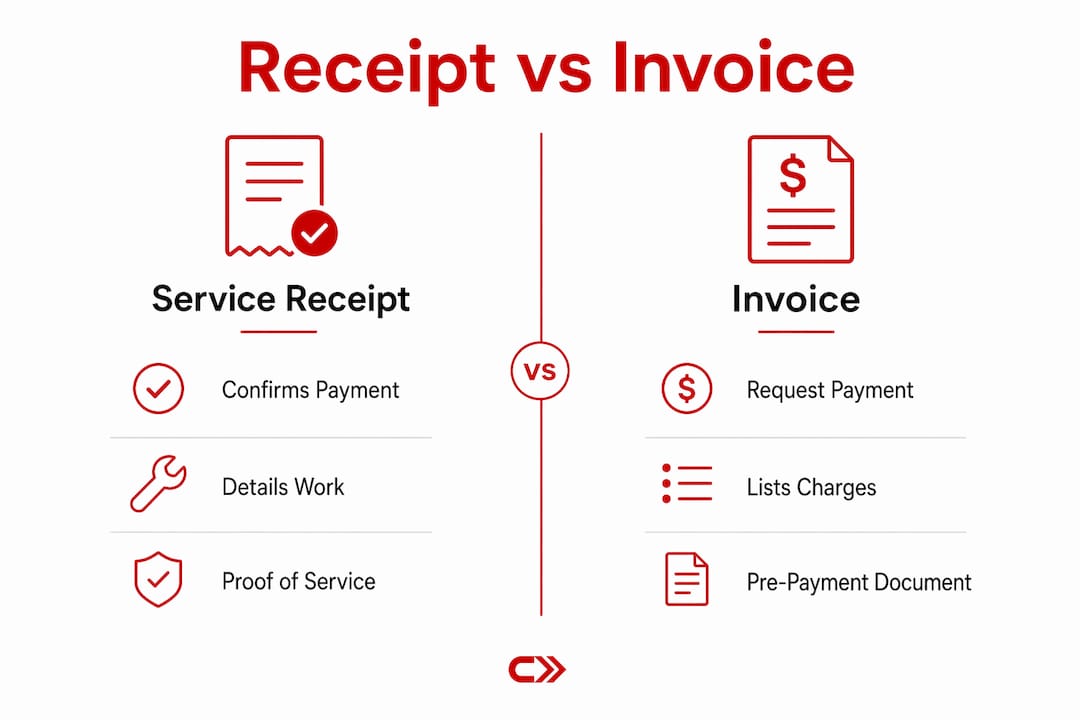
A receipt and an invoice are not the same document. An invoice is a request for payment sent before money changes hands. A receipt confirms that payment was made and the service was delivered. Confusing the two is a common mistake that leaves car owners without proper documentation when they need it most.
| Document | Purpose | Confirms payment? | Confirms service details? |
|---|---|---|---|
| Service receipt | Proof of completed service and payment | Yes | Yes |
| Invoice | Request for payment | No | Partially |
| Credit card statement | Proof of a transaction | Yes | No |
| Bank statement | Proof of a debit or transfer | Yes | No |
Payment confirmation alone is not a service receipt. A credit card statement shows that $450 left your account on a Tuesday. It does not show that a certified technician replaced your brake pads with Brembo rotors and bled the lines. That distinction matters enormously in a warranty claim or a resale negotiation.
Services differ from goods in one critical way. With a physical product, a shipping document or packing slip can verify delivery. With a service, no such paper trail exists. The service receipt is the only objective record confirming what was actually done. That makes it the most important document in your vehicle file.
Many car owners assume a credit card statement suffices as proof of maintenance. It does not. Banks and warranty administrators require specific documentation of professional servicing, including scope, parts, and dates.
Why do service receipts matter for resale value and buyer trust?
Thorough service receipts provide maintenance provenance. That is a term appraisers and dealers use to describe a verifiable ownership and care history. A buyer walking up to your car does not know you. Your receipts speak for you.
- They answer the hard questions before buyers ask. A buyer wondering whether the transmission was ever serviced gets a direct answer from a dated receipt. That eliminates doubt and builds confidence faster than any verbal assurance.
- They create a narrative of attentive ownership. Organized chronological service logs act as proxies for mechanical care during appraisals and private sales. Structured logs affect negotiation positioning by showing a story of consistent, attentive ownership.
- They reduce friction during pre-purchase inspections. A mechanic doing a pre-purchase inspection can cross-reference receipts against current vehicle condition. Matching records and condition accelerates buyer decisions.
- They support premium pricing. A detailed receipt for complex repairs that includes labor hours and specific part numbers gives buyers the confidence to pay more. This is especially true for high-end or collector vehicles where OEM parts matter.
- They protect you from post-sale disputes. If a buyer claims a repair was never done, your receipt is your defense. Without it, you have no documented proof the work occurred.
Pro Tip: Build a service log for resale by organizing receipts chronologically in a dedicated folder or app. Present this log during any test drive. Buyers who see organized records make faster decisions.
Receipts also ease buyer concerns during pre-purchase inspections by documenting meticulous care and validating the vehicle’s maintenance history. That validation is worth real money at the negotiating table.
What are best practices for storing and organizing service receipts?
Paper receipts fade. Thermal paper receipts can become unreadable within two years. A receipt you cannot read is a receipt that cannot protect you.
Digital receipt archiving prevents fading and loss, enables instant retrieval, and supports professional ownership tracking. Moving from paper to digital is now an industry best practice for automotive professionals and enthusiasts who want long-term document utility.
Best practices for organizing your vehicle service receipts:
- Scan immediately after every service. Do not wait. Scan or photograph the receipt the same day and save it to a dedicated folder labeled by vehicle and year.
- Use a vehicle maintenance app. Apps designed for auto maintenance let you attach receipts directly to service log entries, making retrieval instant and organized.
- Organize chronologically, not by category. A timeline of service is more useful to buyers and warranty administrators than a stack sorted by repair type.
- Back up to cloud storage. Google Drive, iCloud, or Dropbox provide redundancy. A house fire or flood should not erase your vehicle’s entire history.
- Keep the original paper receipt for at least one year. Some warranty claims require original documentation. Store paper receipts in a labeled envelope inside your vehicle file.
| Storage method | Longevity | Searchability | Cost |
|---|---|---|---|
| Paper folder | 2–5 years (thermal fades) | Low | Free |
| Scanned PDFs in cloud | 10+ years | Medium | Free to low |
| Dedicated vehicle app | Indefinite | High | Low monthly fee |
Integrating receipt archiving into a vehicle maintenance app also simplifies tax preparation, warranty claims, and resale documentation. Car owners who use dedicated tools consistently outperform those relying on glove box piles when it comes to resale negotiations.
Pro Tip: After every oil change or major service, take 60 seconds to photograph the receipt with your phone. File it immediately. That habit, repeated consistently, builds a complete ownership record without any extra effort.
Key Takeaways
Service receipts are the single most verifiable record of your vehicle’s care history, and organized documentation directly affects resale value, warranty outcomes, and buyer confidence.
| Point | Details |
|---|---|
| Receipts confirm service details | A receipt documents what was done, not just what was paid, making it essential for warranty and resale. |
| Nine elements make a receipt complete | Include provider info, VIN, service description, part numbers, labor hours, and payment method. |
| Bank statements are not receipts | Credit card and bank records confirm payment but cannot verify the scope or quality of service performed. |
| Organized records support premium pricing | Chronological service logs create a provenance narrative that builds buyer confidence and supports higher asking prices. |
| Digital storage beats paper | Scanned receipts stored in a vehicle app or cloud folder are searchable, durable, and instantly shareable. |
The detail most owners skip is the one that costs them most
Most car owners I talk to keep receipts for about six months, then toss them. They figure the car runs fine, so why bother. That thinking costs real money at resale time.
The detail that gets skipped most often is part numbers. A receipt that says “brake job, $320” is almost useless for a serious buyer. A receipt that says “Brembo HC brake pads, front axle, part #P85075N, installed by certified tech, 2.0 labor hours” is a completely different document. It answers questions the buyer has not even asked yet. That is the difference between a buyer who haggles and a buyer who pays your asking price.
I have also seen owners lose warranty claims because they could not produce documentation of a prior repair. The shop did the work. The owner paid. But the receipt was gone, and the warranty administrator had no obligation to accept a bank statement as proof. That is an expensive lesson.
Going digital is not complicated. Photograph every receipt the day you get it. Drop it into a folder named after your vehicle. Do this every single time, without exception. After a year, you will have a complete, searchable ownership record that most buyers have never seen from a private seller. That record builds buyer trust in a way that no amount of verbal reassurance can match.
The car owners who get top dollar at resale are not always the ones with the best-maintained vehicles. They are the ones who can prove it.
— Chally
How Carjourney helps you manage service receipts
Carjourney was built specifically for car owners who want their vehicle’s history organized and accessible, not buried in a glove box.
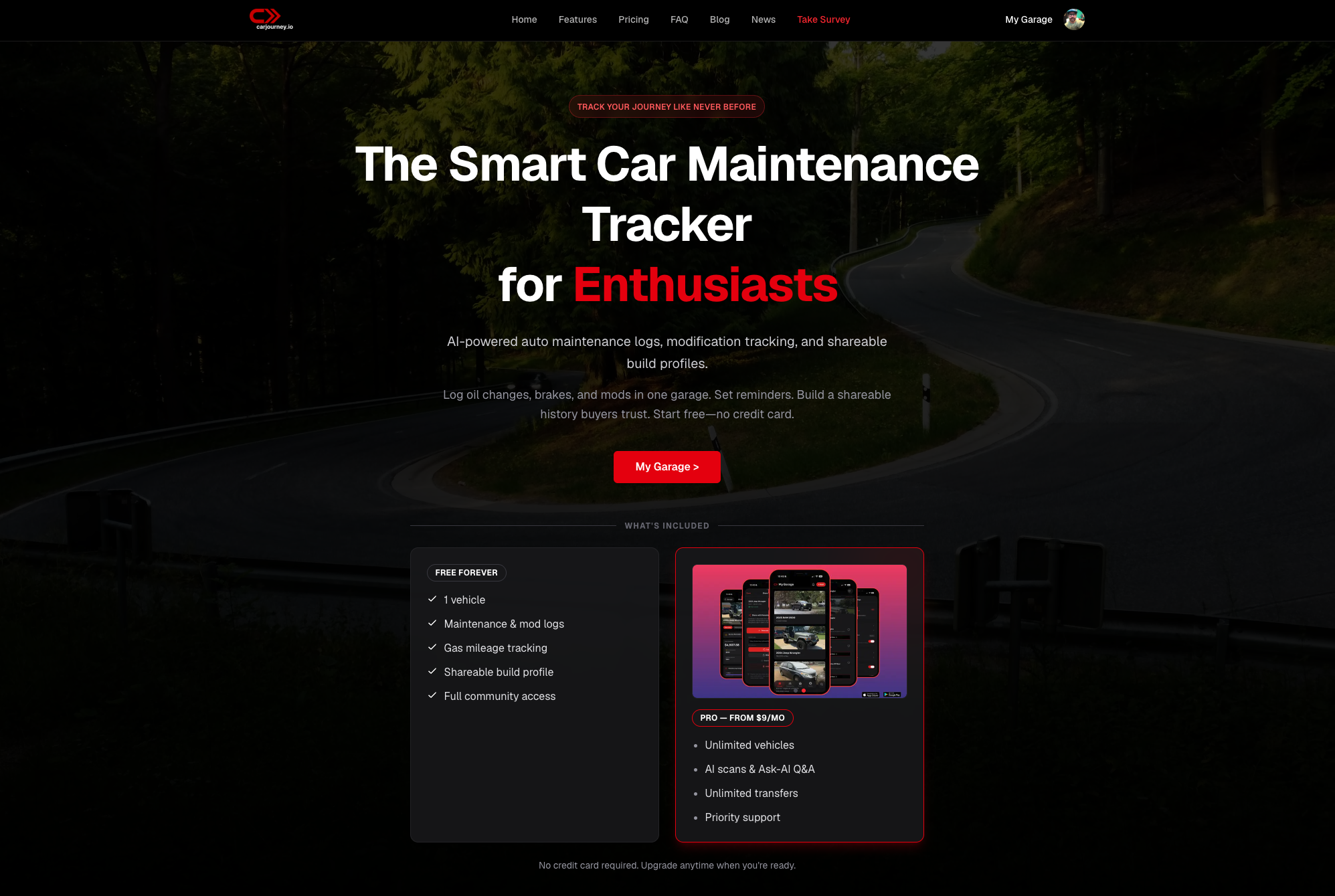
With Carjourney, you can upload and store service receipts directly to your vehicle’s profile, attach them to specific maintenance events, and retrieve them instantly when a buyer or warranty administrator asks. The AI built into Carjourney scans your uploaded documents and answers detailed questions about your vehicle’s service history, so you are never caught off guard. For enthusiasts tracking modifications or managing multiple vehicles, Carjourney’s maintenance tracker keeps every receipt, every part number, and every service date in one searchable place. That is the kind of organized ownership record that commands attention at resale.
FAQ
What is the role of service receipts for car owners?
Service receipts confirm that a specific vehicle service was completed, paid for, and detail the scope of work performed. They serve as the primary evidence for warranty claims, resale documentation, and dispute resolution.
Are service receipts the same as invoices?
No. An invoice is a request for payment before money changes hands. A service receipt confirms that payment was made and the service was delivered.
Can a credit card statement replace a service receipt?
A credit card statement cannot replace a service receipt. It confirms a payment was made but does not document what service was performed, which parts were used, or who did the work.
How should car owners store service receipts long-term?
Digital storage is the most reliable method. Photograph or scan each receipt immediately after service and save it to a dedicated vehicle folder in cloud storage or a vehicle maintenance app.
Do service receipts affect vehicle resale value?
Organized service receipts directly support resale value by providing a verifiable maintenance history. Buyers pay more confidently when they can review dated, detailed records of every repair and service performed.