 carjourney
From the CarJourney journal
How to analyze service history: a complete guide

Your car’s service records tell a story, but most owners never actually read it. Learning how to analyze service history is one of the highest-value things you can do as a vehicle owner, whether you’re trying to understand what your car really needs next or preparing to sell it for the best possible price. A stack of receipts in the glovebox is not the same as a verified maintenance picture. Gaps, mileage inconsistencies, and vague stamps can hide thousands of dollars in deferred work, and knowing how to spot them puts you in control.
Table of Contents
- Gather what you need to analyze your vehicle’s service history
- Step-by-step evaluation of your vehicle’s service records
- Common challenges and expert tips for verifying service history accuracy
- Using service history analysis to boost maintenance and resale value
- Why most vehicle owners miss critical signs in service history analysis
- Simplify your service history analysis with CarJourney
- Frequently asked questions
Key Takeaways
| Point | Details |
|---|---|
| Comprehensive record gathering | Collect paper, digital, MOT, and VIN-based records to get a full service history picture. |
| Chronological analysis | Organize history by date and mileage to spot gaps, inconsistencies, or tampering signs. |
| Invoice detail review | Read invoices carefully, focusing on parts and labor specifics, not just service stamps. |
| Confirm with garages and inspections | Contact garages and hire a mechanic to verify undocumented or suspicious service details. |
| Service history boosts value | Complete and verified maintenance records increase resale value and buyer confidence. |
Gather what you need to analyze your vehicle’s service history
Before you can make sense of anything, you need everything in one place. Service history is not stored in a single location. It lives across paper invoices, digital portals, dealership records, independent garage files, and government databases. Treating just one of those sources as the full picture is where most people go wrong.
Start by collecting every physical document you have: receipts, invoices, service booklets, and inspection reports. Then move to digital sources. Your vehicle’s VIN (Vehicle Identification Number, the 17-character code on the dashboard or door jamb) is the master key. Use it to request digital records from the manufacturer or any dealerships that serviced the car. Many manufacturers maintain their own service portals with timestamped entries that are far harder to fake than a rubber stamp.
For independent verification of mileage, the MOT history database is one of the most underused tools available. MOT mileage records go back to 2005 and give you a free, government-stamped log of what the odometer read each time the car was tested. That is your baseline for catching any manipulation.
Here is a checklist of what to gather before you begin your analysis:
- All paper receipts and invoices (not just stamps)
- Manufacturer service booklet or digital equivalent
- Vehicle history report (CARFAX, AutoCheck, or NMVTIS)
- MOT history printout or online check
- Any extended warranty or recall paperwork
Pro Tip: Once you have all documents, use your phone to photograph every page and store them in a folder labeled by year. This gives you a backup and makes it easier to compare dates and mileages side by side on a screen.
Once you have everything, organize it in chronological order before doing anything else. This single step transforms a confusing pile into a readable timeline. For more on what solid records look like from a buyer’s perspective, the auto service history essentials breakdown is worth reviewing alongside your own records.
| Document type | What it tells you | Where to get it |
|---|---|---|
| Paper invoices | Parts used, labor hours, technician notes | Previous owners, garages |
| Manufacturer digital records | Timestamped, dealer-verified service entries | OEM portals using VIN |
| MOT history | Government-recorded mileage at each test | Free government database |
| Vehicle history report | Accidents, title issues, odometer flags | CARFAX, NMVTIS |
| Service booklet stamps | Quick visual summary | Physical logbook |
Step-by-step evaluation of your vehicle’s service records
With everything laid out in order, the actual service history analysis begins. This is where you move from collecting to interpreting.
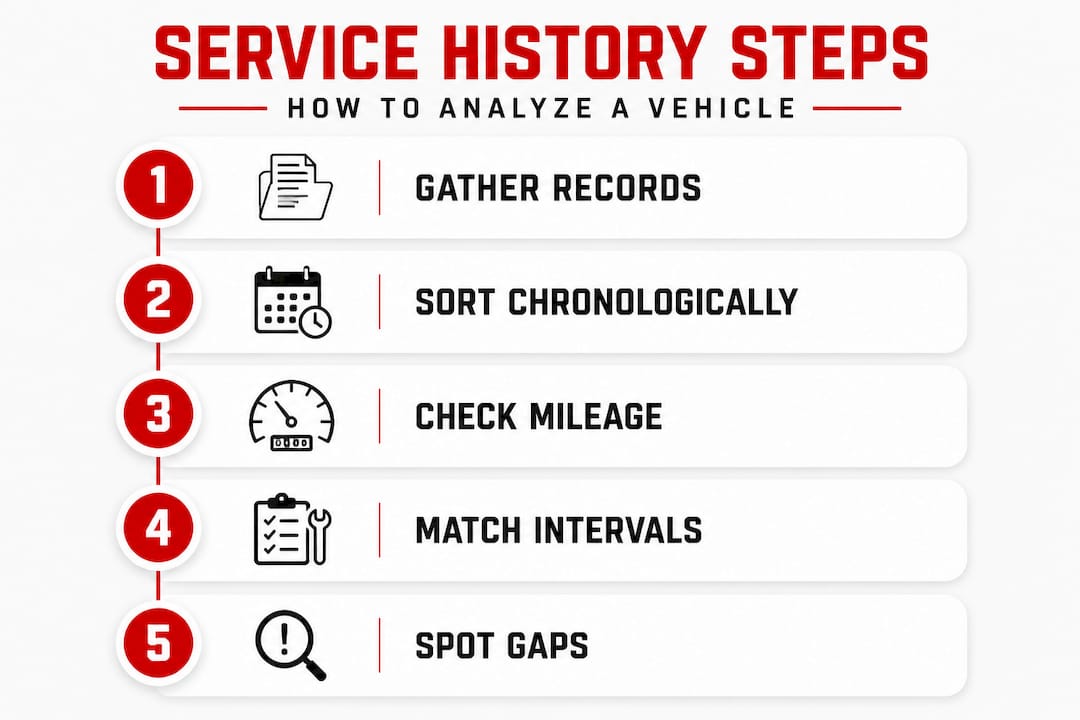
- Build a chronological timeline. Arrange every record by date, earliest to most recent. Note the mileage on each entry.
- Plot mileage progression. Mileage should increase steadily. A typical driver covers 8,000 to 12,000 miles per year. If you see a jump of 25,000 miles in eight months with no explanation, that deserves investigation.
- Check service intervals against manufacturer specs. Lay out all service records in date order and confirm intervals align with what the manufacturer requires for oil changes, brake fluid, air filters, and coolant. Most modern vehicles call for service every 10,000 to 15,000 miles or every 12 months, whichever comes first.
- Read invoices, not just stamps. A stamp says “serviced.” An invoice tells you which oil was used, whether the cabin filter was actually replaced or just inspected, and how long the technician spent on the car. Those details are where quality hides.
- Cross-check with MOT mileage. MOT mileage readings should land within about 1,000 miles of what a nearby service record shows. If your MOT says 47,000 miles in March but the service invoice from the same month says 41,000, that is a serious red flag.
- Flag gaps and vague entries. A two-year gap with no records does not necessarily mean neglect, but it demands explanation. Repeated entries that say only “general check” without itemized work are equally suspicious.
- Verify major milestone maintenance. Look specifically for timing belt (or timing chain) replacement, which typically occurs between 60,000 and 100,000 miles, along with transmission service, coolant flushes, and brake pad replacements. Missing these from the record on a high-mileage car is a warning sign.
Understanding the maintenance recommendations for your specific make and model is essential at this step. Generic advice only gets you so far because manufacturers vary significantly on interval requirements. A service maintenance schedule built for your exact vehicle takes that guesswork out.
| Maintenance item | Typical interval | Red flag if missing |
|---|---|---|
| Oil change | Every 5,000-10,000 miles | Yes, especially on high-mileage cars |
| Timing belt replacement | 60,000-100,000 miles | Critical on interference engines |
| Transmission fluid | 30,000-60,000 miles | Yes if over 80,000 miles total |
| Brake fluid flush | Every 2-3 years | Moderate concern |
| Coolant flush | Every 50,000-100,000 miles | Moderate concern |

Pro Tip: If you are evaluating a used car and the seller cannot provide the original timing belt invoice, assume it has not been done and factor that cost into your offer. Replacing a timing belt runs $500 to $1,500. Ignoring it can total the engine.
Common challenges and expert tips for verifying service history accuracy
Even a well-organized analysis can hit walls. Knowing where the data breaks down is as important as knowing how to read it.
The biggest limitation is that vehicle history reports often miss independent garage work and DIY maintenance entirely. A car that had every oil change done at a local shop rather than a dealership may look unserviced on paper. That is not automatically a problem, but it means you cannot rely on the report alone.
Here are the most common challenges and how to handle them:
- Incomplete commercial reports. CARFAX tends to capture dealership visits more reliably than independent shops, which means gaps in the report do not always mean gaps in maintenance.
- DIY maintenance with no paper trail. Some knowledgeable owners change their own oil and rotate their own tires but keep no formal receipts. Ask the seller directly and look for signs of quality work during a physical inspection.
- Stamps without invoices. A service book full of stamps can be forged in an afternoon. If there are no supporting invoices, treat those entries as unverified.
- Digital records on newer vehicles. Many manufacturers since 2015 have moved to fully digital service logs. These are more trustworthy than paper, but still verify them against MOT records.
“The stamp in the book tells you someone turned up. The invoice tells you what they actually did.” This distinction is the difference between a car that looks well-maintained and one that genuinely is.
Contacting listed garages is an underused but highly effective step. Most workshops retain records for several years and can confirm whether the work described on an invoice actually happened. A phone call takes five minutes and can surface forged entries immediately.
For anything beyond paper verification, a professional mechanic inspection costing $100 to $200 is worth every dollar. A good technician can spot signs of deferred maintenance, unreported body damage, or repairs done with substandard parts, things that no document will ever reveal. This is especially true for evaluating service records on a high-mileage vehicle you are considering purchasing.
Using service history analysis to boost maintenance and resale value
A thorough service history assessment is not just about catching problems. Used well, it is a tool for proactive maintenance and a direct driver of resale value.
When you know exactly what has been done and when, you can plan what comes next without guessing. That is the difference between reacting to breakdowns and preventing them. Owners who actively review their records and schedule upcoming services spend less on repairs over time because they catch small issues before they cascade.
On the resale side, the numbers are concrete. Complete digital records since 2012 can increase resale value by up to 20% compared to partial paper histories. Buyers are paying for certainty. When you hand someone a clean, documented, chronological service record, you remove their biggest source of negotiation leverage: doubt.
- Highlight timing belt, transmission, and brake work in any listing or private sale conversation
- Keep every invoice, not just the service booklet, including receipts for parts you bought yourself
- Detailed invoices with part numbers and oil specs signal a higher standard of care than stamps alone
- Key maintenance milestones like transmission service and documented major repairs directly increase buyer confidence
- Matching service intervals with manufacturer recommendations signals quality maintenance to any informed buyer
Pro Tip: When selling privately, organize your service records into a single PDF with a cover page summarizing key milestones and total documented mileage. It takes 20 minutes and signals the kind of ownership that commands a higher price.
| History quality | Buyer perception | Resale impact |
|---|---|---|
| Complete digital records | High trust, minimal negotiation | Up to +20% value |
| Full paper invoices | Good trust with verification | Moderate premium |
| Stamps only, no invoices | Skepticism, more negotiation | Neutral to slight discount |
| Gaps with no explanation | Low confidence | Significant discount |
| No records available | Assumed neglect | Largest discount |
Learning how to boost resale value with documented history is one of the highest-return activities you can do as an owner, and it starts with keeping records right from your first oil change. A resale value example with real numbers makes that case even clearer.
Why most vehicle owners miss critical signs in service history analysis
Here is the uncomfortable truth: most people do a surface-level review and call it analysis. They flip through the service booklet, count the stamps, and move on. That approach misses the most telling details every single time.
80% of buyers overlook chronological mileage plotting entirely. They do not graph the progression, they do not cross-reference with MOT dates, and they do not notice when a car apparently gained 5,000 miles in a single month and then barely moved for the following year. Those patterns are invisible to a quick visual scan but obvious the moment you put the numbers in order.
The second thing most people miss is the difference between frequency and quality. A car serviced every 8,000 miles with cheap oil and wrong-spec parts is worse off than one serviced at 11,000 miles with the correct full-synthetic. Stamps and service book entries alone are insufficient. Invoices revealing oil types, part numbers, and labor hours show you actual maintenance quality, not just maintenance frequency.
We have seen this play out repeatedly in the CarJourney community. Someone buys a car with a full stamp history, proud of the find, then discovers three months later that the “full service” entries were oil-and-filter jobs with a rubber stamp. Nothing else was ever touched. The service history trust you earn or lose is built on detail, not volume.
The habit worth building is simple: never evaluate service history based on what is there. Evaluate it based on what the records prove, and flag everything they cannot.
Simplify your service history analysis with CarJourney
Pulling together receipts, cross-checking MOT records, and building a mileage timeline manually is exactly the kind of friction that causes most owners to give up and just trust the stamps. CarJourney was built to remove that friction entirely.
With CarJourney, you can digitally log every service record in one place, and our AI scans your documents to flag gaps, mileage inconsistencies, and missed manufacturer intervals automatically. Automatic reminders keep your maintenance schedule on track without requiring you to remember interval specs for every system on your car. The platform tracks mileage, receipts, MOT data, and inspection records together so discrepancies surface early rather than at sale time. When you are ready to sell, your CarJourney record becomes the organized, trustworthy history that commands a better price. Start building your vehicle’s verified history at CarJourney today.
Frequently asked questions
What is the most reliable way to verify my car’s mileage using service history?
Compare mileage from service invoices directly against MOT mileage records, which provide government-stamped, independent verification at each test date. Any significant gap between the two is a strong indicator of odometer tampering or missing records.
Can vehicle history reports like CARFAX guarantee a complete service history?
No. CARFAX misses all DIY and independent shop maintenance, which means a clean-looking report can still hide significant service gaps. Always review physical invoices and consider a mechanic inspection for a complete picture.
How can contacting previous garages help in service history analysis?
Most workshops retain records for several years and can confirm whether specific work was actually performed, which is the fastest way to validate or disprove suspicious stamps or entries in a service booklet.
What major maintenance milestones should appear in my service history?
Look specifically for timing belt replacement, transmission fluid service, coolant flushes, and brake work, with timing belt typically documented between 60,000 and 100,000 miles depending on the manufacturer’s specification.
Why is a mechanic’s pre-purchase inspection recommended even with complete service records?
Records can be fabricated or incomplete, and a mechanic inspection costing $100 to $200 can detect hidden damage, unreported repairs, and deferred maintenance that no document will ever capture.