
 carjourney
Smarter garage storage for better car space and function
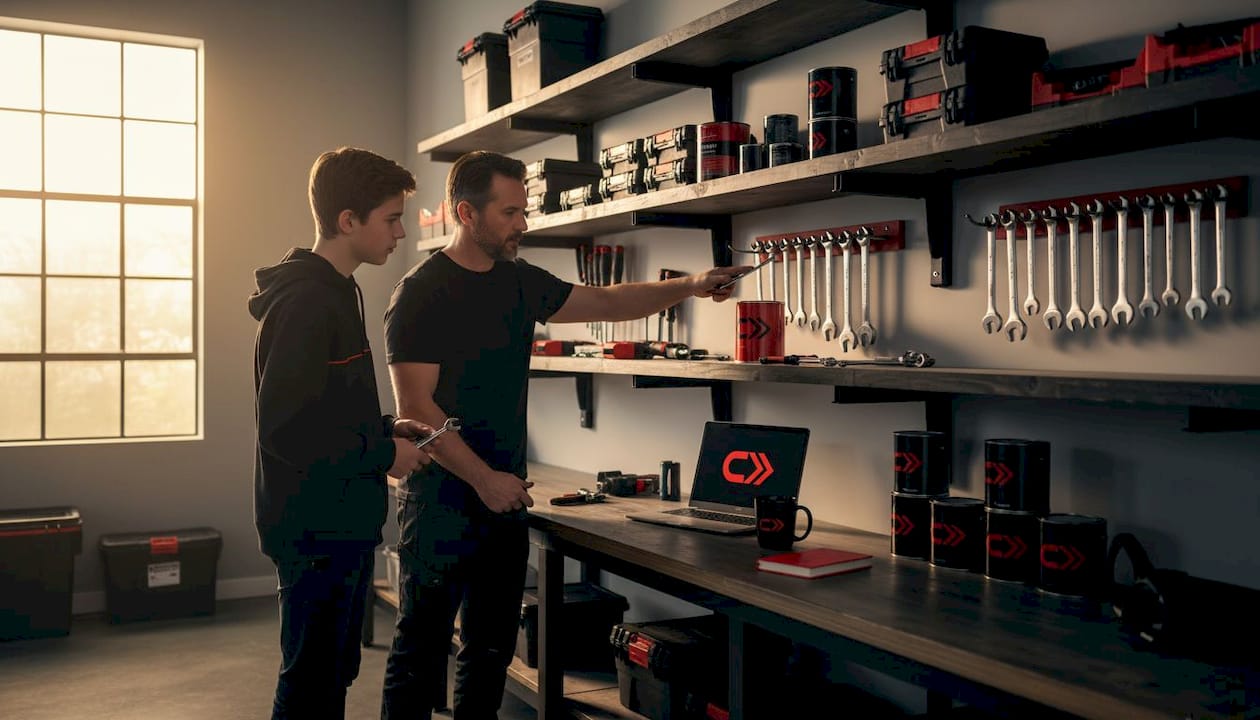
Most people think garage organization means buying a set of wire shelves, stacking a few labeled bins, and calling it done. That approach almost always fails within a season. What actually works is designing a repeatable system where everything has a permanent home, your car fits safely, and the space resets quickly after a project or weekend of use. Garage organization is the process of planning and arranging your garage so tools, car-care supplies, seasonal gear, and stored goods all have designated places, and the space stays usable for its primary purposes year-round.
Table of Contents
- What garage organization really means
- The core steps of organizing your garage
- Garage zoning: Your secret weapon for lasting order
- Common mistakes and safety musts in garage organization
- Why most garage organization advice misses what actually works
- Take garage and car organization further
- Frequently asked questions
Key Takeaways
| Point | Details |
|---|---|
| System over supplies | Prioritize creating a resettable organization system rather than just adding more bins or racks. |
| Declutter first | Always remove unnecessary items before setting up garage zones or storage. |
| Zoning drives function | Assign areas in your garage for different uses to streamline storage and access. |
| Avoid classic mistakes | Do not overuse floor space or skip secure mounting—use vertical and overhead storage where safe. |
| Safety matters | Store chemicals and hazardous materials properly to keep your garage and household safe. |
What garage organization really means
Building on our definition, let’s dig deeper into what true garage organization means and what most people get wrong when they start.
Most homeowners treat a messy garage like a tidying problem. They spend a Saturday afternoon moving things around, buying a few bins, and sweeping the floor. Two months later, the garage looks exactly the same. The reason? They organized the surface, not the system.
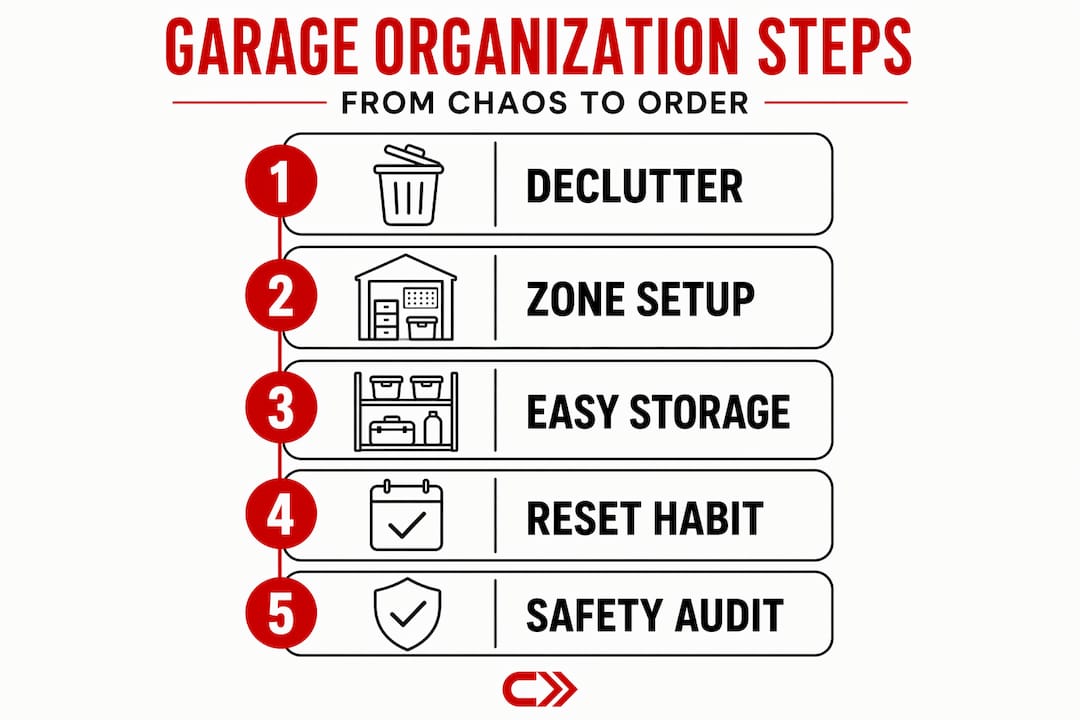
Real garage organization is a repeatable structure built around three core activities: decluttering, zoning, and assigning storage homes. Each of those steps feeds the next. Without decluttering first, you end up creating expensive storage for things you never needed to keep. Without zones, you spend ten minutes hunting for a socket wrench every time you need one. Without dedicated storage homes, items drift back to random spots the moment you’re in a hurry.
“Garage organization is the process of planning and arranging a garage so items (tools, car-care supplies, seasonal gear, and other stored goods) have designated places and the space is usable for its primary purposes, such as parking vehicles and/or creating a workspace.”
Think about how your garage actually gets used week to week. Do you pull a car in every night? Do you work on a project vehicle on weekends? Do kids grab bikes and sports gear from this space daily? Your primary uses should drive every storage decision you make. A garage used mainly for parking has very different needs than a weekend workshop.
Here’s what a well-designed garage organization system actually delivers:
- Every item returns to one spot — no more searching or piling things on the hood of your car
- Clear floor space — enough room to open car doors, walk around vehicles, and work safely
- Zones that match real behavior — gear stored close to where it gets used, not wherever it fits
- Easy reset — after a project, the space goes back to normal in minutes, not hours
Pro Tip: Before you buy a single shelf, spend thirty minutes writing down every activity that happens in your garage. Park car, change oil, store holiday bins, grab the lawnmower — all of it. That list becomes your zone map. Good car maintenance software can also help you track what supplies and tools you actually reach for, so you know what deserves prime shelf space.
The core steps of organizing your garage
Now that you understand the philosophy, here’s the proven, step-by-step process to take your garage from messy to organized.
The biggest mistake in any organization project is skipping straight to storage solutions. That’s like painting a wall before you patch the holes. Follow these three steps in order, and the results actually stick.
-
Declutter first, completely. Pull everything out of the garage or at least off every surface and into the center of the floor. This forces a real decision about every single item. Use the three-box method: keep, donate/sell, and trash. Be ruthless. Old paint cans from 2011, duplicate hand tools, broken sporting equipment — these items cost you space every single day. A pro organizer rule worth following: pull everything out before you sort, categorize, or build any storage solution.
-
Sort and categorize what stays. Group your keepers by function, not by size or container. Car-care supplies go together. Hand tools go together. Power tools together. Seasonal decorations together. Sports gear together. This step reveals how much of each category you actually have, which tells you exactly how much storage each zone needs.
-
Design storage around your categories and zones. Only after steps one and two do you go shopping for shelves, hooks, or cabinets. Now you know exactly what you need, in what quantities, and where each zone should live in the garage. A vehicle maintenance workflow benefits directly from this step because your oil, filters, and fluids end up in one accessible spot near where you work.
Here’s a quick reference table for matching each step to common tools and outcomes:
| Step | Action | Practical tool | Expected outcome |
|---|---|---|---|
| 1. Declutter | Remove everything, sort by keep/donate/trash | Three labeled boxes or bins | Reduced volume by 20-40% |
| 2. Categorize | Group items by function | Tape on floor to mark temporary piles | Clear list of zones needed |
| 3. Design storage | Buy and install storage for each zone | Measuring tape, stud finder | Permanent homes for every item |
Pro Tip: Photograph your garage before you start and after each step. These photos reveal how much space you’re actually gaining, and they help you plan wall storage placement without second-guessing yourself later. They’re also useful if you’re following car care best practices and want to record where you store specific products or supplies.
Garage zoning: Your secret weapon for lasting order
With the step-by-step process in hand, it’s time to use zones to make your organization endure.
Zones are the reason some garages stay organized for years while others fall apart in weeks. A zone is simply a defined area of your garage dedicated to one category of activity or storage. The key insight is that storage should match what happens in each zone, not the other way around.
“A common methodology is zoning the garage into functional areas and matching storage type to each zone, rather than treating the garage as one undifferentiated space.”
Most residential garages benefit from five zones. Here’s how they compare and what storage fits each one:
| Zone | What goes here | Best storage type |
|---|---|---|
| Vehicle area | Clear floor space for parking, oil changes | Floor mats, drain pans, drip trays |
| Workshop/tools | Hand tools, power tools, workbench | Pegboard, tool chests, wall-mounted cabinets |
| Car-care supplies | Fluids, cleaners, wax, detailing gear | Locked cabinet or dedicated shelf near vehicle zone |
| Seasonal storage | Holiday decor, camping gear, rarely used items | Overhead racks, labeled bins on high shelves |
| Sports/outdoor gear | Bikes, balls, gardening tools | Wall hooks, bike mounts, freestanding racks |
A few things to notice about this layout. The vehicle area sits at the center and should be kept as clear as possible. Every other zone orbits around it. You never want to squeeze between a shelf and your car door just to reach the lawnmower.
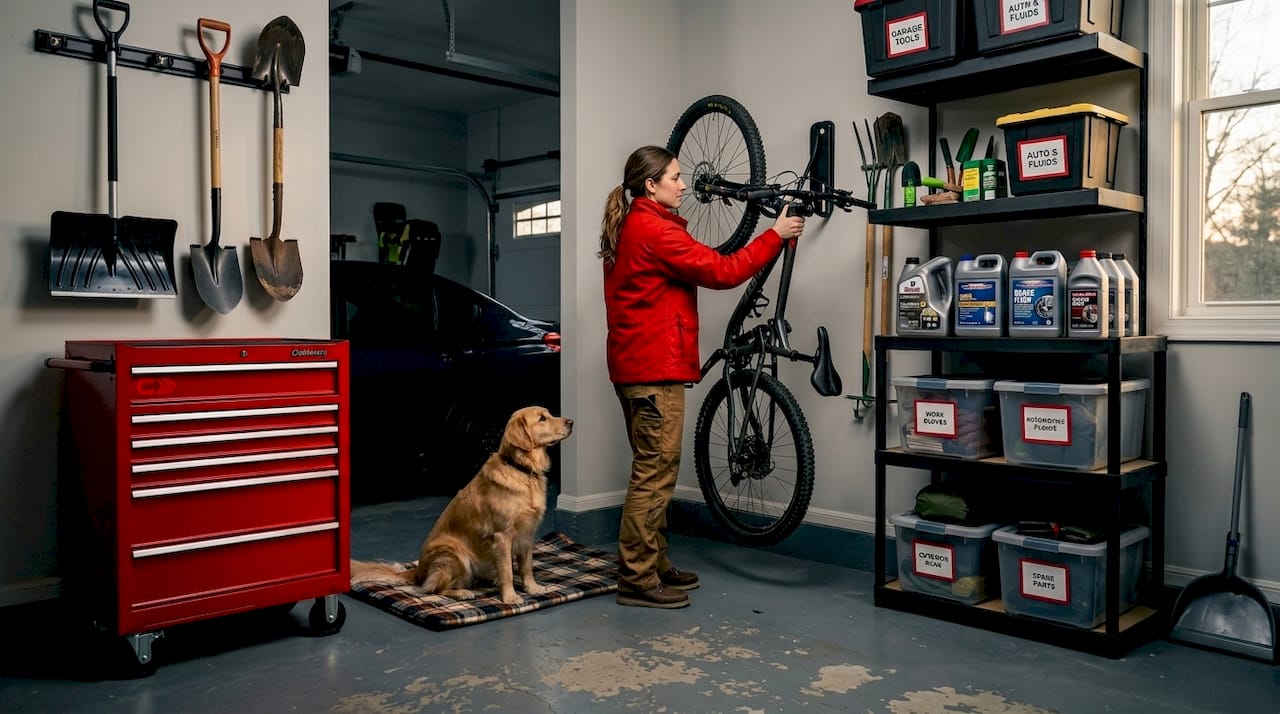
The workshop zone deserves special attention for car owners. If you do your own documenting a car build or track your modifications and service history, having a small wall-mounted whiteboard or clipboard in the workshop zone keeps notes close to the action. A simple hook for a clipboard costs almost nothing but saves real time.
Here’s what effective zoning looks like in practice:
- Assign zones based on frequency of access — daily items at eye level, seasonal items overhead
- Keep similar items together — don’t scatter car fluids across three different shelves
- Mark zone boundaries — paint lines, tape, or floor mats all work well
- Revisit zones seasonally — spring and fall are natural reset points to check that zones still match how you use the space
Common mistakes and safety musts in garage organization
Even with solid zones, many homeowners fall into common traps. Here’s how to sidestep trouble and keep your garage both efficient and safe.
Knowing what to do is half the battle. Knowing what to avoid is the other half. Here are the most common organization failures and the safety issues that come with them.
The most common mistakes:
- Just adding bins without a system. Bins feel like progress but become mystery boxes within weeks if they aren’t labeled and placed within defined zones. Over-relying on floor space and using bins without a plan are two of the most common failure modes in garage organization.
- Ignoring vertical space. Most garages have 8 to 10 feet of wall height. Only using the bottom four feet wastes more than half your available storage area.
- Not anchoring wall storage properly. Shelves loaded with heavy gear need to be mounted into studs, not just drywall. A shelf that pulls free under load is a serious injury risk.
- Cluttered floor paths. Items left on the floor near your car create trip hazards and make it easy to scrape or dent a door. Keep a clear path from the garage door to the car’s driver side at all times.
Safety rules for car owners specifically:
“For homeowners storing hazardous or chemical materials in garages, organization should include safe storage practices.”
Gasoline, motor oil, brake fluid, and solvents all need secure, ventilated storage away from heat sources. Never store flammable liquids on open shelving near a water heater or furnace. Use a locked metal cabinet for any chemicals that could harm children or pets. Keep a fire extinguisher rated for Class B fires mounted near the garage entry and not buried behind shelves.
For heavy items like toolboxes and rolling cabinets, use anti-tip straps or wall anchors. A floor-mounted tool chest can weigh several hundred pounds when fully loaded and will topple if pulled open unevenly without proper support.
A solid car maintenance checklist helps you track exactly which fluids and products you keep on hand, so you always know what needs to be stored safely and what’s overdue for disposal. For routine service and detailing, professional car care can handle jobs that require chemicals or equipment you’d rather not store at home.
Pro Tip: Do a “safety audit” of your garage twice a year. Check that all chemical containers are sealed, wall anchors are tight, and pathways around vehicles are clear. It takes about fifteen minutes and prevents accidents that happen when garages become overstuffed between seasons.
Why most garage organization advice misses what actually works
Here’s a hard-won truth that most garage organization content won’t tell you.
Almost every guide on this topic leads with products. Buy this slatwall system. Get these stackable bins. Install these overhead racks. The product recommendations aren’t wrong, exactly, but they put the cart before the horse. A beautiful storage system installed without a clear system behind it looks great for about three weeks before real life takes over.
The truth is that any organization system will eventually be tested by a bad week, a rushed project, or a season change when everything gets pulled out and thrown back in. What survives that test isn’t the fanciest shelving. It’s the system with the fewest steps to reset. If putting something away requires opening a bin, removing a lid, finding the right compartment, and replacing the lid, that thing will end up on the floor 80% of the time. If it requires hanging it on a hook or dropping it in an open bin, it goes back every single time.
Design for the messy version of yourself, not the idealized one. That means open shelving over closed cabinets for items you use weekly. It means fewer zones with bigger buckets rather than twenty tiny categories nobody can remember. It means the car always has priority on floor space, full stop. No project overflow, no seasonal gear blocking the parking spot.
The garages that stay organized longest are the ones treated like a workflow, not a showroom. You wouldn’t design a kitchen around how it looks in photos. Design your garage around how it works on a Tuesday night when you’re rushed. Good expert car care tips follow the same logic: make the right action the easiest action, and you’ll do it every time.
Take garage and car organization further
Building better habits around your garage can spark better car care and maintenance. Here’s how to go further.
A well-organized garage and a well-maintained car are two parts of the same system. Once your space is dialed in, the next natural step is making sure your vehicle records and maintenance schedule are just as organized.

CarJourney brings the same logic to vehicle ownership. Instead of scattered receipts in the glove box and missed service intervals, you get a single place to track everything. The CarJourney maintenance tracker uses AI to scan your service documents, answer questions about your specific vehicle, and recommend maintenance schedules based on your actual build and driving habits. You can even organize car receipts digitally so your service history is always at your fingertips. Pair it with the oil change tracking app to stop guessing when your next service is due and start knowing.
Frequently asked questions
Why is zoning important in garage organization?
Zoning separates your garage into functional areas so you can find items easily and keep floors clear for vehicles. Matching storage type to each zone prevents items from drifting into random spots over time.
How can I make sure my garage stays organized long term?
Focus on decluttering first, establish zones, and assign storage solutions that are easy to reset after use. Organization works best when storage is built around what you actually keep, not around what might be useful someday.
What is a common mistake people make with garage storage?
Relying only on bins or ignoring wall and overhead space makes garages cluttered and less functional over time. Over-relying on floor space and using bins without a clear plan are among the most cited failure modes by professional organizers.
How should hazardous materials be stored in the garage?
Hazardous items like gasoline, chemicals, and fertilizers should be stored in sealed, ventilated metal cabinets away from heat sources. Safe storage practices for chemical materials are a critical part of any complete garage organization plan.