
Streamline your vehicle maintenance workflow for fewer surprises
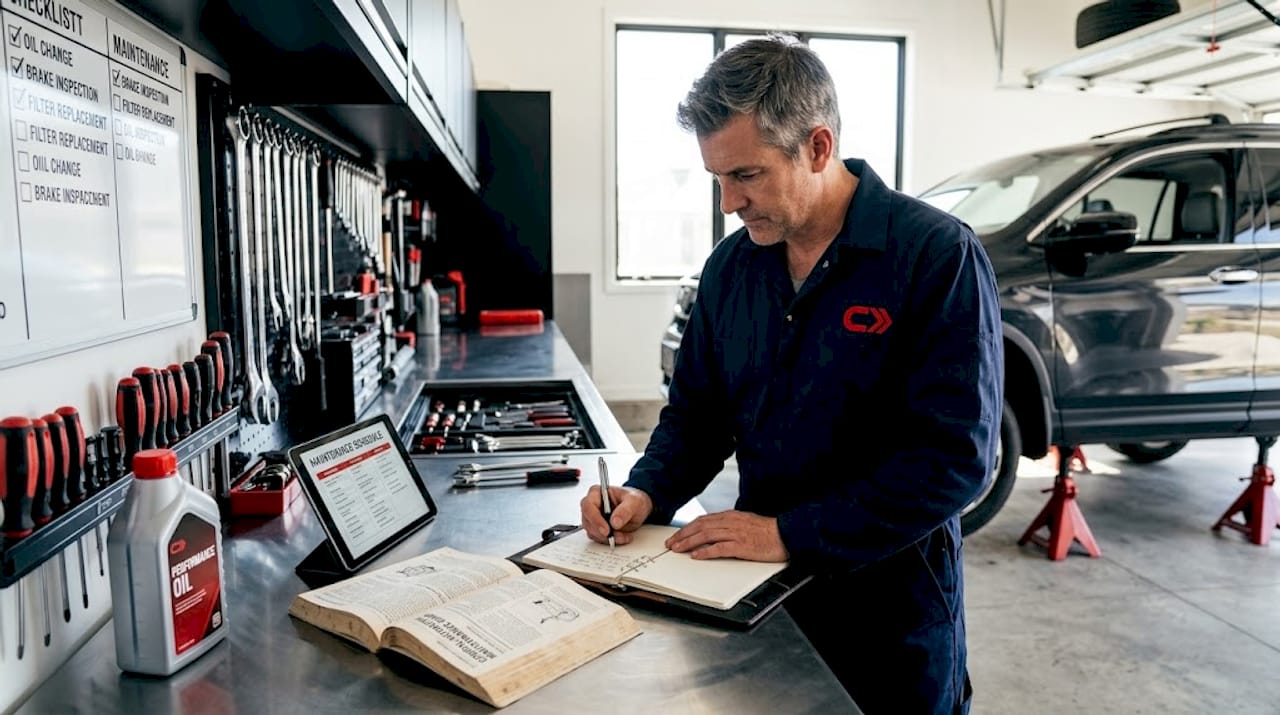
Skipping an oil change by 2,000 miles might feel harmless, but that kind of drift compounds fast. A missed coolant flush leads to overheating. A forgotten brake inspection turns into a rotor replacement. Before long, you’re staring at a $1,400 repair bill that a $30 fluid change would have prevented. A practical vehicle maintenance workflow gives you a repeatable system to follow your manufacturer’s schedule, catch problems early, and build records that make troubleshooting easier. This guide walks through that exact system, step by step.
Table of Contents
- What you need to streamline vehicle maintenance
- Step-by-step vehicle maintenance workflow
- Troubleshooting, warning signs, and what to do next
- Verify, track, and improve your workflow
- What car owner communities taught us about maintenance workflows
- Get more from your workflow with the right tools
- Frequently asked questions
Key Takeaways
| Point | Details |
|---|---|
| Follow a consistent workflow | Rely on a clear routine for inspections, scheduled services, and adaptation for your driving habits. |
| Track everything | Log all maintenance, services, and anomalies for proactive problem-solving and cost control. |
| React quickly to warning signs | Act on dashboard alerts, tire issues, and brake performance changes to avoid costly breakdowns. |
| Use community wisdom | Tap into enthusiast forums for unique insights while anchoring critical steps to your owner’s manual. |
| Choose the right tools | Digital trackers and guides make maintenance easier and reduce the risk of missed services. |
What you need to streamline vehicle maintenance
Before any workflow can stick, you need the right foundation. Think of this like a mechanic’s bay: without the right tools and information on hand, even the best intentions fall apart fast.
Essential items to get started:
- Owner’s manual: This is your ground truth. Every interval, fluid spec, and torque rating lives here. Not the sticker on the windshield, not a generic internet checklist.
- Maintenance logbook or digital tracker: Whether it’s a paper notebook in your glove box or a digital tool, you need somewhere to record every service, date, and mileage.
- Basic inspection tools: A quality tire pressure gauge, a flashlight for underhood and undercarriage checks, and a tread depth gauge cover most visual inspections.
- Access to digital resources and communities: Forums, enthusiast groups, and platform-based communities give you access to real-world knowledge that no manual can replicate.
The importance of solid record-keeping can’t be overstated. Bridgestone’s service interval guidance reinforces that consistent documentation makes it far easier to identify what changed between service visits and catch problems before they escalate. Consumer Reports echoes this, recommending you follow manual intervals and talk through your driving habits with a trusted mechanic. AAA’s time-stamped checklist approach supports the same principle by making every inspection a recorded data point.
Choosing the right way to track your services matters too. Good maintenance logs function like a health history for your car. When something goes wrong, you can scan back and see if there’s a pattern. You can also compare different log book options to find the format that works best for your routine, whether that’s a physical notebook or an app with photo uploads.
Maintenance tools at a glance:
| Tool | Purpose | Cost range |
|---|---|---|
| Tire pressure gauge | Monthly pressure checks | $8 to $20 |
| Tread depth gauge | Tire wear tracking | $5 to $15 |
| Flashlight or inspection light | Underhood and undercarriage visual | $10 to $40 |
| Maintenance logbook or app | Service history tracking | Free to $15/year |
| OBD-II code reader | Read/clear diagnostic codes | $25 to $80 |
Pro Tip: Set recurring calendar reminders for your upcoming checks. Monthly for fluids and tires, every 3,000 to 5,000 miles for oil inspection, and seasonal reminders for battery, belts, and coolant. Make the reminder do the remembering so you don’t have to.
Step-by-step vehicle maintenance workflow
With your essentials ready, here’s how to put a proven vehicle maintenance workflow into action. The goal isn’t to add complexity to your schedule. It’s to replace random, reactive car care with a reliable system.
The five-step workflow:
-
Review your schedule. Pull out your owner’s manual and note every service interval for your specific make, model, and engine. Build your schedule around those figures, not around what worked for a different car. Manufacturer intervals for things like transmission fluid, timing belt replacement, and spark plugs vary dramatically from one vehicle to the next.
-
Perform short-term inspections. Daily and weekly checks are fast and mostly visual. Scan for warning lights, check tire condition, and note any odd sounds or smells. Monthly checks include tire pressure, fluid levels (oil, coolant, brake fluid, power steering if applicable), and wiper condition. These only take a few minutes, but they’re your early warning system.
-
Carry out mileage and time-based services. Oil changes, air filter swaps, tire rotations, brake inspections, and spark plug replacements all have defined intervals. Track your odometer consistently so you never blow past one of these milestones without noticing. The recommended maintenance for most vehicles follows a tiered schedule that escalates in depth every 15,000 to 30,000 miles.
-
Adapt for severe use. This is the step most guides leave out entirely. If you tow regularly, drive in extreme heat or dusty conditions, make a lot of short trips in freezing temperatures, or sit in heavy stop-and-go traffic, your car is working harder than the standard schedule assumes. Severe-use tailoring means shortening your oil change intervals, inspecting brakes more often, and checking cooling system components more frequently. Ignoring this step is how people end up with transmission failures at 60,000 miles on a vehicle rated for 100,000.
-
Keep complete records. Every service gets logged. Date, mileage, what was done, what was found, and what it cost. This record is valuable when selling the vehicle, but it’s even more valuable when troubleshooting a repeat issue with your mechanic or the enthusiast community.
Example maintenance intervals:
| Service | Short-term interval | Medium-term interval | Long-term interval |
|---|---|---|---|
| Tire pressure check | Monthly | N/A | N/A |
| Oil and filter change | 3,000 to 7,500 miles | Varies by oil type | N/A |
| Tire rotation | Every 5,000 to 7,500 miles | N/A | N/A |
| Brake inspection | Every 12,000 miles | Replace pads as needed | Rotors every 50,000+ |
| Air filter replacement | N/A | Every 15,000 to 30,000 miles | N/A |
| Coolant flush | N/A | Every 30,000 miles | N/A |
| Spark plug replacement | N/A | Every 30,000 to 60,000 miles | Iridium plugs: 100,000+ |
| Timing belt/chain | N/A | N/A | 60,000 to 100,000 miles |
Cross-reference these ranges with Bridgestone’s maintenance checklist and your owner’s manual to confirm the exact numbers for your vehicle.
For a complete framework that accounts for different vehicle types and driving conditions, the maintenance schedule guide is a solid resource to keep bookmarked.
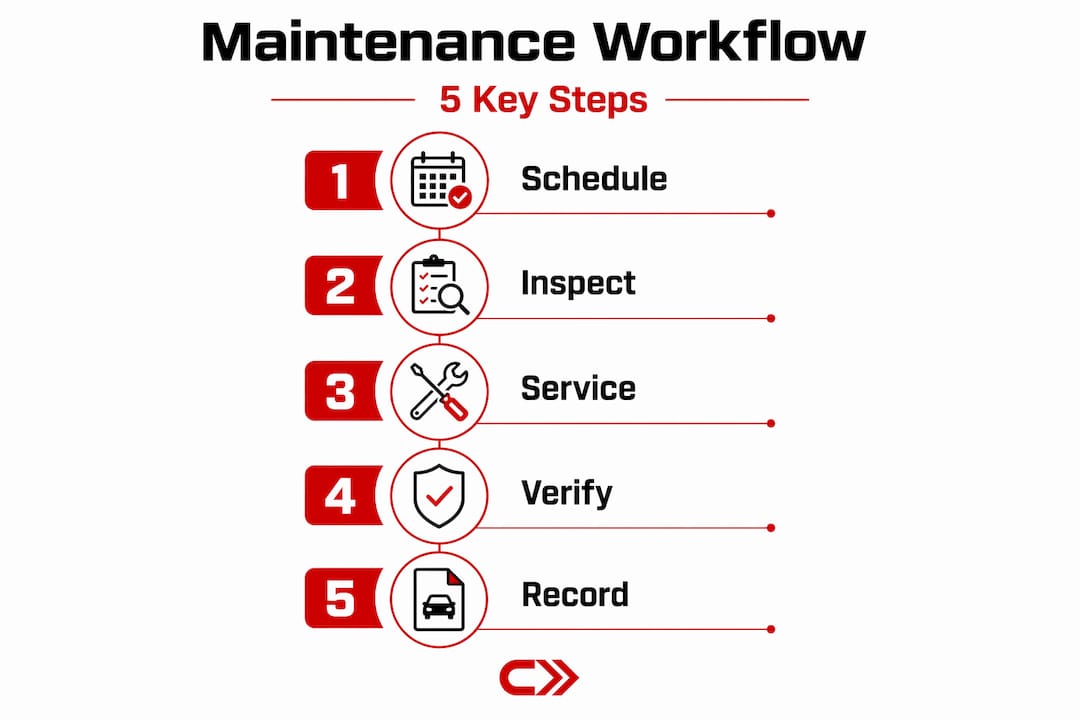
Pro Tip: Treat your maintenance workflow like a pipeline. The stages are: schedule, inspect, service, verify, and record. If you skip any stage, the system has a gap. A verified but unrecorded service is almost as problematic as a service that never happened, especially when you’re troubleshooting a recurrence six months later.
Troubleshooting, warning signs, and what to do next
Knowing the workflow is half the battle. The real test is handling surprises or anomalies on the road. Not every problem announces itself at a scheduled service interval. Some arrive as a strange noise at highway speed, a warning light at 11 PM on a Tuesday, or a subtle pull to the left that wasn’t there last week.
Common warning signs and first responses:
- Low tire pressure warning (TPMS light): Check all four tires and the spare with your gauge. Look for nails, valve stem leaks, or sidewall damage. Tire pressure and tread should be corrected promptly since underinflation increases blowout risk and reduces fuel economy by up to 3%.
- Check engine light (amber/yellow): Don’t panic, but don’t ignore it. Use an OBD-II reader to pull the diagnostic trouble code and cross-reference it. This is a great moment to post in an enthusiast community with your vehicle specifics and the code. You’ll often get useful context from someone who has seen that exact failure.
- Brake warning light or soft pedal feel: Do not defer this. Brake system issues require prompt professional attention, not a forum post. Low brake fluid, a worn pad sensor, or a hydraulic leak are all potentially dangerous.
- Temperature gauge rising toward hot: Pull over when it’s safe to do so. A rising temp with steam from under the hood means stop driving immediately. Running an overheating engine causes catastrophic damage in minutes.
- Unusual sounds (grinding, squealing, knocking): These are the most diagnostic sounds a car makes. A grinding sound from the brakes means metal-on-metal contact. A knocking engine sound at idle can mean low oil or rod bearing wear. Document when it happens, what speed, what conditions, and share that context with your mechanic or community.
Safety note: Act immediately on brake warning lights and any red dashboard warning. Red indicators signal a critical system issue. Amber indicators warrant investigation soon. Never drive on a brake warning without getting the system professionally inspected first.
When deciding whether to consult the enthusiast community or a professional, consider the stakes. A community is excellent for diagnostic shortcuts, unusual symptom patterns, and model-specific quirks. A professional is non-negotiable for anything touching safety-critical systems: brakes, steering, suspension, or anything flagging a red warning light.
For a practical breakdown of what specific warning signs mean and how to prioritize them, the warning signs guide covers the most common scenarios. And if you’re ever locked out of your vehicle during a roadside situation, understanding your key types for emergencies can save serious time.
When a warning light appears, the smart sequence is to check your owner’s manual for the exact meaning, assess urgency by the color and symbol, and get professional diagnosis for any red light or persistent combination of warnings.
Verify, track, and improve your workflow
After troubleshooting, verifying your results and keeping solid records closes the loop on proactive maintenance. A workflow that never gets reviewed is just a checklist. A workflow that gets reviewed regularly becomes a genuine asset.
What to record for every service or inspection:
- Service performed (be specific: “replaced front brake pads, resurfaced rotors” not just “brake job”)
- Date and current odometer reading
- Cost, including parts and labor separately if possible
- Any symptoms that triggered the service or were noted during it
- Parts brand and specifications (especially important for filters, fluids, and spark plugs)
- Receipts or invoice scans attached digitally
The tracking maintenance process gets more valuable over time. After a year or two of consistent logging, you can look back and see which parts fail early on your specific vehicle, which services cluster together naturally, and where your actual costs land versus what you budgeted.
A well-maintained maintenance log also speeds up troubleshooting dramatically. Instead of your mechanic asking “when was the last time you changed the coolant?” and getting a shrug, you hand over a complete history. That context saves diagnostic time and often saves money.

Pro Tip: Take your maintenance history to enthusiast forums when you’re dealing with a recurring issue. Sharing the full record, dates, mileage, what was replaced, and what symptoms persist gives community members the detail they need to spot patterns you might have missed. Enthusiasts who own the same vehicle and engine combination often recognize failure signatures that aren’t documented anywhere else.
Community feedback is also a great way to audit your workflow. If five other owners of your exact model report that the factory-recommended coolant flush interval is too long for high-mileage driving, that’s actionable data. Not a reason to ignore your manual, but a reason to have a specific conversation with your mechanic.
What car owner communities taught us about maintenance workflows
Here’s something most maintenance guides won’t say directly: the owner’s manual is your starting point, not your complete strategy.
When we built CarJourney, we talked with hundreds of car owners and enthusiasts about how they actually manage their vehicles. The pattern that came up most often wasn’t about intervals or products. It was about edge cases. The third-generation owner of a specific diesel pickup who discovered that the factory service interval for injector cleaning was designed for low-sulfur diesel in controlled climates, not the biodiesel blends common in certain regions. The hatchback owner who found out from a community forum that her specific model year had a known issue with the thermostat housing that caused coolant leaks after 50,000 miles, something the dealer had quietly updated in a later revision.
Standard schedules are written for average use by an average driver in average conditions. Real life doesn’t work that way. Community advice works best when you use it to refine your diagnostic hypothesis, while keeping the manufacturer’s schedule as the anchor for safety-critical timing.
The most common pitfall we see is treating enthusiast advice as a replacement for the manual rather than a supplement to it. Community members can tell you what failed on their build. They can’t tell you the metallurgical tolerances your engine was designed to meet.
The best workflow we’ve seen blends both. Use the manual for timing. Use the community for insight, patterns, and diagnostic shortcuts. And use deeper logging strategies to build a record that makes every conversation, with a mechanic or a forum, more productive.
Pro Tip: When you post a symptom to an enthusiast community, include your exact year, make, model, engine code, mileage, and when the symptom started. Vague posts get vague answers. Specific posts get specific help.
Get more from your workflow with the right tools
Managing a vehicle’s full lifecycle, from scheduled services to community-sourced insights, is genuinely easier when everything lives in one place instead of scattered across paper receipts, forum bookmarks, and calendar reminders.
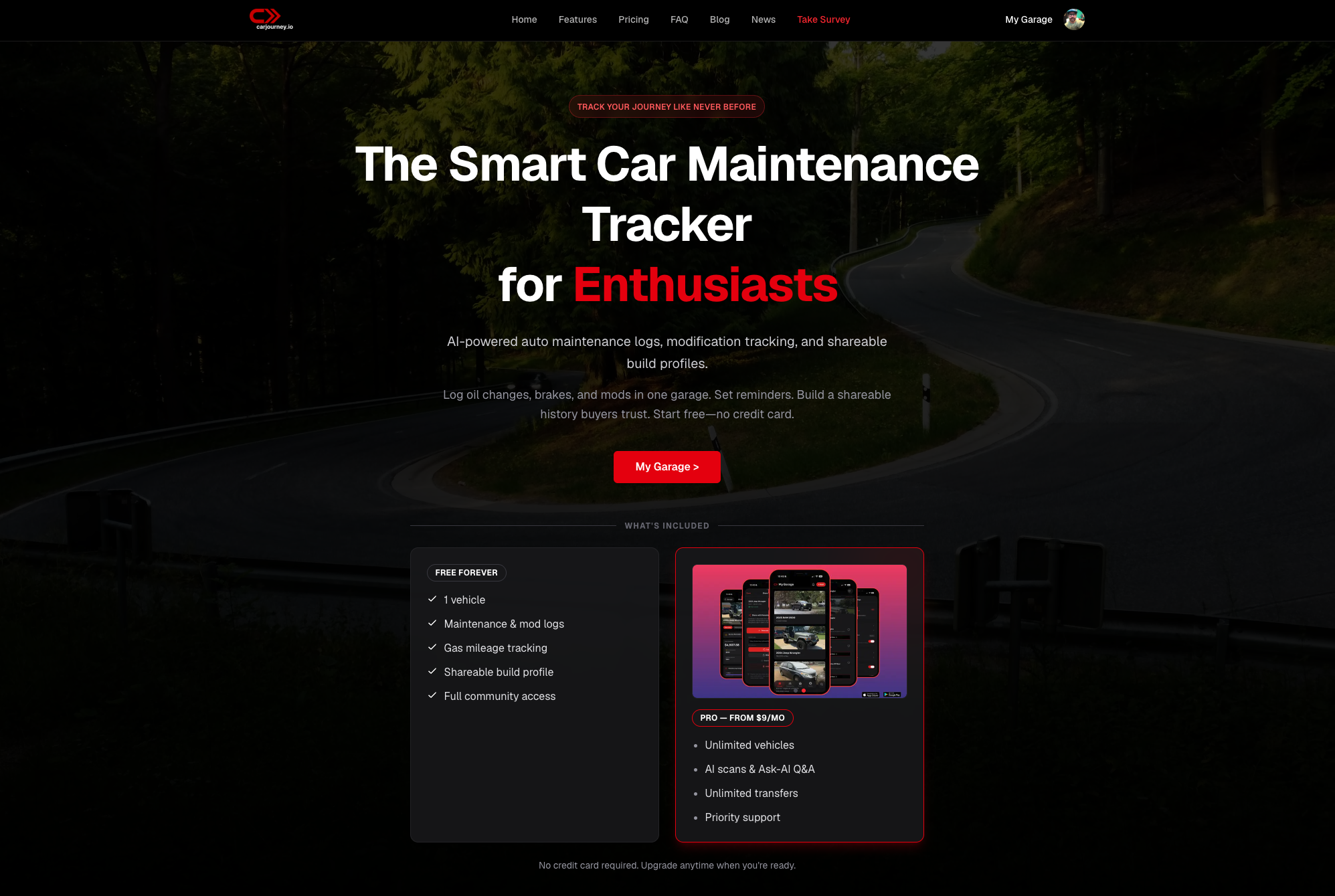
CarJourney was built for exactly this. Our platform lets you track your entire workflow, schedule, inspect, service, verify, and record, in one dedicated maintenance tracker. CarJourney’s AI scans your service documents, answers questions about your specific vehicle, and recommends maintenance schedules verified across multiple models. You also get access to a community of enthusiasts who share real-world data and build knowledge from direct experience. If you’re serious about fewer surprises and lower long-term costs, it’s worth making your workflow work smarter.
Frequently asked questions
How often should I check tire pressure?
Check your tire pressure at least once a month and whenever temperatures change significantly, since pressure drops with temperature at roughly 1 PSI for every 10-degree Fahrenheit drop.
What records should I keep for vehicle maintenance?
Keep a log of all services, dates, mileages, receipts, and repairs. A complete maintenance record speeds up both troubleshooting and resale conversations.
When do I need to adjust my maintenance intervals?
Increase your service frequency if you regularly tow, drive in hot or dusty conditions, or make frequent short trips in freezing weather, since severe-use driving puts more stress on fluids and components than standard intervals account for.
What should I do if a warning light appears?
Check your manual for the exact meaning, assess urgency by color and symbol, and seek professional diagnosis for any red or persistent warning without delay.