 carjourney
From the CarJourney journal
What Is a Vehicle VIN? Your Complete 2026 Guide
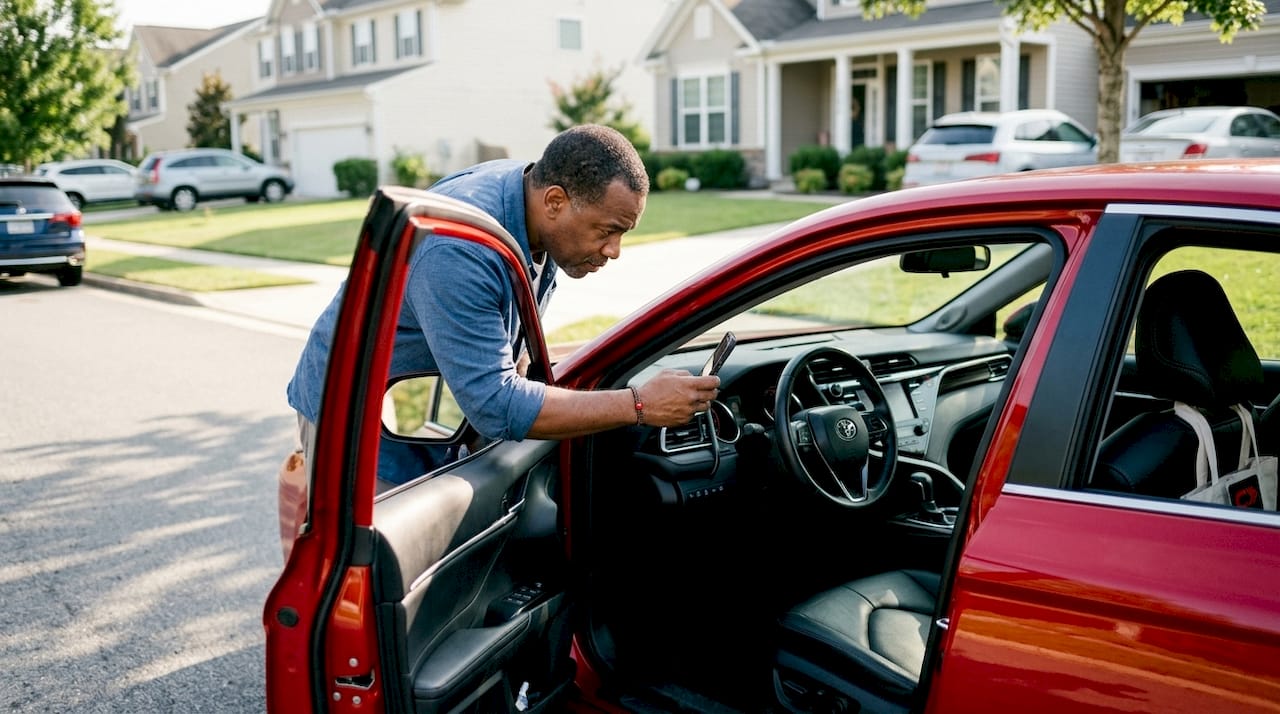
A Vehicle Identification Number, or VIN, is a standardized 17-character alphanumeric code that uniquely identifies every motor vehicle on the planet. No two vehicles share the same VIN. The format has been mandatory in the United States since 1981, governed by ISO 3779 and ISO 4030, and used daily by manufacturers, insurers, government agencies, and buyers to verify a vehicle’s identity and full history. If you’re buying, selling, or insuring a car in 2026, understanding what a vehicle VIN tells you is one of the most practical skills you can have.
What is a vehicle VIN and where does it come from?
A VIN is the automotive equivalent of a Social Security number. It encodes the country of manufacture, the builder, the vehicle’s physical attributes, and its unique production sequence into a single string of characters. The International Organization for Standardization sets the rules through ISO 3779, which governs content, and ISO 4030, which governs placement. Every automaker selling vehicles in the U.S. must comply. That compliance is what makes a VIN decoded in Virginia mean the same thing as one decoded in California or Germany.
The 17-character standard replaced a chaotic era when manufacturers used their own formats, some as short as 5 characters. Pre-1981 vehicles carry inconsistent VIN formats that complicate historical tracking and raise fraud risk. For any vehicle built after 1981, the format is locked and globally readable.
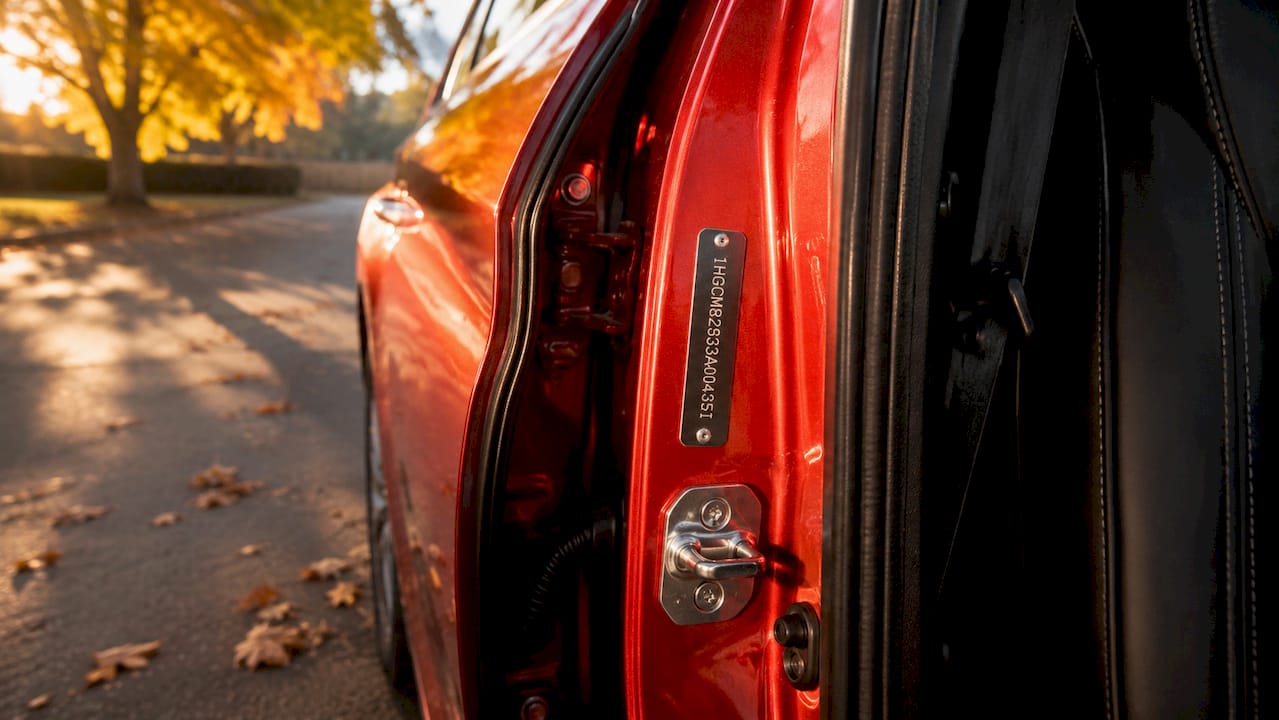
Where to find the VIN on your car
The VIN appears in several places, and knowing all of them matters when you’re verifying a vehicle’s identity.
Physical locations on the vehicle:
- Driver’s side dashboard: The most common spot. Look through the windshield at the lower corner of the dashboard near the A-pillar. This is the primary location required by federal regulation.
- Driver’s side doorjamb: Open the driver’s door and look at the sticker on the door frame. This location is standard on most modern vehicles.
- Engine block: Stamped directly into the metal, usually on the front of the block. This location is harder to alter than a plate.
- Firewall: The metal wall between the engine bay and the passenger cabin. Some manufacturers stamp the VIN here as a secondary reference.
On your paperwork:
The VIN also appears on your title and registration, insurance policy declarations page, and any loan documents tied to the vehicle. These document-based VINs should always match the physical ones.
Why cross-checking matters:
A mismatch between the dashboard VIN and the doorjamb VIN is a red flag for fraud. Criminals sometimes swap VIN plates from salvage vehicles onto stolen ones. Checking multiple physical locations and comparing them to the title takes less than five minutes and can save you from a very expensive mistake.
Pro Tip: Before buying any used vehicle, photograph the VIN from at least two physical locations and compare both to the title. If they don’t match exactly, walk away.
How to decode a VIN: what each character means
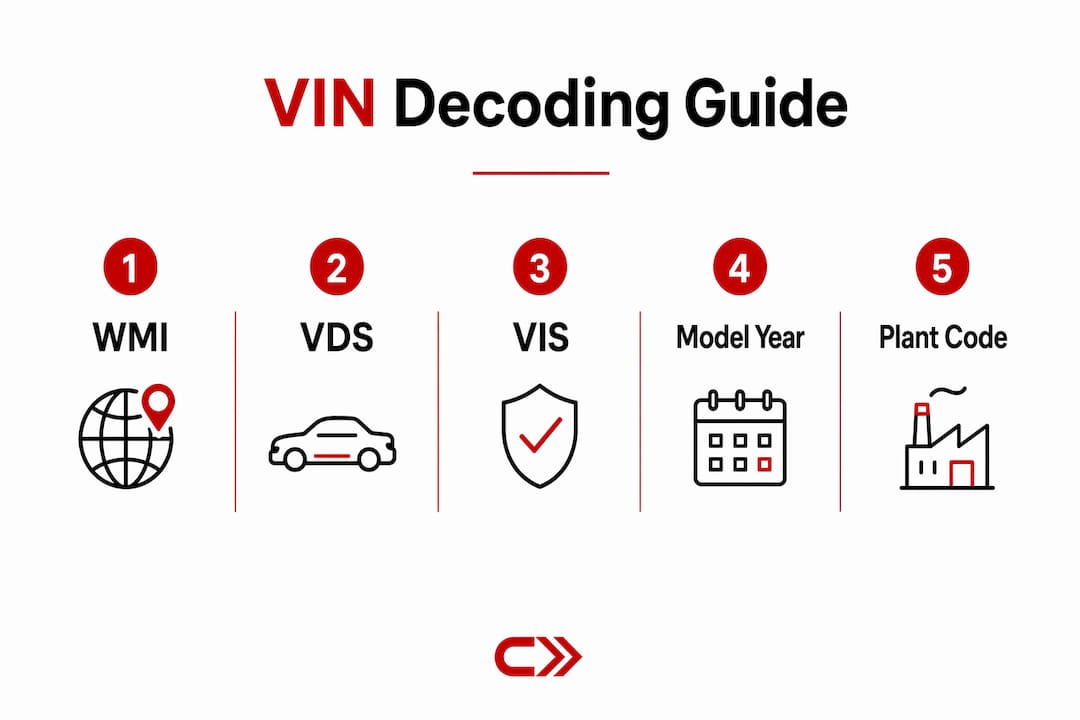
The 17 characters in a VIN are not random. They divide into three sections, each carrying specific information.
The three sections of a VIN
-
World Manufacturer Identifier (WMI) — characters 1–3: The first character identifies the country of manufacture. “1,” “4,” and “5” indicate the United States. “J” indicates Japan. “W” indicates Germany. The second character identifies the manufacturer. The third narrows it to the vehicle type or manufacturing division.
-
Vehicle Descriptor Section (VDS) — characters 4–9: Characters 4 through 8 describe the vehicle’s attributes: body style, engine type, restraint systems, and model. Character 9 is a check digit calculated mathematically from the other characters. The National Highway Traffic Safety Administration (NHTSA) uses this check digit to verify that a VIN is legitimate and not fabricated.
-
Vehicle Identifier Section (VIS) — characters 10–17: Character 10 encodes the model year. Character 11 identifies the assembly plant. Characters 12 through 17 form the vehicle’s unique serial number within that plant.
Character restrictions you need to know
The letters I, O, and Q are excluded from all VINs. ISO 3779 bans them because they look too much like the digits 1 and 0. This rule exists to prevent transcription errors in both manual and automated systems. If you ever see an “O” in a VIN, it is actually a zero. If you see an “I,” it is a one.
| VIN Section | Characters | What it encodes |
|---|---|---|
| WMI | 1–3 | Country, manufacturer, vehicle type |
| VDS | 4–9 | Body style, engine, restraint, check digit |
| VIS | 10–17 | Model year, plant, serial number |
Pro Tip: Use the NHTSA’s free VIN decoder at nhtsa.gov to decode any post-1981 VIN instantly. It pulls directly from manufacturer-submitted data and costs nothing.
Why the VIN is essential for buyers, sellers, and insurers
The VIN functions as a vehicle’s fingerprint. It creates a permanent, immutable link between the physical chassis and every legal record ever attached to it. That link is what makes the VIN so powerful across multiple industries.
For buyers and sellers
Buyers use the VIN to pull vehicle history reports that reveal accidents, title status, odometer rollbacks, open safety recalls, and theft records. Sellers benefit too. A clean VIN history report is a selling point that justifies a higher asking price and builds buyer confidence. Many buyers today treat a VIN check as a non-negotiable first step, not an optional extra.
“The VIN is the single most reliable tool a private buyer has. It connects a car’s physical identity to its entire documented past. Skipping a VIN check before buying a used vehicle is like signing a contract without reading it.”
For insurance companies
Insurance companies use VIN-based underwriting to set premiums based on the exact trim level, engine, and safety features of your specific vehicle. Two cars that look identical on the lot can carry different premiums if their VINs reveal different airbag configurations or engine sizes. A minor trim difference decoded from the VIN can meaningfully change what you pay each month.
For law enforcement and regulators
Law enforcement agencies use VINs to track stolen vehicles, verify legal ownership during traffic stops, and identify vehicles involved in crimes. The NHTSA uses VINs to issue and track safety recalls. When a recall is issued, it targets specific VIN ranges, so knowing your VIN tells you immediately whether your vehicle is affected.
Knowledgeable buyers treat VIN checks as fraud prevention, not just a formality. A VIN check through a reputable vehicle history service can surface title washing, where a salvage title is hidden by re-registering a vehicle in a different state.
Common VIN mistakes and how to avoid them
VINs are simple in concept but easy to misread or misuse. These are the mistakes that cost buyers the most.
- Misreading characters: The exclusion of I, O, and Q means any character that looks like those letters is actually a number. Transcribing a VIN by hand increases error risk. Always copy it digitally when possible, or photograph it and zoom in.
- Trusting only one source: Relying solely on the seller’s paperwork is not enough. Always verify the VIN physically on the vehicle and compare it to the title. Mismatched VINs on different parts of the same vehicle signal tampering.
- Ignoring pre-1981 vehicles: Older vehicles with non-standard VIN lengths require special identification methods. Standard history report services may not cover them. If you’re buying a classic car, consult a specialist appraiser.
- Skipping the recall check: An open safety recall tied to a VIN is the seller’s problem until it’s fixed. Check the NHTSA database before finalizing any purchase.
- Overlooking counterfeit plates: VIN plates can be swapped or forged. A plate that looks newer than the surrounding metal, or shows signs of re-riveting, deserves closer inspection.
Pro Tip: Run the VIN through the NHTSA recall database and a reputable vehicle history service before signing anything. Both checks together take under ten minutes.
Key Takeaways
A vehicle’s VIN is the single most reliable identifier for verifying its origin, history, and legal status before any transaction.
| Point | Details |
|---|---|
| VIN is a 17-character code | Standardized since 1981 under ISO 3779 and ISO 4030 for global compatibility. |
| Multiple physical locations | Check the dashboard, doorjamb, and engine block, then compare all three to the title. |
| Three decoded sections | WMI identifies the maker, VDS describes the vehicle, and VIS gives the unique serial. |
| Essential for transactions | VIN history reports reveal accidents, title issues, recalls, and theft records. |
| Insurance and legal use | Insurers decode VINs to set premiums; law enforcement uses them to track ownership and theft. |
The VIN is the one thing you should never skip
I’ve seen buyers spend weeks researching trim levels, fuel economy ratings, and color options, then skip the VIN check entirely because they trusted the seller. That’s backwards. The VIN check is the one step that tells you whether everything else the seller said is true.
What surprises most people is how much the VIN reveals beyond basic identity. The model year character alone can tell you whether a vehicle qualifies for certain manufacturer warranties. The assembly plant character can explain why two vehicles with the same model name have different build quality reputations. These are not obscure details. They’re facts encoded into every car built since 1981, waiting to be read.
The technology side has improved dramatically. Carjourney uses AI to scan service documents and answer detailed questions about your exact vehicle, pulling from the VIN to give you maintenance schedules and modification recommendations specific to your build. That’s a different experience from a generic lookup. It treats your vehicle as the specific machine it is, not a category.
My honest advice: treat the VIN as your starting point, not a formality. Run it before you negotiate price. Run it before you finalize insurance. And keep your own VIN records organized so you can pull them instantly when you need them. The buyers who do this consistently make better decisions and pay less for the privilege.
— Chally
Carjourney makes VIN-based vehicle tracking simple
Knowing your VIN is the first step. Putting it to work over the life of your vehicle is where most owners fall short.

Carjourney is built for exactly that. The platform lets you log your VIN and build a complete, searchable record of every service, repair, and modification tied to your specific vehicle. Carjourney’s AI scans your service documents, answers questions about your exact build, and recommends maintenance schedules verified across multiple AI models. Whether you’re tracking a daily driver or managing a project build, start with your VIN and let Carjourney handle the rest. You can also explore alternatives to standard history reports to get the most complete picture of any vehicle you’re considering.
FAQ
What does a VIN stand for?
VIN stands for Vehicle Identification Number. It is a standardized 17-character alphanumeric code that uniquely identifies a specific motor vehicle worldwide.
How do I find my VIN quickly?
The fastest location is the driver’s side dashboard, visible through the windshield at the lower corner near the A-pillar. It also appears on your registration, title, and insurance documents.
Can two vehicles have the same VIN?
No. Each VIN is unique to one vehicle. Duplicate VINs indicate fraud, a clerical error, or a counterfeit plate, all of which require immediate investigation before any transaction proceeds.
Why are the letters I, O, and Q missing from VINs?
ISO 3779 excludes those letters because they are visually similar to the digits 1 and 0. Removing them prevents transcription errors in both manual reading and automated scanning systems.
What can a VIN history report tell me?
A VIN history report can reveal prior accidents, title status, odometer readings, open safety recalls, theft records, and the number of previous owners. It is the most reliable tool a buyer has for verifying a vehicle’s past.