 carjourney
From the CarJourney journal
What Is Maintenance AI? a Guide for Car Owners

Most car owners think AI in maintenance means a chatbot telling you to change your oil. That misses the point completely. Maintenance AI is a system that learns your vehicle’s behavior, detects problems before they become failures, and tells you exactly what needs attention and when. It does not replace your mechanic. It makes you a smarter owner. This article breaks down what maintenance AI actually is, how it works on your specific vehicle, what it can realistically do for you, and where it still needs a human in the loop.
Table of Contents
- Key takeaways
- What is maintenance AI and how does it work
- Real benefits of AI-driven vehicle maintenance
- Practical applications of maintenance AI for vehicle owners
- Limitations of maintenance AI to understand
- My take on AI as a tool, not a replacement
- Smarter car care starts with CarJourney
- FAQ
Key takeaways
| Point | Details |
|---|---|
| AI predicts problems early | Predictive maintenance AI can detect component degradation 14 to 60 days before failure occurs. |
| Your data drives the system | Maintenance AI learns from your vehicle’s actual sensor data, not just generic mileage schedules. |
| Human expertise stays critical | AI handles data analysis and alerts, but skilled technicians remain necessary for physical diagnosis and repair. |
| Cost savings are real | AI-informed maintenance reduces costs by 25 to 30% and cuts unplanned downtime by 35 to 45%. |
| Tools exist for everyday owners | Apps and OBD devices now bring predictive and prescriptive maintenance AI to regular vehicle owners, not just fleet managers. |
What is maintenance AI and how does it work
Maintenance AI is technology that collects real-time data from your vehicle, runs it through machine learning models, and generates predictions or recommendations about what needs service. Think of it as a continuous health monitor for your car, not a one-time diagnostic scan.
The process starts with sensors. Modern vehicles are packed with them, tracking everything from engine temperature and oil pressure to brake pad wear and transmission behavior. Older vehicles can get similar coverage through retrofit sensor solutions like clamp-on devices and OBD-II adapters, which means you do not need a brand new car to benefit.
That sensor data feeds into machine learning algorithms that have been trained on thousands of failure patterns. The AI looks for deviations from normal operating ranges and compares your vehicle’s behavior against historical data to estimate how much useful life a component has left.
Here is how the three main maintenance approaches differ:
- Preventive maintenance: Fixed schedule based on time or mileage. Your oil change every 5,000 miles regardless of actual oil condition.
- Predictive maintenance AI: Condition-based. The system monitors your specific vehicle and alerts you when data suggests a component is degrading.
- Prescriptive maintenance: The most advanced tier. The AI not only detects the problem but delivers step-by-step repair guidance to the person doing the work.
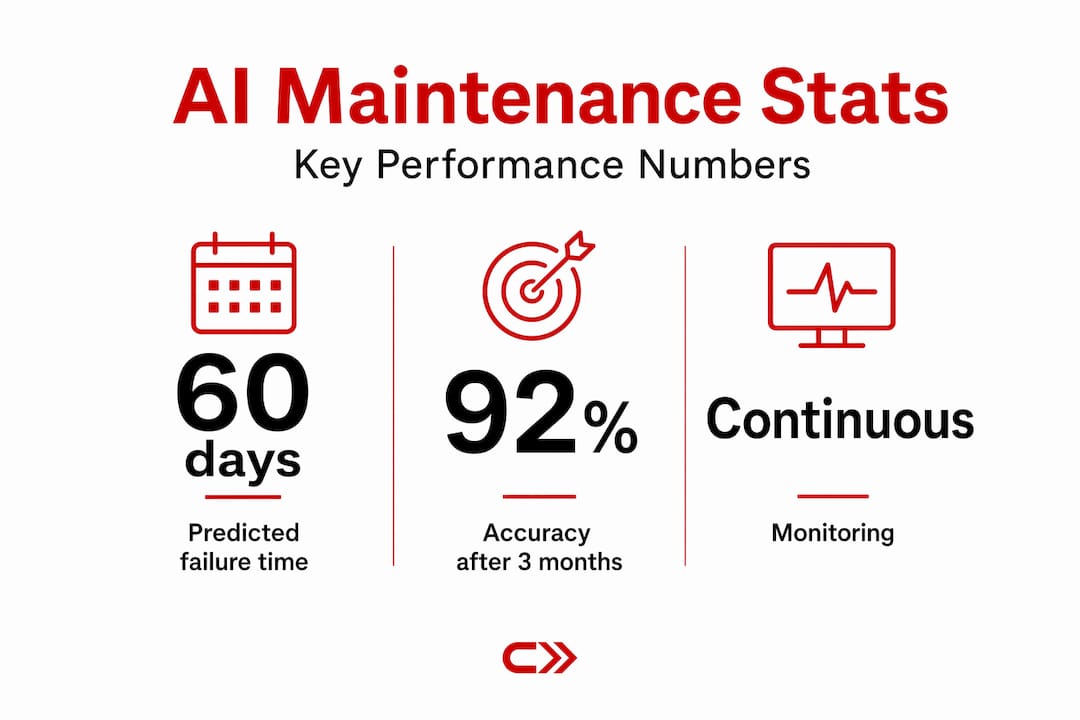
Predictive systems can detect degradation 14 to 60 days before a failure occurs, with accuracy climbing above 92% after 12 months of learning your vehicle’s patterns. That window is the difference between a planned $200 repair and a roadside breakdown.
Pro Tip: If you use an OBD-II reader with a maintenance AI app, leave it connected during regular driving cycles, not just when you suspect a problem. The more baseline data the AI collects during normal operation, the more accurate its anomaly detection becomes.
Real benefits of AI-driven vehicle maintenance
The case for using AI in maintenance is not abstract. The numbers are concrete and they hold up across industries where the technology has been deployed at scale.
Predictive maintenance reduces costs by 25 to 30% and cuts unplanned downtime by 35 to 45%. For a vehicle owner, that translates directly into fewer emergency repair bills and more confidence that your car will start when you need it to.
Beyond the dollar savings, here is what AI-driven maintenance actually changes for you:
- No more guesswork on timing. Generic schedules treat every car the same. AI reads your driving patterns, your climate, your actual component condition, and adjusts recommendations accordingly.
- Early warning for safety issues. Brake fade, suspension wear, and cooling system degradation do not announce themselves until they become dangerous. AI catches the early signals.
- Less manual tracking. You stop digging through a folder of receipts trying to remember when you last changed the transmission fluid. The system holds that history and flags what is coming due.
- Smarter use of technician time. When AI handles data analysis and scheduling, your mechanic spends more time on the actual repair work rather than chasing down paperwork and history.
Think of it the way modern medicine shifted from treating illness to monitoring health continuously. AI maintenance mirrors that healthcare model, moving car care from emergency response to proactive condition monitoring. For enthusiasts who want their build performing at its best, that shift matters enormously.
Practical applications of maintenance AI for vehicle owners
Maintenance AI is not confined to commercial fleets and industrial machinery anymore. The technology has moved into tools and apps that individual car owners and enthusiasts can use right now.
Here are four ways you can apply maintenance AI to your own vehicle care routine:
- OBD-II AI diagnostics. Plug a device into your car’s OBD-II port and pair it with an AI-powered app. The system reads live sensor data, translates fault codes into plain-language explanations, and tracks patterns over time rather than just showing you a code to Google.
- AI maintenance tracker apps. Platforms like CarJourney’s AI maintenance tracker scan your service documents, learn your vehicle’s history, and generate customized schedules based on your specific make, model, and driving behavior.
- Automated service alerts and scheduling. Advanced maintenance AI solutions do not just notify you of a problem. They can automatically generate work orders and coordinate service scheduling. At the fleet level, this happens in under 15 seconds. For individual owners, it means an alert that says “your coolant temp has been running 8% high for 3 weeks, schedule a thermostat check.”
- AI-assisted pre-purchase inspections. Before buying a used vehicle, AI tools can analyze available vehicle history data and flag anomalies in reported service records, giving you a data-backed starting point before a physical inspection.
Pro Tip: When evaluating any AI maintenance tool, look specifically for prescriptive capability, not just predictive. A system that tells you something is wrong without telling you what to do about it leaves a critical gap. Prescriptive AI closes that gap with specific guidance.
Where AI also shines is in complementing your technician’s expertise. When you show up to the shop with three months of logged sensor data and a clear pattern showing intermittent misfires under load, your mechanic diagnoses faster and more accurately. That is not replacing skill. It is giving skilled people better information to work with.
You can learn more about how these tools fit into a broader maintenance approach to understand where AI-based recommendations sit alongside routine service intervals.
Limitations of maintenance AI to understand
No technology earns your trust without a balanced read on what it cannot do. Maintenance AI has real limitations, and understanding them makes you a smarter user of the tools.
| Limitation | What it means for you | How to address it |
|---|---|---|
| Data quality dependency | AI is only as good as the sensor data feeding it | Use quality OBD adapters; keep sensors clean and functional |
| Novel failure modes | AI struggles with failure patterns outside its training data | Always pair AI alerts with physical inspection |
| False positives | Systems can flag issues that turn out to be sensor noise | Treat alerts as prompts for inspection, not confirmed diagnoses |
| Execution gap | Predictive alerts without repair guidance leave owners stuck | Choose tools with prescriptive maintenance features |
| Historical data requirement | New vehicles or fresh installs take time to build accurate baselines | Expect 30 to 90 days before predictions become highly reliable |
The execution gap deserves extra attention. Prescriptive maintenance fills the space between accurate fault detection and knowing what to actually do. Pure predictive systems tell you a part is degrading. Prescriptive systems tell you the part, the likely cause, and what the repair involves.
There is also the question of human judgment. AI replaces paperwork, not skilled expertise. A machine learning model trained on historical failure data cannot physically feel a worn CV joint or smell a coolant leak. Those sensory inputs belong to the technician. Your job as an informed owner is to use AI to get to the right diagnosis faster, not to skip the inspection entirely.
The technology also improves with time. Systems that seemed noisy or inaccurate in their first month often become significantly more precise once they have accumulated enough baseline data from your specific vehicle and driving environment.
My take on AI as a tool, not a replacement
I have spent a lot of time watching how automotive culture reacts to new technology, and the pattern is always the same. First, people assume it will replace everything. Then they realize it did not. Then they figure out how to actually use it well.
AI in maintenance is following that exact arc. The owners I see getting the most out of it are not the ones treating it as a magic diagnostic oracle. They are the ones using it to sharpen their own instincts. They know when their car is running differently. The AI confirms it and adds data they could not feel.
What genuinely excites me is the shift in maintenance culture this enables. We spent decades in reactive mode, fixing things after they broke. AI is what makes truly proactive stewardship practical for everyday owners, not just fleet operations with dedicated maintenance managers.
The best maintenance AI solutions are also honest about their limits. They do not pretend to replace the relationship between an owner who knows their vehicle deeply and a technician who can physically diagnose a problem. They sit in the middle, handling the data layer that neither party has time to manage alone.
Where this goes in the next few years is more personalization. AI that knows your specific build, your modification history, your driving routes, and your climate. That level of context will make generic maintenance schedules feel as outdated as a paper map.
— Chally
Smarter car care starts with CarJourney
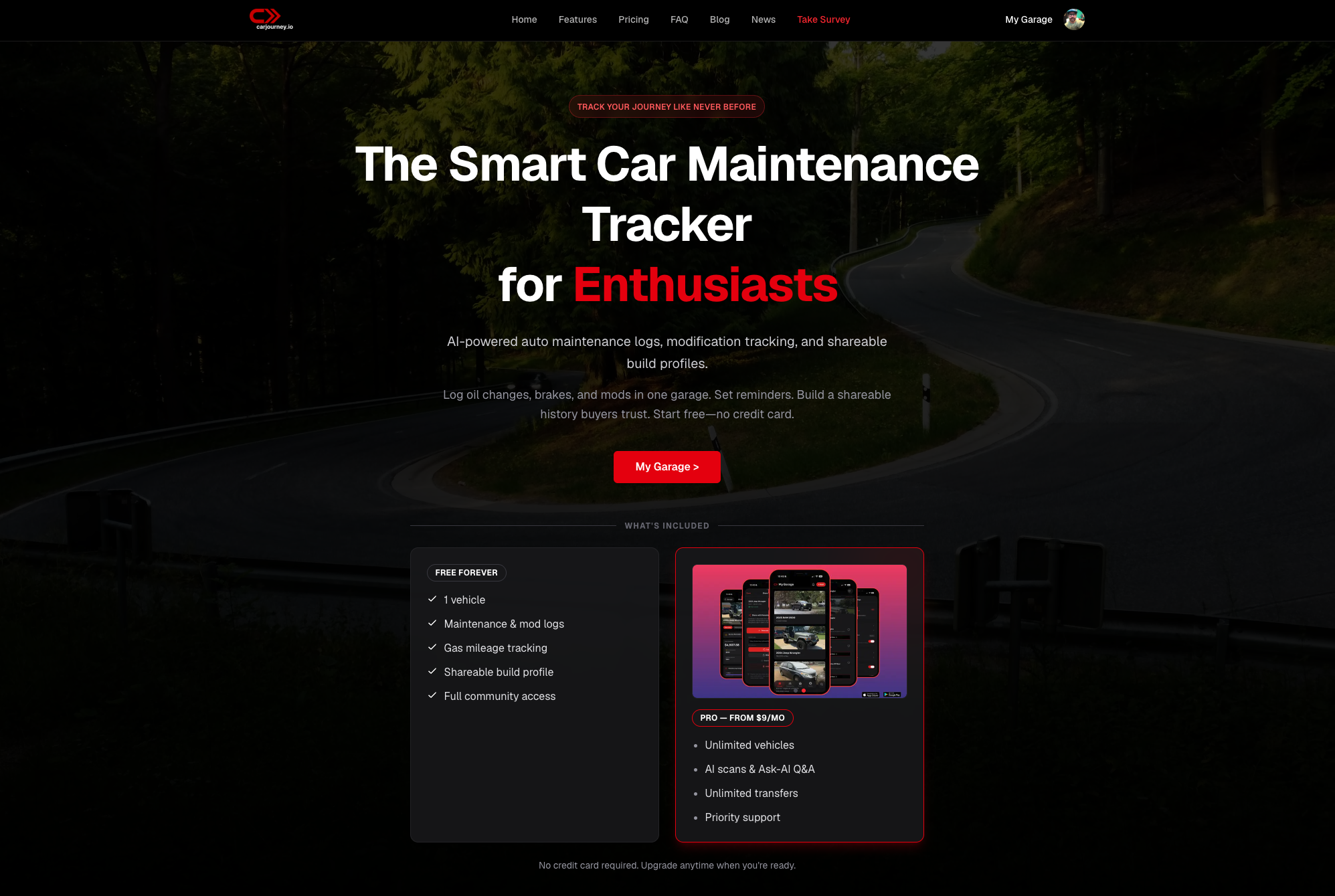
CarJourney was built specifically for owners who want more than a mileage counter. The AI scans your actual service documents, answers detailed questions about your specific vehicle, and builds a customized maintenance schedule that reflects your real driving conditions, not a generic factory timeline.
You get automated reminders before problems develop, data-driven insights into your vehicle’s condition, and a community of enthusiasts sharing real-world experience with the same builds. No scattered receipts. No guessing which service is overdue. Just a clear picture of your vehicle’s health, updated every time you drive.
If you are ready to stop managing your car reactively and start staying ahead of it, CarJourney gives you the tools to do exactly that.
FAQ
What is maintenance AI in simple terms?
Maintenance AI is a system that uses sensor data and machine learning to monitor your vehicle’s condition, predict when components will need service, and recommend specific actions before failures occur.
How does predictive maintenance AI differ from a regular service schedule?
A regular schedule is time-based and applies the same intervals to every vehicle. Predictive maintenance AI reads your specific vehicle’s actual condition and only recommends service when the data shows it is genuinely needed.
Can maintenance AI work on older vehicles?
Yes. Retrofit sensor technology like clamp-on devices and OBD-II adapters allows older vehicles to feed data into AI systems without requiring major hardware upgrades.
Will AI replace my mechanic?
No. AI handles data analysis and administrative tasks, freeing technicians to focus on skilled diagnostic and repair work. Human expertise remains essential for physical inspection and judgment calls that sensors cannot make.
How accurate is maintenance AI?
Predictive maintenance AI accuracy typically climbs above 92% after roughly 12 months of collecting baseline data from your vehicle, with the ability to detect degradation 14 to 60 days before a failure occurs.