 carjourney
From the CarJourney journal
What Is Personalized Maintenance for Your Car?
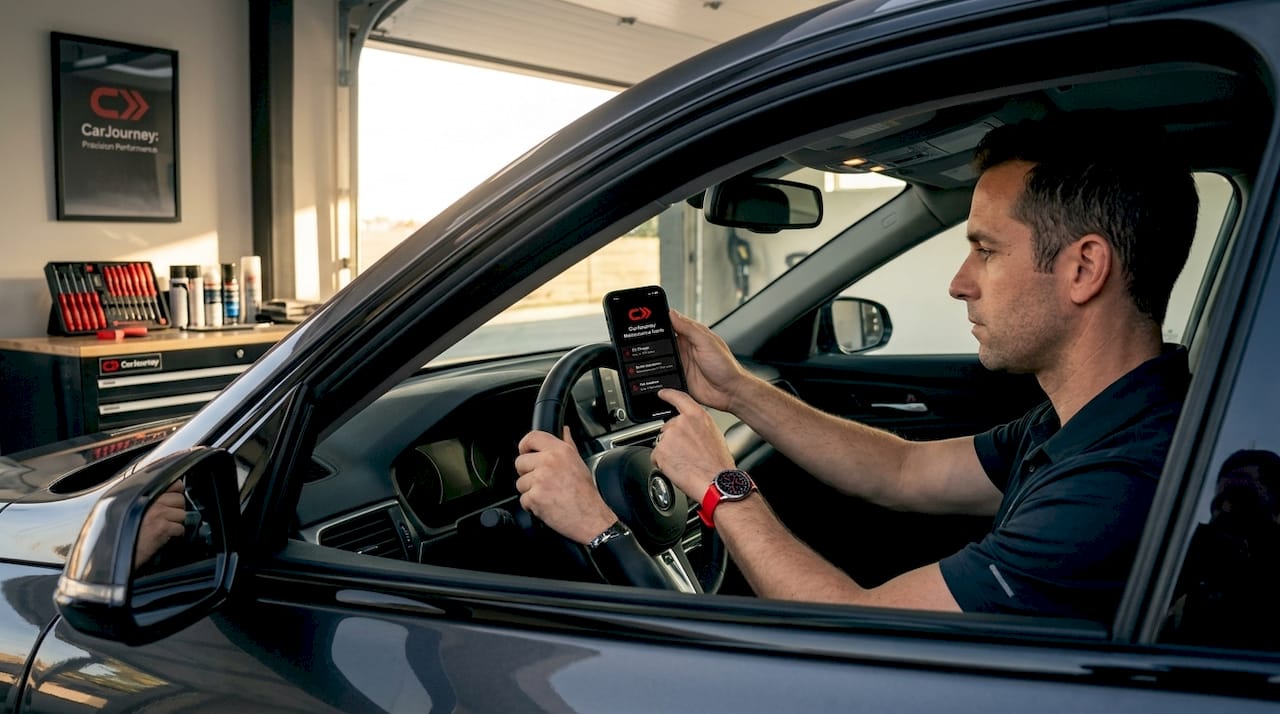
Most car owners follow a simple rule: change the oil every 5,000 miles, rotate the tires every 6,000, and check the brakes at every other service. It feels logical. But that rule was written for an average driver, an average vehicle, and average conditions. If you drive a turbocharged performance car hard on mountain roads, you are not average. If your daily commute is mostly highway miles, your brake pads wear at a fraction of the rate a city driver experiences. What is personalized maintenance? It is a fundamentally different approach: one that replaces fixed schedules with service intervals built around your specific vehicle, your driving patterns, and real wear data.
Table of Contents
- Key takeaways
- What personalized maintenance actually means
- How personalized maintenance works
- Benefits of personalized maintenance for car owners
- Personalized maintenance strategies you can apply right now
- Fixed schedule vs. personalized maintenance: a direct comparison
- My take on why personalized maintenance changes everything
- How CarJourney makes personalized maintenance practical
- FAQ
Key takeaways
| Point | Details |
|---|---|
| Not one-size-fits-all | Personalized maintenance adapts service intervals to your actual vehicle condition, not generic mileage milestones. |
| Data is the foundation | OBD sensor readings, driving patterns, and wear signals replace guesswork with condition-based decision making. |
| AI makes it practical | Machine learning models update your schedule automatically when your driving habits or routes change. |
| Cost and reliability improve | Eliminating unnecessary services and catching real wear early reduces both spending and unexpected breakdowns. |
| Anyone can start today | Combining OBD-II data with manufacturer baselines gives you a workable personalized calendar without professional tools. |
What personalized maintenance actually means
Personalized maintenance means your car’s service schedule is built around what is actually happening inside your vehicle, not what a calendar or odometer says. The traditional model uses fixed time or mileage intervals. Every car gets the same treatment at the same marks, regardless of how it was driven or what conditions it faced. Personalized maintenance replaces that with vehicle-specific decisioning based on condition monitoring and real usage data, reducing both over- and under-maintenance.
Think about brake pads. A rideshare driver in a dense urban area hits the brakes hundreds of times daily. A highway commuter might tap them a handful of times per trip. Under a fixed schedule, both drivers replace their pads at the same mileage interval. One set gets replaced too early, wasting money. The other might be approaching metal on metal. Personalized maintenance reads the actual wear and sets the service trigger accordingly.
The core data sources that feed a personalized maintenance system include:
- OBD-II sensor signals: Engine load, coolant temperature, throttle position, and brake application frequency are all transmitted in real time.
- Driving pattern analysis: Aggressive acceleration, frequent short trips, and high-RPM operation all accelerate wear on specific components.
- Environmental context: Cold climate starts, dusty road driving, and towing conditions change how quickly fluids degrade and filters clog.
- Historical service records: Past repairs and part ages give the system context for how worn a component likely is right now.
Delivery fleets use OBD diagnostics on brake application, engine load, and tire pressure to determine per-vehicle service triggers. Private car owners can apply the same logic.
Pro Tip: If your vehicle was manufactured after 1996, it supports OBD-II. A basic Bluetooth OBD-II reader costs under $30 and unlocks the live sensor data that powers a personalized maintenance approach.
How personalized maintenance works
Understanding the technology behind personalized maintenance does not require an engineering degree. The process follows a straightforward chain: collect data, analyze wear, update your schedule.
- Data collection: An OBD-II adapter or built-in telematics system reads your vehicle’s sensor outputs continuously. This includes everything from transmission temperature to fuel trim values.
- Wear modeling: AI and machine learning algorithms compare your sensor data against known degradation curves for each component. They calculate remaining useful life in real time.
- Schedule generation: When wear signals cross a threshold, the system creates a service recommendation with specific timing, parts needed, and urgency level.
- Dynamic adjustment: As your driving patterns change, the model updates. When route or usage changes occur, wear models update automatically within 7 to 14 days, adjusting intervals without manual input.
- Prescriptive output: The most advanced systems go beyond alerts. Prescriptive maintenance recommends specific repair actions, timing, and exact parts needed, turning a warning into a complete action plan.
The distinction between predictive and prescriptive maintenance matters here. Predictive maintenance tells you something is going to fail. Prescriptive maintenance tells you exactly what to do about it, when to do it, and what it will cost to defer. Turning predictive alerts into prescriptive action packages is what separates a useful system from one that just generates notifications you ignore.
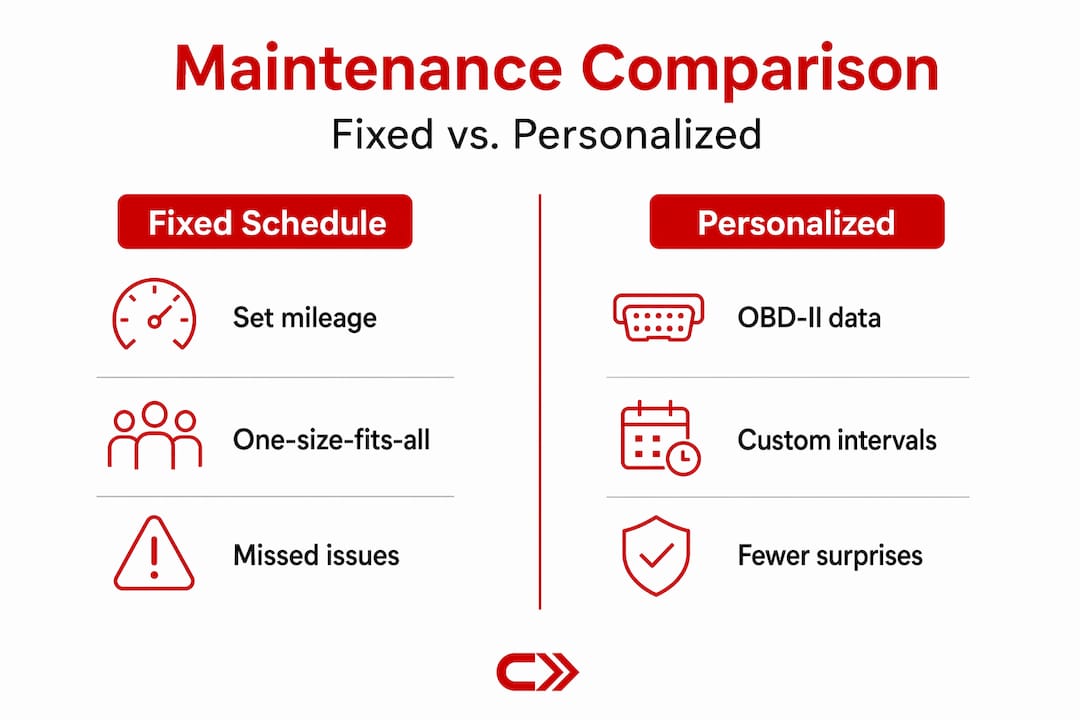
| Feature | Traditional fixed schedule | Personalized maintenance |
|---|---|---|
| Service trigger | Mileage or calendar date | Condition data and wear signals |
| Advance warning | None until service date arrives | 2 to 8 weeks before threshold breach |
| Adapts to driving style | No | Yes, dynamically |
| Risk of over-servicing | High | Low |
| Risk of missed failures | Moderate | Very low |
Pro Tip: Look for car maintenance software that integrates OBD data with your service history. The combination gives wear models far more accuracy than sensor data alone.
Benefits of personalized maintenance for car owners
The importance of personalized maintenance comes down to three things: money, reliability, and peace of mind. Each one is real and measurable.
Shifting from fixed intervals to condition-based maintenance eliminates unnecessary services and reduces missed failures. That means you stop paying for oil changes your engine does not need yet, and you catch brake wear before it becomes rotor damage. Both outcomes save money. One saves money directly. The other saves you from a repair bill three times larger than the service you skipped.
- Fewer surprises: Predictive wear alerts give you 2 to 8 weeks of advance warning before a component fails, giving you time to schedule service on your terms instead of getting stranded.
- Extended vehicle life: Catching wear early prevents secondary damage. A failing water pump caught at 70% wear is a $400 repair. One that fails completely can warp a cylinder head and cost $2,000.
- Smarter scheduling: Alerts tied to actual wear let you batch services together. Replacing the air filter, spark plugs, and cabin filter in one visit costs less in labor than three separate trips.
- Reduced guesswork: You stop wondering whether your oil is still good or your tires need rotation. The data tells you clearly.
- Better resale value: A vehicle with documented, condition-based service records shows buyers that maintenance was driven by actual need, not neglect or overkill.
One overlooked benefit is the grouping effect. Components with similar remaining useful life can be serviced together, cutting redundant shop visits and reducing total labor costs. A personalized system identifies these opportunities automatically. You would never spot them on a fixed schedule.
Personalized maintenance strategies you can apply right now
You do not need a fleet management system to start benefiting from personalized maintenance. The tools available to individual owners have gotten remarkably good.
Start with an OBD-II baseline. Plug a reader into your diagnostic port and pull your current sensor data. Many apps will generate a personalized maintenance score from 0 to 100 based on component wear signals. That score becomes your baseline. From there, you track changes over time.
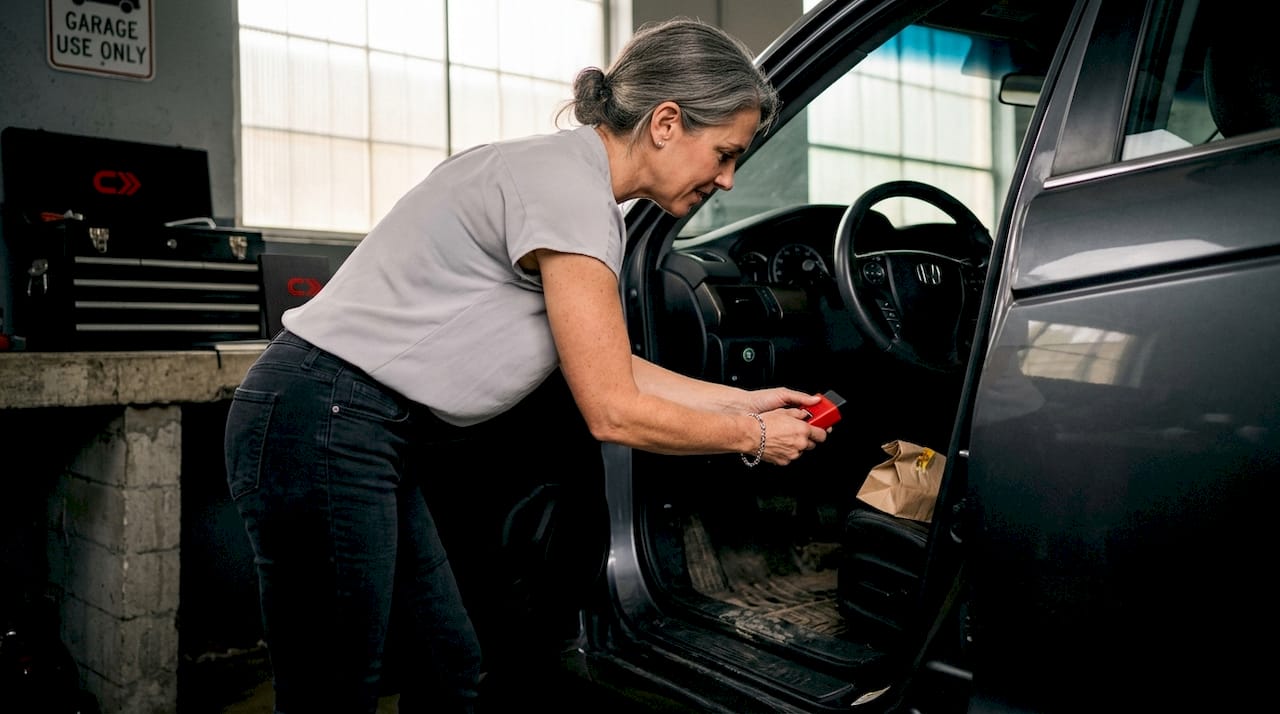
Layer in manufacturer recommendations. Combining the manufacturer’s baseline intervals with your live OBD data is the practical core of DIY personalized maintenance. Use the manufacturer’s numbers as a ceiling, not a fixed target. If your oil still reads clean at 4,500 miles because you mostly drive highway, you have real data to support waiting. If you have been doing short cold-weather trips, your oil may need changing sooner.
Build a dynamic calendar. A static spreadsheet does not serve you well here. Use a maintenance tracking app that updates service reminders based on your actual driving data rather than fixed date triggers. This is the difference between a tool that thinks for you and one that just reminds you of arbitrary dates.
Common pitfalls to avoid:
- Do not reset wear models without cause. If your OBD app has a wear model and you reset it after a minor software update, you lose all the historical weighting that made it accurate. Effective wear models weight historical data after driving changes rather than starting from zero.
- Do not ignore low-priority alerts. Personalized systems assign urgency levels. A low-urgency alert that goes unaddressed often escalates to a critical one within weeks.
- Do not confuse warning lights with personalized maintenance. Your check engine light is a fault code, not a wear signal. Diagnostic trouble codes and predictive wear alerts are different data streams that both deserve attention.
Pro Tip: After any significant change in your driving routine, such as a new job with a different commute or a long road trip, review your wear model outputs. The system needs 7 to 14 days of new data to recalibrate. During that window, treat your old intervals as approximations.
Fixed schedule vs. personalized maintenance: a direct comparison
Some car owners genuinely benefit from fixed-interval schedules. If you drive a simple, older vehicle under consistent, gentle conditions and you have no access to OBD data tools, the manufacturer’s fixed schedule is far better than no schedule at all. The risks of fixed scheduling become apparent as vehicles age, usage patterns become irregular, or components age at different rates.
| Scenario | Best approach | Why |
|---|---|---|
| New car, average driving, warranty period | Fixed schedule | Manufacturer intervals protect warranty compliance |
| High-mileage vehicle with irregular use | Personalized | Fixed intervals miss component-specific wear accurately |
| Performance or modified vehicle | Personalized | Modified components degrade differently than stock specs predict |
| Fleet or commercial vehicle | Personalized | Per-vehicle OBD data prevents expensive group-schedule over-servicing |
| Older car without OBD-II access | Fixed schedule | No real-time data available to drive personalization |
The honest answer is that most modern vehicles driven by real people with real schedules benefit from a personalized approach. Predictive maintenance forecasts failures 2 to 8 weeks in advance using real-time condition data. Fixed schedules cannot do that. As AI wear modeling tools become more accessible, the case for staying on a purely fixed schedule gets harder to defend.
My take on why personalized maintenance changes everything
I have spent years watching car owners follow rigid maintenance schedules that were written for a hypothetical driver who does not actually exist. The 5,000-mile oil change rule made sense when motor oil technology was simpler and engine tolerances were looser. Today, a modern turbocharged engine running full synthetic oil in a car with mostly highway miles might not need service until 8,000 miles. And yet, the sticker on the windshield says 5,000.
What I find more interesting is the flip side. I have seen owners with short-trip, cold-weather driving patterns who genuinely needed more frequent service than the manufacturer recommended. Fixed schedules failed them in the opposite direction. Personalized maintenance is not about doing less service. It is about doing the right service at the right time.
The technology part intimidates people less than you would think. Once you connect an OBD-II reader and see your own vehicle’s data, the abstract concept becomes concrete fast. Your car is already generating this information. You are just finally reading it.
My advice: start simple. Track your maintenance recommendations against real wear signals for three months. You will be surprised how quickly patterns emerge that your old fixed schedule was either ignoring or over-responding to.
— Chally
How CarJourney makes personalized maintenance practical
If the gap between knowing what personalized maintenance is and actually practicing it has felt frustrating, that is exactly the problem CarJourney was built to solve.
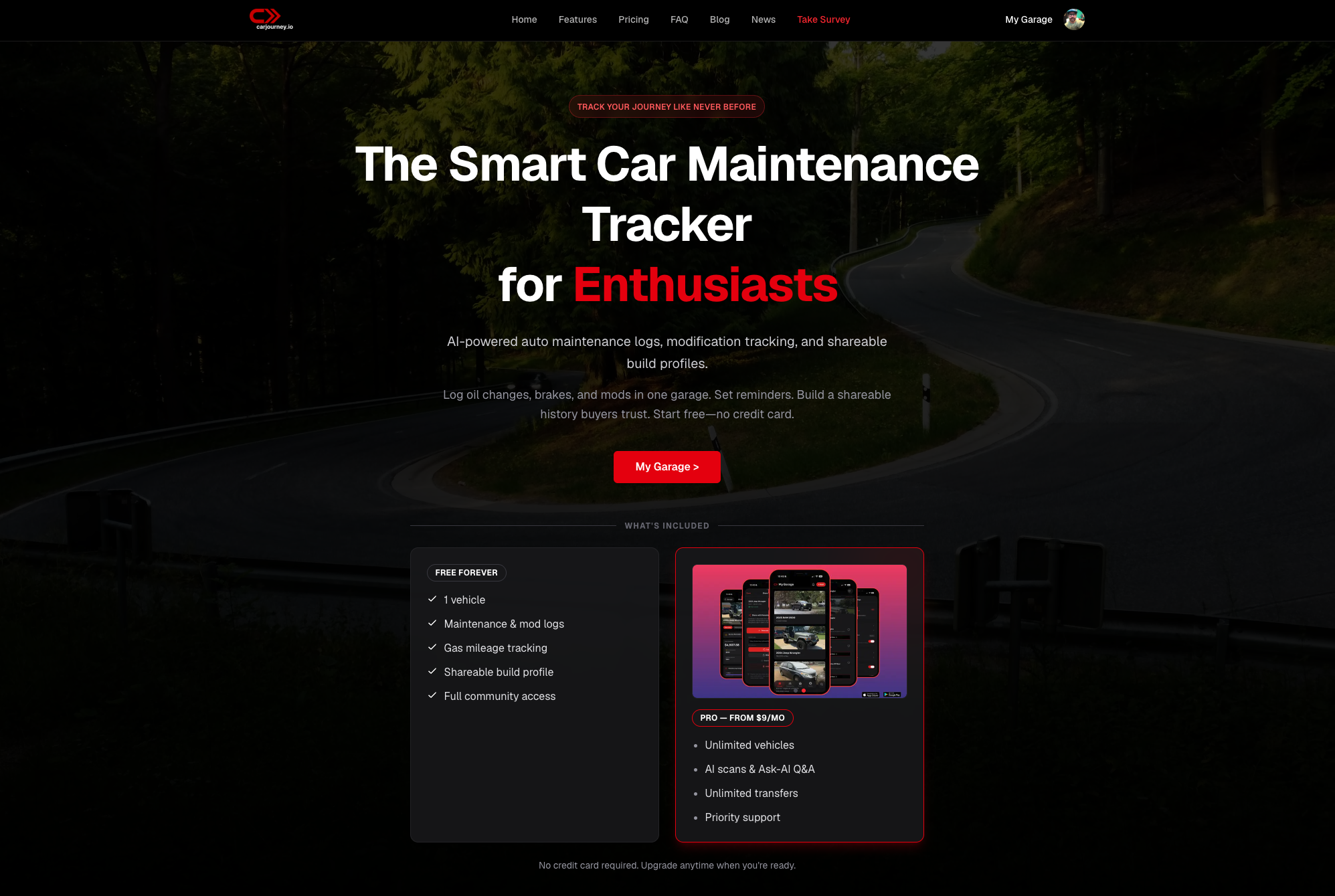
CarJourney uses AI to scan your service documents, read your vehicle’s data, and generate maintenance schedules tailored to your specific build and driving patterns. You can ask detailed questions about your exact vehicle, get modification recommendations verified across multiple AI models, and connect with other owners who share real-world data on the same components you are running. There is no scattered paperwork, no guessing, and no generic advice written for a car you do not own. Whether you are tracking wear on a daily driver or managing a full build, CarJourney gives you the tools to move from fixed-interval guessing to genuine condition-based care. Visit CarJourney to see how it works for your vehicle.
FAQ
What is personalized maintenance for a car?
Personalized maintenance is a service approach that replaces fixed mileage or calendar intervals with schedules driven by your vehicle’s actual wear data, sensor signals, and driving patterns. Each service trigger is based on real component condition, not a generic timetable.
How does personalized maintenance differ from traditional scheduled maintenance?
Traditional maintenance uses fixed intervals the same for every vehicle. Personalized maintenance reads OBD data and driving behavior to set service timing specific to your car, reducing both unnecessary services and missed failures.
What data does personalized maintenance use?
It uses OBD-II sensor outputs including engine load, brake application, and fluid temperatures combined with driving pattern data and historical service records to calculate remaining useful life for each component.
Can I do personalized maintenance without a professional service?
Yes. A basic OBD-II Bluetooth reader and a good maintenance tracking app give you the core data needed to build a personalized service calendar, layering your real wear signals over manufacturer baseline intervals.
What are the main benefits of personalized maintenance?
The primary benefits are reduced unnecessary servicing, earlier warning of actual component wear, lower long-term repair costs, and extended vehicle life through timely, condition-triggered care rather than reactive or excessive maintenance.