 carjourney
From the CarJourney journal
What Is Vehicle Valuation? A 2026 Buyer's Guide

What Is Vehicle Valuation? A 2026 Buyer’s Guide
Vehicle valuation is the process of estimating what a car is worth at a specific point in time, using condition, mileage, market data, and comparable sales to guide buying, selling, and insurance decisions. The industry term for this process is “vehicle appraisal,” and understanding both terms helps you speak the same language as dealers, insurers, and private buyers. Whether you are selling a used sedan or trading in a truck, an accurate valuation is the difference between a fair deal and leaving money on the table. Resources like Kelley Blue Book and professional appraisal services have built entire frameworks around this process, and knowing how they work puts you in control.
What is vehicle valuation and how does it work?
Vehicle valuation is a market-based estimate of what a car would sell for under normal conditions on a given date. It is not a fixed number. The figure shifts with local demand, seasonal trends, fuel prices, and the overall used-car market. Kelley Blue Book, one of the most widely used pricing references in the United States, updates pricing weekly across more than 100 geographic regions to reflect those local and seasonal changes. That weekly cadence matters because a truck worth $28,000 in july may be worth $26,500 by october if demand softens.
Three core methods produce a vehicle valuation. Each serves a different purpose and produces a different number.
-
Online valuation tools. Platforms aggregate millions of comparable sales, adjust for region and trim level, and return an instant estimate. These tools are fast and useful for benchmarking, but they do not account for physical condition beyond what you self-report.
-
Professional appraisals. A formal vehicle appraisal includes a physical inspection, a review of service history, a vehicle history report, and documented market research. The result is a defensible figure used in legal disputes, insurance claims, and estate settlements.
-
Dealership trade-in appraisals. A dealer walks the car, checks the odometer, pulls a history report, and runs the numbers against wholesale auction data. The offer reflects what the dealer can resell the car for, minus reconditioning costs and profit margin.
Pro Tip: Get an online estimate before you visit any dealership. It takes five minutes and gives you a baseline number the dealer cannot easily dismiss.
What factors most influence a vehicle’s value?

Mileage and physical condition are the two biggest drivers of car market valuation. A well-maintained vehicle with 40,000 miles will consistently outvalue the same model with 95,000 miles, even if both look identical from the curb. Mileage affects resale value in a compounding way: higher miles signal more wear on the drivetrain, suspension, and consumables, which raises a buyer’s perceived risk.
Beyond mileage, the following factors shape what a vehicle is worth:
- Make, model, and trim level. A fully loaded trim with a premium audio system and driver-assist features holds value better than a base model of the same vehicle.
- Accident history and title branding. A salvage or rebuilt title can cut a vehicle’s value by 20–50% compared to a clean-title equivalent. Even a single reported accident on a vehicle history report reduces buyer confidence.
- Service and maintenance records. Documented oil changes, timing belt replacements, and brake jobs tell a buyer the car was cared for. Service records increase resale value because they reduce uncertainty.
- Location and season. Four-wheel-drive trucks command higher prices in northern states during winter. Convertibles peak in spring. Local supply and demand shift the number more than most sellers expect.
- Modifications. Aftermarket wheels, lift kits, and performance tunes rarely add dollar-for-dollar value. Most buyers discount modified vehicles because they cannot verify the quality of the work.
Pro Tip: Timing a private sale for spring or early summer typically produces the strongest offers, especially for trucks, SUVs, and convertibles.
How do trade-in, private sale, and insurance valuations differ?
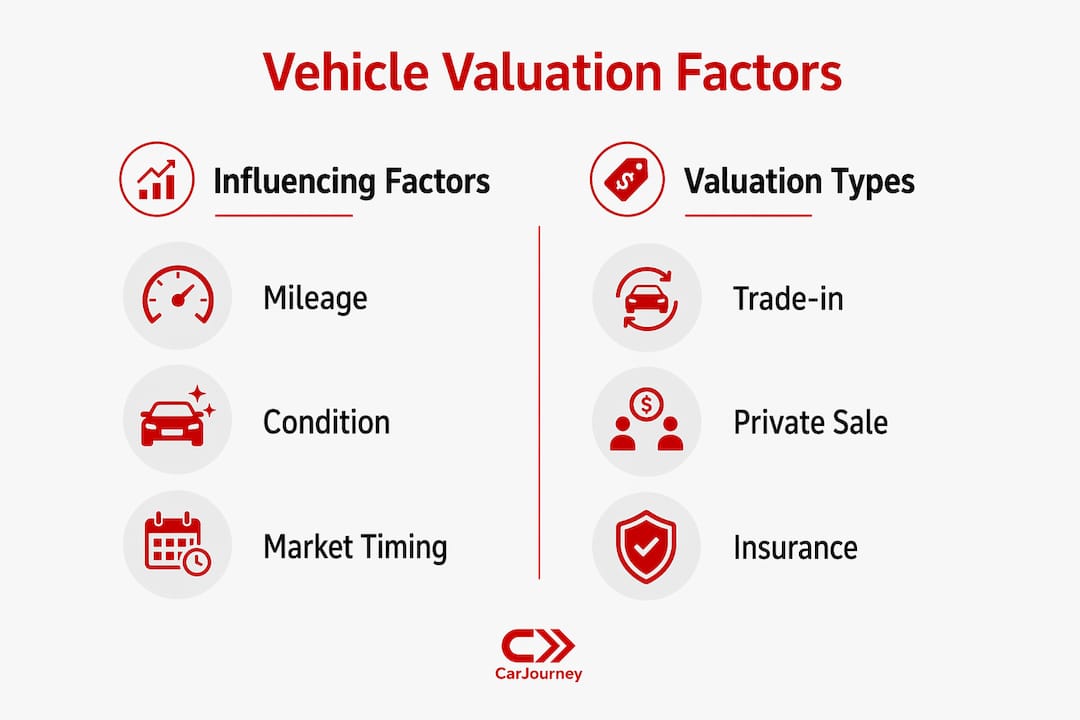
The same car produces three different numbers depending on who is doing the valuing and why. Understanding those differences protects you from accepting a low offer without realizing it.
Private party values are typically higher than trade-in values because the seller handles all the marketing, negotiation, and paperwork. That effort has a price, and buyers pay it. A private sale also removes the dealer’s reconditioning margin from the equation.
Trade-in values are lower by design. Dealerships factor in reconditioning costs of $300–$800 and profit margins of roughly $1,000–$3,000 when calculating what they can offer. That spread is not a trick. It reflects the real cost of preparing a used vehicle for retail sale. Dealers also absorb the risk of sitting on inventory if the car does not sell quickly.
Insurance valuations work differently from both. An insurer calculates the market value at claim time, which reflects what the car was worth on the day of the loss, not what you paid for it or what you insured it for. If the market dropped between your purchase date and the claim date, your payout reflects that drop. This surprises many owners who assume their insured amount equals their payout.
| Valuation type | Typical value level | Who benefits | Key consideration |
|---|---|---|---|
| Private party sale | Highest | Seller | Requires time, marketing, and negotiation |
| Dealership trade-in | Lowest | Dealer | Convenient but costs the seller in net proceeds |
| Insurance market value | Mid-range | Insurer | Reflects market at claim date, not purchase price |
What does the vehicle appraisal process look like?
A professional vehicle appraisal follows a defined sequence. Knowing the steps helps you prepare and avoid surprises.
- Physical inspection. The appraiser checks body panels for rust, dents, and paint inconsistencies. They inspect the interior for wear, test all electronics, and look under the hood for fluid leaks or signs of deferred maintenance.
- Mileage verification. The odometer reading is recorded and cross-referenced with service records and vehicle history data to flag any discrepancies.
- Provenance verification. This step checks title status, lien holders, and accident history. A vehicle with an open lien cannot legally be sold until the lien is cleared. Appraisers treat this as the decisive step because a clean title is non-negotiable.
- Market research. The appraiser compares the vehicle against recent sales of similar models in the same region, adjusting for trim, mileage, and condition.
- Written report. A formal appraisal produces a documented report with the methodology, comparable sales, and a final value. This document holds up in legal and insurance contexts.
A typical dealership appraisal takes 30–90 minutes. Top-performing dealerships complete the process in under 30 minutes to keep deals moving. The efficiency gap between dealerships is significant. A slow appraisal process costs both the dealer and the seller time, which is why dealership trade-in efficiency has become a focus area for high-volume stores.
How can you use vehicle valuations to buy or sell smarter?
Preparation separates sellers who get strong offers from those who accept whatever the first buyer proposes. A vehicle worth assessment is only as useful as the effort you put into supporting it.
-
Gather your service records before listing. A complete maintenance history is one of the fastest ways to justify a higher asking price. Buyers and appraisers both reward documented care. Updating service records before a sale signals transparency and reduces negotiation friction.
-
Use at least two valuation sources. No single tool captures every variable. Cross-referencing two or more estimates gives you a realistic range and stronger footing in negotiations.
-
Know your local market. A vehicle that sells for $18,000 in Dallas may fetch $20,500 in a market with lower supply of that model. Check local market trends before setting your price.
-
Get a professional appraisal for high-value transactions. If you are selling a vehicle worth more than $20,000, a formal appraisal pays for itself. It gives you a defensible number and removes ambiguity from the negotiation.
-
Avoid accepting the first trade-in offer. Dealers expect negotiation. An initial offer often has room to move, especially if you arrive with documented service history and a competing valuation in hand.
The most common mistake sellers make is accepting a trade-in offer without knowing their private party value. That gap can easily represent $2,000–$4,000 in lost proceeds. Knowing both numbers before you walk into a dealership is the single most effective preparation step.
Key Takeaways
Accurate vehicle valuation requires combining multiple data sources, documented vehicle history, and an understanding of how trade-in, private sale, and insurance figures differ.
| Point | Details |
|---|---|
| Valuation is market-based | A vehicle’s worth changes weekly with local demand, season, and comparable sales. |
| Three methods produce three numbers | Online tools, professional appraisals, and dealer trade-ins each serve a different purpose. |
| Mileage and condition lead the factors | Accident history, service records, and title status follow closely behind. |
| Trade-in values are lowest by design | Dealers deduct reconditioning costs and profit margin before making an offer. |
| Preparation raises your outcome | Service records, multiple estimates, and market timing all improve your final number. |
Why most sellers leave money on the table
The biggest misunderstanding I see is that sellers treat the first number they receive as the real number. It is not. A dealer’s opening trade-in offer is a starting point, not a final answer. The dealer knows your private party value. You should too.
What actually moves the needle is documentation. I have watched sellers add thousands to their asking price simply by showing up with a complete service history, a clean title, and two independent valuation estimates. That combination tells a buyer or dealer that you know what the car is worth and you have the records to back it up. It shifts the negotiation dynamic immediately.
The other thing most guides skip is the timing factor. Selling a truck in november versus march can be a $1,500 difference in the same market. Seasonal demand is real, and most private sellers ignore it entirely. If you have flexibility on timing, use it. Check what similar vehicles are selling for locally, not nationally, before you set your price.
Finally, do not overlook the insurance angle. Many owners discover at claim time that their payout is lower than expected because the market moved. Reviewing your vehicle’s current market value annually and adjusting your coverage accordingly is a simple step that most people skip until it is too late.
— Chally
Carjourney helps you know what your car is worth
Understanding your vehicle’s value starts with having the right information in one place. Carjourney brings together service records, maintenance history, and AI-powered insights so you can walk into any sale or trade-in conversation with confidence.

Whether you are preparing to sell, negotiating a trade-in, or just want to know where your car stands in the current market, Carjourney’s vehicle tools give you the data to back up your number. The platform scans your service documents, tracks your vehicle’s history, and connects you with a community of owners who share real-world data. That is the kind of preparation that turns a guessed asking price into a justified one.
FAQ
What is vehicle valuation in simple terms?
Vehicle valuation is an estimate of what a car is worth at a specific point in time, based on condition, mileage, market data, and comparable sales. It guides buying, selling, and insurance decisions.
How is a car valued for a trade-in?
A dealer inspects the vehicle, checks its history report, and compares it against wholesale auction data. The offer subtracts reconditioning costs and profit margin from the estimated resale price.
Why is my trade-in offer lower than the private sale value?
Trade-in values are lower because the dealer absorbs reconditioning costs, inventory risk, and profit margin. Private party sales transfer that effort to the seller, which is why buyers pay more in that channel.
What affects car value the most?
Mileage, physical condition, accident history, and title status are the primary factors. Service records, trim level, location, and seasonal demand also influence the final number significantly.
How often do vehicle valuations change?
Kelley Blue Book updates pricing weekly across more than 100 geographic regions. Values shift with local supply and demand, fuel prices, and broader used-car market trends.