 carjourney
From the CarJourney journal
What Is an AI Car Advisor? Your 2026 Buyer's Guide

What Is an AI Car Advisor? Your 2026 Buyer’s Guide
An AI car advisor is a specialized software system that helps buyers research, compare, and negotiate vehicle purchases using real-time market data and personalized recommendations. Unlike a generic search engine, it functions as a purchase strategist, analyzing dealer incentives, financing terms, and inventory conditions to guide you toward the best possible deal. The industry term for this category is “AI automotive consultant,” though “AI car advisor” has become the common shorthand among buyers. Over 40% of vehicle shoppers now use AI-powered tools during at least one phase of their search. That number signals a fundamental shift in how people buy cars.
What is an AI car advisor and how does it work?
An AI car advisor combines machine learning models, live market data, and natural language processing to deliver vehicle recommendations tailored to your specific needs. The system ingests inputs like your budget, preferred body style, commute distance, and financing situation, then cross-references those against current dealer pricing, regional inventory, and manufacturer incentives.
The core technology relies on large language models trained on automotive data, including trim specifications, historical transaction prices, and dealer negotiation patterns. When you ask the system a question, it does not just retrieve a webpage. It synthesizes multiple data points and returns a recommendation with a rationale behind it.

Most platforms fall into two distinct categories. Consumer-facing negotiation advisors help you prepare offers, counter dealer tactics, and evaluate financing packages before you sign anything. Ownership-phase advisors focus on the period after purchase, providing repair guidance, maintenance scheduling, and unbiased second opinions on shop estimates. Understanding which type you need is the first decision you should make.
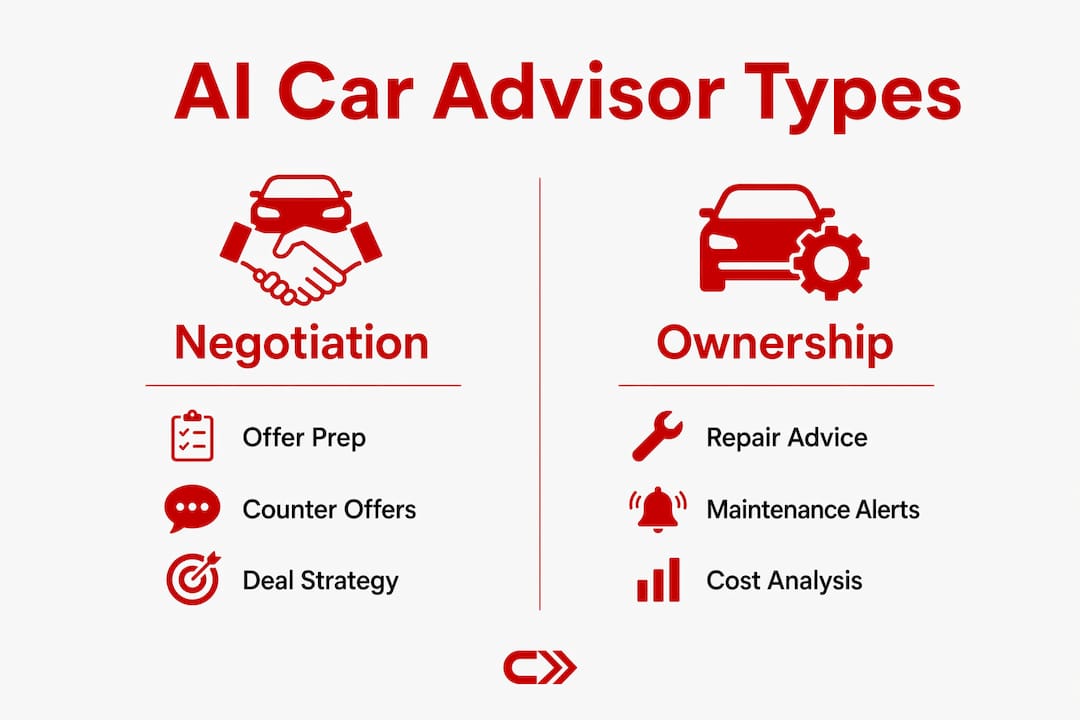
Modern AI car advisors go well beyond chatbot functions. They analyze incentives, inventory cycles, market timing, and financing structures to guide buyers through the entire purchase lifecycle.
Core features most platforms offer
- Vehicle comparison: Side-by-side analysis of trim levels, reliability ratings, and total cost of ownership across multiple models
- Market price benchmarking: Real-time data on what buyers in your region are actually paying, not just MSRP
- Financing evaluation: Breakdown of APR offers, loan terms, and lease residuals to identify the true cost of each option
- Negotiation strategy building: Suggested opening offers, counteroffers, and tactics based on current dealer inventory pressure
- Natural language search: Describe what you want in plain English and the system surfaces matching vehicles beyond rigid filter categories
Pro Tip: Before your first session with any AI advisor, gather your credit score, trade-in details, and a list of three to five vehicles you are already considering. The more context you provide upfront, the more targeted the recommendations become.
What benefits do AI car advisors provide over traditional methods?
Traditional car research means hours of forum threads, conflicting review sites, and salespeople whose incentives do not align with yours. An AI automotive consultant replaces that scattered process with a single, structured workflow.
“AI advisors act as an ‘experienced friend’ who understands negotiation psychology, dealer tactics, and technical specs, helping buyers avoid overpaying or accepting bad financing terms.” Jenova AI, June 2026
That framing matters. Most buyers lack the domain knowledge to spot a dealer marking up a money factor on a lease or burying fees inside a trade-in offer. An AI advisor flags those moves in real time, giving you the same awareness a seasoned buyer would have after decades of experience.
The benefits break down into three practical areas:
- Cost savings: Real-time market data shows you what comparable buyers paid, giving you a defensible number to anchor your negotiation
- Time efficiency: The system compresses weeks of research into hours by filtering irrelevant options and surfacing only vehicles that match your actual criteria
- Decision confidence: Personalized recommendations replace generic “top 10 lists” with analysis tied to your specific budget, lifestyle, and risk tolerance
AI advisors transform car buying into a buyer-controlled process focused on total cost of ownership rather than monthly payment manipulation. Dealers often frame deals around monthly payments because it obscures the true price. An AI advisor keeps the conversation anchored to the full transaction cost.
The ownership-phase category adds another layer of value. Free AI diagnosis advisors provide unbiased, jargon-free second opinions on repair needs and shop estimates. That kind of commission-free guidance builds trust between owners and repair shops, which is a gap that has existed in the industry for decades.
What are the best practices for using an AI car advisor?
Getting real value from a smart car buying assistant requires more than typing a question and accepting the first answer. The quality of your output depends directly on the quality of your input and how you engage with the tool over time.
-
Document every dealer communication. Keeping detailed communication histories gives the AI the context it needs to spot patterns, identify pressure tactics, and adjust your strategy in real time. Paste email threads, text summaries of phone calls, and written quotes directly into the platform.
-
Treat AI scripts as starting points, not scripts. AI-generated negotiation responses should be adapted before you use them. Experienced dealership staff recognize templated language and can counter it. Use the AI’s logic, then deliver it in your own voice.
-
Never skip the physical inspection. AI advisors process data, not physical condition. A vehicle with a clean history report can still have undisclosed damage, worn components, or mechanical issues that only a hands-on inspection or independent mechanic will catch.
-
Choose tools that cover the full lifecycle. A platform that only helps you buy the car leaves you without support the moment you drive off the lot. Look for tools that extend into maintenance tracking, repair guidance, and ownership management.
Pro Tip: When evaluating financing offers, ask the AI advisor to calculate the total amount paid over the full loan term, not just the monthly payment. A lower monthly payment with a longer term often costs thousands more in interest.
Understanding how dealer incentive programs work gives you a significant edge when an AI advisor surfaces manufacturer-to-dealer cash that does not appear in advertised pricing.
How are AI car advisors evolving in 2026?
The category has moved fast. Two years ago, most AI car tools were basic chatbots that answered FAQ-style questions about vehicle specs. Today, the leading platforms function as full purchase strategists with access to live inventory feeds, regional pricing databases, and financing calculators.
Several trends are reshaping what buyers can expect:
- Conversational vehicle discovery: AI-powered natural language finders let buyers describe their needs in plain terms, like “something reliable for a long commute with good cargo space under $35,000,” and surface relevant matches without requiring buyers to know exact trim names or filter categories
- Deeper financing analysis: Platforms now model lease versus buy scenarios, factor in expected depreciation curves, and flag when a dealer’s financing offer exceeds what a credit union or direct lender would charge
- Integration with ownership tools: The boundary between buying advisors and AI car maintenance assistants is narrowing, with some platforms tracking your vehicle from purchase through every service interval
- Multi-dealer coordination: Emerging tools can run simultaneous quote requests across multiple dealers and use competing offers as negotiation leverage automatically
The most significant shift is philosophical. Early AI car tools gave buyers information. Current platforms give buyers strategy. The next generation will give buyers execution, handling outreach, comparison, and negotiation coordination with minimal manual input from the buyer.
For buyers who want to understand the full picture of AI tools for vehicle care, the ownership phase is where AI delivers some of its most consistent value. Repair decisions, maintenance timing, and parts selection all benefit from the same data-driven approach that makes buying advisors effective.
Key Takeaways
An AI car advisor is the most direct way for individual buyers to access the market knowledge and negotiation strategy that previously required years of automotive experience.
| Point | Details |
|---|---|
| Two distinct advisor types | Negotiation advisors help during purchase; ownership advisors support repair and maintenance decisions after the sale. |
| Data quality drives results | Feeding the AI detailed context, including dealer emails and quotes, produces more targeted and effective strategy. |
| AI scripts need human delivery | Adapt AI-generated negotiation language before using it, since dealerships recognize and counter templated responses. |
| Physical inspection is non-negotiable | AI advisors cannot assess vehicle condition; always pair AI guidance with an independent mechanical inspection. |
| Full-lifecycle tools deliver more value | Platforms that extend from purchase research into ownership tracking provide compounding benefits over time. |
Why I think most buyers underuse these tools
Most buyers treat an AI car advisor like a search engine. They ask one question, get an answer, and move on. That approach wastes most of the platform’s actual capability.
The buyers who get the best results treat the AI like a running conversation with a knowledgeable advisor. They update it after every dealer interaction, ask follow-up questions when something feels off, and use it to pressure-test their own assumptions before committing. I have seen buyers walk into a dealership with a clear target price, a documented counter-offer strategy, and a list of specific fees to challenge, all generated through sustained back-and-forth with an AI advisor over several days.
The other thing most buyers miss is the ownership phase. Buying the right car is one decision. Keeping it in good shape for 150,000 miles is hundreds of decisions. AI tools that track your maintenance history and flag upcoming service needs based on your actual driving patterns are genuinely useful, not just a feature list item.
The honest limitation is that AI cannot replace physical judgment. A car that looks perfect on paper can have a salvage title history buried under a clean Carfax, or a transmission that is three months from failure. No algorithm replaces a trusted mechanic putting the car on a lift. Use AI for strategy and information. Use humans for physical verification. That combination is where the real advantage lives.
— Chally
Carjourney takes AI beyond the purchase
Buying the right car is only the beginning. Once you own it, the decisions multiply: when to service it, which parts to trust, and whether a repair quote is fair.
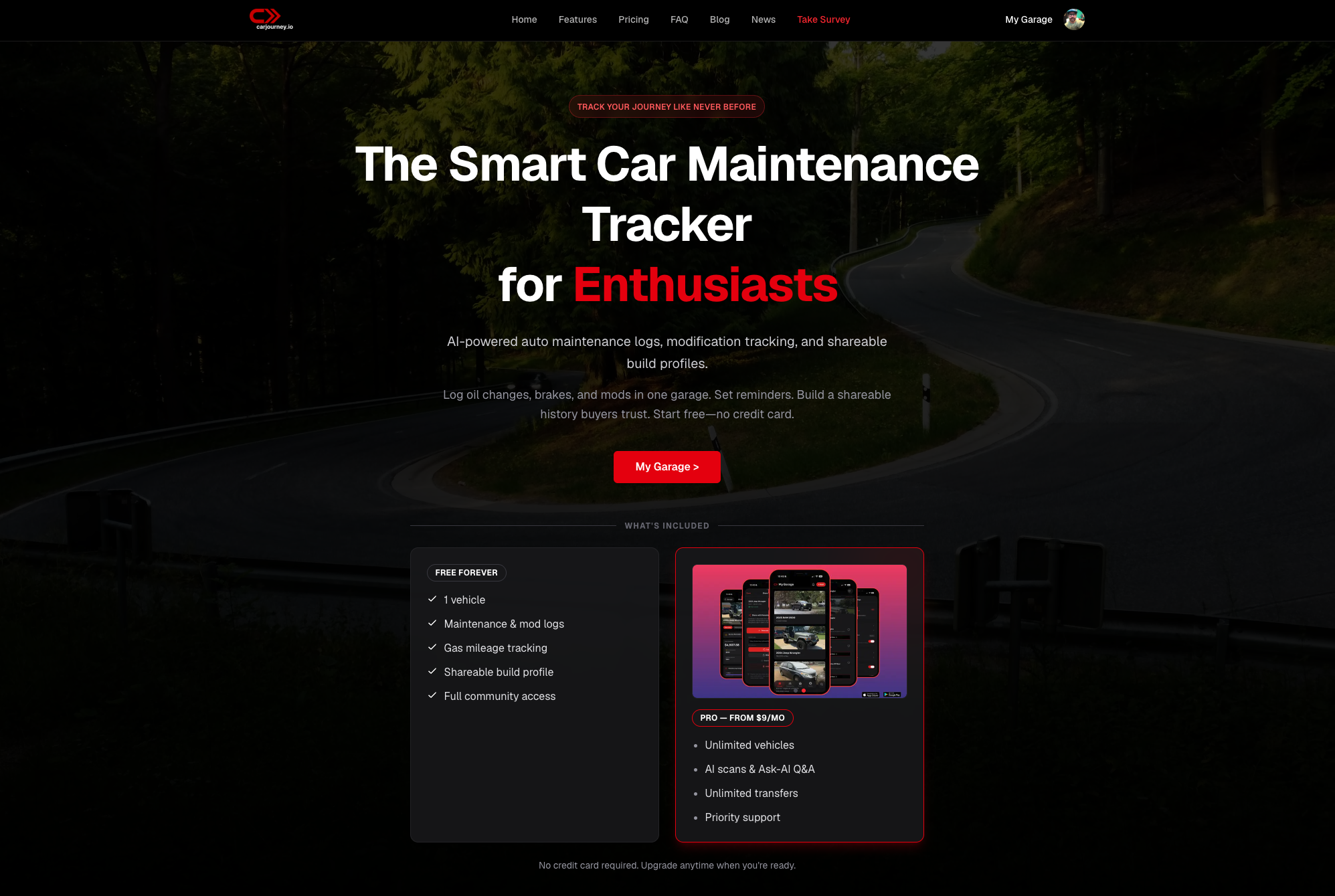
Carjourney was built by a team of gearheads and software engineers in Virginia who wanted one place to handle all of it. The platform uses AI to scan your service documents, answer detailed questions about your specific vehicle, and recommend maintenance schedules verified across multiple AI models. It also connects you with a community of enthusiasts sharing real-world build data and product experience. If you want AI working for your vehicle long after the purchase is done, Carjourney is where that starts.
FAQ
What is an AI car advisor?
An AI car advisor is a software platform that uses machine learning and real-time market data to help buyers research, compare, and negotiate vehicle purchases. It functions as a purchase strategist rather than a simple search tool.
How much do AI car advisors cost?
Pricing varies by platform and feature set. Some negotiation-focused tools charge around $79 for full negotiation access, while ownership-phase diagnostic advisors are often available at no cost.
Can an AI car advisor replace a car salesperson?
An AI car advisor does not replace the transaction itself, but it gives buyers the knowledge and strategy to negotiate from an informed position. You still complete the purchase at the dealership.
Are AI car advisors accurate for repair advice?
AI repair advisors provide useful second opinions on diagnoses and shop estimates, but they cannot assess physical vehicle condition. Always confirm AI repair guidance with a hands-on inspection from a qualified mechanic.
What should I look for in an AI car advisor?
Look for platforms that cover both the buying and ownership phases, use live market data rather than static databases, and allow you to input your own dealer communications for context-aware strategy. Tools that extend into vehicle management deliver the most long-term value.