 carjourney
From the CarJourney journal
Why Save Service Receipts: A Car Owner's Guide

Why Save Service Receipts: A Car Owner’s Guide
Saving service receipts means preserving a verifiable record of every repair, oil change, and inspection your vehicle has ever received. Most car owners toss these documents without a second thought, but that habit quietly costs them money at resale, voids warranty claims, and leaves them defenseless during insurance disputes. Whether you call them service invoices, maintenance receipts, or repair records, these documents are the paper trail that proves your car was cared for. This guide explains why save service receipts matters, and how to do it right.
Why save service receipts for your car
Keeping service receipts is the single most effective way to document your vehicle’s maintenance history. Experts recommend retaining all maintenance and repair receipts for the entire ownership period to substantiate service history and warranty claims. That recommendation exists because a receipt does something a verbal claim cannot: it proves the work happened, at a specific mileage, on a specific date, by a named shop.
The practical benefits are immediate. Receipts tell you when your last oil change occurred, which brake pads were installed, and whether the timing belt was replaced on schedule. Without that record, you are guessing. Guessing leads to redundant services you already paid for, or missed intervals that cause premature wear.

Digital backups matter just as much as the originals. 94% of receipts are printed on thermal paper, which fades within 6–18 months. A receipt stored in your glove compartment through a Virginia summer will be unreadable by the time you need it.
Pro Tip: Scan every receipt the same day you receive it. Use your phone’s camera app or a dedicated scanning app like Adobe Scan, then drop the file into a labeled folder in Google Drive or iCloud. The habit takes 90 seconds and saves hours of frustration later.
The importance of keeping receipts goes beyond simple record keeping. Organized records let you spot patterns, like a shop that keeps replacing the same part, or a recurring issue that signals a deeper mechanical problem.
How do service receipts protect warranty and insurance claims?
Service receipts are the primary proof that warranty terms were followed. Warranty periods begin on the purchase date, not the date a defect is discovered. That distinction matters because a claim filed two years after purchase must still prove the vehicle received proper maintenance throughout. A receipt with the date, mileage, service description, and technician’s signature satisfies that burden of proof.
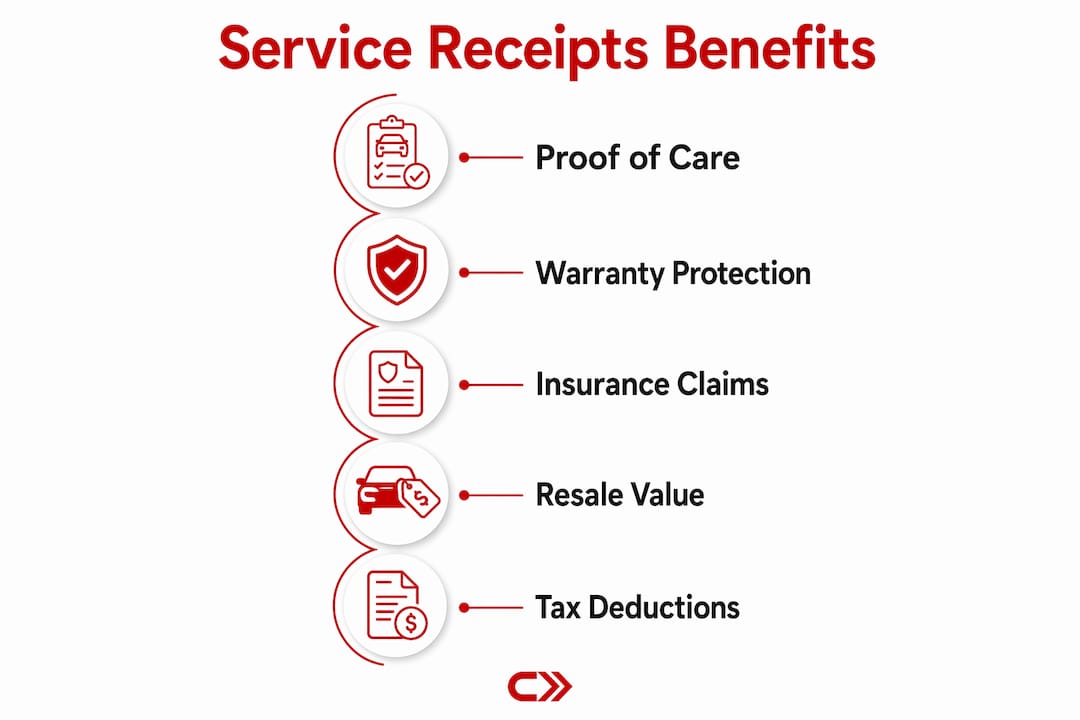
Thermal paper fades fast. Digital scans are accepted by insurers and warranty providers as valid proof, which makes digitizing receipts immediately after receiving them a non-negotiable step. A faded receipt is the same as no receipt in a dispute.
The financial stakes are real. Without original documentation, insurers often pay depreciated actual cash value instead of replacement cost. That gap can run into thousands of dollars on a major repair or total loss claim.
Key details every warranty receipt should include:
- Date of service and current mileage
- Name and address of the service provider
- Description of work performed and parts replaced
- Part numbers or serial numbers for major components
- Technician’s name and signature
Experts also recommend keeping receipts for 90 days beyond the warranty end date to cover delays in claim processing. A warranty that expires in march does not mean your claim window closes in march.
In what ways do service receipts boost resale value?
A documented service history is one of the most persuasive selling tools a private seller or dealer can present. Buyers and dealerships look for a complete service log because it signals responsible ownership. A car with receipts commands a higher asking price than an identical car without them, because the receipts remove uncertainty.
Mileage notes paired with receipts validate maintenance intervals for buyers and dealerships during resale. A buyer who sees receipts for every oil change at the correct mileage intervals has no reason to worry about sludge in the engine or worn components. That confidence translates directly into willingness to pay more.
Here is how to build a resale proof folder that buyers trust:
- Collect every receipt from day one of ownership, including oil changes, tire rotations, and fluid flushes.
- Add mileage notes to each receipt if the shop did not record it.
- Pair receipts with any warranty documents and recall completion notices.
- Include notes on any modifications, upgrades, or custom work with part numbers.
- Store the complete folder digitally and bring a printed copy to any sale negotiation.
“Organizing receipts by service event in a dedicated folder with warranty info and notes reduces resolution times for disputes and builds resale trust.” — idarb.com
A centralized proof folder combining receipts, warranties, and serial numbers accelerates dispute resolution. When a buyer raises a concern at the negotiating table, you can answer it immediately with documentation instead of a shrug.
What are the best practices for organizing service receipts long-term?
The biggest mistake car owners make is treating receipt storage as a one-time task. Effective receipt management is a routine, not a seasonal cleanup. Proactive and routine receipt management maximizes audit defense and claim readiness far better than scrambling to reconstruct records after the fact.
Thermal paper receipts stored in a glove compartment face a specific threat. Heat accelerates fading, and a car interior in summer can reach temperatures that destroy thermal ink within weeks. Immediate digitization is the only reliable defense against this.
Digital copies offer searchability, portability, and protection from physical damage that paper cannot match. A searchable PDF archive lets you pull up every brake service in seconds, which is useful when a shop claims a repair was never done.
| Method | Best for | Weakness |
|---|---|---|
| Physical folder | Quick access at point of sale | Fading, fire, flood risk |
| Cloud storage (Google Drive, iCloud) | Searchability and remote access | Requires consistent upload habit |
| Dedicated vehicle app (Carjourney) | Automated tracking and AI scanning | Requires initial setup |
| Email archive | Low effort, automatic timestamps | Hard to search across years |
Avoid these common pitfalls:
- Storing receipts in only one location (physical or digital)
- Skipping receipts for “minor” services like tire rotations or wiper replacements
- Failing to note the mileage if the shop did not record it
- Letting thermal paper sit in a hot car before scanning
The IRS also has a stake in your records. The IRS requires documentary evidence for vehicle-related tax deductions and disallows unsupported expenses during audits. If you use your vehicle for business, every service receipt is also a tax document.
Pro Tip: Set a recurring weekly reminder on your phone labeled “receipt scan.” Spend five minutes uploading any new receipts to your cloud folder and tagging them by service type. This habit prevents the backlog that makes most car owners give up on organized records.
For car owners who want a purpose-built solution, tracking service expenses through a dedicated vehicle app removes the manual effort and keeps everything tied to your specific build.
Key Takeaways
Saving service receipts protects your warranty rights, supports insurance claims, and directly increases your car’s resale value by proving responsible ownership.
| Point | Details |
|---|---|
| Receipts prove maintenance history | A dated, mileage-stamped receipt is the only verifiable proof a service was performed. |
| Thermal paper fades fast | Scan receipts immediately; 94% are thermal and become unreadable within 6–18 months. |
| Warranty claims require documentation | Keep receipts 90 days past the warranty end date to cover claim processing delays. |
| Resale value depends on records | Buyers pay more for cars with complete service logs because documentation removes doubt. |
| Digital storage beats paper alone | Cloud backups offer searchability and protection from heat, fire, and physical loss. |
The receipt habit most car owners skip until it’s too late
I have watched car owners lose hundreds of dollars at the negotiating table because they could not prove a timing belt replacement happened. The buyer assumed the worst, knocked the price down, and the seller had no way to push back. That scenario plays out constantly, and it is entirely preventable.
The part that surprises most people is how little effort the solution requires. Scanning a receipt takes less time than finding a parking spot. The problem is not the effort. The problem is that the consequence of skipping it is invisible until the moment you need the receipt and do not have it.
Digital tools changed this equation significantly. When I started using a dedicated vehicle app to log services, I stopped thinking about receipts as paperwork and started thinking about them as data. Every oil change, every tire rotation, every warranty repair became a searchable entry tied to my car’s mileage and build. That shift in mindset is what separates car owners who get full resale value from those who leave money on the table.
My honest recommendation: do not wait for a warranty dispute or a lowball offer to build this habit. Start with your next service visit. Scan the receipt before you leave the parking lot. The maintenance history your car builds over years of consistent documentation is one of the most undervalued assets you own.
— Chally
How Carjourney makes receipt tracking automatic
Scattered receipts in glove boxes and forgotten email attachments are the norm for most car owners. Carjourney was built specifically to fix that problem for enthusiasts who want their vehicle’s full history in one place.

Carjourney uses AI to scan your service documents, extract the key details, and attach them to your vehicle’s maintenance timeline automatically. Every oil change, repair, and warranty service gets logged against your specific build, not a generic schedule. When it is time to sell, you have a complete, credible service history ready to share. When a warranty question comes up, the answer is one search away. Start tracking your car’s history with Carjourney and stop losing receipts to heat, time, and disorganization.
FAQ
Why should I save service receipts for my car?
Service receipts prove that maintenance was performed on schedule, which protects warranty eligibility, supports insurance claims, and increases resale value. Without them, buyers and insurers have no reason to take your word for it.
How long should I keep car service receipts?
Keep receipts for the entire ownership period, and hold them for at least 90 days after any warranty expires to cover claim processing delays.
Do digital copies of service receipts count as proof?
Yes. Digital scans are accepted by insurers and warranty providers as valid proof. Scanning receipts immediately also protects against thermal paper fading within 6–18 months.
Should I save service invoices for minor repairs too?
Yes. Tire rotations, fluid flushes, and wiper replacements all contribute to a complete service log. Buyers and dealerships evaluate the full picture, not just major repairs.
Can service receipts help with tax deductions?
The IRS requires documentary evidence for vehicle-related tax deductions and will disallow unsupported expenses during an audit. If you use your vehicle for business, every service receipt is a tax record.