 carjourney
From the CarJourney journal
Why Maintenance History Matters for Your Car's Value

Why Maintenance History Matters for Your Car’s Value
Most car owners focus on mileage when thinking about what makes a vehicle worth more. That’s the wrong lens. Why maintenance history matters is a question that hits your wallet directly. Vehicles with documented maintenance histories can command resale premiums of 5% to 20%, which translates to $1,000 to $4,000 more on a $20,000 car. On top of that, missing records are one of the fastest ways to lose a warranty claim or watch a buyer walk away. This article breaks down what to keep, why it pays off, and how to build a system that works for you.
Table of Contents
- Key takeaways
- Why maintenance history matters more than you think
- How records directly protect your car’s reliability
- The real financial impact on resale value
- Records as warranty and legal protection
- How to organize your vehicle’s records effectively
- My take on the records most owners ignore
- Track your car’s full history with Carjourney
- FAQ
Key takeaways
| Point | Details |
|---|---|
| Resale value premium | Documented history can add 5% to 20% to your car’s sale price compared to an undocumented vehicle. |
| Faster sale timeline | Cars with verified service history sell up to 3.5 times faster than those without records. |
| Warranty protection | Missing maintenance records are a leading cause of warranty claim denials, so consistent logging is critical. |
| Legal documentation | Detailed repair orders support lemon law claims and warranty disputes when problems persist. |
| Organized records save time | A concise summary sheet with dates and mileage cuts buyer due diligence to under 60 seconds. |
Why maintenance history matters more than you think
Maintenance history is the documented record of every service, repair, and inspection your vehicle has received. It goes well beyond a few oil change receipts sitting in your glove box. A complete history includes dates, mileage readings, the specific work performed, parts replaced, and the name and contact information of the service provider. Together, these records tell the full story of how a vehicle was treated throughout its life.
The records that carry the most weight include:
- Oil and fluid changes with dates and mileage intervals
- Brake inspections and replacements, including pad thickness notes if available
- Timing belt or timing chain service, since these repairs carry disproportionate influence on buyer confidence
- Transmission fluid flushes and filter changes
- Major repairs such as engine work, suspension replacements, or electrical fixes
- State inspections and emissions testing records
- Tire rotations, alignments, and replacements
Simple receipts are a start, but they fall short of what buyers and warranty administrators actually want. A receipt that says “oil change, $49.99” tells you almost nothing. A repair order that shows the mileage at service, the oil specification used, the technician’s notes, and the shop’s details tells a complete story.
Pro Tip: Take photos of your odometer reading every time you get service. A photo with date metadata adds a layer of credibility that paper receipts alone cannot match.
Under federal law, you are also legally protected in where you get your service. Independent or self-performed maintenance counts as valid proof, as long as it follows the manufacturer’s recommended schedule and is well documented. You do not need to go to a dealership to keep your records legitimate.
How records directly protect your car’s reliability
There is a clear and practical link between documented maintenance and fewer expensive breakdowns. When you track every service with dates and mileage, patterns emerge. You can see that your transmission fluid has gone 60,000 miles without a flush. You notice that your brake pads were last replaced 40,000 miles ago and you are approaching the typical service interval. Documentation turns reactive repairs into scheduled care.
Consider timing belts as a specific example. Most manufacturers specify replacement between 60,000 and 100,000 miles. Without a log, owners frequently miss this interval and do not know when the last replacement happened. A snapped timing belt on an interference engine often means total engine failure, a repair costing $3,000 or more. A single line in a maintenance log prevents that outcome.
“Maintenance history is operational infrastructure, not paperwork. It enables proactive care and gives owners the data to make smarter decisions before failures happen.” — Tractian Maintenance Glossary
The importance of maintenance records also extends to the years that matter most. Documented routine maintenance is especially effective at slowing depreciation during years three through seven of a vehicle’s life, which is when most owners start to see significant value loss. A car that has consistent, logged service during that window depreciates at a noticeably slower rate than one that lacks documentation.
When a problem does appear, your log also helps a mechanic diagnose faster. Instead of guessing what was last done, they can see exactly where the vehicle stands. That saves both time and money on diagnosis.

The real financial impact on resale value
Here is where the benefits of maintenance history become impossible to ignore. The numbers are specific and significant.

Cars with verified service history sell up to 3.5 times faster than those without. That is the difference between 14 days on the market and 49 days. For someone trying to move a car quickly, that gap matters enormously. Documented history converts a seller’s verbal claims into verifiable evidence, and that shift changes the entire negotiation dynamic.
| Scenario | Typical outcome |
|---|---|
| Full documented history | 5%–20% price premium, faster sale, minimal negotiation friction |
| Partial records | Moderate buyer skepticism, some price pressure, longer time to close |
| No records at all | 5%–15% price reduction, extended selling time, aggressive buyer negotiation |
The negotiation effect deserves particular attention. Buyers who cannot verify a car’s history assume the worst. They budget for unknown repairs and push prices down accordingly. Documented history flips that psychology. When a buyer sees a clean, organized log showing consistent service, they have no reason to discount for risk. The trust premium from documentation is real and measurable.
Pro Tip: When preparing to sell, create a one-page summary of your car’s major service milestones. Listing key milestones with dates, mileage, and service providers cuts a buyer’s verification time to under 60 seconds and builds immediate confidence.
Buyers today also expect specific detail. Verifiable documentation including dates, mileage, and shop info is what separates a car that sells at asking price from one that sits and accumulates days on market.
Records as warranty and legal protection
This is an area where the maintenance history implications go far beyond convenience. Missing records are not just an inconvenience during a warranty claim. They can be the reason a valid claim gets denied outright.
Manufacturers and extended warranty providers routinely require proof of routine services like oil changes, fluid flushes, and filter replacements. If you cannot show that you maintained the vehicle per the recommended schedule, they have grounds to deny coverage. Missing maintenance records are consistently cited as a top reason warranty claims are delayed or rejected.
For legal disputes, the stakes get even higher. There are several critical points to understand:
- A detailed repair order that documents symptoms, diagnosis, and repair steps is legally stronger than a vague one that just says “inspected vehicle.” Insist on detailed repair descriptions every time you visit a shop.
- If a repair attempt fails to fix the problem, that outcome should be documented. A “no problem found” repair order is a critical document for lemon law claims because it proves the defect was reported and multiple repair attempts were made.
- Many owners wrongly assume that dealerships or manufacturers are storing all of their service records automatically. Independent filing is safer and the only approach that puts you in full control of your documentation.
- Keep records for at least the life of the vehicle if you plan to sell. For warranty purposes, keep them for at minimum the full warranty period plus two years.
The bottom line is that your maintenance log is not just a convenience tool. It is a legal document that can protect thousands of dollars in warranty coverage and give you standing in a dispute.
How to organize your vehicle’s records effectively
Building a solid maintenance history does not require a complicated system. It requires consistency and the right setup from the start. Here is a practical approach that actually holds up over time:
- Start a dedicated folder today. Whether physical or digital, create one location for all service records. A manila folder in a fire safe works. A cloud folder works better because it travels with you and cannot be lost in a move.
- Scan or photograph every receipt and repair order immediately after service. Do not wait until you get home. Do it in the parking lot while it is in your hand.
- Log the key details in a simple spreadsheet or app. Date, mileage, what was done, who did it, and how much it cost. That is all you need for each entry.
- Create a summary sheet once a year that lists only the major milestones. Timing belt replacement, new brakes, transmission service, and major repairs. This is what you hand a buyer or show a warranty administrator.
- Back up digitally and in print. Digital logs synced to cloud storage prevent paper loss and make sharing records fast and easy.
Pro Tip: Use an app that lets you attach photos directly to service entries. A photo of the odometer at the time of service, attached to the corresponding log entry, is the kind of organized, accessible file that impresses buyers and satisfies warranty claims without any back-and-forth.
If you have done some of your own maintenance, document it the same way. Record the date, mileage, what you did, what parts you used including brand and part numbers, and any photos of the work. Self-performed work done to manufacturer specifications and properly documented carries legal weight.
My take on the records most owners ignore
I have seen a lot of car owners go through the selling process with a stack of scattered receipts and wonder why a buyer is grinding them down on price. The vehicle is clean. It runs well. But the story is missing. That is the issue.
What I have learned is that documentation anxiety is real. People think they need a perfect binder with every oil change since the car was new. They do not. What buyers and warranty administrators actually respond to is a clear pattern of care. A few gaps with good records around major services is far better than no records at all.
The maintenance history implications I see people miss most often involve the high-confidence items. Timing belt done at 95,000 miles? Write it down with the shop’s name. Transmission fluid flushed last year? Keep that receipt somewhere you can find it in 30 seconds. Those two records alone can shift a negotiation meaningfully.
My honest advice: start tracking now, not before you sell. Every month you wait is a service interval you will not be able to prove. The owners who come out ahead are the ones who treated their maintenance log as a running asset, not a chore they got to eventually.
— Chally
Track your car’s full history with Carjourney
Managing maintenance records should not mean chasing receipts across your glove box, email inbox, and a notes app. Carjourney was built specifically to solve that problem.
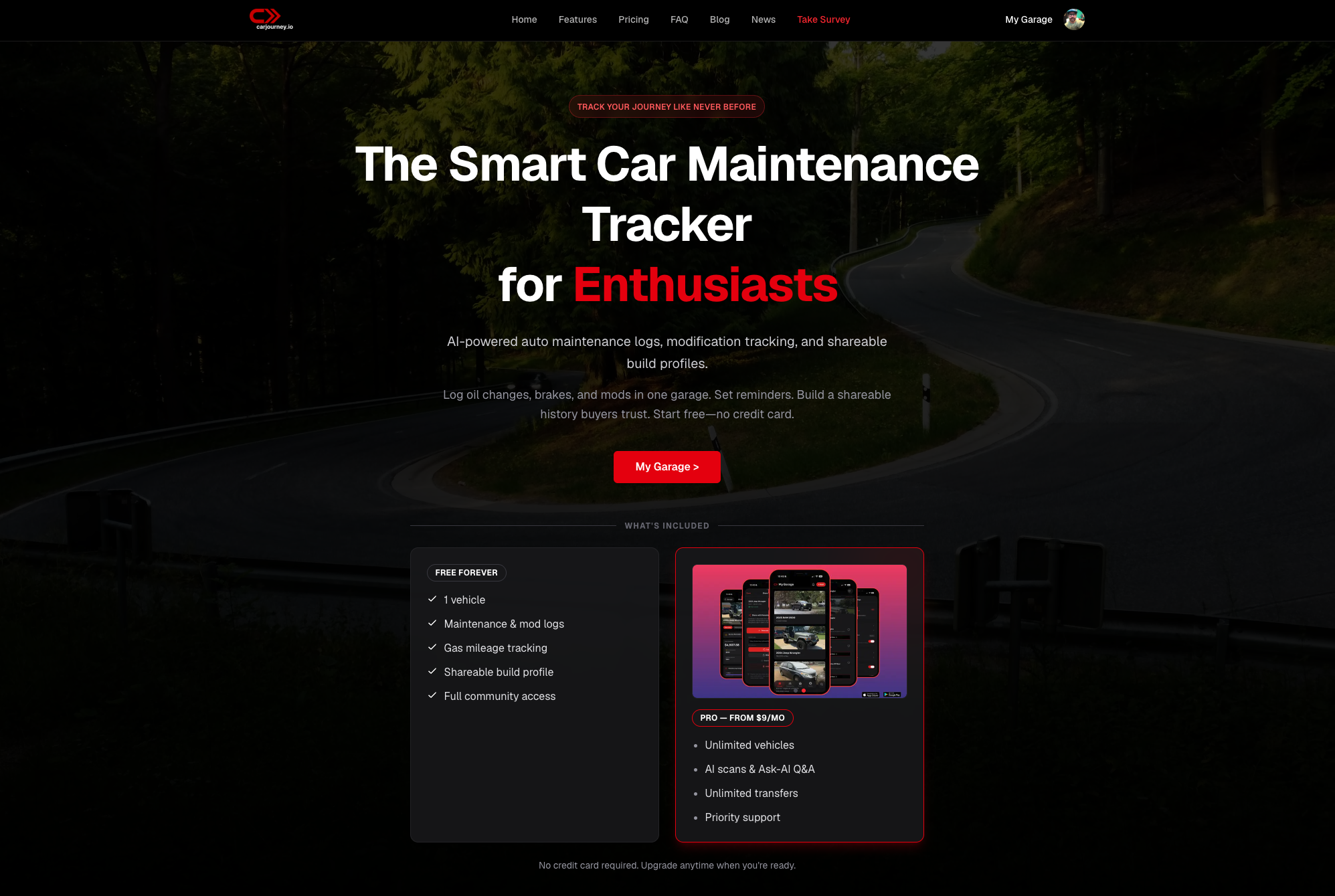
With Carjourney, you can log and organize every service in one place, attach photos directly to entries, and get AI-powered reminders based on your specific vehicle and driving patterns. Whether you are protecting your warranty, preparing to sell, or simply want to know what your car actually needs next, Carjourney gives you the full picture. Start building a record that works for you at carjourney.io.
FAQ
How much does maintenance history affect resale value?
Vehicles with complete service records typically sell for 5% to 20% more than comparable cars without documentation. On a $20,000 car, that difference can reach $4,000.
Can I use independent shop records for warranty claims?
Yes. Federal law allows maintenance records from non-dealer sources to support warranty claims, as long as the service followed the manufacturer’s recommended schedule and is properly documented.
How do I prove maintenance history without dealer records?
Collect repair orders, receipts, and photos with odometer readings from any service provider you used. A well-organized log from independent shops or self-performed work carries the same legal weight as dealer records when documentation is thorough.
Why do cars without records sell slower?
Buyers cannot verify the condition of an undocumented vehicle, so they assume risk and negotiate harder. Cars with no service history spend an average of 49 days on the market versus 14 days for cars with verified records.
What records matter most for a warranty claim?
Oil change receipts, fluid flush records, and any repair orders related to the issue being claimed are the most critical. A repair order that documents symptoms, diagnosis, and repair attempts in detail is especially important if you are building a lemon law case.