 carjourney
From the CarJourney journal
Community Car Platforms: Real Advantages for Enthusiasts

Community car platforms built for enthusiasts give you documented resale value, AI-backed maintenance schedules, crowd-verified troubleshooting, and a searchable build profile that buyers actually trust. Start capturing those advantages today by creating a vehicle record and logging one service entry.
Core advantages at a glance:
- Documentation and resale value: Every receipt, photo, and part number lives in one searchable place instead of a glove box
- AI maintenance and reminders: Personalized schedules and faster diagnosis based on your exact build
- Community troubleshooting: Peer-verified fixes from owners who have solved the same problem on the same platform
- Build profiles for buyers: A shareable, read-only record that converts skeptical buyers into confident ones
- Event and connectivity features: Local meets, group builds, and real-time Q&A with your vehicle’s community
Key Takeaways
Community car platforms give enthusiast owners a documented, verifiable vehicle history that protects resale value, accelerates maintenance decisions through AI, and connects them with peer-verified troubleshooting that generic search cannot match.
| Point | Details |
|---|---|
| Documentation protects resale value | Photo-rich, VIN-linked service logs are the single biggest green flag for buyers of enthusiast cars. |
| AI cuts diagnosis time | AI-assisted workflows can reduce diagnosis time by up to 90% when given accurate vehicle context. |
| Community depth beats generic search | Specialized forums with build threads and photo posts produce faster, more specific solutions than general search results. |
| Data ownership matters | Confirm export options and privacy terms before committing; reputable platforms let you retrieve your full record. |
| Carjourney delivers all five advantages | Carjourney combines AI document scanning, build profiles, community forums, and service reminders in one freemium platform. |
Table of Contents
- What are the real advantages of community car platforms?
- How documentation and receipts increase resale value
- What AI actually adds to your maintenance workflow
- How community troubleshooting beats a generic search
- Using build profiles to earn buyer confidence
- What to check about privacy and data ownership
- How to choose the right community car platform
- How Carjourney maps features to each advantage
- Quick-start checklist: capture the advantages in your first session
- Why the documentation gap is the real problem worth solving
- Carjourney: built for owners who take their records seriously
- Sources
What are the real advantages of community car platforms?
These platforms do five concrete things that scattered tools and general forums cannot.
- Documentation: Every service entry, photo, and receipt is timestamped and VIN-linked, not buried in a phone camera roll
- AI maintenance: Schedules adapt to your actual mileage and modification history, not a generic OEM interval
- Community troubleshooting: Owners who have already solved your exact fault code post the fix, the part, and the cost
- Build profiles: A structured record that shows provenance at a glance, which matters most when you are selling
- Connectivity: Event calendars, group threads, and photo posts keep you inside the community between wrenching sessions
Pro Tip: Prioritize documentation first. A complete service history is the foundation every other advantage builds on. Without it, AI recommendations lack context and buyers lack confidence.
How documentation and receipts increase resale value
Buyers of enthusiast cars are skeptical by default, and they should be. A car with a verbal service history and a folder of crumpled receipts gives them nothing to verify. A searchable, photo-rich digital log is a different story entirely.
Andrew P. Collins, writing for The Drive, calls thorough DIY documentation “the single biggest green flag” for buyers of project and enthusiast cars. Structured digital logbooks that consolidate photos, part numbers, and searchable notes outperform binders and scattered phone photos in every practical way. A buyer can scroll a timeline, zoom into a photo of the freshly installed suspension components, and see the receipt date. That removes the negotiating leverage that vague histories hand to buyers.
What to document for maximum buyer trust:
- VIN-linked service entries with mileage and date
- Part numbers and brand names for every replaced component
- Photos from multiple angles (before, during, and after the repair)
- Receipts or invoices with timestamps
- Dyno sheets, alignment printouts, or track logs where applicable
- Notes on any known issues, even resolved ones
The transparency on resolved issues is counterintuitive but effective. Disclosing a fixed problem with photographic proof reads as honest, which is exactly what a serious buyer wants to see.
What AI actually adds to your maintenance workflow
AI-assisted diagnostic workflows can reduce diagnosis time by up to 90% by cross-referencing current readings against millions of historical repair patterns. That same industry analysis reports that a large share of owners say they would use an AI agent if it could diagnose and address issues in real time.
The workflow in a well-built platform looks like this:
- Scan: You upload a service receipt or photo; the AI extracts the part, mileage, and service type using OCR
- Map: The platform maps that data to your vehicle’s known service rules and modification history
- Recommend: It generates a prioritized list of upcoming maintenance items and flags anything that conflicts with your current build
- Alert: Reminders fire at the right mileage interval, not a generic 5,000-mile default
Edge AI integration takes this further by enabling real-time, context-aware adjustments tied to live vehicle data, shortening the feedback loop for performance tuning. The same analysis warns that model transparency matters: you need to trace a recommendation back to a sensor reading or service manual entry, not accept it as a black-box verdict.
Pro Tip: Cross-reference AI maintenance recommendations against your vehicle’s factory TSBs (Technical Service Bulletins) and known model-specific issues from your community before acting. AI is fast; community knowledge is specific.
How community troubleshooting beats a generic search
Type a fault code into a general search engine and you get forum threads from 2009, half of which end with “solved it, thanks guys” and no actual solution. A platform built around enthusiast communities produces something different: long-form build threads, step-by-step repair posts with photos, and Q&A tied to specific model years and trim levels.
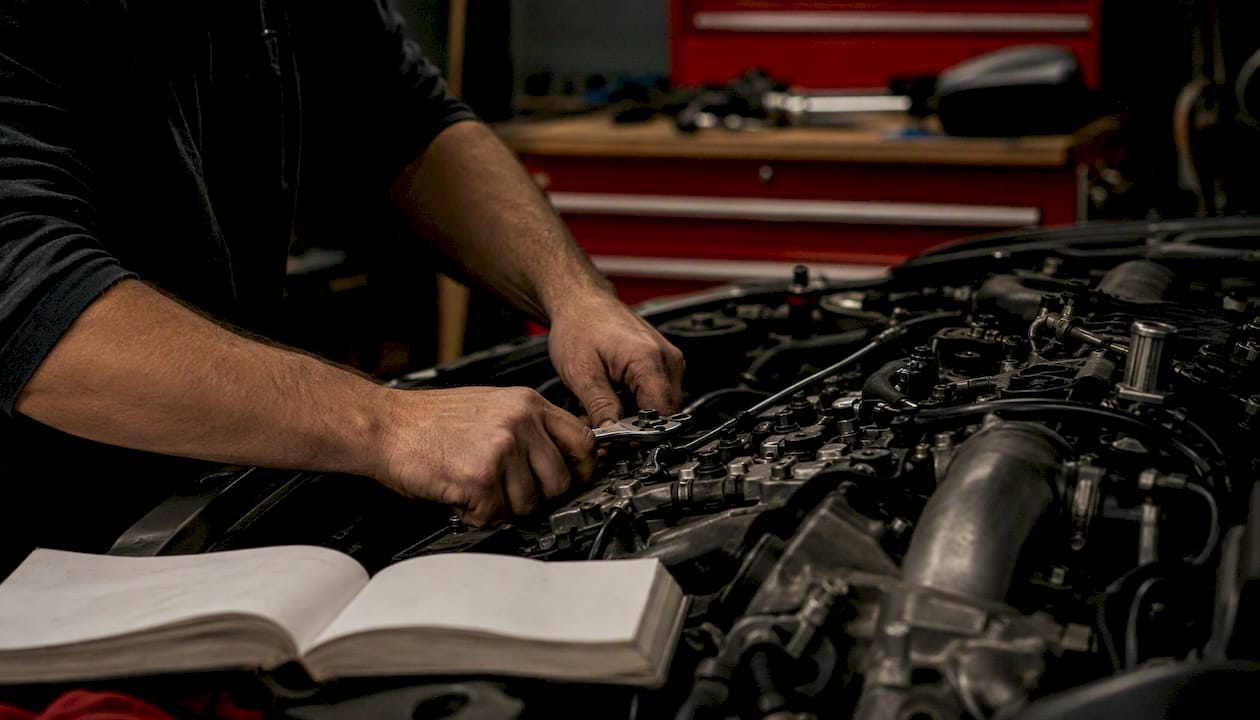
Specialized platforms that restore forum-style depth, including digital garages, event calendars, and long-form build threads, provide technical continuity that general social networks cannot match. The difference is persistence. A well-tagged build thread from two years ago is still searchable, still linked to the correct vehicle, and still accumulating replies from owners who hit the same issue later.
What makes community troubleshooting work:
- Build threads that document the entire arc of a project, not just the finished photos
- Photo-based posts that show the actual failure, not just a description of it
- Parts sourcing threads where owners share vendor experiences and pricing
- Local meet-up coordination that turns online knowledge into in-person help
Pro Tip: When posting a problem, include your mileage, modification list, recent service history, and a photo of the fault. Vague posts get vague answers. Specific posts get solutions.
Using build profiles to earn buyer confidence
A build profile consolidates everything a buyer needs to evaluate your car without a 45-minute phone call. One shareable link replaces the awkward “I have all the receipts somewhere” conversation.
The fields that matter most to buyers:
- VIN and baseline condition at acquisition
- Chronological modification list with part numbers and install dates
- Photo gallery organized by system (suspension, engine bay, interior)
- Receipts or invoices attached to each modification entry
- Dyno or track logs if performance claims are part of the listing
- Known issues, past and present, with resolution notes
You can share a read-only link that shows the full history without exposing what you paid for parts. That protects your negotiating position while giving the buyer everything they need to feel confident. For a detailed walkthrough on structuring this kind of record, the guide to documenting car upgrades covers the checklist in full.
Lighting and cosmetic modifications are part of the story too. How lighting factors into community culture and build showcase posts is worth understanding when you are building a profile meant to impress buyers and fellow enthusiasts alike.
What to check about privacy and data ownership
Your build records represent years of work. Before committing to a platform, confirm who owns that data and how you get it back.
Questions to ask any platform:
- Can you export your full record in a standard format (CSV, PDF, JSON)?
- Do you retain ownership of uploaded photos and documents?
- Who can see shared links, and can you revoke access?
- Does the platform sell or share your data with third parties?
Red flags that should prompt caution:
- No export function or export locked behind a paid tier with no trial
- Terms of service that grant the platform a broad license to your uploaded content
- Shared links with no expiration or revocation option
- Vague or absent privacy policy language around user-generated content
- No clear answer on what happens to your data if the platform shuts down
Reputable platforms state data ownership clearly, offer export in at least one portable format, and give you granular control over who sees shared build profiles.
How to choose the right community car platform
Apply three filters first: documentation fidelity, AI accuracy and transparency, and community depth with active moderation.
Decision checklist:
- Does the platform support photo uploads, part numbers, and receipt attachments per entry?
- Does the AI explain its recommendations or just deliver them?
- Is the community active on your specific vehicle type?
- Can you export your full history before committing to a paid tier?
- Is there a moderation layer that keeps threads accurate and on-topic?
Free vs. Pro trade-offs:
- Free tiers typically limit vehicle count and restrict AI-powered features
- Pro tiers unlock unlimited vehicles, AI document scanning, and full export access
- Lifetime payment options exist on some platforms and suit owners who plan to document long-term builds
Pro Tip: Before upgrading, test the export function on the free tier. If you cannot get your data out easily on the free plan, that tells you something important about how the platform treats your records.
Red flags beyond data: a closed community with no moderation, hidden fees that appear only at checkout, and AI recommendations with no source traceability are all reasons to keep looking.
How Carjourney maps features to each advantage
Carjourney, built by Blue Shed Digital, LLC in Virginia, delivers every advantage covered above through specific features tied to account tier. The full feature breakdown shows the mapping in detail.
Setup tips for new users:
- Add your VIN first so AI recommendations are vehicle-specific from day one
- Upload your most recent service receipt immediately to seed the AI context
- Join the vehicle-specific community thread before posting your first question
The freemium model gives you documentation and community access at no cost. Pro unlocks AI scanning, unlimited vehicles, and full export, available monthly, annually, or as a one-time lifetime purchase.
Quick-start checklist: capture the advantages in your first session
- Create your Carjourney account and add your vehicle’s VIN
- Enter baseline condition notes (mileage, known issues, recent work)
- Upload your most recent service receipt for AI extraction
- Add your modification list with part numbers and install dates
- Attach photos organized by system (engine, suspension, interior)
- Set your first mileage-based service reminder
- Join your vehicle’s community thread and introduce your build
- Post one question or share one tip to establish your presence
- Generate and test your read-only build profile link
- Confirm your export settings and download a backup copy
Pro Tip: For photos, shoot in good natural light and capture the part number label in at least one frame. That single detail eliminates the most common buyer question about aftermarket components.
Why the documentation gap is the real problem worth solving
The conventional take on enthusiast platforms focuses on community features: forums, meets, group buys. Those matter, but they are not the core value. The core value is provenance.
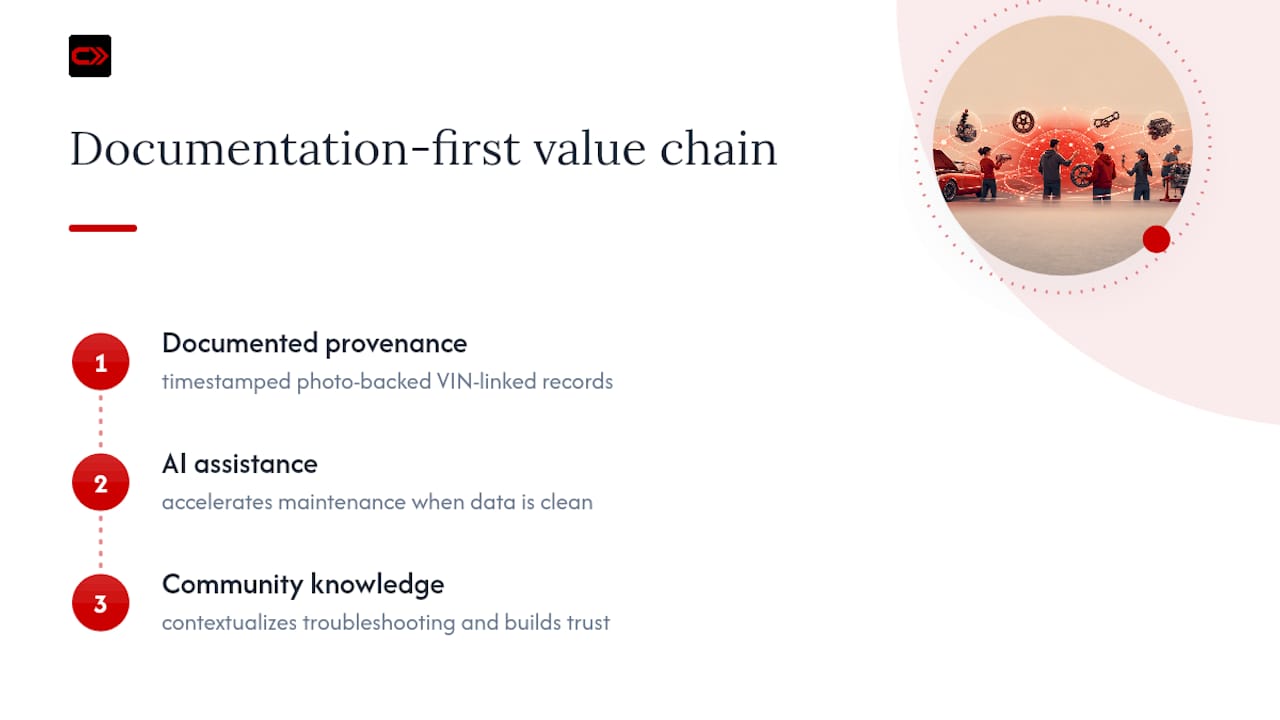
Most enthusiast cars change hands with a story instead of a record. The seller remembers the work; the buyer has to trust the memory. That gap costs sellers money and costs buyers confidence. A platform that closes that gap with timestamped, photo-backed, VIN-linked records does something no forum thread can: it makes the car’s history verifiable.
The AI layer accelerates maintenance and troubleshooting, but it only works well when the underlying data is clean and complete. That is why documentation comes first. Build the record, then let the AI and the community amplify it.
Carjourney: built for owners who take their records seriously
Carjourney is the platform for enthusiasts who want their build history to work as hard as they do. Where scattered receipts and buried forum threads leave gaps, Carjourney closes them: AI scans your service documents, extracts the details, and maps them to your exact vehicle. Your build profile becomes a shareable, buyer-ready record. Your community thread becomes a searchable knowledge base specific to your make and model.
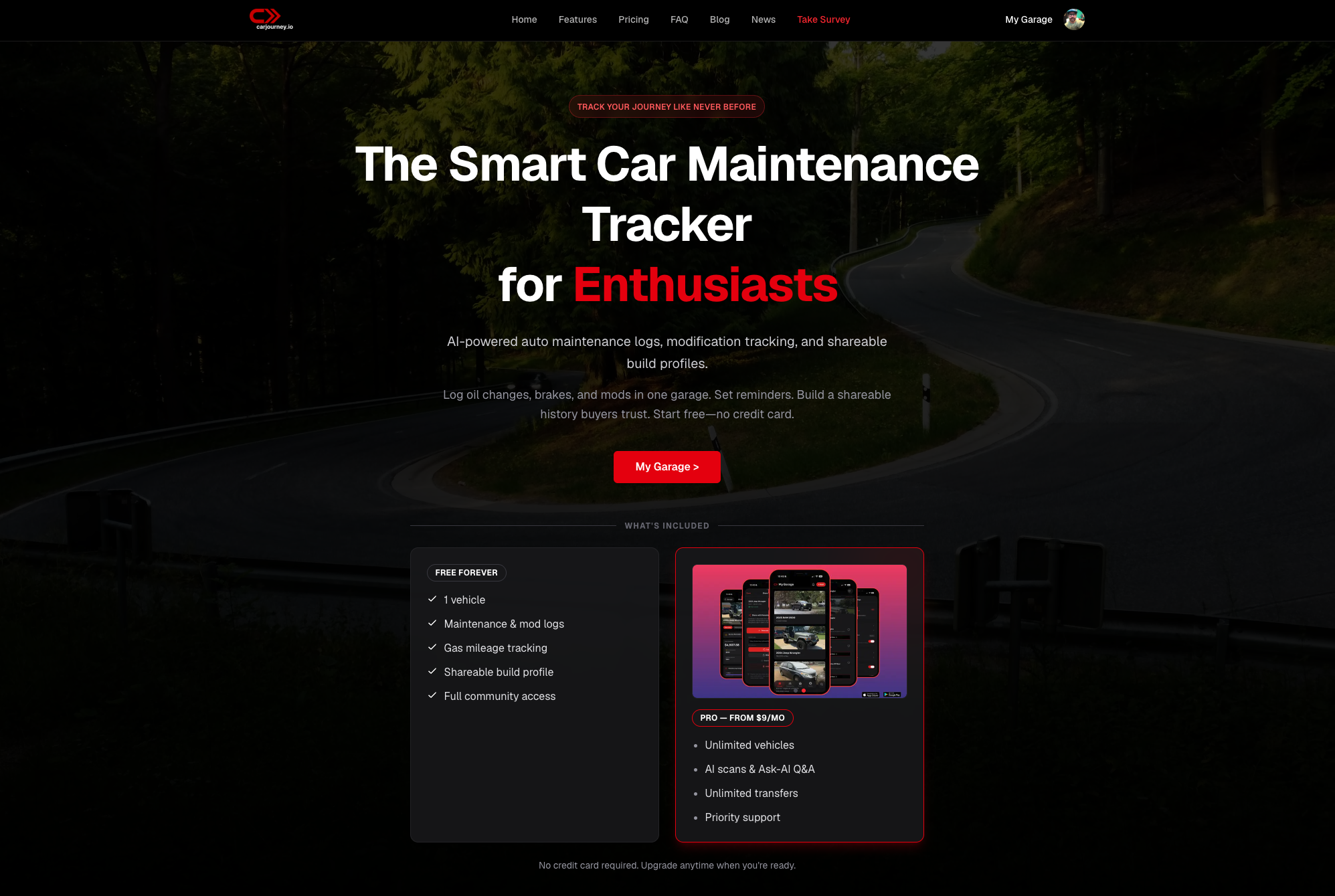
Built by gearheads at Blue Shed Digital, LLC in Virginia, Carjourney was designed around one problem: no single tool combined vehicle tracking, community knowledge, and AI-powered insights. It does now. Free accounts cover documentation and community access. Pro unlocks AI scanning, unlimited vehicles, and full data export. Carjourney and have a complete service entry logged before you close the tab.
Sources
- AI Auto Mechanic: How AI Is Changing Car Diagnostics and Repair (May 2026)
- This Free App Is a Godsend for Anyone Working on a Project Car (The Drive)
- Tunedbyai