 carjourney
From the CarJourney journal
7 Signs Your High-Mileage Car Needs a Timing Belt

Last Updated: November 7, 2026
Quick Summary
Replace the timing belt at whichever comes first: the mileage limit or the time limit in your owner's manual, matched to your exact engine code. On an interference engine past its interval with no proof of a prior change, replace it as preventive maintenance, since belts usually fail without warning.
- Rubber ages whether you drive or not, so a low-mileage car that sat for years can be overdue.
- Timing belts usually give no warning at all, which makes the replacement interval more important than any symptom checklist.
- A visual inspection cannot tell you how much life is left in a belt that still looks fine.
- The belt, tensioner, and idler are often sold as a kit, and skipping the water pump means paying the same labor again.
- Record the date, mileage, parts, and shop so you know exactly when the next interval starts.
Table of Contents
- Why High Mileage Changes the Timing Belt Question
- Timing Belt Replacement Interval by Make and Model
- Timing Belt Replacement by Age vs. Mileage
- Warning Signs of a Worn Timing Belt
- A Decision Process for Cars With Unknown Service History
- Timing Belt Replacement Cost and What Drives It
- Log Your Belt Replacement and Every Service After It
- Frequently Asked Questions
Why High Mileage Changes the Timing Belt Question
A timing belt is a reinforced rubber band that keeps your engine's crankshaft and camshafts spinning in sync. When it snaps, that sync disappears in a fraction of a second. High-mileage owners often weigh a belt job against a repair bill they can't predict. For the broader maintenance picture this decision fits into, see our car maintenance schedule for high mileage vehicles. The answer isn't a single number. It's a decision, and it changes once your odometer climbs past the point where the original belt has already outlived its design life.
What a Timing Belt Actually Does
The belt turns the camshafts at exactly half the crankshaft's speed. That ratio keeps the valves opening and closing in step with the pistons. Some engines use a timing chain instead, which usually lasts longer but isn't maintenance-free. If you're unsure which one your car has, check the owner's manual or look for a belt cover on the front of the engine.
Interference vs. Non-Interference Engines
This distinction decides how bad a failure gets.
- Interference engine: valves and pistons share the same space at different times. A broken belt lets them collide. Result: bent valves, damaged pistons, and in serious cases a cracked head.
- Non-interference engine: valves and pistons never occupy the same space. A broken belt usually means a tow bill, not an engine rebuild.
Most modern engines are interference designs. Assume yours is until you confirm otherwise.
Timing Belt Replacement Interval by Make and Model
There's no universal number. A timing belt replacement interval by make and model varies widely, and the only authoritative source is your vehicle's own documentation. Manufacturer recommendations vary by engine, and the only reliable source is your vehicle's own documentation. What matters is matching the interval to the exact engine under your hood, not the badge on the trunk.
How to Find the Right Interval for Your Specific Engine
Follow this sequence:
- Open the owner's manual and find the maintenance schedule section.
- Look for "timing belt" under the mileage-based service table.
- Check for a separate time limit, often listed in years.
- Confirm the engine code, since one model year can carry two different engines with different intervals.
- Cross-check with the manufacturer's published service information if the manual is missing.
Here's the part most guides skip: the same car model can have two engines with two different belts. A four-cylinder and a V6 in the same year often don't share an interval. Match the engine code, not just the badge on the trunk. The engine code is usually stamped on a plate or sticker in the engine bay, on the door jamb, or in the VIN itself, and a dealer parts counter can decode it from your VIN if you can't find it.
Why Generic Mileage Ranges Mislead
A generic mileage range is only a starting point, not an answer. Within that band, the spread is driven by engine design and belt material.
Owner's manuals often pair a mileage figure with a time limit for the belt.
Watch out: relying on a forum post or a generic online chart for your interval can leave you 30,000 miles past due on an interference engine. The chart may be for a different engine code in the same model year.
Maintenance intervals differ because wear rates aren't uniform, and our guide on why maintenance intervals differ for your vehicle explains how driving style and climate shift the schedule.
Timing Belt Replacement by Age vs. Mileage
Rubber ages whether you drive or not. A low-mileage car that sat for years can have a belt closer to failure than a high-mileage commuter that ran daily. Many vehicles list both a mileage limit and a time limit, and the first one reached is the one to follow.
That's the rule to remember: whichever comes first. A belt with 40,000 miles but twelve years of age is overdue. If you're deciding between mileage reminders and calendar reminders, our breakdown of mileage reminders versus time reminders covers how to run both without losing track.
Warning Signs of a Worn Timing Belt
Warning signs rarely appear before a belt fails. That's the uncomfortable truth. Because timing chains can fail without the same replacement schedule, knowing the signs of timing chain failure helps distinguish their warning patterns from the silence of a worn belt.
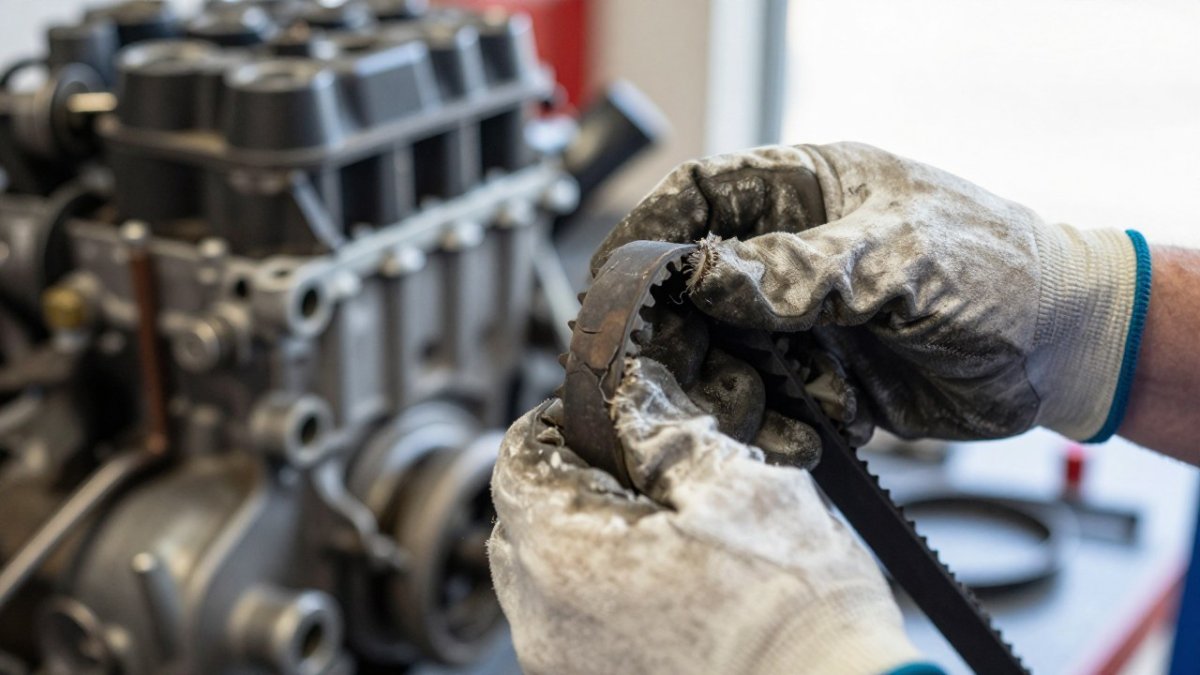
When symptoms do show up, look for:
- Cracks, glazing, or fraying on the belt's ribbed surface
- Missing or rounded teeth
- A chirping or squealing noise from the front of the engine
- Rubber dust inside the timing cover
- Rough idle or misfires from skipped teeth
A common mistake is confusing the timing belt with the accessory belt. The accessory belt runs the alternator and power steering. It's visible, cheap, and easy to swap. The timing belt hides behind a cover and costs far more to reach.
What a Visual Inspection Can and Cannot Tell You
A visual inspection can confirm obvious damage: cracks, frayed edges, missing teeth. It cannot tell you how much life is left in a belt that still looks fine. Rubber degrades from the inside out, and the cords that carry the load are buried under the surface. A belt that passes a visual check can still snap next month. If the belt is past its interval, inspection is not a substitute for replacement.
A Decision Process for Cars With Unknown Service History
Unknown history is the hardest case, and it's more common than you'd think. Here's how we'd work through it:
- Check for a sticker or record. Look under the hood, in the door jamb, and in any paperwork for a timing belt service note.
- Run a VIN check. A vehicle history report sometimes flags major service visits.
- Ask the previous owner directly. A receipt or shop name is enough to confirm the work.
- Assume it's original if nothing turns up. On an interference engine past the interval, that assumption should drive your decision.
- Budget for replacement as preventive maintenance. Treat it as a cost of ownership, not a repair.
If records are genuinely missing, our guide on what to do when a car has missing service history walks through the full checklist, from VIN checks to pricing the risk. On an interference engine with no proof of a belt change and an odometer past the interval, replace it. The math favors the belt job every time.
Timing Belt Replacement Cost and What Drives It
Timing belt replacement cost depends on labor access, not the belt itself. The belt is a modest part. The labor is what you're paying for, because the job means removing covers, belts, and often the water pump to reach everything. Labor time varies with engine design and access, and that difference shows up on the invoice.
Timing Belt Part Cost vs. Total Job Cost
The timing belt part cost alone is usually a small slice of the total. The rest is labor and the parts you should replace while the engine is open. Here's what a typical job includes:
| Item | What It Is | Replace With the Belt? |
|---|---|---|
| Timing belt | The ribbed rubber belt | Yes, always |
| Tensioner | Keeps belt tension correct | Yes, it wears out |
| Idler pulley | Guides the belt path | Yes, bearings fail |
| Water pump | Coolant circulator, belt-driven on many engines | Yes, if belt-driven |
| Accessory belt | Runs alternator and accessories | Often, since it's off anyway |
| Coolant | Drained during water pump work | Yes, refill required |
A common pattern is that the belt, tensioner, and idler are sold as a kit, and the kit price is a fraction of the total bill. The water pump is the swing item: on engines where the pump is driven by the timing belt, skipping it means paying the same labor again if it fails later. On engines where the pump runs off the accessory belt, it can be deferred.
What Drives the Price Up or Down
- Engine layout. A longitudinal four-cylinder with room at the front of the engine is the cheapest case. A transverse V6 packed against a fender well is the most expensive.
- Bundled parts. Adding the water pump, tensioner, idler, and coolant raises the parts total but avoids repeat labor.
- Shop labor rate. Dealer rates run higher than independent shops, and the gap widens on longer jobs.
- While-you're-in-there items. Cam and crank seals, if leaking, are cheap parts with the engine already open.
Skipping the tensioner or water pump to save money is a false economy. If either fails later, you pay the same labor again. When you're facing a bill this size, choosing the right shop matters as much as the parts. Our guide on how to choose a mechanic and keep better service records covers comparing written estimates and what to ask about warranties.
Watch out: a quote that lists only the belt and labor, with no tensioner or water pump, is usually the low bid that costs more later. Ask for an itemized estimate that names every part and the labor hours separately.
Log Your Belt Replacement and Every Service After It
The belt job is a milestone, and it's worth documenting properly. Record the date, the mileage, the parts used, and the shop that did the work. That record does two things: it tells the next owner the belt is fresh, and it tells you exactly when the next interval starts.
A digital garage can keep the belt replacement alongside every oil change, tire rotation, and modification. CarJourney offers unlimited maintenance and modification tracking, reminders tied to both time and mileage, VIN-based setup, and shareable build profiles for resale transparency. Scattered receipts and phone photos get lost.
If your high-mileage car is due for a timing belt and you're not sure where the last service left off, don't guess. Start a free CarJourney garage, log what you know, and let time-and-mileage reminders keep the next interval in view.
Frequently Asked Questions
Can a timing belt last 150,000 miles?
Rarely, and never on the original schedule. Manufacturer recommendations vary by engine, so check your owner's manual. A belt that reaches 150,000 miles is running far past its design life, and rubber deterioration continues even when the car sits. If your high-mileage car still has its original timing belt at that point, replace it now rather than waiting for symptoms.
Should I replace the timing belt if I don't know when it was last changed?
Treat an unknown history as overdue. Check the owner's manual for the interval, then look for a service sticker under the hood or receipts in the glovebox. If neither turns up, assume the belt is original. On an interference engine, a snapped belt can bend valves and turn a routine job into a major repair, so replacing it is the cheaper bet.
Does a timing belt need replacement based on age as well as mileage?
Yes. Rubber degrades with heat cycles and time, not just distance. Many manufacturers list a time limit alongside the mileage figure, often 7 to 10 years. A low-mileage car that sat for years can still have a brittle belt. When age and mileage disagree, follow whichever limit comes first.
What else should be replaced with a timing belt?
Most kits include the tensioner and idler pulley, and many mechanics recommend the water pump at the same time since the labor overlaps. Replacing the water pump later means paying for the timing belt job twice. Ask for a complete kit quote so the timing belt part cost and labor are bundled into one figure.