 carjourney
From the CarJourney journal
Why Maintenance Intervals Differ for Your Vehicle

Maintenance intervals differ because wear rates are not uniform. Every vehicle ages differently based on how it’s driven, where it’s driven, and what its components are made to tolerate. The OEM schedule in your owner’s manual is a baseline built around average conditions. Your conditions are almost certainly not average. Understanding the factors that drive these variations lets you stop guessing and start maintaining your vehicle on a schedule that actually matches how you use it.
Why maintenance intervals differ: the core explanation
The technical term for this concept is preventive maintenance interval calibration, and it exists because degradation is not a fixed-rate process. Oil breaks down faster under heat and contamination. Filters clog faster in dusty environments. Brake pads wear faster under heavy loads. OEM maintenance schedules assume average usage and controlled environments, which means they require adjustment the moment your real-world driving accelerates wear beyond that assumption.
Three variables drive nearly every interval difference you will encounter: usage intensity, operating environment, and component-specific wear profiles. A driver who commutes 15 miles each way on a highway in a mild climate will follow a very different schedule than someone who hauls a trailer through desert heat or makes five short grocery runs a day. Same car, same engine, completely different maintenance timing. That gap is not a flaw in the system. It is the system working correctly.
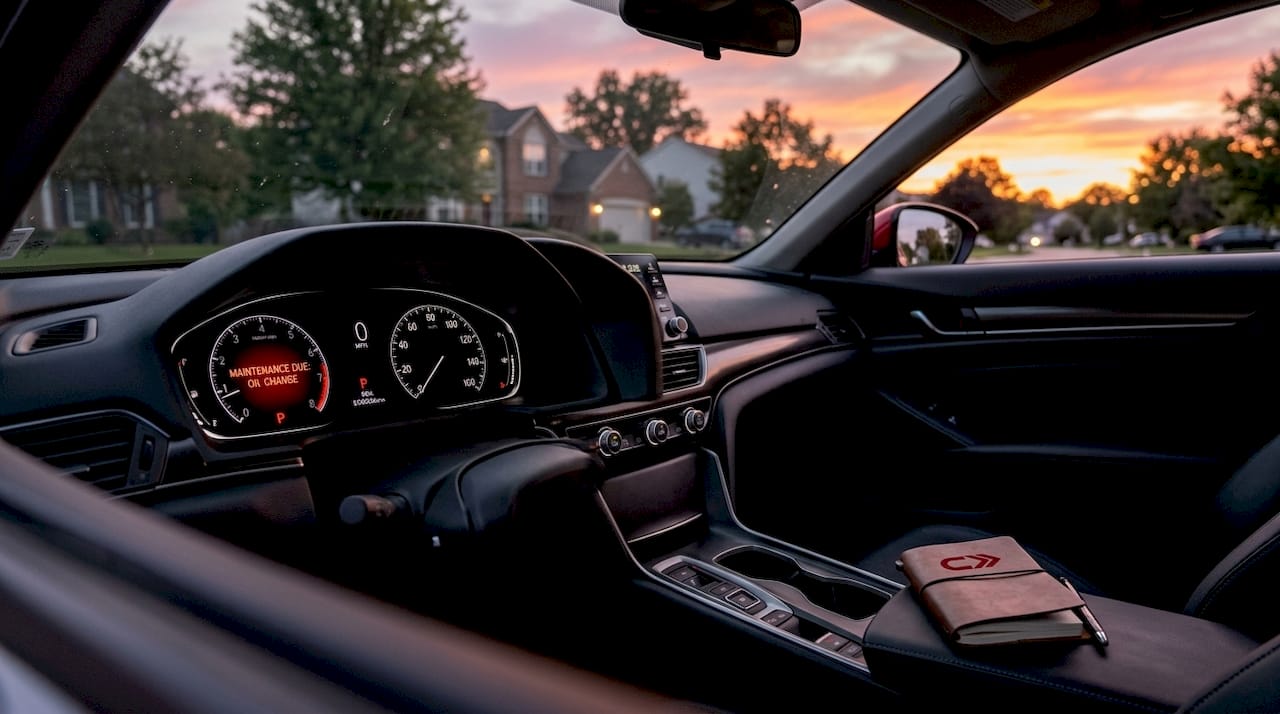
How does driving behavior change your maintenance schedule?
Usage patterns are the single biggest reason why maintenance timing varies from one owner to the next. Mileage is the most common trigger, but it tells only part of the story.
Short trips under 5 miles prevent the engine from reaching full operating temperature, which means condensation inside the oil never fully evaporates. That moisture mixes with combustion byproducts to form acids and sludge, degrading oil quality far faster than highway miles do. A driver logging 5,000 miles of short urban trips may need an oil change sooner than someone who drove 7,500 miles on the interstate.
Towing and hauling add a different kind of stress. Pulling a trailer pushes the transmission, cooling system, and brakes beyond their normal operating range. Transmission fluid degrades faster under sustained load, and brake pads wear at a rate that standard mileage intervals simply do not account for. Engine hours are a better metric for vehicles that idle heavily, like trucks used on job sites, because idle time adds wear without adding odometer miles.
The most reliable scheduling approach uses a “whichever comes first” rule across multiple trigger types: mileage, calendar time, and engine hours. This prevents any single degradation mechanism from going untracked.
- Mileage triggers catch wear from high-use driving
- Time triggers catch degradation in low-mileage vehicles where fluids age on the calendar
- Engine hour triggers catch wear from idle-heavy or load-heavy operation
- Symptom triggers catch issues that fixed intervals miss entirely
Pro Tip: If you regularly tow, haul, or make frequent short trips, check your owner’s manual for the “severe duty” schedule. Most manufacturers include one, and it typically shortens intervals by a meaningful margin compared to the standard schedule.
What environmental conditions shorten maintenance intervals?
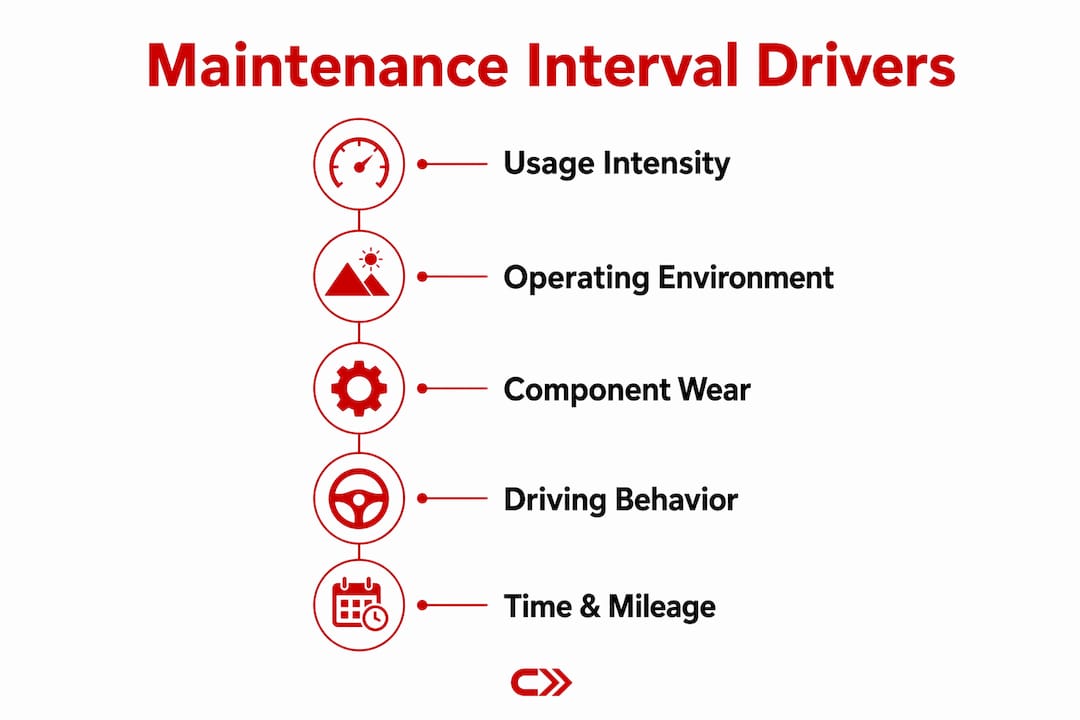
Operating environment acts as a multiplier on every wear rate your vehicle experiences. The same component that lasts 30,000 miles in a temperate climate may need attention at 22,000 miles in a harsh one.
Heat is the most aggressive factor. Every 10°C above 25°C roughly halves lubricant service life. A vehicle driven regularly in Phoenix in July is burning through oil protection at twice the rate of the same vehicle in Seattle. This is not a marginal difference. It is the difference between an oil change at 5,000 miles and one at 2,500 miles for the same product.
Dust and off-road conditions accelerate filter degradation at a similar rate. Air filters in dusty environments can clog in a fraction of the time they would last on paved roads. Contaminated air entering the engine increases wear on cylinders, pistons, and rings. Mud and water exposure accelerates corrosion on brake components, suspension joints, and undercarriage hardware.
Severe-use conditions, defined as short trips, towing, or temperature extremes above 95°F or below 10°F, require shortening OEM baseline intervals by approximately 20 to 25%. That figure applies broadly across fluid changes, filter replacements, and inspection cycles. Optimizing your schedule for your specific climate is one of the highest-return adjustments you can make. CarJourney’s guide on harsh condition scheduling walks through exactly how to do this for common vehicle types.
What are the different types of maintenance intervals?
Maintenance intervals fall into four categories, and each one captures a different dimension of wear. Using only one type leaves gaps.
| Interval type | Best used when | Limitation |
|---|---|---|
| Mileage-based | High-use, consistent driving | Misses time-decay in low-mileage vehicles |
| Time-based | Low-mileage or seasonal vehicles | Misses wear from high-intensity use |
| Engine hour-based | Idle-heavy or load-heavy operation | Requires hour meter; uncommon in consumer vehicles |
| Condition-based | Critical components with sensor data | Requires monitoring hardware or frequent inspection |
Time-based intervals exist because fluids and seals degrade on the calendar regardless of miles driven. A vehicle that sits for six months still needs fresh oil and a brake fluid check. Rubber degrades, moisture enters brake fluid, and coolant loses its corrosion inhibitors over time. Mileage alone would never trigger service for a low-use vehicle, which is why most manufacturers specify intervals as “every X miles or X months, whichever comes first.”
Condition-based maintenance is the most precise approach. Sensors or inspection results determine service timing rather than a fixed schedule. Modern vehicles with oil life monitoring systems use this method for engine oil, adjusting the service reminder based on actual driving data rather than a fixed mileage counter. Condition-based methods are increasingly supplementing fixed intervals across the industry as sensor technology becomes more accessible.
Pro Tip: For a mileage-by-mileage breakdown of what your vehicle needs and when, CarJourney’s maintenance by mileage guide maps out the full service timeline from 5,000 to 150,000 miles.
Why do similar vehicles still have different maintenance schedules?
Two identical vehicles rolling off the same assembly line can have meaningfully different maintenance needs within two years. The reason is that a maintenance interval and a maintenance cycle are not the same thing. An interval is how often a single task repeats. A cycle is the complete set of tasks across all components, each running on its own timeline.
Component-level wear profiles drive this divergence. Brake pads on a vehicle driven in a hilly city wear at a rate that has nothing to do with the brake pad interval on the same model driven on flat rural roads. Transmission fluid in a vehicle used for towing degrades faster than in one that never exceeds 60 mph. Spark plugs in an engine running rich due to a slightly miscalibrated fuel system will foul faster than the OEM interval predicts.
Maintenance engineers design intervals by balancing the risks of over-servicing and under-servicing. Over-maintenance wastes money and introduces unnecessary disassembly risk. Under-maintenance allows wear to accumulate past safe thresholds. The OEM baseline sits at the midpoint for average conditions, which means it is slightly conservative for easy use and potentially too lenient for hard use.
Real-world failure data continuously refines these baselines. Manufacturers track warranty claims and field failures to adjust recommended intervals across model years. This is why a 2022 model may carry a different transmission service interval than a 2019 model with the same powertrain. The schedule reflects what actually fails in the field, not just what engineering theory predicts.
- Component age matters independently of mileage. Rubber seals, belts, and hoses degrade on a time clock regardless of how many miles they have traveled.
- Modification history changes wear assumptions. A lifted truck with larger tires stresses wheel bearings and CV joints beyond OEM predictions.
- Previous maintenance quality affects current intervals. Skipped services compound wear, meaning the next interval may need to be shorter to compensate.
Key takeaways
Maintenance intervals differ because wear is driven by usage intensity, environment, and component-specific degradation rates. No single schedule fits every driver.
| Point | Details |
|---|---|
| OEM schedules are baselines | Adjust intervals when your driving conditions exceed average assumptions. |
| Usage type changes timing | Short trips, towing, and idle-heavy use accelerate wear beyond mileage-only predictions. |
| Environment multiplies wear | Heat above 95°F and dusty conditions can shorten intervals by 20 to 25%. |
| Use multiple triggers | Mileage, time, and engine hours together prevent any wear mechanism from going untracked. |
| Components age independently | Each part has its own wear profile; a vehicle’s full schedule coordinates many different intervals. |
The real cost of treating your schedule as one-size-fits-all
I have seen car owners follow the sticker on the windshield religiously and still end up with sludged engines or failed transmissions. The sticker is not wrong. It is just not specific to them.
The most common mistake I see is treating the OEM interval as a ceiling rather than a floor. Owners in hot climates, those who tow regularly, or those who make mostly short trips are often running their vehicles on intervals that are too long for their actual conditions. The engine does not know what the sticker says. It only knows what the oil looks like.
The second mistake is ignoring time as a trigger. A vehicle that sits for eight months and then gets driven 3,000 miles before an oil change is not getting adequate service. The oil aged on the calendar. The mileage counter did not capture that.
What actually works is building a personal schedule from three inputs: your OEM manual, your real driving patterns, and your environment. Start with the severe-duty schedule if any of your conditions qualify. Then track what you observe at each service. If your oil looks dark at 4,000 miles, shorten the interval. If your air filter is clean at 15,000 miles, you may be able to extend it. The schedule should evolve based on evidence, not habit.
Fleet programs that use this kind of multi-trigger approach reduce unplanned breakdowns by 30 to 40%. That number applies to individual vehicles too. The math on planned maintenance versus reactive repair is not close. Reactive maintenance costs 2.8 to 3.4 times more than a planned program.
— Chally
Track your intervals the way your vehicle actually needs
CarJourney is built for exactly this problem. Generic schedules ignore your specific build, your climate, and how you actually drive. CarJourney’s maintenance tracker lets you log mileage, engine hours, and calendar dates as separate triggers, so your reminders fire based on whichever threshold you hit first. The AI scans your service documents, learns your vehicle’s history, and recommends adjustments based on your real usage patterns rather than a generic baseline. If you have been running on a schedule that was never designed for your conditions, CarJourney gives you the tools to fix that without needing a spreadsheet or a mechanic on speed dial.
FAQ
Why do oil change intervals vary so much between vehicles?
Oil change intervals vary because driving conditions, engine design, and oil type all affect how quickly oil degrades. Short trips under 5 miles, high temperatures, and heavy loads each accelerate contamination at different rates, making a single universal interval inaccurate for most drivers.
What does “severe duty” mean on a maintenance schedule?
Severe duty refers to conditions that accelerate wear beyond average assumptions, including frequent short trips, towing, extreme temperatures, and dusty environments. Vehicles operated under severe duty typically need service intervals shortened by 20 to 25% compared to the standard OEM schedule.
Is time or mileage more important for maintenance intervals?
Both matter, and the correct approach is to use whichever trigger comes first. Mileage captures wear from driving intensity, while time captures degradation from fluid aging and component exposure, even when a vehicle sits unused for extended periods.
Why does the same model have different intervals across model years?
Manufacturers update intervals based on real-world failure data from warranty claims and field inspections. A revised interval on a newer model year reflects what actually fails in use, not just what engineering theory originally predicted.
Can I extend my maintenance intervals if I drive gently?
Gentle highway driving in a mild climate can support longer intervals for some services, particularly oil changes with full-synthetic oil. Confirm any extension against your OEM severe-duty and standard schedules, and monitor fluid condition at each service to verify the adjustment is safe for your specific vehicle.