
Car Maintenance Schedule for High Mileage Vehicles
Table of Contents
- Why High Mileage Maintenance Changes After 100,000 Miles
- The 100,000 Mile Service Checklist Every Owner Needs
- High Mileage Oil vs Standard Oil: What Actually Protects Your Engine
- Tires, Fluids, and Wear Items: Your Ongoing Service Interval
- Preventative Maintenance Tracking Tools That Keep Records Straight
- Repair or Replace? A Cost-Benefit Framework for High Mileage Cars
- DIY vs. Mechanic: Which High Mileage Jobs to Hand Off
- Frequently Asked Questions
Last Updated: September 22, 2026
Why High Mileage Maintenance Changes After 100,000 Miles
A car maintenance schedule for high mileage vehicles shifts from reactive repairs to proactive component replacement once the odometer crosses 100,000 miles. Parts that were merely "wearing" at 60,000 miles are now near the end of their design life.
The biggest mistake is treating the owner's manual as the final word. It was written for the first 100,000 miles; past that mark, you're managing wear and tear on a different curve.
The 30-60-90 Maintenance Rule Explained
The 30-60-90 rule spaces high-mileage inspections: every 30 days check fluids and tire pressure, every 60 days inspect belts, hoses, and the battery, and every 90 days handle a deeper service item like a fluid flush or filter replacement. It ties preventative maintenance to the calendar, not just the odometer.
| Interval | What to Check | Why It Matters |
|---|---|---|
| Every 30 days | Oil level, coolant, tire pressure, tread depth | Catches leaks and slow losses before damage |
| Every 60 days | Serpentine belt, hoses, battery terminals | Prevents roadside breakdowns |
| Every 90 days | Transmission fluid, brake fluid, filters | Stops sludge and contamination buildup |
The 100,000 Mile Service Checklist Every Owner Needs
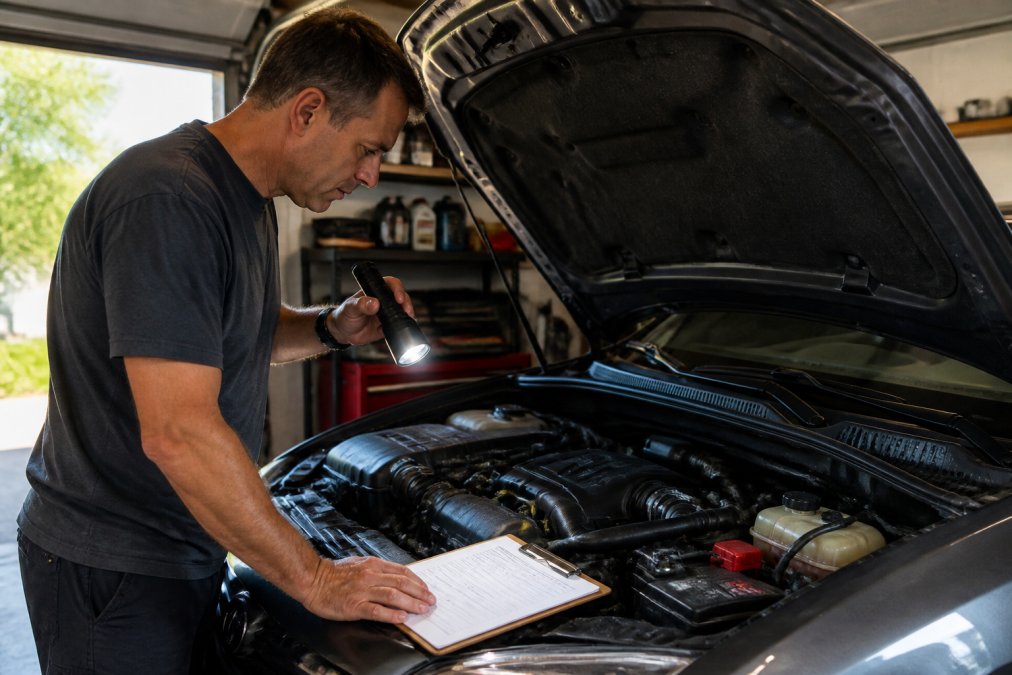
A 100,000 mile service checklist covers the components most likely to fail between 100,000 and 150,000 miles: fluids, filters, belts, battery, brakes, and suspension. Work through it once at the milestone, then fold each item into your ongoing service interval. Knowing the failure mechanism behind each line item lets you judge urgency instead of guessing.
Fluids, Filters, and Belts to Replace
Fluids degrade with heat cycles, not just miles. Transmission fluid, brake fluid, and coolant should be replaced at this milestone unless your records show a recent service. Automatic transmission fluid (ATF) carries friction modifiers that shear down over time, degrading shift quality and wearing clutch packs faster. Brake fluid is hygroscopic, absorbing moisture that lowers its boiling point and invites corrosion in the calipers and ABS module. Coolant loses its corrosion inhibitors and its pH drifts, which is what actually eats water pumps and radiator cores.
Filters are the cheapest line items and the easiest to verify.
Battery, Brakes, and Suspension Checks
Battery health is the most common surprise failure on a high-mileage car. Check terminal corrosion, look for a swollen case, and have the battery load-tested rather than relying on a voltage reading alone. A battery can show 12.6 volts at rest and still fail under cranking load. Most batteries last three to five years, and heat shortens that more than cold does.
Pro Tip Build the checklist around what you can verify yourself. A $20 tread depth gauge, a $15 brake fluid test strip, and a flashlight will catch most of the items above before they become a tow bill.What to Skip at 100,000 Miles
Not every upsell belongs on the list. Fuel injector flushes, engine flushes, and throttle body cleanings are frequently pushed at this mileage without a symptom to justify them. If the engine idles smoothly and passes an emissions check, those services can usually wait. The exception is a direct-injection engine with known intake valve carbon buildup, where a walnut blast may be warranted for rough idle or misfires.
High Mileage Oil vs Standard Oil: What Actually Protects Your Engine
High mileage oil is formulated with seal conditioners and a slightly higher viscosity to reduce oil consumption and slow leaks in older engines. Standard oil still meets the manufacturer's specification, but it does not address the wear patterns that develop past 100,000 miles.
Watch Out Never jump to a thicker viscosity than the manufacturer specifies to "quiet" an older engine. It can reduce oil flow to tight clearances and accelerate wear instead of preventing it.Tires, Fluids, and Wear Items: Your Ongoing Service Interval
Tire rotation and pressure checks anchor your ongoing schedule. Rotate tires at the manufacturer's recommended interval, check pressure monthly, and measure tread depth with a gauge rather than by eye. Uneven wear points to alignment or suspension problems worth investigating early.
Preventative Maintenance Tracking Tools That Keep Records Straight
Preventative maintenance tracking tools replace the shoebox of receipts with a single service history. The requirement is simple: the tool must tie reminders to both time and mileage, because high-mileage cars age on two clocks at once.
Key Takeaway The best tracking tool is the one you will actually update. If logging a service takes more than a minute, you will stop doing it within a month.Repair or Replace? A Cost-Benefit Framework for High Mileage Cars
The repair-or-replace decision comes down to one ratio: annual repair cost versus the cost of replacing the vehicle. If repairs stay below roughly a year's worth of payments on a replacement, keeping the car usually wins. Once a single repair approaches half the vehicle's value, replacement deserves serious consideration. But the ratio alone is not enough, because it treats every repair as equal when some are one-time costs and others are the first domino in a chain.
The 50% Rule and the Annual Payment Test
Two rules of thumb do most of the work. The 50% rule says that if a single repair costs more than half the vehicle's current market value, replacement is usually the better financial move. The annual payment test says that if projected repair and maintenance spending over the next 12 months exceeds 12 months of payments on a replacement vehicle, the math favors replacing.
One-Time Repairs vs. Recurring Repairs
The most useful distinction is whether a repair is a one-time event or the start of a pattern. A failed alternator at 120,000 miles is a one-time repair. A car that has needed a water pump, then a radiator, then a heater core in 18 months is telling you the cooling system is at end of life, and more failures are coming.
A practical way to frame it:
- List every repair completed in the last 12 months and total the cost.
- List every repair a mechanic has flagged as "coming soon" and estimate the cost.
- Add the two numbers. That is your realistic 12-month exposure.
- Compare that exposure to 12 months of payments on a replacement, plus the down payment.
- If exposure exceeds the payment figure and the car has no sentimental or practical reason to keep it, replacement wins.
The Factors the Ratio Ignores
Several factors sit outside the math and can flip the decision:
- Safety systems. A car with failing brakes, steering, or airbag components is not a financial decision, it is a safety decision.
- Reliability risk. A car that has stranded you twice in a year carries a cost the spreadsheet does not capture: missed work, tow bills, and rental cars.
- Resale value. A car with a documented service history holds more value at resale. Buyers pay for proof, and a clean record can add hundreds to the sale price compared to a car with no records.
- Replacement cost. In a market where used-car prices are elevated, the replacement math shifts. A $3,000 repair on a car worth $8,000 can still be the cheaper path if the alternative is a $25,000 replacement.
- Emissions and inspection. A car that cannot pass a state emissions or safety inspection has a hard deadline attached to the decision.
When to Get a Second Opinion
Before committing to a major repair, get a second estimate from an independent shop. Dealer service departments and independent shops often quote significantly different prices for the same job, and a second opinion can reveal whether the diagnosis itself is correct. Ask for the specific failure, the test that confirmed it, and whether the repair is safety-critical or can be deferred.
DIY vs. Mechanic: Which High Mileage Jobs to Hand Off
DIY handles inspection and light-replacement work; a mechanic handles anything requiring a lift, specialized tools, or a torque-critical procedure. Oil changes, air filters, cabin filters, wipers, and battery checks are within reach for most owners. Timing belt replacement, transmission fluid service on a sealed unit, and brake fluid flushes are jobs to hand off.
Frequently Asked Questions
What maintenance needs to be done on a high mileage car?
Once a car passes 100,000 miles, the priority list shifts. Replace the timing belt and serpentine belt if due, flush brake fluid and coolant, swap transmission fluid, and check spark plugs, hoses, and the battery. Tires need rotation every 5,000 to 7,000 miles with tread depth checked monthly. Follow your owner's manual for the manufacturer's recommended service interval, then add inspections for suspension components and chassis lubrication.
What fluids should be replaced at a 100,000 mile service?
At 100,000 miles, plan on a brake fluid flush, a coolant system exchange, and transmission fluid replacement if it has not been done. Power steering fluid and differential fluid may also be due depending on your drivetrain. Engine oil and the oil filter still follow your normal interval, but consider high mileage oil if you notice consumption or leaks. Check the owner's manual for exact specs.
Is high mileage oil worth it compared to standard oil?
High mileage oil contains seal conditioners and a slightly thicker viscosity that can reduce leaks and oil burning in older engines. If your car uses oil between changes or shows minor seepage, it is worth trying. If your engine runs clean with no consumption, standard synthetic oil at the correct viscosity still protects it well. Match whatever grade your manufacturer recommends.
What is the $3,000 rule for cars?
The $3,000 rule is a rough guideline some owners use when deciding whether to repair or replace a high mileage vehicle. If a single repair costs more than the car's current market value, or if annual repair costs approach the price of a replacement, replacement often makes more sense. It is not a hard formula. Compare the repair estimate against the vehicle's resale value and your budget.
Start free