 carjourney
From the CarJourney journal
What Is a Maintenance Log for Your Vehicle?

Keeping track of your car’s service history sounds straightforward until you realize that most people are working from memory, a handful of crumpled receipts, or nothing at all. A maintenance log fixes that. At its core, a maintenance log is a chronological, structured record of every maintenance task performed on your vehicle. Understanding what it contains, why it matters, and how to build one can protect your warranty, boost your resale value, and save you from preventable breakdowns. This guide covers everything you need to know.
Table of Contents
- Key takeaways
- What is a maintenance log, exactly?
- What to include in a maintenance log
- How to create a maintenance log
- The real benefits of keeping a maintenance log
- Manual vs. digital maintenance logs
- My honest take on why most people skip this
- Track your vehicle history with Carjourney
- FAQ
Key takeaways
| Point | Details |
|---|---|
| Maintenance log definition | A structured, chronological record of every service task performed on your vehicle. |
| Core fields matter | Date, odometer reading, service type, and parts used are the minimum for an effective log. |
| Proof for warranties and resale | Consistent dated entries with mileage notes are the evidence that converts care into credibility. |
| Digital beats scattered receipts | Apps and trackers preserve interval timelines far better than shoeboxes full of paper. |
| Start simple, stay consistent | Log every service the same day it happens to avoid gaps that weaken claims later. |
What is a maintenance log, exactly?
A maintenance log is more than a list of service dates. According to the maintenance log definition from maintenance specialists, it captures “who did what, when, why, and with which parts,” creating a living document that feeds your vehicle’s full service history over its entire life. That is a fundamentally different thing from a receipt in your glove box.
A receipt tells you money changed hands. A maintenance log tells a story. It records the service date, the mileage at the time of service, who performed the work, what parts were used, and what the next recommended service interval is. Strung together over months and years, those entries become the official upkeep history of your vehicle.
A maintenance log functions as the official history of an asset’s upkeep and supports failure analysis, compliance audits, and planning for future maintenance. It is the primary, systematic record that feeds maintenance history over a vehicle’s life.
The purpose of maintenance logs goes well beyond organization. A well-kept log supports warranty claims when a dealer disputes whether you followed the manufacturer’s schedule. It proves to a prospective buyer that your car was maintained properly. For commercial operators, structured maintenance records are not optional. Under U.S. regulation 49 CFR 396.3, motor carriers must keep records showing vehicle ID, inspection dates, and repair history, retained for at least one year. That legal framework exists because scattered informal records simply do not hold up.
What to include in a maintenance log
The difference between a useful maintenance log and a useless one comes down to what fields you capture. A log with only “oil change, March” leaves out the mileage, the product used, and the next due date. That missing data is exactly what you need when a warranty dispute arises.
Here is a comparison of basic versus thorough log fields, and the purpose each one serves:
| Field | Basic log | Thorough log | Purpose |
|---|---|---|---|
| Service date | ✓ | ✓ | Establishes timeline |
| Odometer reading | ✗ | ✓ | Proves service intervals |
| Type of service | ✓ | ✓ | Identifies what was done |
| Parts and fluids used | ✗ | ✓ | Verifies spec compliance |
| Service provider or shop | ✗ | ✓ | Confirms accountability |
| Cost | ✗ | ✓ | Supports budget tracking |
| Next service due | ✗ | ✓ | Drives proactive scheduling |
| Technician name or ID | ✗ | ✓ | Adds traceability |
A practical vehicle maintenance log structure includes all of those thorough fields, plus optional notes for any abnormalities observed during service. That “notes” field catches things like “mechanic noticed slight brake wear” before it becomes a $600 problem.
Pro Tip: Link every receipt or photo of the work order directly to the log entry for that date. A photo on your phone that sits in an unmarked folder three years later is nearly impossible to use as evidence. An attached receipt tied to a specific mileage entry is bulletproof.
Understanding maintenance logs at this level of detail also helps you spot gaps. If you pull your current records and realize you have no mileage notation for the last two oil changes, you already know where your log needs work.
How to create a maintenance log
You do not need special software or a complex spreadsheet to start. The best log is the one you will actually maintain. Here is a practical approach to building and keeping one:
- Choose your format. A dedicated notebook, a printed template stored in a folder, a spreadsheet, or a purpose-built app all work. Pick the one that fits your habits, not the one that looks most impressive.
- Record the basics at every service. Date, current odometer reading, type of service, and who performed it. That four-field minimum is infinitely better than nothing.
- Log it the same day. Delayed logging or reconstructing service dates after the fact creates gaps that weaken warranty claims. Memory fades fast, and “sometime in November” is not a date a manufacturer will accept.
- Attach receipts or photos immediately. Take a photo of the receipt before you leave the shop. Mileage at service plus a dated receipt is the combination that satisfies most warranty and resale scrutiny.
- Set your next service reminder. Whether by mileage or calendar date, record the next due date in the same log entry. This turns your log into a proactive scheduling tool, not just a backward-looking record.
- Review the log at every oil change. Use that regular touchpoint to check for any missed entries and to see whether any upcoming services are due.
For tracking vehicle maintenance across multiple vehicles or complex builds, digital tools add a layer of automation that paper cannot match. Odometer-linked reminders, searchable history, and cloud backup all reduce the friction that causes people to fall behind.
Pro Tip: A time-stamped maintenance checklist that tracks monthly and seasonal tasks alongside your log entries dramatically reduces the chance of skipping something critical, like checking fluids before a long trip.
The real benefits of keeping a maintenance log
If you have ever tried to negotiate a warranty claim without documentation, you already understand the stakes. If you have not, here is what a thorough maintenance tracking log actually delivers:
- Warranty protection. Manufacturers can deny warranty claims if you cannot prove you followed the maintenance schedule. Consistent dated receipts plus mileage notes taken the same day as service are the proof that matters. A log ties those pieces together in one place.
- Higher resale value. A buyer presented with a complete, organized service history has no reason to haggle on price for unknown maintenance risk. A vehicle with no paper trail practically invites low offers.
- Fewer unexpected breakdowns. Linking maintenance events to odometer readings is the only reliable way to track service intervals. A log that shows your last transmission fluid change at 67,000 miles tells you at 90,000 miles that you are overdue. Memory alone will not do that.
- Budget clarity. Logging costs over time reveals spending patterns. If you spent $1,800 on your vehicle last year, you can plan for roughly the same next year, or recognize that repair frequency is trending upward.
- Safety and accountability. Accurate maintenance records identifying what was done, when, and by whom enable traceability when something goes wrong. That matters whether you are the owner, a mechanic, or a future buyer.
The benefits of maintenance records compound over time. A log started today becomes genuinely valuable in two years. One started “eventually” never gets there.
Manual vs. digital maintenance logs
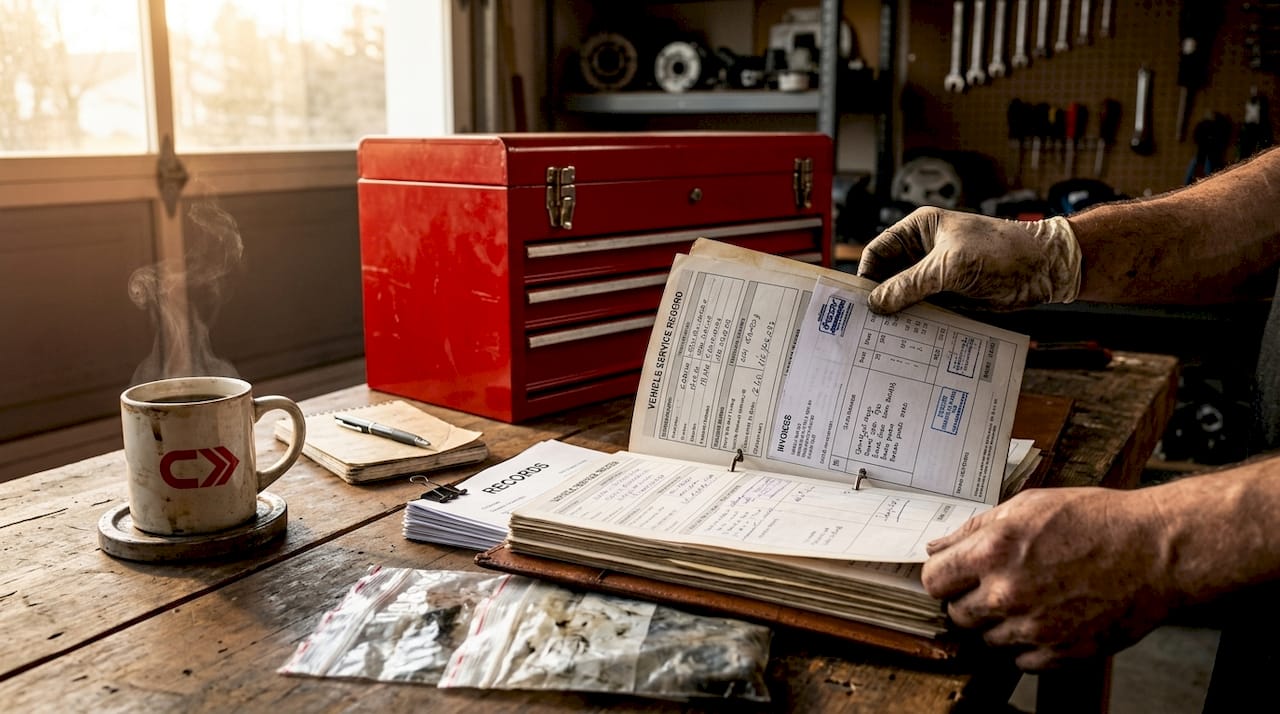
Both formats work. The question is which one you will actually stick with.
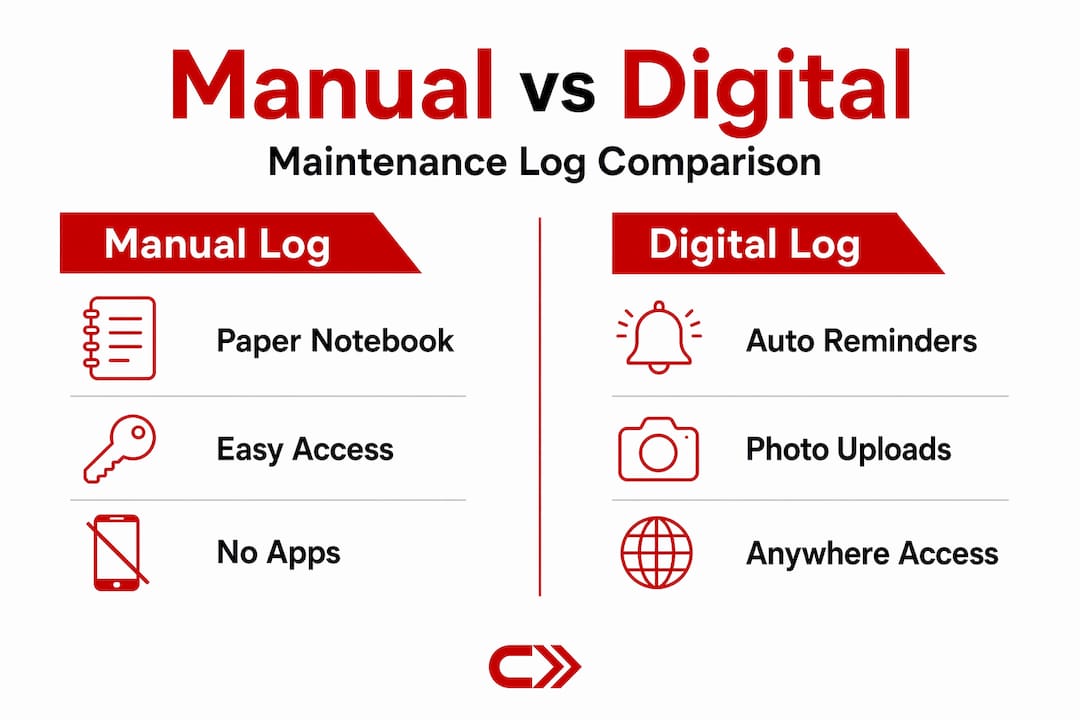
| Format | Pros | Cons |
|---|---|---|
| Notebook or binder | No tech needed, always accessible, no subscription | No reminders, no search, easily lost or damaged |
| Printed template | Structured fields, easy to store with receipts | Same limitations as a notebook |
| Spreadsheet | Customizable, searchable, shareable | Requires discipline to update, no automatic reminders |
| Dedicated app or tracker | Reminders, odometer tracking, cloud backup, searchable history | Depends on the platform staying active |
Paper logs have a real advantage for people who distrust apps or prefer a physical record they can hand to a buyer. The act of writing by hand also tends to stick in memory better, which means you are less likely to forget the entry later.
Digital tools win on accessibility and automation. A quality auto maintenance tracker can notify you when your next oil change is due based on mileage, pull up your full history in seconds during a warranty call, and store photos of receipts alongside log entries. For anyone managing more than one vehicle, or anyone who has ever lost a paper receipt, the case for going digital is strong.
The hybrid approach works too. Keep a simple notebook in the glove box to capture the basics immediately, then transfer the data to a digital tool at home. You get the immediacy of paper with the organization of software.
My honest take on why most people skip this
I have talked to a lot of vehicle owners about their record-keeping habits, and the pattern is nearly always the same. They start strong when the car is new, log the first two or three oil changes, then fall off when life gets busy. Two years later, they have a folder with maybe four receipts and a warranty issue with no documentation to back it up.
The mistake most people make is treating the log like a project rather than a habit. A project has a start date, a finish line, and momentum that fades. A habit is something you do in under two minutes at the moment of service, every single time.
In my experience, the people who maintain the best logs are not more organized by nature. They have just reduced the friction to near zero. A note on their phone, an app that opens in two taps, or a template already sitting in their glove box. The format is less important than the trigger. Service happens, log gets updated. That’s the whole system.
I have seen firsthand how a clean, complete log shifted a resale negotiation in the owner’s favor without a single word of convincing. The buyer looked at the history, saw every oil change, every tire rotation, every fluid flush with mileage attached, and made a strong offer. The log did the talking.
— Chally
Track your vehicle history with Carjourney
If building a maintenance log from scratch feels like more friction than you want to deal with, Carjourney was built specifically to take that friction away.
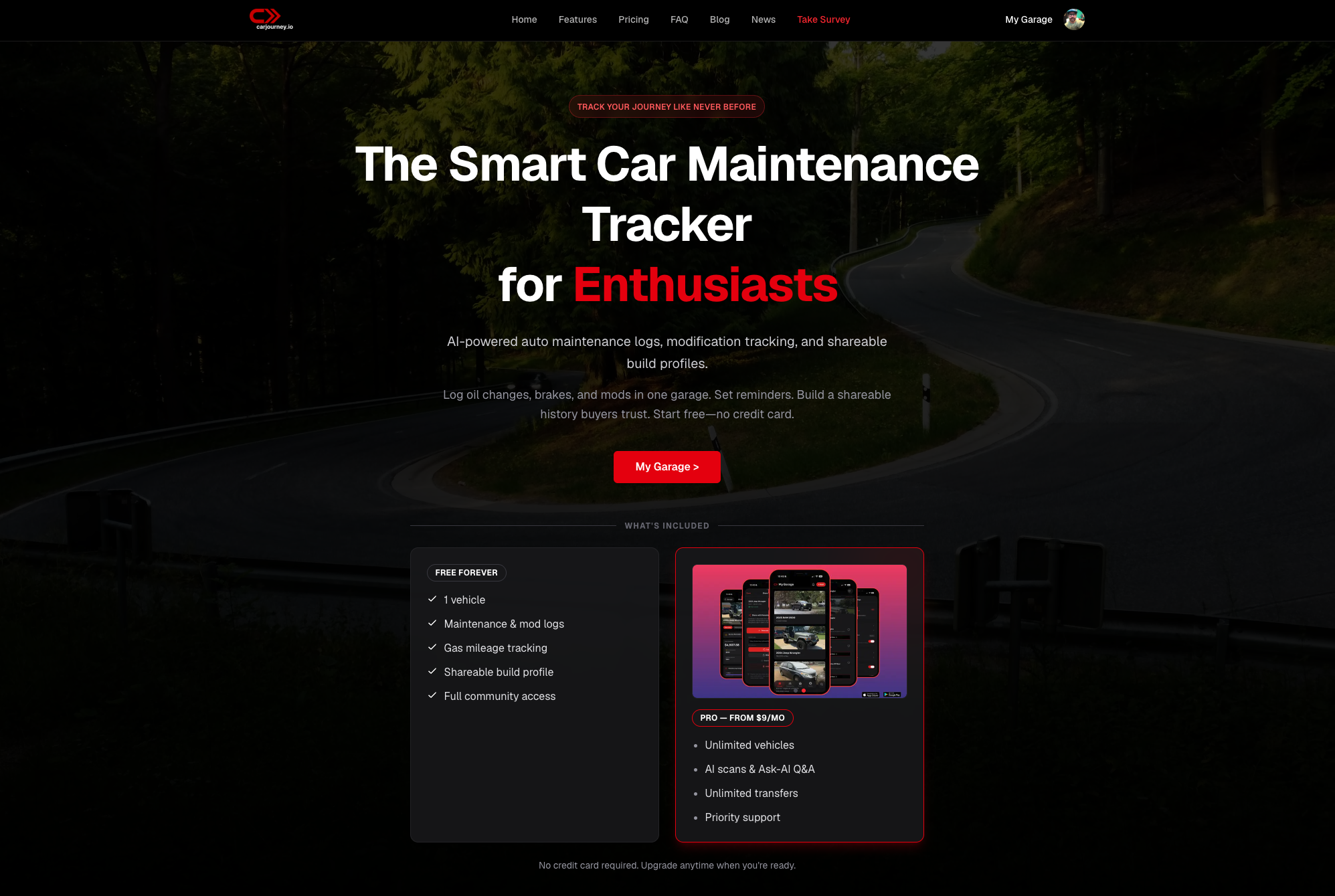
Carjourney is a car maintenance tracker designed for vehicle owners who want a real history, not a shoebox of receipts. It uses AI to scan your service documents, tracks your odometer, sets mileage-based reminders, and keeps your full service history searchable and ready for warranty or resale moments. Whether you own one car or a small fleet, the CarJourney maintenance tracker gives you the structure that manual logs rarely achieve long-term. Start building your vehicle’s history today at CarJourney.
FAQ
What does a maintenance log include?
A maintenance log includes the service date, odometer reading, type of work performed, parts or fluids used, service provider, cost, and the next recommended service date. More thorough logs also include technician names, notes on observed conditions, and attached receipts.
Why is a maintenance log important for vehicle owners?
A maintenance log provides verifiable proof of care for warranty claims, supports higher resale value, helps you track service intervals accurately, and creates an accountability record if something goes wrong with the vehicle.
Is a receipt the same as a maintenance log?
No. A receipt confirms a transaction but rarely includes all the detail needed for warranty or resale purposes. A structured service history ties receipts to specific mileage entries and service descriptions, creating a complete and credible record.
How often should I update my maintenance log?
You should update your maintenance log the same day any service is performed. Waiting even a few days increases the risk of missing details, and reconstructed records are far less credible than same-day entries.
Can I keep a maintenance log digitally?
Yes, and for most vehicle owners a digital log is more reliable long-term. Digital tools offer searchable history, automatic reminders tied to mileage, and cloud backup that protects your records if your vehicle is damaged or sold.