 carjourney
From the CarJourney journal
Legal Requirements for Modified Car Inspections Explained
Table of Contents
- State Laws on Vehicle Modifications: What Varies by State
- Vehicle Safety Inspection Checklist for Modified Cars
- Emissions Testing for Modified Cars and Common Failure Points
- Exhaust, Muffler, and Engine Modifications That Can Fail Inspection
- Modified Car Inspection Documentation: What to Bring
- Insurance, Aftermarket Parts Certification, and Your Next Inspection
- Frequently Asked Questions
Last Updated: November 4, 2026
A modified car inspection is not the same as the routine safety check your mechanic runs on a stock vehicle. Readers who want a step-by-step guide to modifying vehicles safely and legally in the US can use this guide to modifying vehicles safely and legally to make sure their build passes inspection.
Most friction comes from paperwork and parts, not workmanship. Owners buying or owning undocumented modified cars can review the legal risks of undocumented modified cars before they face an inspector.
Here is how the two inspection types differ in practice:
- Scope: A standard check compares the car to factory specs. A modified check compares it to the rules for each change.
- Paperwork: Standard inspections rarely require receipts. Modified inspections often do.
- Failure points: Stock cars fail on worn brakes or tires. Modified cars fail on lighting, exhaust, ride height, and emissions equipment.
Treat the inspection as a verification exercise: assemble your evidence before you arrive, and you will spend far less time arguing about what the inspector can see.
State Laws on Vehicle Modifications: What Varies by State
Vehicle modification law in the United States is built in layers, and knowing which layer governs your build is the biggest time-saver before an inspection:
- Federal equipment standards. NHTSA sets Federal Motor Vehicle Safety Standards (FMVSS) for lighting, glazing, and brake systems, applying to vehicles as manufactured and to replacement equipment sold for street use. A part marked "off-road use only" is generally not legal for street use regardless of state law.
- Federal emissions authority. The EPA regulates emissions equipment nationally, and the Clean Air Act prohibits tampering with or removing emissions controls on certified vehicles. California's Air Resources Board (CARB) sets its own standards under a waiver, and a group of states have adopted the CARB program.
- State equipment statutes. States write their own rules for exhaust noise, tint, ride height, lighting color and placement, and bumper height, the rules an inspector or officer actually enforces.
That layering explains why the same exhaust system can be legal in one state and a citation in another: the federal tampering rule applies everywhere, but the noise limit that triggers a stop is a state number.
The Three Inspection Program Types You Will Encounter
Most states fall into one of three buckets, and knowing which bucket you are in tells you when your build will be scrutinized:
- Periodic safety inspection. A scheduled check, often annual or biennial, covering brakes, lights, tires, steering, suspension, glass, and exhaust. Modified vehicles get a closer look at lighting aim, ride height, and exhaust integrity.
- Emissions-only inspection. A smog check required in certain counties or metro areas, usually tied to model year and vehicle weight. Tunes, catalytic converter changes, and engine swaps cause the most failures here.
- Registration or transfer inspection. A one-time check when a vehicle is titled, registered, or transferred, often verifying the VIN and that the car matches its paperwork. This catches engine swaps and reconstructed titles.
A handful of states run no periodic inspection, but that does not make illegal modifications lawful. Equipment statutes still apply, and an officer can cite a non-compliant exhaust, tint, or lighting setup during a traffic stop.
Where the Numbers Actually Diverge
When you pull your state's equipment statutes, focus on these five thresholds, because they are the ones inspectors measure:
- Exhaust noise. Limits are usually expressed in decibels (dB) at a specified distance and engine speed, often at idle and at higher RPM. Some states reference a manufacturer's original specification instead of a fixed dB number, making documentation of the stock system valuable.
- Window tint. Measured as visible light transmission (VLT) percentage, with separate minimums for the windshield, front side windows, and rear windows. Reflectivity limits and rules on colored or mirrored film are separate from VLT.
- Ride height and bumper height. Some states cap frame or bumper height from the ground; others regulate suspension travel or require minimum ground clearance. Lift plus larger tires can push you over a limit the lift alone would not.
Check your state motor vehicle agency's equipment statute page and inspection program page directly. Forum summaries frequently quote another state's numbers or an older version of the rule.
Interstate Travel and Cars Registered in Another State
A car registered in one state does not get a pass when you drive it through another. Officers generally enforce the equipment laws of the state where they stop you, so a build that passed inspection at home can still draw a citation on a road trip.
If you travel often, research the stricter rules on your route and carry your documentation, including receipts and compliance paperwork, so you can explain your build quickly if questioned.
NHTSA Federal Motor Vehicle Safety Standards EPA vehicle emissions tampering rules
Vehicle Safety Inspection Checklist for Modified Cars
A safety inspection on a modified car focuses on the systems that change most when you alter a vehicle. Work through the list below before you book the inspection, and fix anything out of spec.
- Brakes: pads, rotors, lines, and fluid condition. Upgraded brake lines should be documented.
- Tires: tread depth, sidewall condition, and whether tire size fits without rubbing.
- Steering and suspension: play in joints, bushings, and alignment.
Ride Height, Suspension Lifts, and Ground Clearance
Ride height is one of the most common reasons modified vehicles fail. Many states set limits on how high a bumper or frame can sit, and some measure ground clearance at specific points.
Measure your vehicle before the inspection, including with the tires you actually run, and keep a record of the lift kit part numbers and before-and-after measurements. You can also learn how to document suspension upgrades with numbers, alignment data, and costs to support your records.
Windshield Tint, Lighting, and Visibility Rules
Tint and lighting are checked closely because they affect how other drivers and police see the road. Tint is typically measured as the percentage of light passing through the glass, with different minimums for the front windshield, front side windows, and rear windows.
Lighting rules cover color, brightness, and placement. Underglow, certain LED strips, and non-approved headlight conversions often violate state law. Confirm each light's legal status before you install it, and keep the packaging or specification sheet for reference.
Emissions Testing for Modified Cars and Common Failure Points
Emissions testing is where many modified cars fail, sometimes for unexpected reasons. The test is usually a combination of three checks, each of which can fail independently:
- Visual inspection. The inspector confirms required emissions components are present, connected, and correctly certified. A missing catalytic converter, an unplugged EGR valve, or a disconnected evaporative canister fails here before any measurement.
- OBD-II scan. On most vehicles from the mid-1990s onward, the test reads the onboard diagnostic system, checking for stored trouble codes and verifying that readiness monitors have completed. A recent battery disconnect or ECU reflash can leave monitors "not ready," an automatic fail in many programs even with no active codes.
- Tailpipe measurement. Where required, a probe measures exhaust gases at idle and under load. A car that runs cleanly on the road can still fail if a sensor is unplugged, a vacuum line is disconnected, or an exhaust leak ahead of the oxygen sensor distorts the reading.
CARB-Compliant vs. Non-Compliant Aftermarket Parts
This is the distinction that decides most modified-car emissions outcomes, and it is the one most guides skip. Aftermarket parts fall into two categories:
- CARB-compliant (executive order) parts. A part evaluated by the California Air Resources Board carries an Executive Order (EO) number. In CARB-adopting states, an inspector looks for that EO number on the part or in your paperwork.
- Non-compliant parts. A part sold "for off-road use only," a "test pipe" or catless downpipe, or a replacement converter without an EO number is not legal for street use in CARB-adopting states and generally violates the federal tampering rule everywhere. No receipt makes a non-compliant part compliant; the certification is the part's status, not your paperwork.
A common pattern is an owner who buys a well-made intake or exhaust that performs well but lacks an EO number, then fails the visual or documentation check even though the car passes the tailpipe test. Because approval rules vary by jurisdiction, checking performance exhaust legality in Ontario can clarify why a part accepted under one inspection program may still require different documentation elsewhere.
Common Emissions Failure Points
- Removed or disabled catalytic converters, including "test pipes" and catless downpipes
- Aftermarket tunes that alter fuel or timing maps and leave readiness monitors incomplete
- Missing or modified EGR, evaporative, or oxygen sensor equipment
Before testing, scan for diagnostic trouble codes and fix any that appear, then drive the car through a complete drive cycle so the readiness monitors set.
Watch out: clearing codes right before the test is a common mistake. It resets the readiness monitors, and an inspector who sees "not ready" may fail the car even though no code is present.
CARB Executive Order parts search
The article breaks down the three checks that can fail a modified car at emissions testing.
| Check | What the inspector looks for | Common failure |
|---|---|---|
| Visual inspection | Required emissions parts present, connected, certified | Missing converter, unplugged EGR valve |
| OBD-II scan | Stored trouble codes and completed readiness monitors | Monitors "not ready" after battery disconnect or ECU reset |
| Tailpipe measurement | Exhaust gas levels at idle and under load | Exhaust leak ahead of oxygen sensor, disconnected vacuum line |
Exhaust, Muffler, and Engine Modifications That Can Fail Inspection
Exhaust systems are a frequent point of contention. Most states regulate noise levels, and some require the original emissions equipment to remain. A straight pipe or race muffler may be legal on a track day and illegal on the street, depending on the local decibel limit.
Pay attention to the following:
- Catalytic converter presence and certification: many states require a certified replacement
- Muffler noise limits and how they are measured
- Exhaust routing, which must not expose the cabin to fumes or drag on the road
Keep the part numbers and any emissions compliance labels on the components. If a part is marked as certified for your state or meets a specific standard, that documentation is your strongest evidence at inspection.
Modified Car Inspection Documentation: What to Bring
Documentation is the difference between a quick pass and a lengthy dispute. Inspectors cannot verify parts they cannot identify, so organized records make the process faster and more credible.
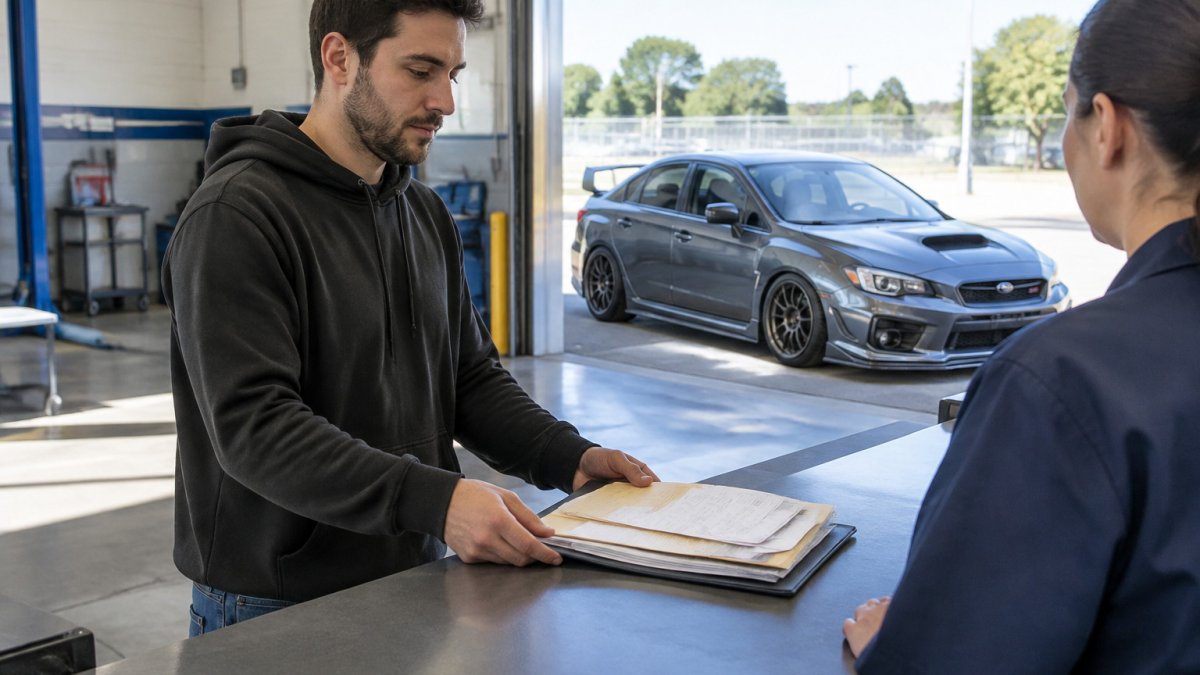
A practical document packet includes:
- Registration and proof of ownership
- Receipts for every major modification, with part numbers and dates
- Photos of installed parts, including labels and certification marks
- Measurements for ride height, tire size, and tint levels
- Emissions compliance documents for any catalytic converter or engine change
- A written list of all changes made to the vehicle
Log every modification as you make it rather than reconstructing the history later.
Watch out: if a part has no receipt and no label, the inspector may treat it as non-compliant until you prove otherwise.
Insurance, Aftermarket Parts Certification, and Your Next Inspection
Modifications can also affect your insurance. Confirm with your insurer which changes must be disclosed.
Aftermarket parts certification matters for the same reason. Look for components carrying a recognized compliance mark or a letter stating they meet the relevant federal or state standard.
Before your next inspection, review your records, confirm each modification's legal status in your state, and address anything on the checklist above.
Frequently Asked Questions
What states allow modified cars?
Most states allow modified cars on public roads as long as the modifications meet that state's equipment rules. Some states apply strict rules to exhaust noise, lighting, tint and emissions equipment. Others focus mainly on basic safety items like brakes, tires and lights. Because rules differ so much, check your state's motor vehicle agency or DMV site before you buy parts. A modification that is legal in one state can still fail an inspection in another state.
Do modified cars need a special inspection?
Many states do not require a separate inspection for modified cars, but they apply their normal safety or emissions inspection to the modified vehicle. Some states require a modified or custom vehicle to pass a specific equipment check before registration, especially when a car is re-titled after a major change such as a engine swap or frame modification. Ask your local inspection station or DMV whether your modification triggers extra steps.
Can you pass inspection with an aftermarket exhaust?
It depends on your state and the exhaust design. Many states require exhaust systems to include working mufflers and to stay within noise limits, and they require catalytic converters to remain in place on cars that must pass emissions testing. Some aftermarket exhausts are sold as 'off-road' or 'race use only' and are not legal for street use. Look for parts labeled as compliant with your state's noise and emissions standards before installing them.
What documents should I bring to a modified vehicle inspection?
Bring your registration, proof of insurance and a government-issued photo ID. For modified cars, also bring receipts or invoices for major parts such as lift kits, exhaust systems, tint film and engine components. If a part has a certification, emissions compliance label or CARB Executive Order number, bring that paperwork too. Organized records help an inspector verify that a part is legal and installed correctly, and they speed up the process.
How do I find my state's inspection requirements for a modified car?
Start with your state's DMV or motor vehicle agency website, which lists safety and emissions inspection rules and any equipment restrictions. Search the state's vehicle code for the specific modification you have in mind, such as tint percentages or ride height limits. You can also call an authorized inspection station and ask how they check modified vehicles. Save the rules you find, since they can change and you may need to show them if an inspector questions a part.
What modifications can cause a car to fail inspection?
Common failure points include lift kits that raise the vehicle beyond the allowed height, window tint darker than state limits, lights that are the wrong color or too bright, loud or missing mufflers, and tires that stick out past the fenders. Removed or disabled emissions equipment, including catalytic converters, is a frequent cause of failure in emissions-tested areas. Tires and wheels that do not meet load ratings can also fail a safety check.
Can a car fail inspection for modifications that are legal in another state?
Yes. Inspections are based on the rules of the state where the car is registered, not the state where the part was bought or installed. If you move to a new state or drive a car registered elsewhere, you must meet local rules. Check the new state's requirements before transferring registration, because a modification that passed in your old state may need to be removed or changed.
Start free