 carjourney
From the CarJourney journal
7 Legal Risks of Buying Undocumented Modified Cars
Last Updated: November 3, 2026
Quick Summary
Buying undocumented modified cars means inheriting compliance problems that transfer with the vehicle, from EPA Clean Air Act tampering violations to failed state inspections and disputed insurance claims. Enforcement generally follows the current owner, so you must restore a non-compliant car to pass. A documented paper trail is your main defense.
- Federal law prohibits removing or disabling emissions control devices, and the risk transfers with the vehicle to you.
- Manufacturers can deny a specific warranty claim if they show the modification caused the failure.
- Undisclosed modifications can give an insurer grounds to dispute a claim after a crash.
- Fix-it citations commonly run into the low hundreds of dollars per violation, plus sign-off time.
- Confirm your state's titling, registration and license document requirements before money changes hands.
Table of Contents
- Why Undocumented Modified Cars Are a Legal Gamble
- EPA Clean Air Act Vehicle Tampering: The Federal Risk You Inherit
- Voided Warranties and Manufacturer Specifications
- Insurance, Civil Liability, and Who Pays After a Crash
- State Inspections, Fix-It Tickets, and Vehicle Impoundment
- Registration Status and Driver License Requirements for Non-Citizens
- How to Document Car Modifications for Resale
- Your Pre-Purchase Inspection Checklist for Modified Cars
- Frequently Asked Questions
Why Undocumented Modified Cars Are a Legal Gamble
Buying a car with unrecorded modifications means inheriting someone else's compliance problems, and those problems do not stay with the seller. The legal risks of buying undocumented modified cars range from failed emissions inspections to civil liability after a crash, and most surface only after the title changes hands.
The core problem is asymmetry. The seller knows what was done to the car. You see a cold air intake, a lowered stance, and a cat-back exhaust, and you assume that is the whole story. It rarely is.
EPA Clean Air Act Vehicle Tampering: The Federal Risk You Inherit
EPA Clean Air Act vehicle tampering is the alteration or removal of emissions control equipment, and it is illegal under federal law regardless of whether you did the work. The risk transfers with the vehicle.
What Counts as Tampering Under Federal Law
Under the Clean Air Act vehicle tampering provisions, it is illegal to remove or render inoperative any emissions control device on a motor vehicle, and that includes catalytic converters, oxygen sensors, and exhaust gas recirculation systems. Deleting a catalytic converter or installing a "defeat device" that tricks the onboard diagnostics are the clearest examples. Swapping a stock ECU tune for one that disables emissions monitoring counts too.
Who Gets Cited When the Previous Owner Did the Work
Enforcement generally follows the current owner, not the person who paid for the work years ago. If a state inspection program or a federal auditor flags the vehicle, you hold a non-compliant car and must restore it to pass.
Watch out: a seller who says "it passes inspection where I live" is telling you about their county, not yours. Emissions testing requirements vary by state and sometimes by county, so a car that is fine in one zip code can fail the moment you register it elsewhere.
Voided Warranties and Manufacturer Specifications
A voided warranty is the most predictable cost of an undocumented build, and it is almost always avoidable with records. Manufacturers cannot void a warranty simply because a modification exists, but they can deny a specific claim if they can show the modification caused the failure (the FTC).
5 Illegal Car Mods Police Are Targeting Across the USA in 2026 🚨
Car Care Xpert
The practical problem is burden of proof. If a tuned engine throws a rod and you have no service history and no documentation of the tune, the dealer holds all the cards.
Manufacturer specifications exist for a reason. Suspension geometry, drivetrain integrity, and cooling capacity are engineered as a system. A lift kit that changes control arm angles without correcting the geometry accelerates wear on ball joints and CV axles.
Insurance, Civil Liability, and Who Pays After a Crash
Civil liability after a crash is where undocumented modifications can get expensive.
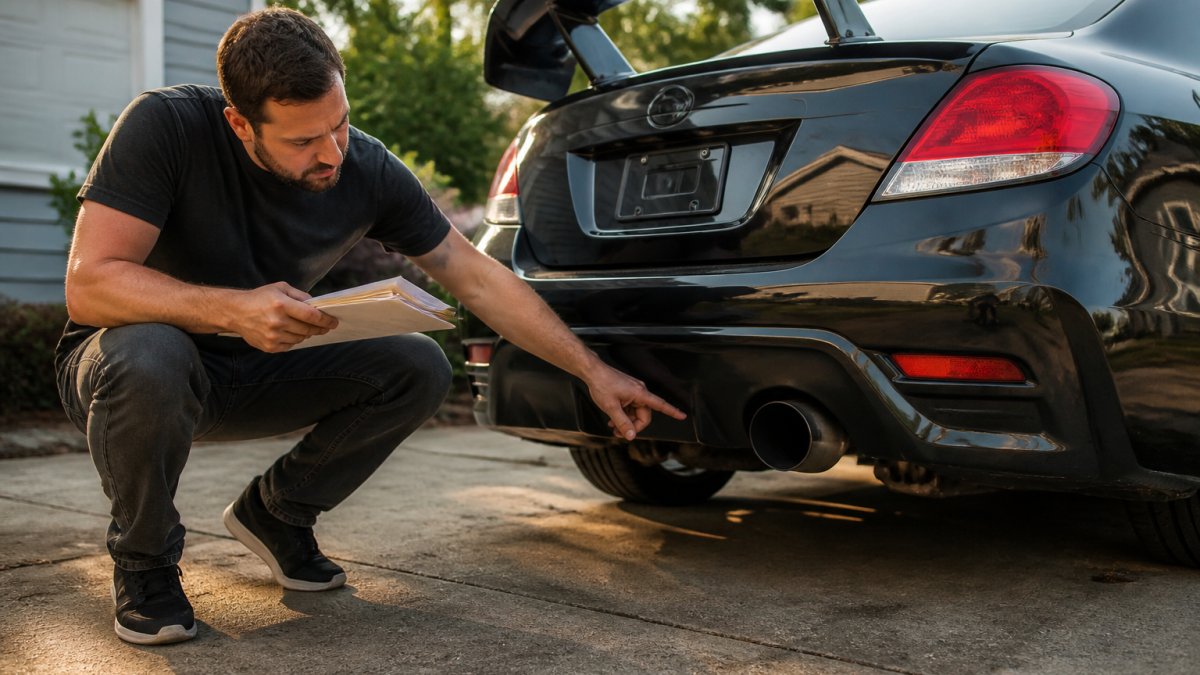
If your car has a suspension lift, an engine tune, or aftermarket brakes that were never disclosed, the insurer can argue it did not agree to insure that vehicle.
Documentation is your defense. Modification records support accurate coverage for the added value of your parts and make a claim easier to process after theft, damage, or a loss.
The man is American.
State Inspections, Fix-It Tickets, and Vehicle Impoundment
Roadworthiness is a state question, and states enforce it through inspection programs, equipment citations, and impoundment authority. The legal risk for a buyer is that compliance is determined by where you register and drive the car, not where the seller did.
How State Inspection Programs Actually Work
Inspection regimes fall into three rough categories, each creating a different exposure:
- Annual safety inspections. A handful of states run periodic safety inspections covering brakes, lights, tires, steering, and exhaust integrity. A modified car with a deleted muffler, non-DOT lighting, or a suspension change that alters ride height can fail before emissions is even considered.
- Emissions-only inspections. Many states require an OBD-II scan or tailpipe test in certain counties. A car with a deleted catalytic converter, a tuned ECU that disables monitors, or a missing oxygen sensor will fail readiness checks even if it runs clean.
- No periodic inspection. Several states have no annual program but still enforce equipment statutes during traffic stops and at registration.
A common pattern is that buyers check the seller's county rules and assume they apply at their own address. They do not. Emissions testing is often county-by-county, and a car that passed where it was sold can fail the moment you title it in a different jurisdiction.
Fix-It Tickets: What They Are and What They Cost
A fix-it ticket is a citation that gives you a compliance window to correct a violation and have it signed off, usually for equipment issues. Typical triggers include:
- Tinted windows that exceed the state's visible light transmission limit
- Missing or modified mufflers that exceed noise thresholds
- Non-compliant lighting, including aftermarket HID or LED swaps in halogen housings
Most fix-it citations carry a base fine plus an administrative or sign-off fee, commonly running into the low hundreds of dollars per violation. The bigger cost is time: you have to make the correction, get it inspected or signed off, and return proof to the court by a deadline.
Watch out: a fix-it ticket for an emissions-related modification is not always correctable by signing off. If the underlying part is illegal under federal law, correcting the citation does not make the vehicle compliant.
Impoundment and Registration Holds
Vehicle impoundment typically follows repeated violations, an inspection that finds the car unsafe to operate, or a stop where the driver cannot produce valid registration or insurance. Getting the car back usually requires:
- Payment of towing and storage fees, which accrue daily
- Proof of correction for the cited violation
- A re-inspection in some jurisdictions before release
Some states also place a registration hold on vehicles with unresolved citations or failed inspections, so you cannot renew the tag until the issue is cleared.
Traffic enforcement officers are not required to be automotive engineers. Maintaining a meticulous record of your modifications also serves as a safeguard against the safety hazards inherent in poor quality auto parts that often fail to meet the rigorous standards required for street legality.
The man is American.
Inspection regimes fall into three rough categories, each creating a different exposure.
| Inspection type | What it covers | Buyer exposure |
|---|---|---|
| Annual safety inspections | Brakes, lights, tires, steering, exhaust integrity | Deleted muffler, non-DOT lighting, altered ride height can fail |
| Emissions-only inspections | OBD-II scan or tailpipe test in certain counties | Deleted converter, tuned ECU, missing oxygen sensor fail readiness |
| No periodic inspection | Equipment statutes enforced at stops and registration | Still cited during traffic stops and at registration |
Registration Status and Driver License Requirements for Non-Citizens
Registration status and driver license requirements intersect in ways that catch non-citizen buyers off guard, and the confusion is compounded by the word "undocumented." In this article, "undocumented modified cars" means modifications with no paper trail. It does not refer to a person's immigration status.
The Distinction That Matters
A car can be legally registered and legally modified while the owner is a non-citizen. A car can also be illegally modified regardless of who owns it. Immigration status affects which documents a state accepts for a license or ID; it does not change whether a catalytic converter delete is legal under federal law.
Document Pathways Vary by State
States set their own rules for what identification they accept for a driver license, a state ID, and vehicle registration. The sets are not always identical. Some states issue driver licenses or privilege cards to residents who cannot provide a Social Security number, while others require one for registration even if they do not for a license.
Before you buy, confirm three things with your state motor vehicle agency:
- Which documents it accepts for titling and registration
- Which documents it accepts for a driver license or state ID
- Whether an ITIN, foreign passport, or consular ID is accepted for either purpose
Do this before money changes hands. A car you cannot register is a car you cannot legally drive, turning a purchase into a parked asset that still accrues insurance, storage, and depreciation costs.
What to Bring to the Title Transfer
The exact list varies, but most transactions require proof of identity, proof of insurance, a completed title transfer or bill of sale, and payment of sales tax and title fees.
Watch out: do not rely on a notary or a dealer to tell you what your state accepts.
Immigration status questions are best directed to an immigration attorney, not a car forum.
How to Document Car Modifications for Resale
Learning how to document car modifications for resale is the single highest-return habit in this article, because it converts every risk above into a selling point. For a deeper guide on documenting car modifications for buyers to build trust and protect resale value, see our dedicated article.
What a credible record includes:
- A dated log of every modification with mileage at install
- Receipts for parts and labor, with vendor names
- Photos of the install, including before and after
CarJourney is designed for this kind of record-keeping. It lets you keep every car, truck, and project in one digital garage, with AI-powered maintenance logs and VIN-based setup, and it supports shareable build profiles for resale transparency.
Your Pre-Purchase Inspection Checklist for Modified Cars
Run this checklist before money changes hands. You can also use our used car inspection checklist as a concrete guide before buying a modified car.
- Verify the VIN on the title matches the VIN on the car and the door jamb
- Check for a catalytic converter and confirm the exhaust is intact from manifold to tip
- Scan the ECU for stored or cleared codes and confirm readiness monitors are set
A common mistake is skipping the ECU scan because the car "runs great." A cleared code history can indicate that someone was recently in there.
For the full picture on building legally from the start, our guide on how to modify vehicles safely and legally covers planning a build around federal and state rules.
Frequently Asked Questions
Can I be held liable for illegal modifications made by a previous owner?
Yes, in many situations. Once you title and register the car, you become the responsible party for its compliance with emissions and safety standards, even if you did not install the parts. A failed inspection, a fix-it ticket, or a tampering citation can land on you as the current owner. Before buying modified cars, request receipts for every aftermarket part, verify CARB exemptions where applicable, and get a pre-purchase inspection. Documenting what was on the car at purchase protects you if a dispute arises later.
How do I check if a car's modifications comply with state emissions laws?
Start with the underhood emissions label and check whether aftermarket parts carry a CARB Executive Order number, which is required in states following California rules. Then look up your state's inspection program requirements, since some states run tailpipe tests and others only check the gas cap and onboard diagnostics. A pre-purchase inspection at a shop familiar with your state's program will confirm whether the exhaust, intake, and tuning will pass. Skipping this step is how buyers end up with non-compliant cars they cannot register.
Will insurance cover a car with undocumented aftermarket parts?
Standard policies typically cover the vehicle as listed, not unlisted modifications. If you crash and the insurer finds undeclared parts, they may deny a claim, reduce the payout, or cancel the policy for material misrepresentation. Declare every modification to your insurer and ask whether it needs a rider or agreed-value endorsement. Undocumented work also makes it harder to prove the car's condition and value, which weakens your position in a civil liability dispute after an accident.
Is it worth buying a modified car with no paperwork?
Only if the price reflects the risk and you can verify the work yourself. Without receipts, you cannot confirm who installed the parts, whether the tune is emissions-compliant, or whether the suspension geometry was set up correctly. Budget for a full inspection, potential rework, and the chance the car fails a state inspection. Documented builds hold resale value better because buyers trust a verifiable history. If the seller cannot produce records, treat the car as a project, not a finished purchase.
The difference between a project car that holds value and one that becomes a liability is almost always documentation. CarJourney gives you AI-powered maintenance logs, VIN-based vehicle setup, and shareable build profiles that prove exactly what was done to your car and when. Start free and turn your build history into something a buyer can actually trust.
Start free Add carjourney.io as a preferred source on Google →