 carjourney
From the CarJourney journal
Financing Options for Heavily Modified Vehicles

Last Updated: November 1, 2026
Quick Summary
Financing options for heavily modified vehicles come down to four main routes: bank or credit union auto loans, dealer financing, specialty lenders, and personal loans. Specialty lenders underwrite the build itself and may require an independent appraisal, while mainstream lenders value against book guides and usually discount aftermarket parts.
- A non-factory engine swap is the single most difficult modification to finance.
- Specialty lenders typically want an independent appraisal, a full parts list, and proof of insurance.
- A larger down payment is the most effective fix for a valuation gap.
- Personal loans are unsecured, so the car is not collateral and modifications are irrelevant to approval.
- Start a build log before you apply, not the week you apply.
Table of Contents
- Why Lenders Treat Modified Vehicles Differently
- Compare Loan Routes for Financing Modified Vehicles
- How Modified Car Loans Get Approved
- Financing a Custom Car Versus Financing Upgrades After Purchase
- When a Personal Loan for a Car Makes Sense
- Financing Aftermarket Parts and Build Upgrades
- Documents and Records That Strengthen Your Application
- Start Your Build Log Before You Apply
- Frequently Asked Questions
Why Lenders Treat Modified Vehicles Differently
Financing options for heavily modified vehicles start with one uncomfortable fact: a lender does not see your build the way you do. A bank sees collateral.
That tension explains almost every approval decision. A vehicle loan is secured against the car, so the lender needs a defensible value.
Enthusiasts often accumulate receipts, photos, and part numbers in shoeboxes and camera rolls, then discover at application time that none of it is organized. The Federal Trade Commission's guidance on vehicle financing is clear that borrowers should understand how the loan is secured and what happens on default, clarity that matters even more when the collateral is a custom build.
Three things follow from that definition:
- Valuation gets subjective. A stock car has a market price; a modified car has a range, and the lender picks the conservative end.
- Risk gets repriced. Lenders may charge a higher rate, require a larger down payment, or decline outright.
- Documentation becomes your use. The borrower who can prove build cost, parts provenance, and professional installation has a materially stronger file.
Most guides skip that third point. It is the one you can actually control.
Compare Loan Routes for Financing Modified Vehicles
Four routes cover most modified car loans, and they differ mainly in how much they care about the build and how much they care about your credit profile. Here is how they stack up before we go into each one.
| Route | Best For | How It Treats Mods | Typical Trade-off |
|---|---|---|---|
| Bank or credit union auto loan | Strong credit, mild to moderate builds | Values against book guides; mods often discounted | Lowest rates, strictest collateral rules |
| Dealer financing | Buying a modified car from a specialty dealer | Dealer arranges lending, sometimes with in-house knowledge | Convenience for a higher effective rate |
| Specialty lender | Heavy builds, classic and performance vehicles | Underwrites the build, may require appraisal | Higher rates, more paperwork |
| Personal loan | Small upgrades, fast approval, no collateral claim | Ignores the vehicle entirely | Higher APR, shorter terms, unsecured |
Bank and Credit Union Auto Loans
Credit unions are the most underrated route for a lightly modified car: many are local, relationship-driven, and willing to look at an appraisal or documented build file when a national bank's automated system would flag the vehicle as non-standard.
The practical consequence is a loan-to-value ratio problem. If the car books at a modest figure but you paid considerably more because of the build, the lender will only advance against the book number.
Dealer Financing and Specialty Lenders
Specialty lenders exist precisely because mainstream underwriting does not fit modified vehicles. They typically want an independent appraisal, a full parts list, and proof of insurance that reflects the build.
Dealer financing sits in between, and a dealer who specializes in modified or performance cars may have lending relationships that understand the inventory. Watch out: convenience is priced in, and the rate you accept at the desk is rarely the best one available to you.
Lender Rules for Specific Modifications
This is where the real approval decisions happen.
Suspension lifts and lowering. Lift kits and coilover conversions change ride height and handling, affecting both valuation and insurability.
Forced induction. Turbo and supercharger kits add significant power and cost, and they are exactly what book-value guides ignore.
Emissions changes. Removing or altering emissions equipment, catalytic converters, EGR systems, diesel particulate filters, creates a financing problem that is also a legal one.
Watch Out Lender policy is not law, and law is not lender policy. A modification that is perfectly legal in your state can still cause a lender to decline the loan, and a modification a lender will finance can still fail a state inspection. Check both before you spend.Personal Loans as a Route
A personal loan ignores the vehicle entirely, which is both its strength and its cost. It belongs in one specific slot: small, fast, unsecured money for a build that conventional auto underwriting will not touch. Borrowers seeking to leverage the equity of a heavy-duty platform should instead explore the specific requirements for financing a truck to ensure the terms align with the vehicle's actual market value.
How Modified Car Loans Get Approved
Approval for a modified car loan comes down to whether the lender can defend the collateral value and your ability to repay. Underwriters weigh five factors, and the build touches at least three of them.
- Credit score and credit history. Payment history and score drive the rate tier more than anything else; a strong profile offsets collateral concerns.
- Debt-to-income ratio. A large existing payment load shrinks your approval odds regardless of the car.
- Loan-to-value ratio. This is where modifications bite, the lender advances a percentage of assessed value, so an undervalued build pushes more of the purchase into your down payment.
- Down payment. A larger down payment reduces the lender's exposure and is the single most effective fix for a valuation gap.
- Vehicle valuation. An independent appraisal or well-documented build file can move the assessed number upward. Understanding how vehicle valuation works shows which factors an appraiser weighs and how to support your figure.
Preapproval is worth pursuing before you shop. It converts an unknown into a budget and gives you a rate benchmark to compare financing offers against.
The Ownership Risks That Follow Approval
Approval is not the finish line.
Insurance. Standard policies are written around factory specification. A heavily modified car may need a stated-value or agreed-value policy, and some carriers decline certain modifications outright.
Warranty. Modifications commonly void or limit the factory warranty on affected systems, and aftermarket warranties often exclude modified vehicles.
Resale. Modifications frequently reduce resale value rather than increase it: a narrow buyer pool, voided warranty, and inspection uncertainty all shrink the market.
Key Takeaway Before you apply, answer four questions: Can I insure it? Can I register it? Is the warranty intact on the systems I care about? If I had to sell tomorrow, would the price cover the loan? A yes on all four makes the financing decision much simpler.Documentation That Moves the Approval
Underwriters approve files, not stories. The applicant who brings an organized record, receipts, part numbers, installation invoices, photos, a current appraisal, and proof of insurance that lists the modifications, gives the lender a defensible number and a reason to say yes. The next section covers exactly what to assemble.
Financing a Custom Car Versus Financing Upgrades After Purchase
The timing of the money changes the entire approval picture. Financing a custom car means the build already exists and the lender must value it as-is. Financing upgrades after purchase means you borrow against a stock vehicle, then spend on parts separately, often through savings or an unsecured personal loan.
Here is the trade-off in plain terms:
- Buying an already-modified car concentrates risk and reward in one transaction: you get the build immediately but inherit someone else's workmanship and documentation.
- Buying stock and modifying later keeps the auto loan clean and cheap because the collateral stays within factory specification; upgrades become a separate budget problem.
- Mixing the two is where people get stuck: they finance the car, then finance the parts on a credit card, and end up with a high-APR balance that outlives the modification's novelty.
If you are weighing the second path, how to budget car upgrades without stalling your build
When a Personal Loan for a Car Makes Sense
A personal loan for a car makes sense when the amount is modest, the timeline is short, and you would rather not hand the lender a claim on your vehicle.
That is genuinely useful in specific situations:
- You need to cover a parts purchase quickly and the amount is small relative to your income.
- The build is too specialized for conventional auto underwriting.
- You want to avoid a lien on a project car you may sell or trade.
The costs are real, though. Unsecured lending carries a higher APR than secured auto financing, terms are shorter, and the monthly payment lands on your debt-to-income ratio in exactly the same way a car payment would.
Financing Aftermarket Parts and Build Upgrades
Financing aftermarket parts is a different market from financing the car, and it is where enthusiasm most often outruns discipline. Options range from retailer promotional financing and store cards to unsecured personal loans and, for business owners, commercial lines of credit for vehicles used in a trade or upfit.
Three questions separate a good decision from an expensive one:
- What is the APR after any promotional period ends? Deferred-interest offers frequently retroactively charge interest from the purchase date if the balance is not cleared in time (How to understand special promotional financing offers on credit cards).
- Does the part add resale value or only enjoyment? Forced induction and suspension work rarely return their cost at sale. Cosmetic and safety items sometimes do.
- Can you document it? A part with a receipt, part number, and install date is an asset. The same part with no paperwork is a story.
If the vehicle is used for business, talk to a tax professional about whether upgrades qualify for a deduction or bonus depreciation under current IRS rules. Do not assume; the rules around business vehicle use are specific and change.
Documents and Records That Strengthen Your Application
The strongest file an applicant can bring to a lender is one that answers questions before they are asked. Lenders and appraisers want to see a coherent history: what was installed, when, by whom, at what cost, and whether it was maintained afterward. How to document car upgrades: a complete guide walks through assembling those organized records.
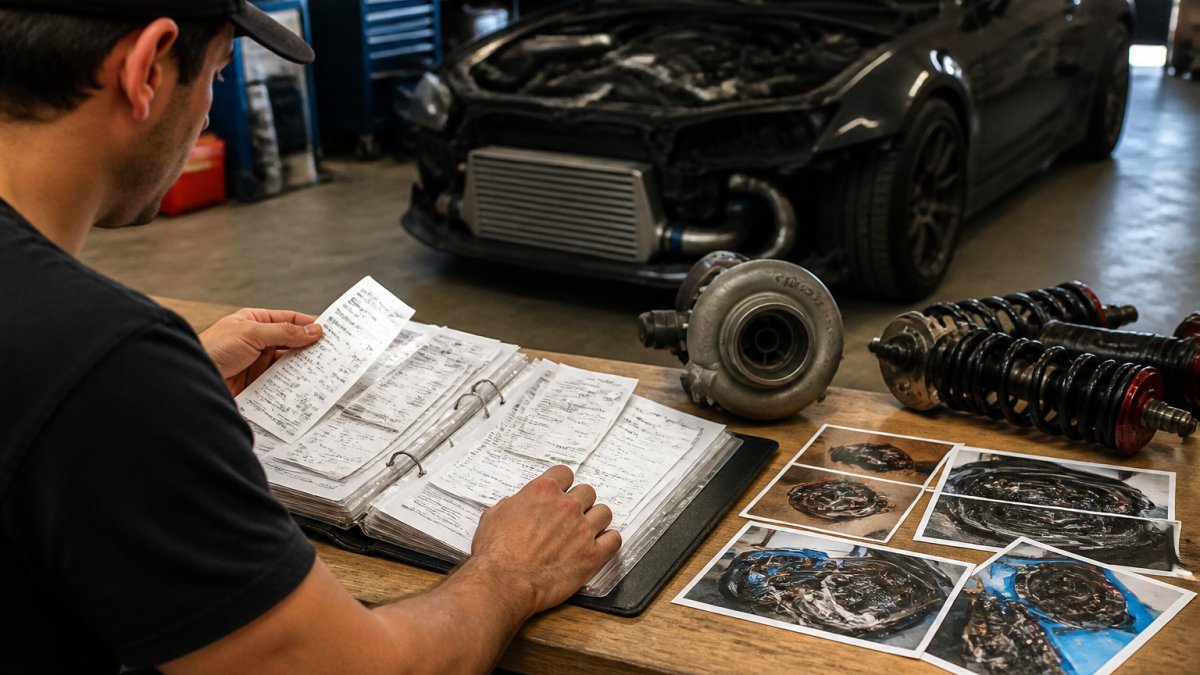
Assemble this before you apply:
- Purchase receipts for every major part, with dates and vendor names
- Part numbers and manufacturer documentation for performance components
- Installation invoices, or your own notes if you did the work
A common mistake is treating documentation as a chore for later. How to document aftermarket parts the right way shows how receipts, photos, and part numbers protect value.
Start Your Build Log Before You Apply
The single highest-use move for financing options for heavily modified vehicles is to start a build log before you need one. Not the week you apply. Now.
A build log is a chronological record of every modification and service event on the vehicle, tied to dates, costs, and supporting documents. It is the difference between telling a lender your car is worth more and showing them why. Your mod log, finally organized shows a real example of a lender-ready build record.
This is the problem CarJourney was designed to solve. CarJourney uses VIN-based vehicle setup to create a record for each car in a single digital garage. Reminders tied to both time and mileage help keep service history current.
Frequently Asked Questions
Can I get an auto loan for a heavily modified vehicle?
Yes, but approval depends on how the lender values the car. Most banks base the loan on book value and treat aftermarket parts as worth little or nothing, so a heavily modified car can appraise far below what you paid. Specialty lenders and credit unions that understand enthusiast builds are more likely to count documented upgrades. Expect to provide a full parts list, receipts, and photos, and be ready for a lower loan-to-value ratio than a stock vehicle would get.
Can I modify a car while I'm still paying off the loan?
Usually yes, but check your loan agreement first. Most contracts require the lender to remain the primary lienholder and prohibit anything that reduces the vehicle's value or safety. Lift kits, engine swaps, and major suspension work can trigger approval requirements. Keep every receipt and photograph each stage of the build. If you sell or refinance later, documented modifications help justify your asking price and support a smoother payoff.
Will a lender include aftermarket parts in a vehicle's loan value?
Rarely at full cost. Standard valuation guides ignore most modifications, and lenders often cap added value at a fraction of parts cost, if they count it at all. Some credit unions will order an independent appraisal that credits documented, professionally installed upgrades. Wheels, suspension, and performance parts typically add the most recognized value; cosmetic or one-off custom work is hardest to finance. Ask the lender upfront how it values modifications before you apply.
Can I use a personal loan to buy a modified car?
A personal loan for a car is common when the vehicle is too modified for standard auto financing. Because it's unsecured, the lender doesn't appraise the car or care about the build, and you get the title outright. The tradeoffs are higher interest rates and shorter terms than a secured auto loan. Compare the total cost against a specialty auto loan before deciding, and check whether the rate reflects your credit profile.
What documents should I provide when applying for a modified vehicle loan?
Bring the standard paperwork plus build-specific evidence: proof of income, recent bank statements, and your credit report come first. For the vehicle, gather the title or lien info, a complete parts list with receipts, installation invoices, photos of the build, and any dyno or inspection reports. A documented service and modification history makes the strongest case, which is why keeping every record in one place from day one pays off at application time.
How can I estimate monthly payments on a modified vehicle loan?
Use the loan amount, APR, and term in a standard amortization formula, or an online calculator. The tricky part is the loan amount: lenders finance a percentage of appraised value, not your total build cost. If the car appraises at $25,000 and the lender allows 80% loan-to-value, you can finance about $20,000 and cover the rest as a down payment. Get a preapproval to see the real number before you commit.
Can I trade in a modified car if I still owe money on it?
Yes. The dealer pays off your existing lien from the trade-in value, and any difference rolls into the new deal. Modifications usually don't raise trade-in offers much, since dealers resell at wholesale values that ignore most aftermarket parts. Selling privately often nets more for a documented build, but you'll need to pay off the loan first or coordinate with the buyer's lender. Either way, a complete modification and service log helps your negotiating position.
The financing conversation gets much easier when the paperwork is already done. Build the record first, and the lender conversation becomes a review rather than a negotiation. Get started with CarJourney and turn every receipt and install note into a documented history that supports your build, your valuation, and your resale.
Start free Add carjourney.io as a preferred source on Google →