 carjourney
From the CarJourney journal
Track Car Power Steering Fluid Cooler: 7 Facts
Last Updated: October 29, 2026
Quick Summary
A track car power steering fluid cooler keeps fluid from overheating during long sessions of tight cornering and repeated steering lock-to-lock. Size it by measuring the fluid temperature rise per session, matching pump flow rate and fittings, and planning for your hottest event. After installation, bleed the system carefully so trapped air does not cause foaming or whining.
- Size the cooler from measured temperature rise, pump flow rate, and your hottest realistic ambient conditions.
- Confirm inlet and outlet fittings match your hoses, and check flow and pressure ratings against the pump's output.
- Bleed the system after installation by cycling steering lock-to-lock with the cap off until the fluid level stabilizes.
- Flush the cooler core separately so degraded fluid is not reintroduced into the fresh fluid.
- Inspect cooler hoses after every session and check clearance at full steering lock.
Table of Contents
- Why Track Cars Overheat Power Steering Fluid
- How Power Steering Fluid Breaks Down Under Heat
- Power Steering Cooler Size: Matching Capacity to Your Build
- Power Steering Cooler Comparison: Tube-and-Fin vs. Stacked-Fin
- Installing a Power Steering Cooler: Location, Mounting, and Hoses
- Maintenance, Flushing Intervals, and Verifying Cooling Performance
- Logging Your Power Steering Cooler Install in CarJourney
- Frequently Asked Questions
Why Track Cars Overheat Power Steering Fluid
Power steering fluid is one of the most overlooked components in a track car power steering fluid cooler setup, yet it is central to a track car's cooling system. On a standard street car, the fluid stays within a safe temperature range during normal driving.
The core problem is simple. The steering pump works hardest when the wheel is turned against resistance, which is exactly what happens in tight, slow corners. Heat builds in the fluid faster than the reservoir and hoses can shed it.
Most owners only notice the problem after a symptom appears, such as a whining pump or stiffer steering. By then the fluid may already be degraded.
How Power Steering Fluid Breaks Down Under Heat
Power steering fluid is designed to handle a moderate operating range. When it runs too hot for too long, its additives begin to break down. The fluid thins, loses its lubricating properties, and starts to form deposits. Those deposits can clog the small passages inside the pump and rack.
The fluid can also begin to foam or cavitate when it nears its boiling point. Air bubbles reduce the pump's ability to pressurize the system. The steering feels inconsistent, and the pump wears faster under the strain.
Fluid can degrade before it visibly changes color, so temperature control matters as much as appearance.
Power Steering Cooler Size: Matching Capacity to Your Build
Choosing a track car power steering fluid cooler is about matching capacity to the heat your system generates and to the volume of fluid it has to move. A cooler that is too small will not keep up on long sessions. One that is oversized adds weight, lengthens the fluid path, and complicates mounting without much benefit.
Summit Autocross Week Prep Ep. 7: Derale Power Steering Cooler
Black Z Garage
Start by considering how the car is used. A lightly modified car that sees occasional autocross runs has very different needs from a dedicated track car running full sessions in hot weather. Your steering rack type, pump output, and total fluid volume all factor in. Match the cooler to your worst realistic use case, not your average one.
Sizing by Heat Load, Not Guesswork
There is no universal cooler size, but there is a repeatable method. Work from three inputs:
- Pump flow rate. A power steering pump moves a fixed volume of fluid per minute at a given engine speed. The cooler must pass that flow without a significant pressure drop. A core with undersized inlet and outlet fittings becomes a restriction and can raise system pressure.
- Temperature rise per session. Measure fluid temperature at the reservoir before and after a session. The difference is your real heat load. A cooler should be sized to pull that peak back toward the normal operating range, not to chase an arbitrary number.
- Ambient conditions. A cooler that works in mild weather may be marginal on a hot day. Size for the hottest event you realistically attend.
Logging temperature for two or three sessions before buying anything can give a useful baseline for deciding whether a small auxiliary cooler or a full replacement unit is needed.
Fluid Capacity and Thermal Load
Total fluid capacity affects how quickly heat spreads through the system. A larger reservoir holds more thermal mass, which slows temperature rise. Adding a cooler increases the system's ability to shed heat, but the cooler only works as well as the flow rate allows.
Here is the part most guides skip: adding a cooler increases total system volume. That extra volume has to be filled, and it changes how you bleed the system.
Thermal load depends on how hard the pump works. Heavier cars, larger tires, and aggressive steering inputs all increase it. Excessive heat often masks mechanical binding that requires you to troubleshoot steering issues before assuming the pump is the sole culprit.
Matching Fittings and Flow
Before buying, confirm the inlet and outlet sizes match your existing hoses or that adapters are available. A cooler with the right core but the wrong fittings will either leak or restrict flow. Check the manufacturer's specification for maximum flow rate and pressure, and compare it to your pump's output. If the numbers are close, go up one size on the fittings rather than the core.
Power Steering Cooler Comparison: Tube-and-Fin vs. Stacked-Fin
Two main cooler designs dominate the market. Each has trade-offs.
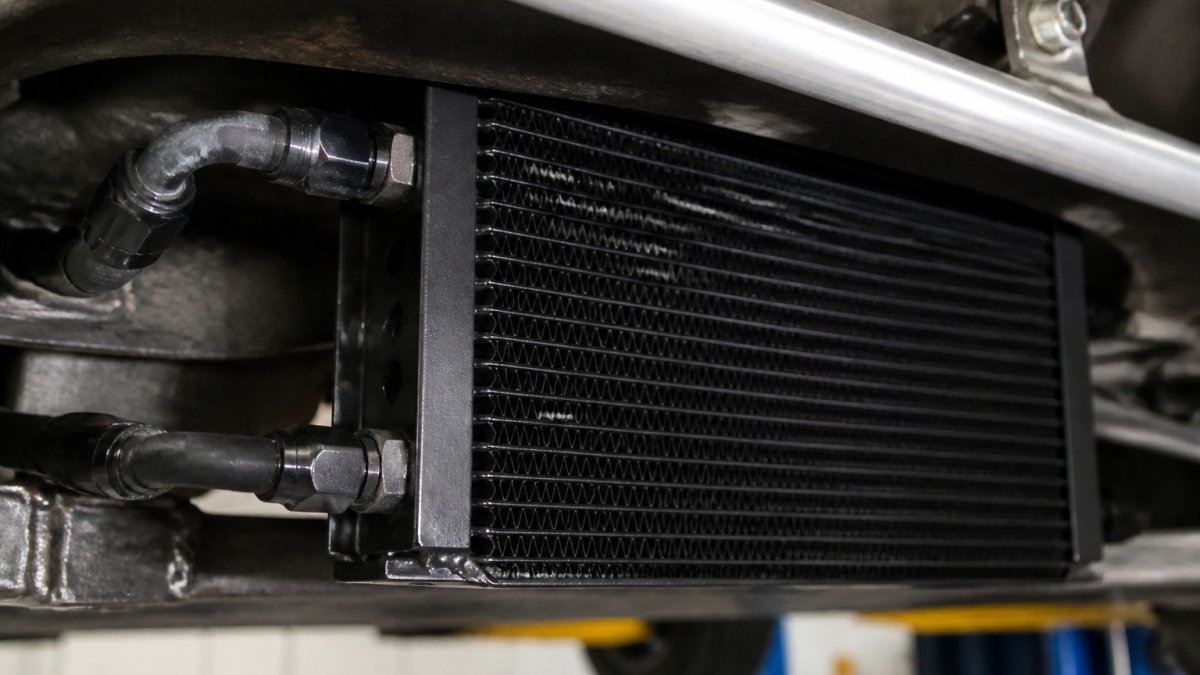
- Tube-and-fin: Tubes run through thin fins that pull heat away from the fluid. This design is common and generally affordable, though it can be bulkier.
- Stacked-fin: Layered plates create a compact core with good surface area. It often packs more cooling into less space, which suits tight engine bays.
Neither design is universally better. Packaging constraints usually decide the choice. A compact stacked-fin cooler may fit where a tube-and-fin unit cannot. Compare cooling capacity, inlet and outlet sizes, and mounting options before buying. Check that the fittings match your existing hoses.
Pricing varies by brand and design, so compare current listings on the manufacturer's site or a retailer's page.
Installing a Power Steering Cooler: Location, Mounting, and Hoses
Placement matters. The cooler needs airflow, so mount it where ambient air reaches it while driving. Common spots include the front of the radiator support or a location that catches airflow from the grille.
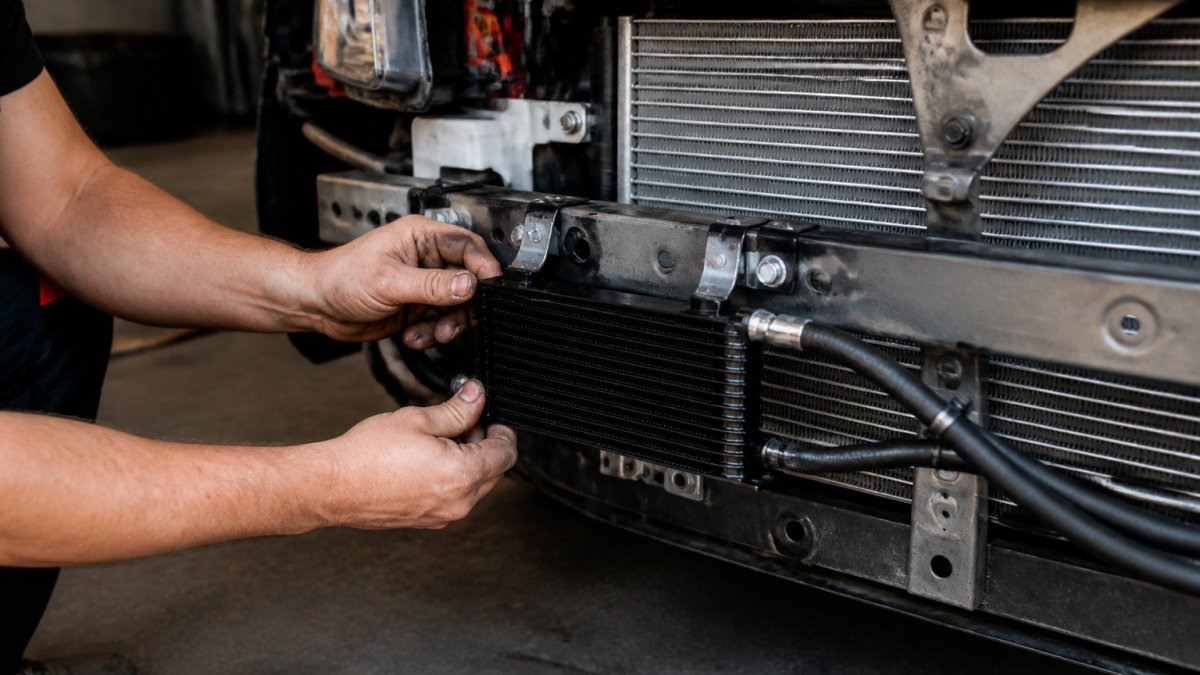
Use the mounting hardware supplied, and secure it so it cannot vibrate loose. Route high-pressure hoses away from sharp edges and hot surfaces.
!A mechanic's hands mounting a compact aluminum power steering cooler in front of a radiator support on a race car, with hose clamps and fittings visible
Watch out: an improperly routed hose that rubs against a suspension arm can wear through under load. Check hose clearance at full steering lock.
DIY vs. Professional Installation
Many owners install a cooler themselves with basic hand tools, especially on simple setups. Professional installation makes sense when routing is complicated, when the fitting sizes need custom adapters, or when the work is part of a larger build. Either way, verify flow and leak-free operation before a track day.
Maintenance, Flushing Intervals, and Verifying Cooling Performance
A cooler is only part of the system. Fluid still degrades, so set a flushing interval based on how hard the car is driven. Track use generally shortens that interval compared with street use, though the right interval depends on the fluid and the car.
Flushing a Cooler Without Cross-Contamination
A cooler adds volume and a new path for old fluid to hide. When you flush the system, the cooler core and its hoses can trap degraded fluid and debris. If you do not flush the cooler itself, you contaminate the fresh fluid on the first start.
The safe sequence is to drain the reservoir, disconnect the return line at the cooler, and flush the cooler separately with fresh fluid in the direction of normal flow until the fluid runs clean. Then reconnect, refill, and bleed the system by cycling the steering lock-to-lock with the engine running and the cap off until the level stabilizes.
Setting a Realistic Interval
There is no single interval that fits every car. A practical approach is to base it on sessions, not miles. Many track drivers inspect fluid condition after every event and flush at the start of a season or after a set number of hot sessions. Use color, smell, and debris in the reservoir as triggers, but do not rely on color alone.
Verifying Cooling Performance With Data
To verify cooling performance, measure fluid temperature after a session and compare it to earlier runs. Log these readings with service records so you can see trends over time. Monitoring over several sessions gives a clearer picture than a single check.
A data-backed approach is to record three numbers: ambient temperature, fluid temperature at the start of the session, and peak fluid temperature during the session. The difference between peak and start is your delta T for that event. Compare delta T across cooler designs or mounting locations only when ambient conditions are similar; otherwise the comparison is not valid.
Here is a simple summary for maintenance planning:
| Task | When to Check | What to Look For |
|---|---|---|
| Fluid level | Before each track day | Correct level, no foaming |
| Fluid condition | Every flush interval | Color, smell, debris |
| Cooler hoses | After each session | Leaks, chafing, loose clamps |
| Fluid temperature | After sessions | Trend over time, delta T |
| Cooler core flush | At each fluid change | Clean fluid from return line |
Logging Your Power Steering Cooler Install in CarJourney
Recording the install is worth the effort. Note the cooler model, part number, install date, hose routing, and the fluid you used. Keeping this history makes future maintenance easier and helps if you sell the car.
With CarJourney, you can log every part and service in one place, including mod tracking and unlimited maintenance and modification tracking. Current pricing is listed on the CarJourney pricing page, and a free plan is available to start. Use a mod list format to record each component consistently, and keep your notes alongside them to track service milestones over time.
For more detail on fluids under track conditions, see our transmission fluid guide.
Frequently Asked Questions
Does a track car need a power steering fluid cooler?
Not every track car does, but any car that runs repeated laps, autocross runs or drift sessions can push power steering fluid past its safe temperature. Fluid that runs hot loses viscosity and can break down, which shows up as heavier steering, whining from the pump and premature pump wear. If your fluid is hot to the touch after a session, or you notice the steering feel changing lap to lap, a cooler is a practical upgrade. Track the fluid temperature over a few sessions before deciding, since ambient air temperature and driving style change the load considerably.
What size power steering cooler should I use?
Cooler size depends on your system's fluid capacity, how hard the steering works during a session, and the airflow the cooler receives at its mounting location. Larger coolers with more surface area dissipate more heat but need room in front of the radiator and may add weight. Check the inlet and outlet fitting sizes against your hoses before buying, because a mismatch forces adapters that restrict flow. Choose a cooler sized for your track use rather than the stock street application, and confirm it fits your radiator support clearance.
Where should a power steering fluid cooler be installed?
The cooler works best in a location that receives cold airflow at speed, typically in front of the radiator or on the radiator support where the airstream is unobstructed. Mount it securely with brackets rated for vibration, keep hoses clear of exhaust heat and moving suspension parts, and route the lines so they do not kink. Avoid placing the cooler where road debris or water splash is heavy. A secure, well-routed installation prevents leaks and keeps the cooler effective throughout a session.
How do I know if my power steering fluid is overheating?
Common signs include steering that feels heavier after a few laps, a whining noise from the pump, fluid that smells burnt, or dark, cloudy fluid on the dipstick or reservoir. Fluid that is too hot to keep your hand on after a session is a strong warning sign. Checking fluid color and smell after each event, and noting any change in steering feel, gives you a simple baseline. If these symptoms appear consistently, the system likely needs better cooling or a fluid change.
Owners who track their cars benefit from keeping cooling upgrades documented and verifiable. CarJourney's AI-powered logs and shareable build profiles make it easier to show a clean maintenance history to a future buyer. Start free and build a record that proves your car was cared for.
Start free Add carjourney.io as a preferred source on Google →