 carjourney
From the CarJourney journal
Can You Spot Fake Car Service Records?
Last Updated: October 24, 2026
Quick Summary
Spotting fake car service records means checking that the VIN on every document matches the VIN on the car, character by character, and calling the shops listed to confirm the date and mileage. Most forgeries fail on small details like mileage gaps, mismatched fonts, or a shop with no record of the visit.
- A VIN is a 17-character code identifying one specific vehicle, so one swapped digit is the most common trick.
- Real repair orders list parts and labor separately and carry a printed invoice number.
- Genuine service-book stamps leave a faint reverse image on the facing page; forged ones often do not.
- CarFax reports only prove an event was logged, since many independent mechanics never report anything.
- Call at least two shops and ask a closed question: can you confirm you serviced this VIN on this date?
Table of Contents
- What Fake Car Service Records Look Like
- How to Verify Car Service History by VIN
- Fake Service History Red Flags to Check Before You Buy
- What CarFax Service Records Can and Cannot Prove
- How to Read Repair Orders, Receipts, and Service Books
- A Step-by-Step Fraud Detection Checklist
- When Records Cannot Be Verified: Next Steps
- Build a Car Maintenance Log Template Buyers Trust
- Frequently Asked Questions
What Fake Car Service Records Look Like
Fake car service records are documents, stamps, or digital entries claiming maintenance happened when it did not, from a forged oil change stamp to a fabricated repair order on plain paper.
Real records share a few traits: a dealer or shop name, address, date, odometer reading, and parts list. Fake ones often skip one.
The most common fakes fall into three groups:
- Blank service books filled in all at once with matching ink
- Reprinted receipts with no shop logo, tax line, or parts numbers
- Copied digital entries pasted from another vehicle's history
Below, we'll show you exactly how to check each one before you hand over money.
How to Verify Car Service History by VIN
The fastest way to verify car service history by VIN is to match the vehicle identification number on the records to the VIN stamped on the car. If you're unsure what those records should contain, our guide on what a vehicle history report includes explains how to read and use one.
Here is the check we recommend:
- Find the VIN on the dashboard near the windshield and on the driver's door jamb.
- Compare it, character by character, to the VIN on every receipt and repair order.
- Watch for one swapped digit. That is the most common trick.
A NHTSA VIN decoder can confirm the make, model, and model year tied to that VIN. If the decoded vehicle doesn't match the car in front of you, the paperwork is worthless.
Then call the shops on the receipts and ask if they serviced that VIN on that date. Most will confirm a date and mileage over the phone, that one call catches more fakes than any app.
Fake Service History Red Flags to Check Before You Buy
The clearest fake service history red flags are inconsistencies, not dramatic forgeries.
Watch for these:
- Mileage gaps. The odometer jumps from 48,000 to 61,000 with no oil change between.
- Date problems. Service dates that fall before the car was built, or two services on the same day at shops 200 miles apart.
- Missing parts lines. Real repair orders list parts and labor separately.
- Perfect uniformity. Every stamp uses the same pen, pressure, and angle.
- No shop contact details. No phone number, no address, no invoice number.
Most guides miss this: check tire wear and warning lights against the claimed maintenance. A car with bald tires and a glowing check-engine light rarely has a spotless service record.
For a deeper walkthrough of spotting gaps and hidden costs, read our used car service records guide for buyers.
What CarFax Service Records Can and Cannot Prove
CarFax service records prove an event was logged, not that the work was done well or at all. Reports pull from shops, dealers, inspection stations, and insurers that choose to share data, many independent mechanics never report anything.
So a clean report is a starting point, not a guarantee.
Use the report to cross-check dates and mileage against the paper records. Our guide on verifying digital records for a car covers what counts as proof.
How to Read Repair Orders, Receipts, and Service Books
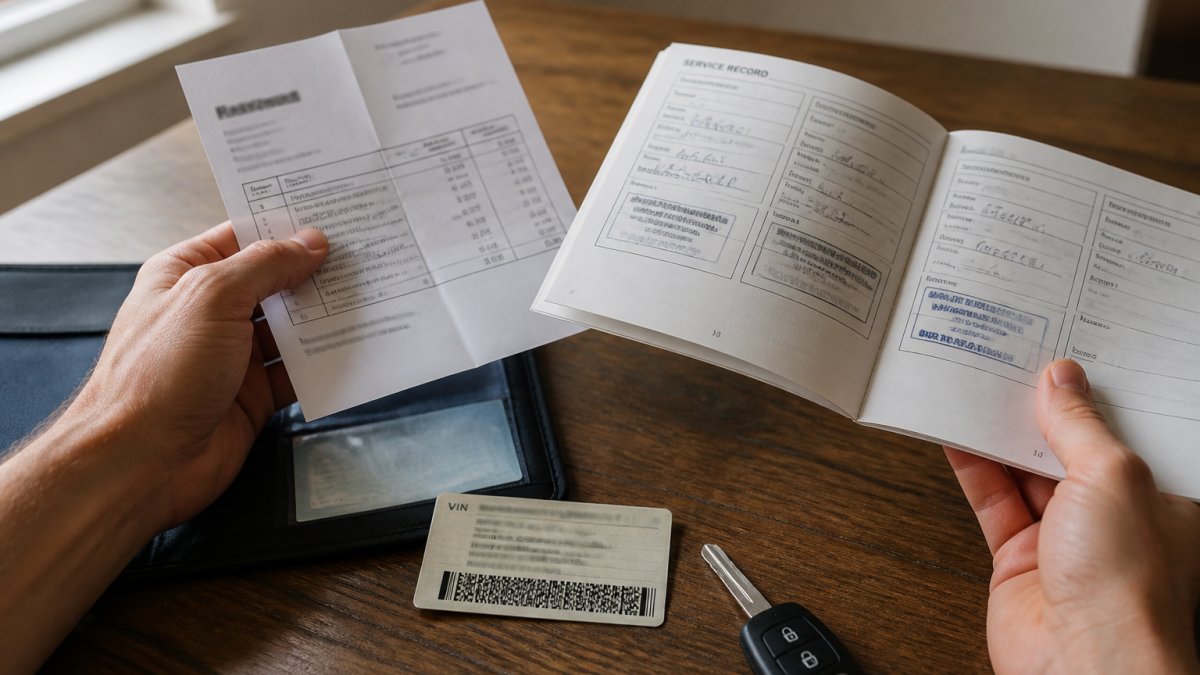
A repair order is the shop's internal document listing the complaint, diagnosis, parts, labor hours, and total charged. A receipt proves payment. A service book is the manufacturer's stamped log. Each tells a different part of the story.
Read them in this order:
- Repair order first. Check the VIN, date, mileage, and parts list. Real orders have a printed invoice number.
- Receipt second. Confirm the total matches the repair order and that a payment method is shown.
- Service book last. Compare each stamp to the matching receipt. A stamp with no receipt behind it is a question mark.
Look at the paper itself: faded thermal receipts from years ago should look faded, so a crisp, bright receipt dated 2015 is a warning. Our explainer on the role of service receipts in car ownership breaks down what a complete receipt should contain.
A Step-by-Step Fraud Detection Checklist
Use this checklist before buying any used car with a claimed service history. Work through it in order and write down what you find, the value is in the pattern that emerges when several items fail together.
Stage 1: Document-level inspection
- Match the VIN on every document to the VIN on the car, character by character
- Confirm the decoded VIN matches the make, model, and model year
- Check fonts and print quality: a real shop's repair orders use consistent fonts, and a forged entry often has a mismatched typeface, uneven spacing, or a logo that looks copied
- Look at the ink: handwriting across years should show different pens, pressure, and slight color variation; identical ink and pressure across a decade is a warning
- Inspect stamps and carbon copies: genuine service-book stamps leave a faint reverse image on the facing page, and forged ones often do not
- Check invoice numbering: real shops use sequential or plausibly formatted invoice numbers; a string of identical or random numbers is a red flag
- Feel the paper: a crisp, bright receipt dated years ago is suspicious, while thermal receipts should look faded
- Look for suspiciously uniform entries: every line in the same hand, the same angle, and the same spacing suggests one sitting
Stage 2: Data consistency
- Line up service dates with mileage in ascending order
- Check that no two services happen on the same day at distant shops
- Confirm each repair order has a parts line and a labor line
- Compare paper records against the vehicle history report
- Cross-check tire wear, brake wear, and warning lights against claimed work
Stage 3: Independent verification
- Call at least two shops to confirm a date and mileage
- Ask each shop to confirm the VIN, the date, and the odometer reading on the repair order
- Request a pre-purchase inspection if any item above fails
Two items catch most fakes: the VIN match and the phone calls. Neither takes more than ten minutes, and both are hard to fake.
Pro Tip When you call a shop, have the VIN and the claimed service date ready. Ask a closed question first: "Can you confirm you serviced this VIN on this date?" A shop that did the work will usually confirm the date and mileage; a shop that did not will often say it has no record. Do not ask whether the receipt is real; ask whether the event happened.A forged record often fails at Stage 1 but passes a casual glance. The checklist forces you to slow down exactly where a seller wants you to speed up.
When Records Cannot Be Verified: Next Steps
When records cannot be verified, treat the car as having no service history and price your offer accordingly. That's not a reason to walk away, it's a reason to protect yourself.
Here is what to do next, in order of effort and cost:
- Get a pre-purchase inspection. An independent mechanic can spot worn parts and deferred maintenance the paperwork hides. Ask them to check what a service history would normally prove: oil condition, brake pad thickness, tire age and wear, and stored diagnostic trouble codes.
- Ask the seller for bank or card statements tied to the claimed repairs. A payment trail is hard to forge, and a seller who paid by card usually has a record.
- Request shop names and call them directly. Even without receipts, a shop can often pull a record by VIN or plate. Have the VIN ready and ask a closed question: "Can you confirm you serviced this VIN on this date?"
- Rebuild the history yourself. Start a log from the inspection date forward, and keep every receipt from that point on.
What a shop will and will not tell you
Most service providers will confirm whether a vehicle was serviced on a given date and the odometer reading then. Many won't release a full repair order, customer name, or payment details to a non-owner, due to privacy rules and shop policy. Expect to be asked for proof of ownership or the seller's authorization.
Decision guidance
- If the inspection is clean and the price reflects the missing history, the car may still be a reasonable buy.
- If the inspection reveals deferred maintenance the records claimed was done, treat the records as unreliable and negotiate or walk away.
- If the seller refuses to provide shop names or authorize a call, that refusal is itself a warning sign.
- If you find a clear mismatch, a VIN that doesn't match or a shop with no record of the claimed visit, don't treat it as proof of a crime; require a full inspection and a written explanation before you commit.
If you're piecing together a car with missing paperwork, our guide on tracking car repairs without receipts walks through practical ways to reconstruct what was done.
Build a Car Maintenance Log Template Buyers Trust
A car maintenance log template is a simple record that captures the date, mileage, service performed, parts used, cost, and shop name for every visit.
Here is the structure we recommend:
| Field | What to Record | Why Buyers Care |
|---|---|---|
| Date | Day service was completed | Proves maintenance intervals were met |
| Odometer | Miles at time of service | Shows mileage consistency |
| Service performed | Oil change, brakes, tires, etc. | Confirms routine maintenance |
| Parts used | Brand and part number | Proves quality of parts |
| Shop name | Dealer or independent garage | Allows independent verification |
| Receipt attached | Photo or scan of invoice | Ties the entry to real proof |
Keep it digital and back it up, paper folders get lost, and a buyer can't verify what isn't there.
Spotting fake records comes down to patience and a few phone calls. Most forgeries fail on VIN mismatches, mileage gaps, or a shop that never heard of the car.
Frequently Asked Questions
Does CarFax show all service records?
No. CarFax service records only include data reported by participating shops, dealerships, and agencies. Independent garages and DIY maintenance often go unreported, so a clean CarFax report does not prove a full service history. Use it as one source, then cross-check with paper receipts, dealer portals, and the vehicle’s VIN.
What are the signs of fake car service records?
Common fake service history red flags include dates that do not match mileage, missing VINs on invoices, handwriting inconsistencies, photocopied stamps, and repair orders that list recommended work as completed work. Look for gaps in service frequency and compare the odometer readings on each record with the vehicle’s actual mileage.
How can I verify car service history by VIN?
Ask a dealership or independent mechanic to run the VIN through manufacturer and shop databases. You can also request records directly from the service provider listed on the invoice. Match the VIN on every document to the vehicle’s dashboard and registration, and confirm the mileage and dates line up.
What should I do if a used car has no service records?
Treat missing records as a negotiating point, not an automatic dealbreaker. Order a pre-purchase inspection from an independent mechanic, check for warning lights and tire wear, and ask the seller for any digital records or dealer printouts. If records cannot be verified, budget for immediate maintenance and price the risk into your offer.
Start free Add carjourney.io as a preferred source on Google →