
What to Do When a Car Has Missing Service History

If a car you’re considering has missing service history, do this first: run a VIN check through NMVTIS, pull a paid vehicle history report, and schedule a pre-purchase inspection (PPI) before you hand over any money. That three-step sequence catches the problems a blank service log can hide.
Here’s the immediate checklist:
- Run the VIN through NMVTIS. It’s the federally backed database that flags title brands, salvage designations, and odometer discrepancies. Free through approved providers.
- Pull a paid vehicle history report (Carfax or AutoCheck). Neither is perfect, but together with NMVTIS they cover different data sources.
- Ask the seller for every physical receipt, invoice, or stamped service booklet they have. Even partial records help.
- Insist on a pre-purchase inspection by an independent mechanic. This is non-negotiable when records are missing.
- Preserve proof of the seller’s claims. Screenshot listings, save texts, and note verbal statements in writing. If the seller claimed “full service history” and can’t produce it, that paper trail matters.
Walk away immediately if the seller refuses a PPI, the title shows a salvage or flood brand, or the odometer reading conflicts with the NMVTIS report.
Key Takeaways
A car with missing service history isn’t automatically a bad buy, but it requires a VIN check, a paid history report, and a pre-purchase inspection before any money changes hands.
| Point | Details |
|---|---|
| Run NMVTIS first | The free federal database catches title brands and salvage designations before you spend money on a paid report. |
| Blank Carfax ≠ neglect | Many independent shops don’t report to aggregators; a blank service section often reflects reporting gaps, not a poorly maintained car. |
| PPI is the decisive step | An independent mechanic’s inspection reveals actual mechanical condition that no database can show. |
| Recovery is possible | A structured outreach sequence (dealer VIN lookup, shop calls, digital receipts) recovers most missing records when the car was serviced at identifiable locations. |
| Carjourney centralizes the fix | Carjourney’s AI receipt scanning and VIN-based logs let you build a verifiable, shareable service record starting today. |
Table of Contents
- Why missing service history raises the real cost of ownership
- Which official and private databases should you check first?
- How to recover lost service records step by step
- What a pre-purchase inspection should cover when records are missing
- If you already own the car: how to build a verifiable record from here
- When missing service history becomes a dealbreaker
- How Carjourney helps you recover, document, and maintain service history
- The honest truth about missing records
- Carjourney keeps your records where they belong
- Sources
Why missing service history raises the real cost of ownership
A blank maintenance log isn’t just an inconvenience. It’s a financial unknown you’re agreeing to absorb.
The most direct risk is deferred maintenance. Without records, you have no way to know whether the timing belt was replaced at the manufacturer’s recommended interval, whether the transmission fluid has ever been changed, or whether the previous owner skipped oil changes for 15,000 miles. Any of those gaps can translate into repair bills that dwarf the price discount you negotiated.
Title problems are a separate category of risk; for guidance on avoiding title-brand risks and fraud, see why buy verified cars. Odometer rollbacks, salvage titles that were “washed” through out-of-state registrations, and undisclosed flood damage all tend to surface as missing or inconsistent documentation. A car with a clean-looking title but no service records deserves more scrutiny, not less.
Resale value takes a measurable hit too. Buyers at every price point expect documented service history, and a car without it sells for less or sits longer. For warranty claims, insurers and extended-warranty providers routinely deny coverage when the owner can’t demonstrate that scheduled maintenance was performed. In accident disputes, an undocumented maintenance gap can complicate liability arguments.
Here’s the important context: a blank service section in a vehicle history report is often a data-coverage problem, not proof of neglect. Private vehicle-history services frequently miss routine maintenance because not every repair shop reports to aggregators. Many independent shops, quick-lube chains, and all DIY work go completely unreported. A blank Carfax service section can coexist with a perfectly maintained vehicle.
That distinction matters for how you respond. The goal isn’t to assume the worst. It’s to verify.
Which official and private databases should you check first?
Three sources cover different slices of a vehicle’s documented past. Knowing what each one actually shows, and what it misses, tells you which to run first.
NMVTIS: the official title-brand check
NMVTIS is a federal database administered by the Bureau of Justice Assistance. It focuses on five key indicators: title brands (salvage, flood, junk, rebuilt), the most recently reported odometer reading, insurance total-loss designations, and theft records. A large majority of the U.S. vehicle population is currently represented in NMVTIS, which means gaps exist. It intentionally excludes routine maintenance details. Run this first, before anything else, because it catches the title fraud that private reports sometimes miss.
Carfax and AutoCheck: broader history, real gaps
Carfax and AutoCheck pull from a wider network of reporting partners: dealers, auctions, rental fleets, state DMVs, and some repair shops. They show accident reports, ownership history, mileage at each reported event, and sometimes service entries. The FTC recommends combining these reports with title checks and inspections rather than relying on any single source.
The limitation is significant: Carfax relies on its reporting partners, and many independent shops, quick-lube chains, and all DIY maintenance simply don’t report. A service section that looks empty often reflects reporting practices, not the car’s actual maintenance history.
Dealer and manufacturer service databases
Franchised dealers frequently retain service logs in brand-specific digital systems. A Toyota dealer can look up every factory-authorized service visit on a Toyota by VIN, even if the current owner has no paperwork. This is one of the most reliable recovery methods for late-model vehicles, and it costs nothing to ask.
Which check to run first
| Situation | First check | Why |
|---|---|---|
| Buying a used car, no records shown | NMVTIS (free) | Rules out title fraud before spending money |
| Already own the car, records lost | Franchised dealer VIN lookup | Fastest way to recover documented history |
| Buying from a private seller | Paid Carfax or AutoCheck | Broadest accident and ownership data |
| Buying at auction | NMVTIS + paid report together | Auction notices often absent from aggregator data |
Pro Tip: Before paying for a Carfax or AutoCheck report, run the VIN through the free NMVTIS portal. If NMVTIS shows a salvage or flood brand, you may not need to spend anything further on that vehicle.
How to recover lost service records step by step
A structured outreach sequence recovers the majority of missing records when the previous owner retained receipts and the car was serviced at identifiable shops. Here’s the playbook:
-
Gather your VIN and ownership documents. You’ll need the VIN for every outreach call. Pull it from the dashboard (visible through the windshield), the driver’s door jamb sticker, or the title.
-
Contact the selling or franchised dealer first. Call the service department of the brand’s nearest franchised dealer and give them the VIN. Ask: “Can you pull up any service history for this VIN in your system?” Many brand networks share service data nationally.
-
Search for physical cues on the car itself. Check the windshield for oil-change stickers, the driver’s door jamb for inspection stamps, and the glove box for any loose receipts. Some newer vehicles log service reminders in the infotainment system under a “Vehicle Info” or “Maintenance” menu.
-
Call independent shops in the car’s likely service area. If you know where the previous owner lived, call shops in that zip code. Give them the VIN and ask whether they have records. Many shops retain customer files for five to seven years.
-
Contact previous owners directly. The title history from NMVTIS or a paid report shows how many owners the car has had. If you can reach a prior owner through the seller, ask them directly for receipts or shop names.
-
Search digital sources. Ask the seller to search their email for invoices, check their bank or credit card statements for auto-shop charges, and look in any dealer owner portals (Ford Pass, MyChevrolet, MyToyota) where service visits are sometimes logged automatically.
-
Document every partial recovery. Scan or photograph each receipt you find. Note the date, mileage, shop name, and services performed. Even three receipts covering oil changes and a brake job tell a buyer more than nothing.
Pro Tip: The infotainment system is underused as a recovery tool. On many vehicles, the “Vehicle Info” or “Service History” menu retains the last several service reminders with mileage triggers. That data won’t tell you what was done, but it tells you what the car was expecting, which helps you identify gaps and target the right shops.
For a deeper look at verifying service records before a purchase, the Carjourney blog covers the full buyer-side process.
What a pre-purchase inspection should cover when records are missing
A PPI is the single most decisive tool when service records are absent. A qualified independent mechanic can read the car’s physical condition in ways no database can.
What the inspection should cover:
- Engine oil condition (color, consistency, and fill level indicate how recently it was changed and whether there’s coolant contamination)
- Transmission fluid color and smell (dark, burnt fluid suggests long-deferred service)
- Coolant condition and evidence of recent flush
- Brake pad thickness and rotor condition
- Suspension components: bushings, ball joints, tie rods, and shock absorbers
- Evidence of fluid leaks under the car and around gaskets
- Rust on the frame, subframe, and undercarriage
- Paint thickness readings across body panels (mismatched readings indicate prior bodywork or repainted panels after a collision)
- Tire wear patterns (uneven wear signals alignment or suspension problems)
- All safety recall status via the NHTSA VIN lookup
Red flags that should change your negotiation or your decision:
- Odometer readings that conflict with the NMVTIS report or show implausible mileage jumps between ownership periods
- Structural repairs not disclosed by the seller (visible weld marks, misaligned body gaps, or paint-thickness anomalies)
- Mismatched paint on adjacent panels
- Open safety recalls the seller hasn’t addressed
- Seller refusal to allow a PPI at all
When the inspection turns up deferred maintenance, convert findings into negotiation leverage:
- Get written estimates from the mechanic for every flagged item.
- Calculate the total repair cost.
- Request a price reduction equal to at least the repair estimate, or ask the dealer to complete the work before sale.
- For private-party sales, consider an escrow arrangement where a portion of the purchase price is held until the first service confirms no hidden issues.
Typical cost benchmarks for common deferred items include timing belt replacement, water pump replacement when concurrent, and a full brake job, though actual costs vary depending on the vehicle and service provider. These figures aren’t precise quotes, but they give you a floor for negotiating.
For a structured approach to analyzing what service records reveal, Carjourney’s guide walks through the evaluation process in detail.
If you already own the car: how to build a verifiable record from here
Owning a car with a spotty history isn’t a permanent liability. A clean, well-documented record built from today forward protects your resale value and your warranty coverage.
Start with what you have. Scan every receipt, invoice, and inspection sticker you can find. Photograph the current odometer reading with today’s date visible. Note the current condition of consumables: tire tread depth, brake pad thickness, fluid levels and colors. This baseline becomes the starting point of your documented history.

Then build the record going forward. Every service visit should produce an itemized invoice with the shop name, date, odometer reading, VIN, and a line-by-line description of work performed. Keep digital copies. A scanned PDF stored in cloud backup is far more durable than a paper receipt in a glove box.
Pro Tip: When you drop a car off for service, ask the shop to include the VIN on the invoice. Many shops do this automatically, but some don’t. A VIN-linked invoice is much harder to dispute than a generic receipt with just a license plate number.
If you’re dealing with a warranty provider or insurer, notify them proactively once you’ve documented your maintenance baseline. Some extended-warranty contracts require proof of maintenance compliance from the purchase date. Getting ahead of that requirement is easier than fighting a denial later.
For a practical system to track vehicle maintenance going forward, consistent digital logging is the most reliable method. The Carjourney blog also covers why updating service records before selling directly affects what buyers will pay.
When missing service history becomes a dealbreaker
Not every gap in a service log is a reason to walk. But some combinations of missing records and physical evidence cross a line where no discount justifies the risk.
Walk away when you see any of these:
- A title brand showing salvage, flood, fire, or rebuilt status that the seller didn’t disclose upfront
- Evidence of structural repair (frame welds, misaligned body panels, paint-thickness anomalies) with no accident disclosure
- Severe frame or subframe rust that the seller attributes to “normal wear”
- Odometer readings that conflict across documents or show a suspicious drop between ownership periods
- Seller refusal to provide any receipts, allow a PPI, or answer direct questions about service history
- A seller who advertised “full service history” but cannot produce a single document
Negotiate harder (don’t walk yet) when:
- Records are simply absent but the car passes a PPI cleanly
- The seller can name the shops that serviced the car, even without paper proof
- The vehicle is low-mileage and the physical condition matches the claimed history
The private-party versus dealer distinction matters here. A dealer who advertised full service history and can’t produce it may have legal exposure. Consumer-adjudication cases have resulted in financial remedies when a vehicle was sold as having a full service history that couldn’t be produced. A private seller has fewer formal obligations, but documented misrepresentation can still support a claim. Keep every listing screenshot and written communication.
How Carjourney helps you recover, document, and maintain service history
Carjourney was built specifically for the problem this article describes: scattered receipts, incomplete records, and no single place to pull it all together.
What the platform does for recovery and documentation:
- AI receipt scanning: photograph or upload a service invoice and Carjourney extracts the date, mileage, shop, and services automatically. No manual data entry.
- VIN-based vehicle pages: every vehicle gets its own page tied to its VIN, so records are linked to the car, not just an account.
- Centralized service log: all scanned invoices, manual entries, and reminders live in one place, accessible on web and mobile.
- Build profiles for buyers: when you’re ready to sell, Carjourney generates a shareable maintenance dossier that gives buyers confidence and supports your asking price.
- Service reminders: set interval-based or mileage-based reminders so the next gap never happens.
Use cases where this matters most:
- You just bought a car with partial records and want to stitch the recovered receipts into a coherent log before the next service
- You’re preparing to sell and want to show buyers a documented history that justifies your price
- You’re in a warranty dispute and need to produce organized, dated, VIN-linked maintenance evidence quickly
Carjourney is free to start, with a Pro subscription that unlocks unlimited vehicles and the full AI feature set.
The honest truth about missing records
Most missing service history comes down to one of two things: the previous owner did their own oil changes and never kept receipts, or they used independent shops that don’t report to aggregator databases. Neither of those scenarios means the car was neglected.
The mistake buyers make is treating a blank Carfax service section as evidence of a problem rather than evidence of a reporting gap. Those are very different things. A car with zero Carfax service entries and a clean PPI is almost always a better buy than a car with a full Carfax history and a mechanic who finds deferred maintenance on the lift.
The PPI is what settles it. Not the report. A qualified mechanic can tell you in 90 minutes whether a car was maintained, regardless of what any database shows. That inspection is the one step buyers consistently skip to save $100–$150, and it’s the one step that would have caught the problem they’re now paying $2,000 to fix.
Run the VIN checks to rule out fraud. Pull the paid report to understand ownership history. But make the PPI the non-negotiable part of the process. Everything else is context.
Carjourney keeps your records where they belong
Scattered receipts and missing logs are a solved problem. Carjourney gives you one place to scan, store, and share your vehicle’s complete service history, so the next buyer, warranty provider, or insurer gets the documentation they need without a scavenger hunt.
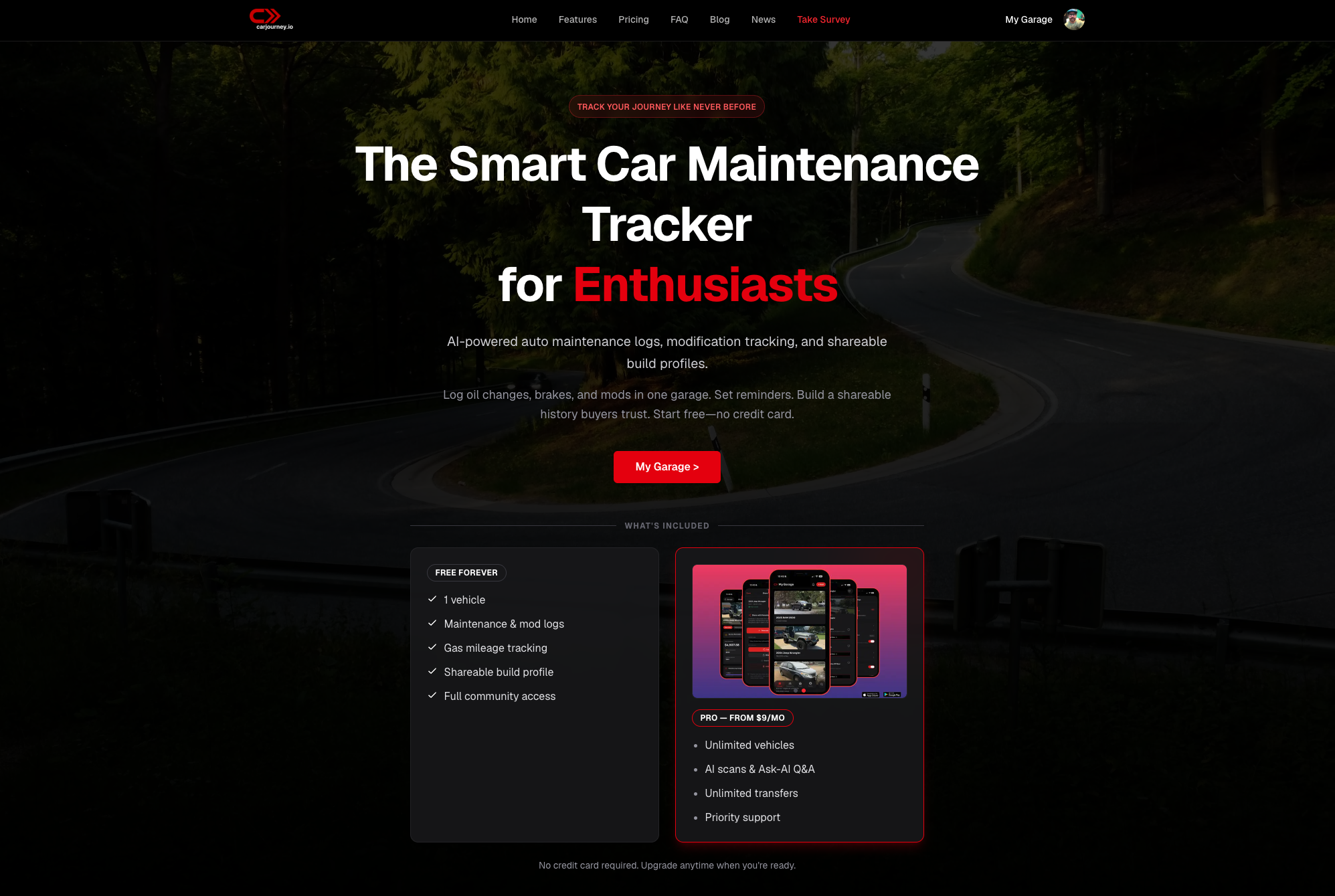
Three things Carjourney does that a glove box can’t:
- Scans invoices with AI so you capture every service automatically, not just the ones you remember to log
- Links every record to your VIN so the history travels with the car, not with you
- Builds a shareable buyer profile that turns documented maintenance into real resale leverage
Start free at Carjourney and import your first receipt today. The Pro plan unlocks unlimited vehicles and the full AI scanning suite.
Sources
The resources below are the authoritative starting points for any VIN check or used-car research in the U.S.:
- NMVTIS consumer information
- Here’s What Might Be Missing From a CarFax Vehicle History Report | Capital One Auto Navigator
- How To Find A Car’s Service Records When The Seller Doesn’t Have Them
- Missing service history - The Motor Ombudsman
- Used Cars - FTC Consumer Advice - Federal Trade Commission