 carjourney
From the CarJourney journal
Essential Car Maintenance Records for Selling a Car
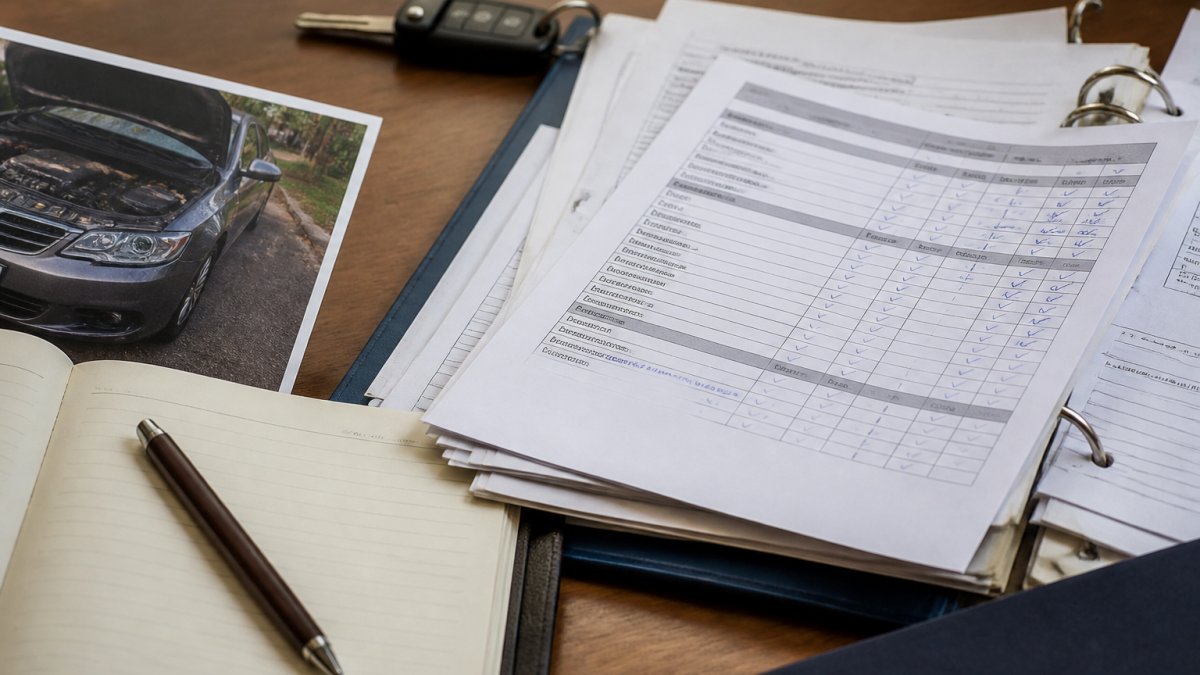
Table of Contents
- Why Car Maintenance Records Matter When Selling
- How Records Build Buyer Trust
- 1. Oil Change and Fluid Replacement Logs
- 2. Brake and Tire Inspection Records
- 3. Mileage-Based Maintenance Schedules
- 4. Car Maintenance Log Template: How to Organize Your Records
- 5. What Documents to Give the Buyer When Selling Your Car
- 6. Does Service History Increase Car Value?
- 7. Handling Missing Records and Verifying Your History
- Frequently Asked Questions
Last Updated: October 2, 2026
Why Car Maintenance Records Matter When Selling
A complete service history is one of the few things a private seller can offer that a dealership cannot fake.
The difference between a fast sale at a fair price and weeks of haggling often comes down to documentation.
Below, we break down the seven record types that matter most, how to organize them, and what to do when paperwork is missing.
How Records Build Buyer Trust
Buyers approach private sales with a simple fear: hidden problems. A maintenance log answers that fear before it becomes a question, shifting the conversation from suspicion to logistics.
Trust is built through consistency, not perfection: a log with a few gaps but honest notes beats a suspiciously flawless stack of receipts. Buyers also cross-check your records against a vehicle history report, so your documented repairs should align with what a third-party report shows.
1. Oil Change and Fluid Replacement Logs
Oil change records are the backbone of any service history, proving the engine received regular preventative maintenance, the single biggest factor in long-term reliability.
Your log should capture the date, odometer reading, type of oil used, and the service center or self-service notation.
If you performed the work yourself, note the brand and specification of the fluids used. That detail signals a careful owner.
2. Brake and Tire Inspection Records
Brake and tire records tell a buyer how much they will spend in the first year of ownership.
Tire records should include rotation dates, tread depth readings, the date of the last replacement, and the brand and size. A receipt for a recent rotation counts as documented preventative care.
Buyers also appreciate alignment records, since misaligned wheels wear tires unevenly.
3. Mileage-Based Maintenance Schedules
Every vehicle has a factory-recommended service schedule tied to mileage milestones, including timing belt replacement, spark plug service, coolant flush, and transmission service. Buyers who know cars will ask whether these were performed at the correct intervals.
Pull your owner's manual or the manufacturer's maintenance schedule and map your records against it. If your car is approaching a major service like a timing belt replacement, disclose that in your listing, honesty builds credibility and prevents post-sale disputes.
4. Car Maintenance Log Template: How to Organize Your Records
A car maintenance log template is a structured document that captures every service event in one place, using consistent fields so a buyer can scan your history in minutes.

Below is a field-by-field template you can copy into any spreadsheet or print as a paper form. The goal is consistency: every row answers the same questions in the same order so a buyer never has to guess.
The Standard Maintenance Log Template
Use these columns for every entry. Keep them in this order so the log reads chronologically and scans cleanly.
| Column | What to enter | Example format |
|---|---|---|
| Date of service | The day the work was performed | 2026-03-14 |
| Odometer reading | Miles at the time of service | 84,210 |
| Service type | Oil change, brake inspection, tire rotation, etc. | Oil and filter change |
| Parts or fluids used | Brand and specification | 5W-30 full synthetic, OEM filter |
| Service provider | Shop name or "self-performed" | Self-performed |
| Cost | Amount paid | $68.42 |
| Receipt or invoice number | Reference for verification | INV-20471 |
| Notes | Issues found, deferred work, next interval | Next change due at 89,000 miles |
A printable version of this grid works for sellers who prefer paper: print a stack, keep it in the glovebox, and fill in a row each time you service the car. The paper version is just as persuasive as a spreadsheet, provided the entries are complete and dated.
How to Build the Template in a Spreadsheet
Open a blank spreadsheet and create the eight column headers above in row one, then freeze that header row. Format the date column as a date, the odometer column as a number with no decimals, and the cost column as currency.
If you prefer a paper trail, print the spreadsheet with gridlines on and keep it in a three-ring binder alongside the receipts.
What to Include in Your Template
Beyond the eight core columns, add these fields if they apply to your vehicle:
- Warranty or recall work performed, with the campaign number if you have it
- Modification or aftermarket part installations, with the brand and part number
- State inspection or emissions test dates and results
- Tire tread depth readings taken at each rotation
- Battery test results and replacement date
These extra fields matter most on older or higher-mileage vehicles, where buyers are doing the math on near-term expenses. A log showing a battery replaced last year and tires at 7/32 inch tells the buyer those costs are already handled.
Pro Tip Photograph every receipt the day you get it and rename the file with the date and mileage (for example, "2026-03-14_84210_oil-change.jpg"). Buyers trust a folder of dated, searchable files far more than a rubber-banded stack of paper. Match each file name to the receipt number in your log so a buyer can cross-check any row in seconds.A Note on Digital vs. Paper Logs
Both formats work, and the best choice is the one you will actually keep current. A digital log is easier to back up, search, and share as a view-only link; a paper log is easier to hand across a table during a test drive.
If you use a tracker like CarJourney, the template fields above map directly to the log entries the app captures, so you can start on paper and move to digital later without losing your history.
5. What Documents to Give the Buyer When Selling Your Car
The documents to give the buyer when selling your car go beyond the title. A complete handover packet includes the signed title, a bill of sale, the current registration, and a copy of your maintenance log, plus the original owner's manual, any warranty paperwork still in effect, and emission or safety inspection certificates if your state requires them.
Keep the original receipts and provide copies or a digital folder. For digital handover, use a shareable build profile or a view-only cloud folder, keeping your personal information secure while giving the buyer everything needed to verify your claims.
Watch Out Never hand over the signed title before payment clears. A common scam involves a buyer taking the title and disappearing. Complete the transfer at a secure location, ideally a bank or a motor vehicle office.6. Does Service History Increase Car Value?
Service history does increase car value, particularly for enthusiast vehicles and well-maintained daily drivers. A documented maintenance record reduces a buyer's perceived risk, which supports a higher asking price, the effect is strongest on higher-mileage vehicles, where buyers rely more heavily on records to judge condition.
The Impact on Depreciation and Resale
Depreciation is unavoidable, but poor documentation accelerates it. A car with a clean service history and a verifiable odometer reading typically appraises higher than an identical model with no records, in any car appraisal, the maintenance log is one of the first things a professional checks.
Documented repairs also matter for warranty compliance. If your vehicle still has a factory or extended warranty, proof of factory-recommended service protects your coverage and transfers confidence to the buyer.
7. Handling Missing Records and Verifying Your History
Missing records are not a deal-breaker if you handle them honestly and rebuild what you can. Reconstruct a verifiable timeline rather than pretend the gaps do not exist, buyers expect some holes in a used car's history, but not a seller who cannot explain them.
How to Recover Lost Documentation
Start by contacting your service center records department. Most franchised dealers and independent shops keep digital copies of repair invoices for several years and can print or email duplicates on request.
If the shop cannot find the invoice, ask whether the work was reported to a vehicle history service.
For self-performed work, parts receipts from auto parts stores are valid documentation.
A Step-by-Step Recovery Checklist
Work through these steps in order and log what you find:
- Request duplicate invoices from every service center you have used, starting with the most recent
- Pull payment records from bank and credit card statements to build a service timeline
- Use parts store receipts for DIY work, matched to mileage entries
- Order a vehicle history report to cross-check accident, title, and reported service records
- Note any remaining gaps openly in your log with a brief explanation, such as "invoice unavailable, payment confirmed on statement"
- Keep a short cover note at the front of the log summarizing what is documented and what is not
A cover note is the single most effective way to defuse a gap. It tells the buyer you already know about the hole and are not hiding it, which is far more reassuring than a log that simply skips a year.
How Buyers Verify Your Records
Verification works in both directions, and a confident seller welcomes it.
Make verification easy by including the VIN on the first page of your log and keeping mileage entries consistent with the odometer.
Encourage the buyer to order a vehicle history report and get a pre-purchase inspection from an independent mechanic, a seller who invites both signals the records will hold up.
Watch Out Do not alter or recreate a receipt to fill a gap. A fabricated document is easy to spot when a buyer cross-checks dates and mileages against a history report, and it turns a minor gap into a credibility problem that can kill the sale. Key Takeaway Missing records reduce value, but a documented recovery effort restores most of it. Buyers pay for honesty backed by evidence, not for a perfect paper trail.Frequently Asked Questions
Is it important to keep car maintenance records when selling a vehicle?
Yes. A complete service history proves you performed preventative maintenance, which builds buyer trust and can justify a higher asking price. Records show oil change intervals, brake inspections, and other factory-recommended services were done on time. Without them, buyers may assume the worst and negotiate down. Even a simple log with dates and odometer readings helps.
What specific service documents should I provide to a private buyer?
Give the buyer repair invoices, service receipts, and a summary log of all maintenance. Include oil change records, tire rotation dates, brake inspection results, and any major repairs like timing belt replacement or coolant flush. Also provide the vehicle identification number (VIN) so they can run a vehicle history report. A digital maintenance tracker can generate a shareable PDF for easy handoff.
How do I look up my car's maintenance history if I lost the paper receipts?
Contact the service centers or dealerships that worked on your car. They often keep digital records tied to your VIN and can print or email copies. You can also check your bank or credit card statements for automotive charges. If you used a digital tracking app, your records may already be stored in the cloud. For future maintenance, start using a car maintenance log template to avoid gaps.
Do digital maintenance trackers help in the car selling process?
Yes. A digital tracker like CarJourney keeps all service records, receipts, and modification details in one place. You can generate a shareable build profile that gives buyers a clear, verifiable history. This reduces back-and-forth and builds confidence. Digital records are also easier to update and harder to lose than paper receipts.
Start free