 carjourney
From the CarJourney journal
How Do You Check Brake Fluid Level Correctly?
Quick Summary
To check the brake fluid level correctly, park on level ground with the engine off and the fluid cold, then read the translucent master cylinder reservoir against its MIN and MAX marks. A level between the two is normal, while a level at or below MIN needs inspection for leaks before topping up to MAX with the correct fluid type.
- Park on level ground and let the car sit, since warm fluid reads higher than it really is.
- Read the level through the translucent reservoir, using a flashlight if needed, before opening the cap.
- Keep the fluid between the MIN and MAX marks, and never top up above MAX.
- Use only the DOT fluid type specified in your owner's manual, because brake fluid types are not interchangeable.
- A level that drops again after a top-up points to a leak, so have the system inspected professionally.
Table of Contents
- What You Need Before You Check the Brake Fluid Level
- Step by Step: How to Check Brake Fluid Level Correctly at Home
- Check Brake Fluid Hot or Cold: Does Temperature Change the Reading?
- Check Brake Fluid With Car On or Off: Which Is Correct?
- Why Brake Fluid Level Drops and What to Do When It Is Below Minimum
- Understanding the Brake Fluid Warning Symbol on Your Dashboard
- Booking Your Next Brake Check and Logging the Result in Your Vehicle Record
- Frequently Asked Questions
What You Need Before You Check the Brake Fluid Level
Checking your brake fluid takes about five minutes and needs no special tools. A few basics make the job safer and the reading more accurate.
Before you open the hood, gather these items:
- A clean rag or paper towel to wipe the reservoir cap and keep dirt out
- A flashlight to see the fluid through the reservoir's side walls
- A bottle of the correct brake fluid in case you need to top up, labeled with its DOT rating (usually DOT 3, DOT 4, or DOT 5.1)
Check the owner's manual first. Brake fluid types are not interchangeable, and mixing the wrong kind can damage the brake system.
Park on a flat, level surface and let the car sit for a while if you just drove it.
Watch out: Brake fluid is corrosive and can strip paint from your car's body.
Step by Step: How to Check Brake Fluid Level Correctly at Home
Most drivers can complete this check in a few minutes. The steps below work for most cars, though exact reservoir shapes vary by make and model.
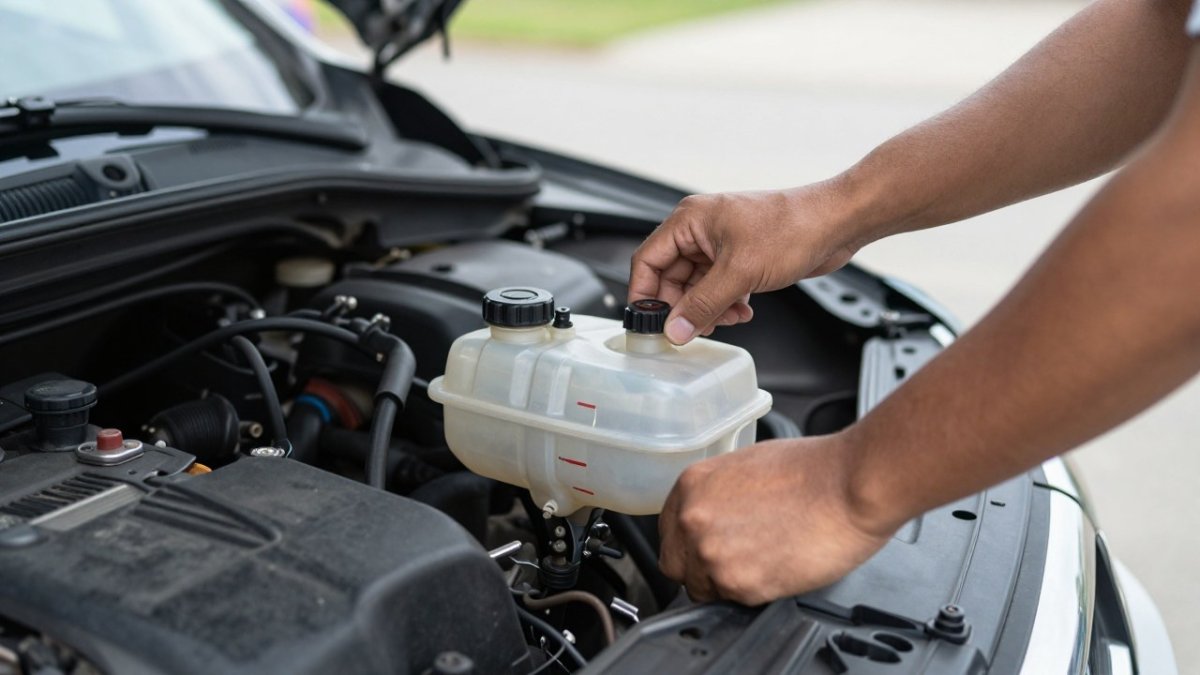
- Park the car on level ground and turn off the engine.
- Open the hood and secure it.
- Find the master cylinder reservoir near the back of the engine bay.
- Wipe the area around the cap so no dirt falls in.
- Look at the side of the reservoir and compare the fluid level with the MIN and MAX marks.
- Note whether the fluid sits between the two lines.
- If it is low, top up only to the MAX line with the correct fluid type.
You can usually read the level without opening the cap. Most reservoirs are translucent, so a flashlight shows the fluid line clearly. Opening the cap lets moisture into the system, which is why many drivers prefer to look without removing it.
Locating the Master Cylinder Reservoir
The master cylinder reservoir sits on the driver's side of the engine bay, near the firewall. It is typically a small plastic container with a cap marked "Brake Fluid" or with a symbol showing a circle with an exclamation mark.
Check the owner's manual if you cannot find it. The diagram shows the exact location for your model.
Reading the Level Against the MIN and MAX Marks
Look at the side of the reservoir. You should see two marks, labeled MIN and MAX.
- Level between MIN and MAX: Normal. No action needed.
- Level at or below MIN: Low. Check for leaks and top up after inspection.
- Level above MAX: Possible overfill, which can happen after a brake job. Have a mechanic check it.
The steps below summarise the core check, with what to do at each point.
| Step | What to do | Time or frequency |
|---|---|---|
| Park level | Turn off the engine on level ground | About 1 minute |
| Open hood | Open and secure the hood | About 1 minute |
| Find reservoir | Locate the master cylinder reservoir near the firewall | Under 2 minutes |
| Clean cap area | Wipe around the cap so no dirt falls in | Under 1 minute |
| Read level | Compare fluid against MIN and MAX marks | Under 1 minute |
| Top up if low | Add only to MAX with the correct fluid type | As needed |
Check Brake Fluid Hot or Cold: Does Temperature Change the Reading?
Yes, temperature changes the reading, and the reason is simple physics: brake fluid expands as it warms and contracts as it cools.
How much does it move?
If you have to check a hot car, for example, at a gas station after a highway drive, treat the reading as a rough sanity check only.
Watch out: do not open the reservoir cap on a hot engine to "get a better look." Brake fluid under heat is under slight pressure, and hot fluid can spit when the cap is released. Once the reservoir has cooled, any uncertainty about the fluid or signs of a leak is a reason to stop and seek professional brake service before driving.
A related trap is checking the level right after a brake job or after someone has pumped the brakes with the engine off.
Check Brake Fluid With Car On or Off: Which Is Correct?
Check with the engine off. The fluid level is easier to read when the car is still, and you avoid moving parts near the engine bay.
The engine does not need to be running for the reservoir to show an accurate level.
Turn the ignition off, set the parking brake, and wait a few minutes before opening the hood. This keeps you safe and gives the fluid time to settle.
Why Brake Fluid Level Drops and What to Do When It Is Below Minimum
A brake fluid level that falls over time usually points to one of three causes, and telling them apart is the whole job:
- Worn brake pads: As the pads wear thin, the caliper pistons extend farther out of their bores, and the system draws more fluid from the reservoir to fill the extra volume. This is normal wear, not a fault, and the drop is gradual, typically over thousands of miles, not overnight.
- A leak: Fluid escaping at a line, hose, caliper, wheel cylinder, or master cylinder seal is a safety-critical fault. A leak can drop the level quickly, and topping up does not fix it, it only masks it until the next drop.
- Moisture absorption: Brake fluid is hygroscopic, meaning it absorbs water from the air over time. That degrades its boiling point and performance, but it does not usually lower the level much on its own. A level that is low is rarely explained by moisture alone.
The pattern matters more than the single reading. A level that sits a little below MAX and stays there for months is usually pad wear. A level that drops from MAX to MIN in a few weeks, or that leaves a wet spot under the car or on a wheel, points to a leak.
What to do when the level is below MIN
- Do not drive on a suspected leak. If the pedal feels soft or spongy, if the brake warning light is on, or if you see fluid on the ground or on a wheel, do not drive the car. Have it towed or inspected where it sits. A brake system that is losing fluid can fail suddenly.
- Wipe and inspect. Clean the reservoir and the area around the master cylinder, then look for wet spots, drips, or a lowered level in the caliper area behind each wheel. A clean, dry system that is simply low is a different situation from a wet one.
- Check the pads if you can see them. Through the wheel spokes, look at the pad thickness against the rotor. Pads near the end of their life explain a gradual drop and mean a brake job is due, the fluid level will come back up when the pads are replaced and the pistons are pushed back.
- Top up only to MAX, and only with the correct fluid. If the level is low, there is no visible leak, and the pads are healthy, top up to the MAX line, never above it. Overfilling can force fluid out of the reservoir cap or damage seals.
- Recheck in a week or two. A level that holds after a top-up is likely pad wear or a one-time change. A level that drops again is a leak until proven otherwise, and it needs a professional inspection.
Use the right fluid, and never mix types
Brake fluid is not interchangeable. The reservoir cap and the owner's manual both state the required specification, usually a DOT rating such as DOT 3, DOT 4, or DOT 5.1. Use exactly what the manufacturer specifies. Mixing a DOT 5 silicone-based fluid into a system designed for DOT 3 or DOT 4 glycol-based fluid can damage seals and is not a roadside fix.
Keep moisture and dirt out
Brake fluid absorbs water from the air, so every time you open the reservoir you give it a chance to take on moisture.
Watch out: never top up a low level and assume the problem is solved. Repeated drops mean something is leaking or the pads are worn, and both need repair, a topped-up reservoir with a leak is still a brake system that can fail.
Understanding the Brake Fluid Warning Symbol on Your Dashboard
The brake warning light on your dashboard usually shows a circle with an exclamation mark, or the word BRAKE.
If the light comes on while you drive, pull over safely and check the reservoir. Low fluid is a serious sign and can mean reduced braking power.
A brake warning light that stays on after you top up the fluid means the system needs professional inspection.
Booking Your Next Brake Check and Logging the Result in Your Vehicle Record
Write down the date, the fluid level you saw, and any top-up you made. A simple log helps you spot a slow drop over several months.
Brake fluid also absorbs moisture over time, so most manufacturers recommend a full replacement at set intervals. Check your owner's manual for the exact schedule. You can track those reminders and your fluid checks in CarJourney, which keeps your maintenance records in one digital garage.
Last Updated: November 14, 2026
Frequently Asked Questions
How do I tell if my brake fluid is low?
Look at the translucent master cylinder reservoir with the car parked on a flat surface and the engine off, then compare the fluid level to the MIN and MAX marks on the side of the reservoir. If the fluid sits at or below the MIN line, the level is low and should be inspected. Also note the fluid color: fresh brake fluid is clear to light amber, while dark brown or black fluid suggests contamination or age and calls for a professional brake fluid service. A low level with no visible leak can also point to worn brake pads, since the fluid level drops slightly as pads wear down. If the brake pedal feels soft or sinks toward the floor, have the system inspected promptly.
Can I just add brake fluid if it is low?
You can top up brake fluid to the MAX line using fluid that matches the specification printed on the reservoir cap or in your owner's manual, usually DOT 3, DOT 4, or DOT 5.1. Do not mix DOT 5 silicone fluid with glycol-based fluids. Keep the reservoir cap sealed between uses, because brake fluid absorbs moisture from the air, which lowers its boiling point. If the level keeps dropping, do not keep topping up. Continued loss almost always means a leak or worn pads, and the cause needs a shop inspection before you drive the car further.
Can brake fluid go low without a leak?
Yes. As disc brake pads wear, the pistons move outward and the fluid level in the reservoir gradually drops to compensate. A slow decline over many months is normal on a vehicle with worn pads. A sudden or steady drop, however, suggests a leak in a brake line, hose, caliper, or the master cylinder itself. Because you cannot always see a leak, check the lines and calipers for wet spots and have the brakes inspected if the level falls noticeably between checks.
How often should you check your brake fluid?
Check the brake fluid level at least once a month and before long trips, and include it in every oil change or routine maintenance visit. Inspect the fluid color during the same check. Most manufacturers recommend replacing brake fluid roughly every two to three years regardless of mileage, because the fluid absorbs moisture over time. Logging each check and fluid change in your CarJourney maintenance history makes it easy to see when the next service is due.
 Add carjourney.io as a preferred source on Google →