 carjourney
From the CarJourney journal
Agreed Value vs Stated Value Insurance for Modified Cars

Last Updated: November 13, 2026
Quick Summary
With agreed value, you and the insurer set the vehicle's worth in writing before the policy starts, and that figure is the payout on a total loss. With stated value, you declare a number, but the insurer can still pay less, typically the lower of the stated amount and actual cash value minus your deductible.
- A stated value is a ceiling, not a promise, so the insurer may pay less than the declared figure.
- Agreed value removes depreciation from the payout calculation entirely on a total loss.
- Standard policies usually exclude aftermarket parts unless you declare every modification.
- Documentation should include receipts, dated photos, a build log, an appraisal, and proof of secure storage.
- Review your insured value yearly and after any major modification or completed restoration.
Table of Contents
- Agreed Value vs Stated Value: The Core Difference
- Agreed Value vs Actual Cash Value: Why Depreciation Changes Everything
- Modified Car Insurance Coverage for Aftermarket Parts
- Documentation for Modified Car Insurance Valuation
- What Modified Car Insurance Cost Actually Depends On
- Real Claim Payout Scenarios and Policy Wording Traps
- Start Your Free Digital Garage Before You Request a Quote
- Frequently Asked Questions
Agreed Value vs Stated Value: The Core Difference
The core difference in comparing agreed value vs stated value insurance modified cars comes down to one question: who controls the number that gets paid? With an agreed value policy, you and the insurer set the vehicle's worth in writing before the policy starts, and that figure is the payout on a total loss. With a stated value policy, you declare a number, but the insurer can still pay less.
That gap surprises a lot of modified-car owners. A stated value is a ceiling, not a promise. The distinction matters most when your build has real money in it.
How a Stated Value Policy Settles a Claim
A stated value policy lists an amount, then compares it to the vehicle's actual cash value at the time of loss. The insurer typically pays the lower of the two, minus your deductible. If depreciation or market conditions push actual cash value down, the stated figure does not protect you. The Zebra's guide to agreed vs stated value explains that the listed amount may not equal the final settlement.
How an Agreed Value Policy Settles a Claim
An agreed value policy fixes the payout in advance. You document the build, the insurer underwrites it, and both sides sign off on a number. On a total loss, that number is what you get, without a depreciation deduction. Collector-vehicle insurers like American Collectors Insurance describe agreed value as removing depreciation from the payout calculation entirely.
| Feature | Agreed Value | Stated Value |
|---|---|---|
| Who sets the payout | You and insurer, in writing | You declare, insurer verifies |
| Depreciation applied | No | Often yes |
| Payout certainty | High | Lower |
| Documentation required | Detailed, up front | Lighter |
| Best for | Modified and collector builds | Mildly modified daily drivers |
Agreed Value vs Actual Cash Value: Why Depreciation Changes Everything
Agreed value vs actual cash value is where modified-car owners lose the most money without realizing it. Actual cash value is replacement cost minus depreciation, and it ignores the sweat and receipts in your build. A modified car often depreciates faster on paper than a stock one because the market discounts custom work it cannot verify.
Agreed value sidesteps that math. Instead of an adjuster guessing what your restomod is worth on a Tuesday, the figure was settled at underwriting. That is the whole appeal. If your build has a documented engine swap or a restoration, actual cash value is the wrong tool for the job.
Modified Car Insurance Coverage for Aftermarket Parts
Modified car insurance coverage for aftermarket parts is not automatic on a standard policy. Most standard auto policies cover the vehicle as delivered from the factory, and custom equipment may fall outside that. If you bolt on a set of wheels or a supercharger and never tell your insurer, you may be paying for coverage that does not include them.
Specialty or collector policies handle this differently. The catch is that the insurer usually wants proof: receipts, photos, and a clear parts list. Experian's overview of stated amount vs agreed value notes that both policy types are options for unique vehicles, but the valuation approach drives what gets paid.
Are Your Modifications Covered Automatically?
No. A common mistake is assuming a premium or "full coverage" policy automatically includes aftermarket parts. It usually does not. Declare every meaningful modification, or it may be excluded at claim time. Watch out: an undeclared turbo kit can turn a total loss into a partial payout.
Documentation for Modified Car Insurance Valuation
Documentation for modified car insurance valuation is the part most owners skip, and it is the part that decides your payout.
A defensible package usually contains five things. Receipts for every part and every labor invoice, because a parts list without labor understates the build. Dated photographs of the car before, during, and after each modification, since a timeline proves the work happened. A written build log that pairs each part with its cost and install date. A professional appraisal for high-value or heavily modified cars, which many specialty carriers require above a certain insured value. And proof of secure storage, which some collector policies require as a condition of coverage.
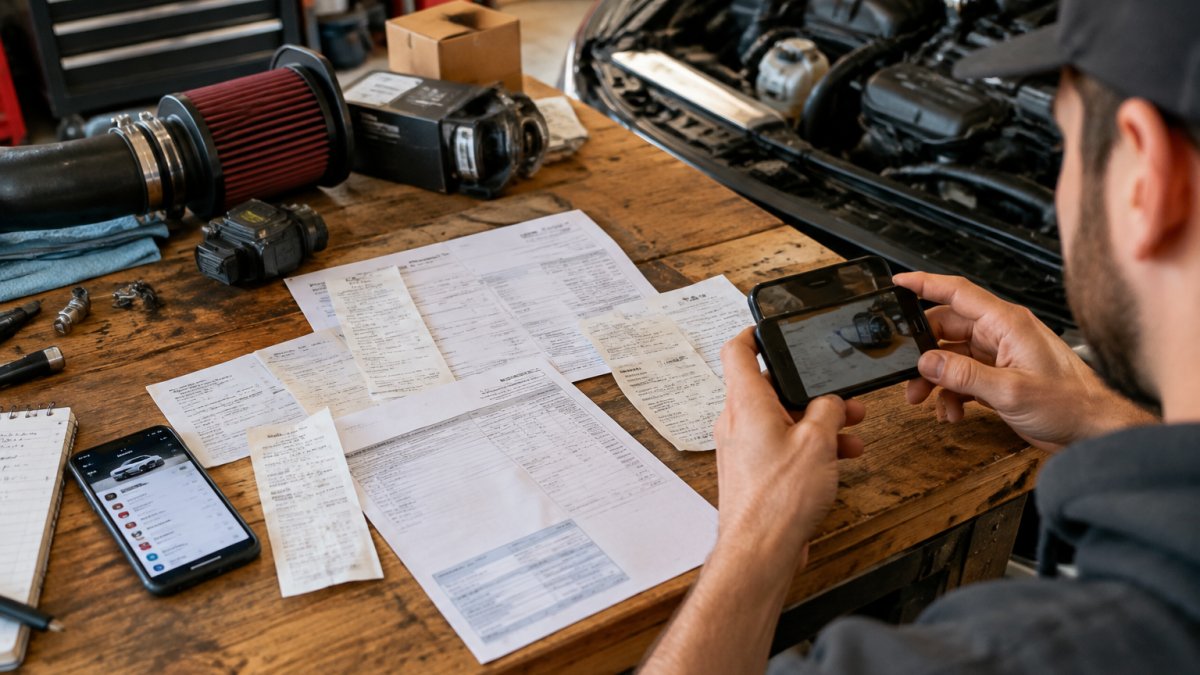
We built CarJourney around exactly this problem. The platform's VIN-based setup and unlimited modification tracking keep upgrades, costs, and receipts in one digital garage, so you can share a clean history instead of a shoebox. For a deeper walkthrough, see our guide on modification records for insurance.
Valuing Specific Modifications Line by Line
Assign a real cost to each modification rather than one lump figure. List the part, the labor, the date, and the receipt, and separate restoration work from performance work so the insurer can see what each contributes. An agreed value is only as strong as the paper behind it, and a line-item build is far easier to underwrite than a single round number. For a system to organize parts, costs, warranties, and spares, our aftermarket parts inventory guide covers the setup, and our breakdown of how to value car modifications before you sell helps you price each line.
Keeping the Insured Value Current
A valuation is a snapshot, and builds do not stand still. Review your insured value on a set schedule, such as once a year and again after any major modification or completed restoration, because market changes and new parts can make an old figure outdated in either direction. When you add a modification, update the build log and notify the insurer before the next renewal rather than after a loss. Watch out: an insurer that was never told about a new turbo kit or a fresh paint job can treat that work as undeclared and exclude it from the settlement, so the update is as important as the receipt.
What Modified Car Insurance Cost Actually Depends On
Modified car insurance cost depends on the valuation method, the build itself, and how you use the car. Because the insured value and usage limits shape what a modified car is worth on the road, check that classic car transport insurance reflects its agreed value while it is being moved.
Specialty policies often add eligibility requirements: mileage restrictions, secure storage requirements, and proof the car is not a daily commuter. Younger drivers face steeper pricing regardless of valuation method; our guide to cheapest modified car insurance for young drivers breaks down what moves the number.
Real Claim Payout Scenarios and Policy Wording Traps
Real claim payout scenarios expose the traps faster than any definition. The cleanest way to see the difference is to run the same modified car through three policies after a total loss.
- Agreed value at $45,000: The payout is the agreed figure minus the deductible, so $44,000. No depreciation argument, no haggling over the engine swap. This is the outcome the policy was written to produce.
- Stated value at $45,000: The insurer compares the stated amount to actual cash value and pays the lower of the two, minus the deductible. That means $28,000 minus $1,000, or $27,000. The $45,000 figure was a ceiling, not a promise, and the gap is $17,000.
- Actual cash value with no declared value: The payout is the depreciated figure minus the deductible, again $27,000, and undeclared modifications may be excluded entirely, pushing it lower still.
The same math applies on a partial loss, but the mechanism differs. A repairable claim is usually settled on the cost to repair or replace damaged parts, and that is where a custom-parts endorsement earns its keep. If your policy schedules the aftermarket wheels, supercharger, or coilovers, the adjuster values those parts directly.
Policy wording is where claims get won and lost, so read four things before you sign. First, the loss settlement clause, which states whether the insurer pays agreed value, stated amount, or actual cash value and whether depreciation is deducted. Second, the definition of custom equipment or aftermarket parts, which determines whether your build is covered at all. Third, the exclusions list, where undeclared modifications and track use often hide. Fourth, the salvage provision, which decides whether you can buy back the wreck and at what price after a total loss.
Be aware that a stated value policy that looks cheaper at quote time can pay less at claim time, because the lower-of-two settlement rule can cap your payout at market value even when you declared a higher number. Ask the agent to confirm in writing which figure the policy pays on a total loss and whether depreciation applies, and keep your insured value current as the build changes, since an outdated figure helps no one.
Total loss payouts for the same modified car under three policies
Agreed value at $45,000 payout $44,000Stated value at $45,000 payout $27,000Actual cash value with no declared value payout $27,000Start Your Free Digital Garage Before You Request a Quote
Start your free digital garage before you request a quote, because the insurer's first question is what you have in the car. A clean, documented history is what turns a stated value guess into an agreed value number.
That is where we come in. CarJourney keeps every receipt, modification, and service milestone in one place, with reminders tied to time and mileage so nothing slips.
Your build deserves a payout that matches what you put into it, not an adjuster's guess. Learn what a digital garage platform should track before you set yours up.
Frequently Asked Questions
Which is better for a modified car, agreed value or stated value insurance?
For most modified cars, agreed value is the safer choice. The insurer and you settle on a fixed figure before the policy starts, and that amount is what gets paid on a total loss, with no depreciation subtracted. Stated value lists a number on the policy, but the payout can be reduced to actual cash value at claim time, which hurts when your build cost more than the book value. Confirm the loss settlement clause in writing before you sign.
Does stated value insurance guarantee a payout equal to the value you declare?
No. A stated value policy sets a ceiling, not a promise. If the car is totaled, the insurer can pay the lower of the stated amount or the actual cash value at the time of loss. On a modified car where you have spent thousands on parts and labor, that gap can be large. Read the loss settlement section of the policy and ask the agent directly how a total loss would be calculated.
What documentation do you need to insure a modified car at an agreed value?
Expect to supply receipts for parts and labor, photos of the build at each stage, a professional appraisal for high-value builds, and a full modification list with costs. Insurers may also ask for mileage and storage details. Keeping a running digital log of every upgrade makes this fast, since you can export a clean history instead of digging through years of paper receipts.
Can a modified daily driver qualify for agreed value insurance?
Sometimes, but eligibility rules vary by insurer. Many agreed value programs target collector vehicles with limited mileage and garage storage. A modified daily driver may still qualify through a specialty carrier if the build is well documented and the usage fits their underwriting guidelines. Ask about mileage restrictions and storage requirements before assuming your car is excluded.
Do modifications increase or decrease a car's insurance value?
Modifications usually raise the value you want insured, but not every insurer sees it that way. Aftermarket parts, custom paint, and restomod work add real cost, yet standard policies may only cover factory equipment or cap aftermarket coverage. That is why you declare modifications and confirm they are covered for a specific amount rather than assuming the base policy handles them.
 Add carjourney.io as a preferred source on Google →