 carjourney
From the CarJourney journal
Cheapest Modified Car Insurance for Young Drivers

Last Updated: November 11, 2026
Quick Summary
The cheapest modified car insurance for young drivers is the policy that survives a claim without being voided, so declare every modification in writing and keep receipts, part numbers and install photos. Cosmetic parts raise premiums slightly, while performance mods like ECU tunes and turbo kits raise them a lot and can push you off mainstream carriers entirely.
- Declare each mod to your insurer in writing as soon as it is fitted.
- Cosmetic mods mainly affect vehicle valuation and theft risk, not driving behaviour.
- An ECU remap is the highest-risk common mod for a young driver and may be declined.
- Telematics can recover part of the modification load but rarely erases the surcharge.
- Verbal notice to an agent is not proof and is the most common cause of disputed claims.
Table of Contents
- Cheapest Modified Car Insurance for Young Drivers: What Actually Drives Your Rate
- Why Young Drivers Pay More for Modified Vehicles
- Quick Comparison: Carriers That Quote Modified Vehicles for Drivers Under 25
- The Impact of Aftermarket Parts on Insurance Premiums
- How to Declare Modifications to Insurance Without Getting Your Policy Voided
- Maintaining Vehicle Modification Records for Cheaper Quotes
- Telematics and Black Box Programs for Modified Cars
- Modification Do's and Don'ts for First-Time Buyers
- Get a Quote on Your Build and Start Logging Every Upgrade
- Frequently Asked Questions
Cheapest Modified Car Insurance for Young Drivers: What Actually Drives Your Rate
Finding cheap modified car insurance for young drivers comes down to three things: the type of modification, how you declare it, and which carrier actually wants to insure your build. Most young drivers assume the cheapest quote is the one with the lowest sticker price. In practice, the cheapest modified car insurance for young drivers is the policy that survives a claim without being voided.
Here's the uncomfortable truth. Insurers price risk, not enthusiasm. A 19-year-old with an ECU tune and lowered suspension looks like a different risk than a 19-year-old in a stock Honda Civic, and carriers act accordingly. Documented modifications often matter more than the mod itself.
Below, we break down what actually moves your premium, which carriers quote modified vehicles for under-25 drivers, and the exact steps to declare a mod without losing your coverage.
Why Young Drivers Pay More for Modified Vehicles
Age and inexperience already push premiums up. Add aftermarket parts and the risk profile climbs further, because insurers see a vehicle that's harder to value, harder to repair, and more likely to be driven aggressively.
A common mistake is assuming a modification only matters if it makes the car faster. Insurers care about anything that changes the vehicle from factory specification, including cosmetic work.
The practical result: young drivers with modified vehicles often face higher premiums, higher voluntary excess requirements, and fewer carriers willing to quote at all. That's not a reason to hide mods. It's a reason to shop smarter.
Quick Comparison: Carriers That Quote Modified Vehicles for Drivers Under 25
No carrier is universally cheapest for modified cars, and rates vary by state, vehicle, and driving record. What matters is knowing which insurers will handle declared modifications and young drivers at the same time.
| Carrier | Best For | Standout Feature | Watch Out For |
|---|---|---|---|
| CarJourney | Documenting mods before you quote | Shareable build profiles and VIN-based setup | Not an insurer, it's your records tool |
| USAA | Military families | Competitive young driver rates | Eligibility restricted to military |
| Erie Insurance | Budget basic coverage | Strong local agent network | Limited geographic availability |
| State Farm | New drivers nationwide | Steer Clear safe driver program | State-by-state rate swings |
| GEICO | Telematics-friendly drivers | DriveEasy monitoring program | Requires constant driving data |
| Progressive | Budget-first shoppers | Name Your Price tool | Rates shift with vehicle type |
| Liberty Mutual | Safety incentive seekers | RightTrack program | Higher base without discounts |
| Nationwide | Long-term value | Vanishing deductible option | Discounts need active management |
| Travelers | Bundlers and students | IntelliDrive program | Telematics not available everywhere |
| Mercury Insurance | Students in select states | Teen safety programs | State-limited availability |
Start with CarJourney to build a clean modification record, then take that record to insurers for quotes. A documented build is a stronger negotiating position than a verbal "it's just a cold air intake."
The Impact of Aftermarket Parts on Insurance Premiums
Aftermarket parts change how an insurer calculates risk and value.
Cosmetic vs. Performance Modifications split into two risk categories. Cosmetic mods, such as alloy wheels, tint, or body kits, mainly affect vehicle valuation and theft risk.
Here is how common parts tend to be treated by insurers in general:
- Aftermarket alloy wheels. Priced mostly as a valuation and theft item. A set of expensive wheels raises the total-loss payout the carrier is on the hook for and makes the car a more attractive theft target. Expect a modest premium load and a requirement to list the wheel value separately.
- Window tint and wraps. Usually treated as cosmetic valuation changes. Tint can raise a compliance question in states with strict tint limits, and a full wrap changes the factory color the carrier has on file, which matters at claim time. Premium impact is typically small, but the disclosure is not optional.
- Cold air intake and cat-back exhaust. Often priced as a mild performance signal. The intake itself is cheap to replace; the exhaust matters more because it can affect emissions compliance and repair cost. Some carriers treat a cat-back as cosmetic, others as performance, so the same part can produce different quotes.
- ECU remap or tune. The highest-risk common mod for a young driver. A remap raises power, can void the factory powertrain warranty, and signals aggressive driving to an underwriter. Some insurers may decline a tuned vehicle rather than surcharge it.
- Lowered suspension. Priced as both a performance and a repair-cost item. Lowering changes suspension geometry, can affect alignment and tire wear, and raises the cost of returning the car to factory spec after a claim. Expect a load and, with some carriers, a request for a professional install receipt.
- Turbo or supercharger kits. Insurers commonly treat large power increases as high risk for under-25 drivers. The power increase is large, the install is expensive, and the repair exposure is high.
The practical pattern: cosmetic parts move your premium a little and your payout exposure a lot, while performance parts move your premium a lot and can move you off a mainstream carrier's appetite entirely.
If you're budgeting a build on a tight income, our guide on how to budget car upgrades without stalling your build walks through staging modifications so insurance costs don't wreck the plan.
How to Declare Modifications to Insurance Without Getting Your Policy Voided
Declaring a modification means telling your insurer, in writing, exactly what changed on the vehicle before the policy starts or as soon as the part is fitted.
Follow this sequence every time:
- List every change from factory spec. Include cosmetic and performance items, even small ones.
- Gather proof. Keep receipts, part numbers, and install photos for each item.
- Contact your insurer in writing. Use email or the app so you have a timestamped record.
- Ask how the mod affects premium and excess. Get the answer before you agree to the updated policy.
- Confirm the update in writing. Save the confirmation to your records.
For a practical method covering receipts, photos, part numbers, and install notes, see how to document aftermarket parts the right way. That record is what an underwriter actually wants to see.
Watch out: telling an agent verbally and assuming it's logged is the single most common way young drivers end up with a disputed claim. Verbal notice is not proof.
Maintaining Vehicle Modification Records for Cheaper Quotes
Modification records are the paper trail that turns a vague "modified vehicle" into a priced, insurable risk. Carriers quote more confidently when they can see the parts, the install dates, and the receipts.
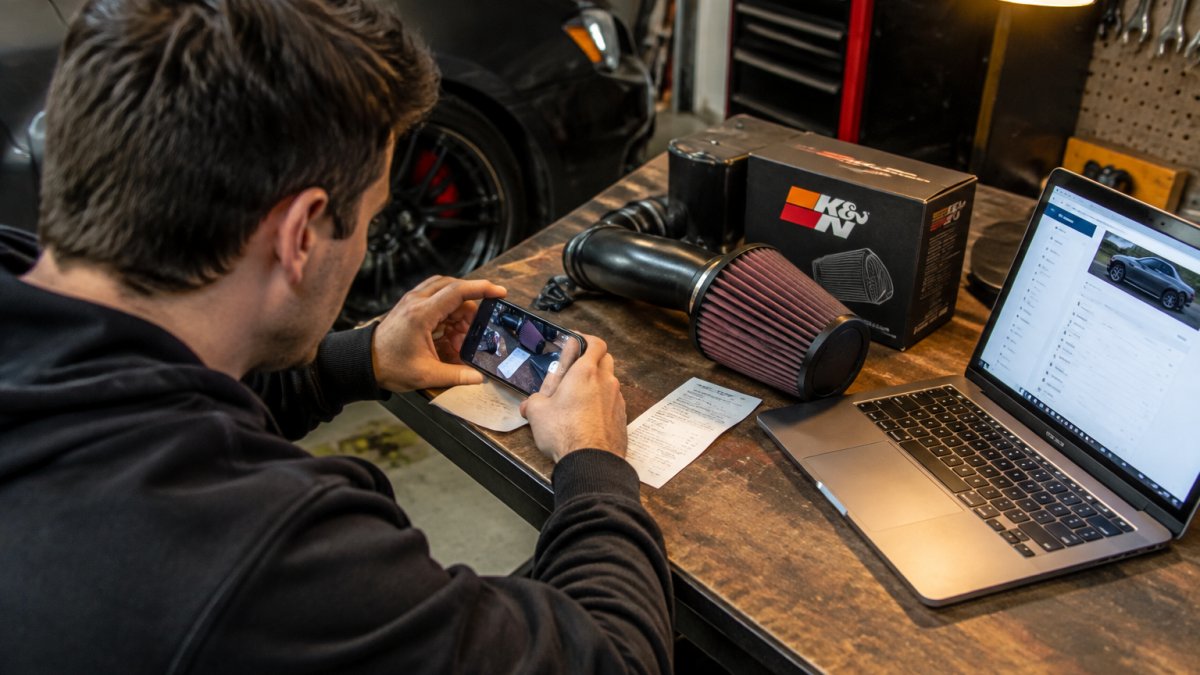
What most guides miss is that records do two jobs. They support your insurance declaration now, and they prove vehicle care to a buyer later. A complete build log with receipts and photos is worth more at resale than a folder of loose paper.
Our complete guide to documenting car upgrades covers how to organize every record so insurers and future buyers both trust it. Keep the log current after each install, not at renewal time when you're scrambling.
Telematics and Black Box Programs for Modified Cars
Telematics programs, often called black box insurance, track driving behavior through an app or plugged-in device and price premiums partly on how you actually drive. Because a telematics score reflects habits rather than every factor insurers consider, a defensive driving course for insurance may offer another way to strengthen a young driver's case for a lower premium.
Start with eligibility. Telematics eligibility for modified vehicles varies by insurer, so check with yours.
Next, understand what the program is actually scoring. Most telematics programs price on a handful of behaviors: hard braking, rapid acceleration, cornering, time of day, and annual mileage. Performance mods tend to show up in the first three.
Where a carrier does allow telematics on a modified car, the offset is real but partial. Smooth braking, low annual mileage, and limited night driving can recover part of the modification load.
Modification Do's and Don'ts for First-Time Buyers
First-time modifiers get into trouble by buying parts before understanding the insurance and legal picture. Get the order right and the whole build stays cheaper and cleaner.
Do:
- Check legality and road compliance for every part before purchase.
- Declare each mod to your insurer as it's fitted.
- Keep receipts, part numbers, and photos from day one.
- Ask about specialist brokers if mainstream carriers decline you.
Don't:
- Assume cosmetic mods are invisible to underwriters.
- Rely on a verbal declaration with no written confirmation.
- Skip the modification record because "it's just one part."
- Buy a part that changes the insurance group without pricing the premium impact first.
Before you buy anything, read our guide on how to modify vehicles safely and legally. It covers the planning and compliance checks that keep a first build out of trouble.
Get a Quote on Your Build and Start Logging Every Upgrade
The cheapest modified car insurance for young drivers starts with a record, not a quote. Carriers reward drivers who can prove exactly what's on the car, when it was installed, and how it's maintained.
CarJourney gives you one digital garage for every car, truck, and project.
You can see what an organized build log looks like in a real mod log with parts, photos, receipts, and build cost.
Stop guessing which carrier will accept your build. Start free with CarJourney, log every modification as you install it, and walk into every quote with a record that does the talking.
Frequently Asked Questions
Who is the cheapest insurance for young drivers with a modified car?
There is no single cheapest carrier because rates depend on your age, state, driving record, and the specific modifications. The only reliable way to find your cheapest modified car insurance is to request quotes from at least three carriers that explicitly write modified vehicles, then compare the total annual premium after discounts rather than the monthly figure.
Does modifying a car increase insurance premiums for young drivers?
Yes, in most cases. Insurers price risk based on repair cost and how the vehicle is driven, and aftermarket parts raise both. A turbocharger, ECU remap, or lowered suspension signals higher performance and higher replacement cost, so the premium rises. Cosmetic changes like alloy wheels or a body kit add less than engine work but still count. Declaring the modification keeps your coverage valid; hiding it can void a claim entirely and leave you paying for damage out of pocket.
How can I prove the value of my modifications to an insurance provider?
Keep receipts, invoices, and photos for every part, plus the installation date and shop name. Maintaining vehicle modification records this way lets an adjuster verify what was on the car at the time of a claim, which matters for agreed-value or custom-equipment coverage. A digital garage that stores receipts and build photos in one place makes this fast at renewal or claim time. Without documentation, insurers may only pay for the factory part.
What types of car modifications are considered high risk by insurers?
Engine and exhaust changes top the list: ECU remapping, turbo or supercharger kits, and performance exhaust systems raise power and speed, which insurers price as higher risk. Lowered suspension, wide-body kits, and large alloy wheels also draw scrutiny because they increase repair cost and can affect road legality. Cosmetic wraps and interior trim are usually low risk. Any modification that changes how the car performs or stops should be declared before you drive it.
Are there specific insurance companies that specialize in modified vehicles?
Yes. Alongside mainstream carriers, specialist brokers may focus on modified and enthusiast vehicles and can sometimes place drivers that standard comparison tools do not. Specialists understand build documentation and agreed-value coverage. Get quotes from both mainstream and specialist sources, and ask each whether they cover aftermarket parts at full value or only factory replacement cost.
 Add carjourney.io as a preferred source on Google →