 carjourney
From the CarJourney journal
Why Document Recent Repairs: A Car Owner's Guide

Why Document Recent Repairs: A Car Owner’s Guide
Repair documentation is the practice of creating a verified, timestamped record of every service, fix, or part replacement performed on your vehicle. Every car owner should understand why document recent repairs matters: a single gap in your service history can cost you thousands at resale, void a manufacturer warranty, or sink an insurance claim before it starts. A $150 preventive tune-up can prevent a $5,000 catastrophic failure when you have the records to prove it was done. This guide covers what to record, why it pays off, and how to build a system that actually holds up.
Why document recent repairs: the financial case
Repair documentation is a financial asset, not just administrative paperwork. It converts invisible maintenance effort into verifiable proof that protects your money at every stage of ownership. Most car owners treat receipts as trash. That habit is expensive.
The numbers make the case clearly. A single insurance claim denial can cost $15,000–$60,000 out of pocket, while consistent maintenance logging reduces legal defense costs by 60%. That is not a minor inconvenience. That is a financial event that proper records prevent entirely.
Resale value is equally at stake. Documented service history gives buyers confidence and removes their leverage to negotiate your price down. Sellers without records face buyers who assume the worst and price accordingly. Your repair log is the evidence that your car was cared for, not just driven.

Documentation also reveals patterns you would otherwise miss. Recurring repairs on the same system signal a deeper problem before it becomes a full component failure. One example: a refrigerant leak caught through multiple log entries avoided a $7,500 compressor replacement. That kind of early detection only happens when you have a complete history to look back on.
What information should you record for each repair?
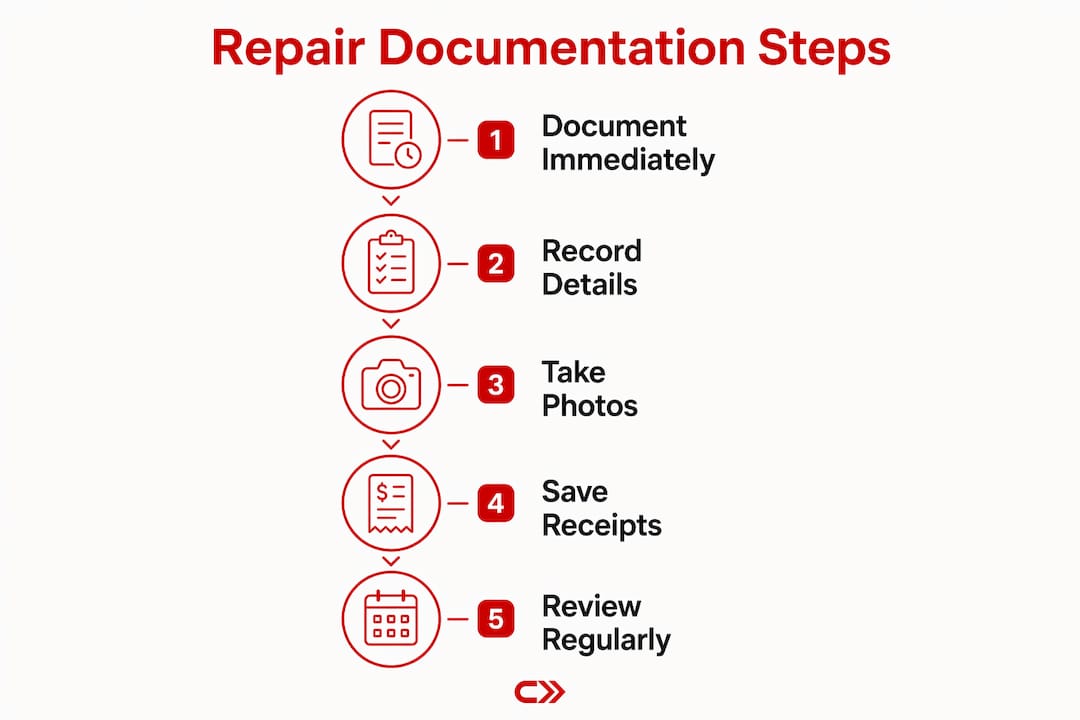
Capturing the right details turns a receipt into real evidence. Five data points make every repair entry useful: the service date, the system or part addressed, the specific work performed, the cost broken down by labor and parts, and the identity of who did the work. Miss any one of these and the record loses credibility.
Here is what a complete repair entry looks like in practice:
- Date of service: The exact date, not just the month. Warranty timelines and insurance claims run on precise dates.
- System or component: “Brakes” is too vague. “Rear brake pads and rotors, left and right” is evidence.
- Work performed: Describe what was done, not just what was replaced. “Replaced worn pads, resurfaced rotors, bled brake fluid” tells the full story.
- Cost breakdown: Separate labor from parts. This matters for warranty reimbursement disputes and insurance claims.
- Technician or shop identity: Name, license number, and shop address. DIY repairs should note your name and any parts sourced.
- Photos: Wide shots of the area, close-ups of the worn or replaced part, and images of serial numbers or part labels.
Receipts alone often lack critical context. Recording the repair symptoms, the parts specifics, and the contractor’s license number significantly improves your acceptance rate on warranty and insurance claims. A receipt says money changed hands. A complete record says responsible maintenance happened.
Pro Tip: Take your photos before and after every repair. A “before” photo showing the worn part and an “after” photo showing the new installation gives adjusters and warranty reviewers exactly what they need to approve a claim without pushback.
How does documentation protect warranty claims, insurance, and legal rights?
Insurance adjusters and courts do not just want receipts. They require the “why” and the “process” behind a repair, including timely decision and completion dates that demonstrate responsible ownership. A stack of invoices without context is far weaker than a log that shows you identified a problem, acted promptly, and used a qualified technician.
“Adjusters treat contemporaneous records created at the time of service as reliable evidence, while reconstructed records created later raise suspicion and risk claim denial.” — Rental Maintenance Documentation Guide
This distinction matters more than most owners realize. If you rebuild your repair history from memory after a dispute arises, adjusters flag it. Contemporaneous records, meaning records created at the time of the repair, carry legal weight that after-the-fact summaries do not.
Warranty protection follows the same logic. Most manufacturer warranties require documented service intervals to remain valid for 10-year coverage terms. If you cannot prove the oil was changed on schedule, the manufacturer has grounds to deny a related engine claim. Your log is the proof that keeps the warranty intact.
Legal disputes follow the same standard. Proof of timely, appropriate maintenance shifts the burden of responsibility. Without records, you are arguing from memory against an adjuster or opposing counsel who has documentation on their side. With records, you control the narrative.
Paper logs vs. digital tools: which method works best?
The best repair documentation method is the one you will actually use consistently. Both paper and digital approaches have real strengths, and the right choice depends on your habits and how you plan to use the records.
| Method | Strengths | Weaknesses |
|---|---|---|
| Paper notebook | No tech required, always accessible, simple to start | Easy to lose, hard to search, no backup |
| Filing receipts in a folder | Low effort, captures original documents | No context added, disorganized over time |
| Spreadsheet (Google Sheets, Excel) | Searchable, easy to share, free | Requires manual entry, no photo storage built in |
| Digital repair log apps | Stores photos, parts data, symptoms, and outcomes | Requires setup, some cost money |
| Carjourney | AI-powered scanning, vehicle-specific tracking, community data | Requires account setup |
Digital tools like repair log apps store contextual information including parts, serial numbers, repair symptoms, and outcomes. That depth makes answering adjuster or buyer questions fast and accurate. Paper logs cannot match that speed when you need to pull a specific date or part number under pressure.
The critical factor for any method is that records must be contemporaneous. Create the entry at the time of the repair, not weeks later. A log entry dated the same day as the service receipt is credible. One reconstructed from memory six months later is not.
For car owners who want their repair history to support resale value, digital records are the clear choice. They are shareable, searchable, and survive a lost phone or flooded garage in ways that paper cannot.
Practical tips to keep your repair records consistent
Consistency separates useful documentation from a pile of forgotten receipts. These habits make the difference between a record that holds up and one that falls apart when you need it most.
- Apply the 24-hour rule. The “receipt-in-pocket” rule means filing every repair document within 24 hours of service. Delaying receipt filing is the leading cause of record loss among owners. Do it the same day, every time.
- Add context beyond the receipt. Write down what symptoms prompted the repair, what the technician found, and what was decided against. This narrative is what adjusters and buyers actually want.
- Take before and after photos at every service. Photos are the fastest way to prove condition and work quality. Store them in the same folder or app as the written record.
- Schedule a quarterly record review. Set a calendar reminder every three months to check that all recent repairs are logged, photos are attached, and nothing is missing. Gaps are easier to fill when the repair is still recent.
- Never reconstruct records after the fact. If you missed logging a repair, note the date you are creating the entry and what source you are working from. Presenting a reconstructed record as contemporaneous is the fastest way to lose a claim.
- Organize by system, not just date. Group records by component (engine, brakes, suspension, electrical) so you can quickly pull the full history of one system when a pattern emerges.
Pro Tip: When you pick up your car from a shop, photograph the invoice on your phone before you leave the parking lot. That single habit eliminates the most common cause of missing records.
Key takeaways
Repair documentation is the single most reliable way to protect your vehicle’s financial value, warranty coverage, and legal standing across its entire ownership life.
| Point | Details |
|---|---|
| Document at the time of repair | Contemporaneous records carry legal and insurance weight that reconstructed logs do not. |
| Capture five core data points | Date, system, work performed, cost breakdown, and technician identity make every entry credible. |
| Photos are non-negotiable | Before and after images of every repair support warranty claims and insurance approvals. |
| Digital tools outperform paper for resale | Searchable, shareable digital logs give buyers and adjusters instant access to your full history. |
| The 24-hour rule prevents most record loss | Filing repair documents the same day eliminates the leading cause of documentation gaps. |
Why I think most car owners underestimate their repair records
I have seen the same pattern repeat itself too many times. A car owner spends years maintaining their vehicle responsibly, then loses thousands at the point of sale or gets a warranty claim denied because they cannot prove what they did. The maintenance happened. The proof did not survive.
The uncomfortable truth is that most people treat repair records as a bureaucratic afterthought. They keep the receipt for a week, then it disappears into a glove box or gets thrown out with the grocery bags. When the dispute or the sale arrives, they are left arguing from memory against someone who has documentation.
What I have found is that the owners who build documentation habits early treat their records the same way they treat their car’s physical condition. They understand that maintenance records matter not just for the next owner, but for every interaction with a warranty department, an insurer, or a mechanic who needs to understand the vehicle’s history.
The shift in mindset is simple but powerful. Stop thinking of a repair log as paperwork. Think of it as a financial record, the same way you think of a bank statement. You would not throw away three years of bank statements. Your repair history deserves the same respect.
Start the habit with your next service. One entry, one photo, one date. Build from there.
— Chally
How Carjourney makes repair logging effortless
Scattered receipts and forgotten service dates are exactly the problem Carjourney was built to solve.

Carjourney is a vehicle maintenance tracker built by a team of gearheads and engineers in Virginia who got tired of managing car records the hard way. The platform uses AI to scan your service documents, track repair history by vehicle, and answer detailed questions about your specific build. You get a complete, searchable log that supports warranty claims, insurance documentation, and resale conversations without digging through a glove box. Start your maintenance log today and turn every repair into a record that actually works for you.
FAQ
Why should I document recent car repairs?
Documenting recent repairs protects you financially by supporting warranty claims, preventing insurance denials, and increasing resale value. A complete repair history gives buyers and adjusters verifiable proof of responsible ownership.
What details should I include in a repair log?
Every entry should include the service date, the system or part addressed, the specific work performed, a cost breakdown by labor and parts, and the technician’s identity. Photos of the repair before and after add critical visual evidence.
Does repair documentation really affect resale value?
Yes. Documented service history increases buyer confidence and reduces their ability to negotiate your price down based on assumed neglect. Sellers without records consistently accept lower offers.
How soon after a repair should I create a record?
Create the record the same day as the repair. Insurance adjusters treat contemporaneous records as reliable evidence and treat records created later with suspicion, which can result in claim denial.
Is a digital log better than keeping paper receipts?
Digital logs are more reliable for resale and claims because they are searchable, shareable, and include photo storage. Paper receipts are easy to lose and provide no context beyond the transaction itself.