 carjourney
From the CarJourney journal
Why Follow Service Schedules: A Vehicle Owner's Guide

Why Follow Service Schedules: A Vehicle Owner’s Guide
A vehicle service schedule is a predefined plan that specifies when maintenance tasks like oil changes, fluid checks, tire rotations, and brake inspections must be performed to keep your car running safely and efficiently. Skipping these intervals is not a neutral decision. It is a choice to accept growing mechanical risk in exchange for short-term convenience. The core reason to follow service schedules is simple: preventive maintenance costs a fraction of what reactive repairs demand, and the gap between those two numbers widens every time you delay. This guide covers the real costs, the scheduling logic, the common myths, and the practical steps to stay on track.
Why follow service schedules: the cost case is overwhelming
Planned maintenance costs 28–35% less annually than reactive repairs. That figure comes from fleet data, but it applies directly to personal vehicle ownership because the mechanical principles are identical.
The numbers tell the story clearly. An oil change runs $85–$140. An engine replacement costs $8,000–$22,000. Those are not edge cases. They are the predictable outcome when lubrication intervals are ignored long enough for metal-on-metal wear to cause permanent damage. Catching a failing belt during a scheduled inspection costs a fraction of the tow, rental car, and labor bill that follows a roadside breakdown.
Early detection is the real value of a service schedule. Routine checks on fluids, belts, and brakes catch minor defects before they become major failures. A cracked serpentine belt spotted at 60,000 miles is a $150 fix. The same belt snapping on the highway triggers a cascade: overheated engine, damaged alternator, and a tow bill before you even reach a shop.

Pro Tip: Track every service visit in a single log. When a mechanic spots a worn component, you can cross-reference it against your last inspection date and catch patterns before they become failures.
Secondary damage is the hidden multiplier. Ignoring structured maintenance intervals produces 2.8–3.4 times greater maintenance costs because one failing part stresses adjacent systems. A neglected coolant flush leads to a corroded thermostat, which leads to an overheated head gasket. Each failure compounds the last.
How do service intervals and scheduling triggers work?
Standard passenger vehicle service intervals follow a straightforward rule. RAC Drive guidance recommends an interim service at 6 months or 6,000 miles and a full service at 12 months or 12,000 miles. The governing principle is “whichever comes first,” not whichever is most convenient.
That “whichever comes first” rule matters more than most owners realize. A vehicle driven mostly on short city trips may accumulate engine wear faster by calendar time than by mileage. For idle-heavy or short-trip driving, time-based triggers often dictate maintenance needs more accurately than mileage alone, because engine oil additives degrade even when the odometer barely moves. A car that sits in traffic for 30 minutes twice a day is harder on its oil than one that covers the same miles on a highway.
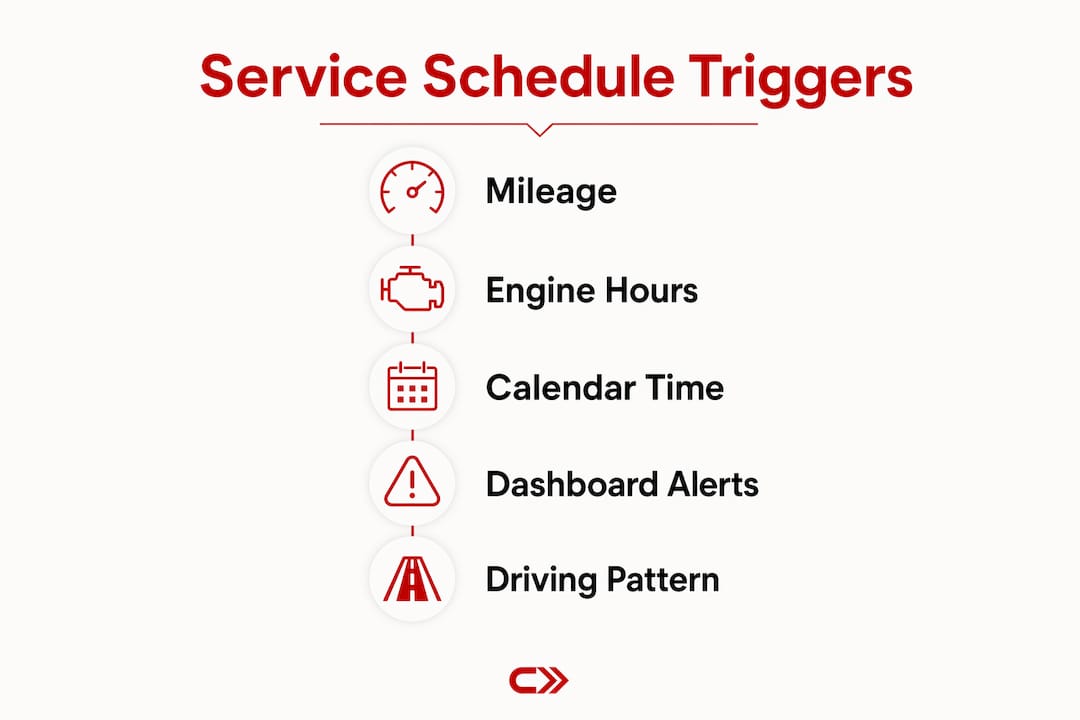
The most effective service maintenance scheduling combines three triggers: mileage, engine hours, and calendar time. Whichever threshold arrives first triggers the service. This prevents both over-maintenance (wasting money on unnecessary work) and under-maintenance (missing critical wear thresholds).
| Trigger type | Best use case | Example threshold |
|---|---|---|
| Mileage | Highway-heavy driving | Every 5,000–7,500 miles |
| Calendar time | Short trips, low annual mileage | Every 6–12 months |
| Engine hours | Towing, idling, off-road use | Every 100–150 engine hours |
| Whichever comes first | Mixed or unpredictable use | First of any trigger met |
Modern vehicles make this easier. Dashboard service alerts, oil life monitors, and tire pressure sensors give real-time feedback. Following those alerts is not optional maintenance. It is the manufacturer’s minimum standard for keeping your warranty valid and your drivetrain intact.
Pro Tip: If your driving pattern changes significantly, such as switching from highway commuting to city stop-and-go, reassess your service intervals. Your old schedule may no longer fit your actual usage.
What misconceptions stop owners from sticking to schedules?
The most damaging myth in vehicle ownership is that reactive maintenance saves money. Experts at OxMaint have documented this as a false economy. Owners who skip scheduled services to avoid the cost consistently pay more in total over the life of the vehicle. The savings feel real in the short term. The bill arrives later, and it is larger.
The gap between intention and action is also well documented. Only 35% of maintenance work time is spent on planned work, despite 71% of vehicle and fleet operators recognizing preventive maintenance as important. The main barrier is not motivation. It is the absence of automated systems that enforce scheduled maintenance before it slips.
Common barriers vehicle owners face include:
- Forgetting intervals because service dates are tracked mentally or on paper receipts buried in the glove box
- Underestimating urgency when a vehicle appears to run fine despite an overdue service
- Assuming dealer schedules are upsells rather than manufacturer-specified minimums
- Skipping records after a service, losing the documented proof that work was done
Most preventive maintenance failures occur because of manual scheduling and passive reminders, not because owners lack commitment. Switching to automated, trigger-based reminders removes the human memory requirement entirely.
Pro Tip: Set a recurring calendar reminder one week before your expected service date. That buffer gives you time to book an appointment rather than scrambling after the interval has already passed.
How to manage your service schedule practically
Maintaining a detailed service log is the single highest-return habit in vehicle ownership. Complete documented service history acts as proof of value, protects your warranty, and directly increases resale price. A buyer choosing between two identical vehicles will pay more for the one with a clean, verified maintenance record. That log is a financial asset, not just a paper trail.
A practical service log should record the date, odometer reading, parts replaced, fluids changed, and technician notes for every visit. This level of detail supports warranty claims and gives any future mechanic a clear picture of your vehicle’s history. Keeping records digitally makes them searchable and impossible to lose.
For owners who want a structured starting point, a monthly and mileage-based self-check covers the basics:
- Monthly: Check tire pressure, engine oil level, coolant level, and windshield washer fluid
- Every 3,000–5,000 miles: Inspect wiper blades, air filter condition, and brake feel
- Every 6,000 miles or 6 months: Schedule an interim service covering oil, filters, and fluid top-offs
- Every 12,000 miles or 12 months: Full service including brake inspection, tire rotation, and belt checks
- As triggered: Follow dashboard alerts immediately. Delayed responses to warning lights are the most common cause of avoidable major repairs
Digital maintenance trackers remove the friction from this process. Carjourney, built by Blue Shed Digital in Virginia, uses AI to scan your service documents, answer questions about your specific vehicle, and recommend maintenance schedules verified across multiple AI models. That specificity matters because a 2019 Ford F-150 with a 5.0L V8 used for towing has different service needs than the same truck used for light city driving.
Coordinating with your dealership or independent shop in advance also reduces delays. Booking your next service before you leave the current one keeps you on schedule without relying on memory. Many shops will send reminders if you ask them to, but the responsibility for tracking intervals ultimately sits with you.
Key Takeaways
Following a vehicle service schedule is the most cost-effective way to protect your investment, maintain safety, and preserve resale value over the full life of your car.
| Point | Details |
|---|---|
| Preventive maintenance saves money | Planned maintenance costs 28–35% less annually than reactive repairs. |
| Neglect multiplies costs | Ignoring intervals produces 2.8–3.4 times higher costs through compounding damage. |
| Use multi-trigger scheduling | Combine mileage, calendar time, and engine hours to avoid both over- and under-servicing. |
| Service records are financial assets | Documented history protects your warranty and increases resale value. |
| Automation beats memory | Automated reminders and digital logs are the most reliable way to stay on schedule. |
Service schedules are the cheapest insurance you will ever buy
I have talked to enough vehicle owners to know that most skipped services are not acts of negligence. They are acts of optimism. The car feels fine. The warning light just came on. It can probably wait another month. That logic is exactly how a $140 oil change becomes a $4,500 engine repair.
What changed my thinking was treating maintenance records the way a homeowner treats a renovation log. Every entry adds value. Every skipped entry is a gap that a buyer, an insurer, or a warranty adjuster will notice. A full service history is not just proof that you maintained the car. It is proof that you understood what you owned.
The “whichever comes first” rule is the insight most owners miss. They track mileage and ignore calendar time, or they service by the calendar and ignore that their short-trip driving is degrading oil faster than the odometer suggests. Matching your schedule to your actual driving patterns is the difference between a schedule that protects your vehicle and one that just looks good on paper.
Treat scheduled maintenance as risk management. The cost of a service is fixed and predictable. The cost of a breakdown is neither. Every time you follow your schedule, you are buying a known expense to avoid an unknown one. That trade is always worth making.
— Chally
Carjourney makes it easier to stay on schedule
Keeping up with service intervals gets complicated when life gets busy. Carjourney was built specifically for vehicle owners who want one place to track everything without the scattered receipts and forgotten dates.
Carjourney uses AI to scan your service documents, flag upcoming maintenance based on your specific vehicle and driving patterns, and build a verified service history you can actually use at resale. It connects you with a community of enthusiasts sharing real-world data on the same makes and models you own. Whether you drive a daily commuter or a weekend build, Carjourney’s maintenance tracker keeps your service schedule working for you, not against you. Start building your vehicle’s service record today.
FAQ
Why is following a service schedule so important?
Following a service schedule prevents minor wear from becoming major failures. Planned maintenance costs 28–35% less annually than reactive repairs, making it the most cost-effective approach to vehicle ownership.
How often should I service my car?
The standard recommendation is an interim service every 6 months or 6,000 miles and a full service every 12 months or 12,000 miles, whichever comes first.
Does skipping a service really cost more in the long run?
Yes. Ignoring structured intervals produces 2.8–3.4 times higher costs per repair dollar due to compounding damage across connected systems.
What is the best way to track my vehicle’s service history?
A digital maintenance log that records the date, odometer reading, parts replaced, and technician notes is the most reliable method. Comprehensive service logs protect your warranty and increase resale value.
What triggers should I use to schedule a service?
Use a combination of mileage, calendar time, and engine hours, and act on whichever threshold arrives first. This multi-trigger approach prevents both over-maintenance and under-maintenance across different driving patterns.