 carjourney
From the CarJourney journal
How to Log Car Modifications: A Complete Guide
Table of Contents
- Why Track Car Modifications
- Essential Data to Record When Logging Car Modifications
- Car Modification Documentation Checklist
- Choosing the Best Car Modification Tracker App vs. Spreadsheets
- How to Keep Car Maintenance Records Alongside Modifications
- Insurance and Legal Documentation for Modified Vehicles
- Resale Value of Modified Cars: Documentation That Matters
- Data Privacy and Security for Your Modification Records
How to Log Car Modifications: A Complete Guide
Last Updated: July 23, 2026
Understanding how to log car modifications is essential for anyone serious about maintaining their vehicle's history. Whether you're documenting performance upgrades, visual enhancements, or routine maintenance, tracking these changes creates a comprehensive record that protects your investment and proves care to future buyers. CarJourney has helped thousands of automotive enthusiasts organize scattered receipts, photos, and service records into one cohesive digital garage. A well-maintained modification log becomes proof of quality work, helps you manage warranty implications, and can significantly increase your vehicle's resale value when buyers see detailed documentation of every upgrade.
Why Track Car Modifications
Tracking your modifications protects you legally, financially, and practically. When you document each upgrade with dates, costs, and installation details, you create an undeniable record of your vehicle's condition. Insurance companies rely on this documentation for claims. A vehicle with a complete service history and modification log commands premium pricing at resale, sometimes recovering 40-60% of upgrade costs depending on the market and modifications chosen.
Beyond resale value, tracking modifications helps you manage warranty implications. Many aftermarket parts void manufacturer warranties on specific components, and you need to know exactly which ones.
Pro Tip Keep your modification log updated within 48 hours of completing work. Memory fades quickly, and details like torque specifications, part numbers, and installation notes become fuzzy after a few days. Capturing them immediately ensures accuracy that buyers and mechanics will trust.Essential Data to Record When Logging Car Modifications
Installation dates and mileage
Recording the exact date and mileage when you install a modification creates a timeline invaluable for troubleshooting and resale documentation. This pairing matters because mileage often tells a more accurate story than calendar dates. Always record both the date (month, day, year) and the odometer reading at installation. If you're doing work over multiple days, note the completion date when the modification was fully functional.
Part numbers and OEM specifications
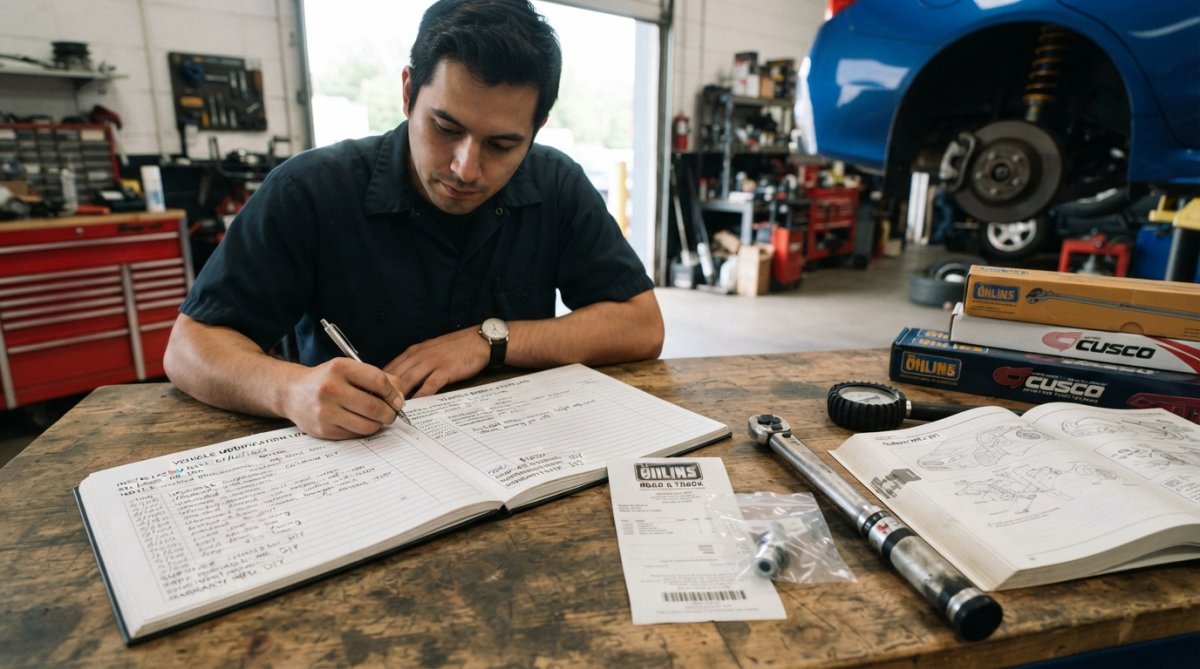
Every modification should include the exact part number, manufacturer name, and product version. This is essential for warranty claims, recalls, compatibility verification, and future reference when you need to find the exact same part again.
OEM (Original Equipment Manufacturer) specifications matter equally. If you're replacing a factory component, document what was there originally. Store part numbers in a consistent format, including the manufacturer's name, product line, and version number. A note like "Bilstein B6 (46-180694)" is far more useful than "upgraded shocks" when verifying compatibility later.
Cost tracking and receipt storage
Record the total cost of each modification including parts, labor, and additional expenses like shipping or installation fees. Separate these costs if possible. Store the original receipt digitally by photographing it immediately after purchase, then scanning if it's paper. Digital receipts from online retailers should be downloaded and saved.
Watch Out Paper receipts fade and deteriorate. Thermal paper receipts from auto parts stores become unreadable within 2-3 years. Photograph or scan every receipt within a week of purchase, then file the digital copy. Many insurance claims and warranty disputes have been lost because the original receipt became illegible.Car Modification Documentation Checklist
What to include in your documentation
A complete modification record includes:
- Installation date and mileage at installation
- Part name, manufacturer, and part number
- OEM specification or equivalent component being replaced
- Total cost (parts + labor separated)
- Installation location on vehicle
- Installer name (DIY, specific shop, or technician)
- Torque specifications and critical measurements
- Any modifications to adjacent components required for installation
- Warranty information (manufacturer warranty period and coverage)
- Performance metrics or changes (if applicable)
- Notes on compatibility or issues encountered during installation
- Digital receipt and invoice copies
This level of detail transforms a casual upgrade log into a professional documentation package that buyers, mechanics, and insurance adjusters take seriously.
Installation photos and build progress tracking
Photographs provide visual proof that modifications were installed correctly and professionally. Take photos before installation, during the process, and after completion. Close-up shots showing part numbers, torque wrench readings, and proper fitment are far more valuable than distant overall shots.
For major modifications, create a photo series showing the progression. Store photos in a consistent folder structure organized by modification type or installation date, with descriptive filenames like "2026-03-15_Bilstein-B6-Shocks_Installation.jpg."
Choosing the Best Car Modification Tracker: App vs. Spreadsheets
Digital apps: pros and cons
Modification tracking apps offer convenience and organization that spreadsheets can't match. Apps typically include automatic VIN-based vehicle setup, photo storage, reminder systems tied to both time and mileage, and the ability to generate shareable build profiles for potential buyers.
The primary advantage is integration. A quality app syncs your data across devices, backs up automatically, and prevents scattered documentation. However, app quality varies dramatically. Some focus only on maintenance and ignore modifications. Integration with your vehicle's actual specifications depends on VIN lookup accuracy, which can be unreliable for older or heavily modified vehicles. Many apps charge monthly subscriptions, though free tiers typically exist with limited features.
Spreadsheet templates: pros and cons
Spreadsheets offer complete control and zero recurring costs. You can customize columns exactly as you need them, create formulas to calculate total modification costs, and sort by any criteria you choose.
However, spreadsheets have serious limitations for modification tracking. They don't sync automatically across devices, risking data loss. Photo management becomes unwieldy. Spreadsheets lack reminder functionality that keeps you on top of maintenance intervals tied to mileage. They're excellent for historical documentation but poor for forward-looking vehicle management.
Comparison: which method works best for your needs
| Tracking Method | Best For | Setup Time | Mobile Access | Photo Storage | Sharing with Buyers |
|---|---|---|---|---|---|
| Digital App | Active builders, frequent modifications, resale planning | 5-15 minutes | Excellent | Integrated | One-click sharing |
| Spreadsheet | Detail-focused owners, occasional modifications, cost control | 30-60 minutes | Limited | External links | Manual export |
| Hybrid Approach | Most owners | 20-30 minutes | Good | Both methods | Flexible |
For most car enthusiasts, a hybrid approach works best. Use a spreadsheet for detailed cost tracking and technical specifications, then migrate key information into an app for mobile access and buyer-ready documentation.
If you're planning to sell your vehicle within 2-3 years, prioritize an app that generates shareable build profiles. If you're maintaining a long-term project car with no immediate resale plans, a spreadsheet may provide sufficient organization without ongoing costs.
CarJourney bridges this gap by offering both detailed modification logging and automatic shareable build profiles. The VIN-based setup eliminates manual data entry, photo storage is integrated, and reminders tie to both calendar dates and mileage.
How to Keep Car Maintenance Records Alongside Modifications
Integrating maintenance schedules with modification logs
Maintenance and modifications are intertwined, yet most tracking systems treat them as separate categories. When you install a modification, note any maintenance implications. Upgrading to a performance suspension requires more frequent alignment checks. Installing a turbocharger means shorter oil change intervals. A larger wheel and tire package affects speedometer accuracy.
Create a unified timeline that shows both modifications and maintenance in chronological order. This reveals patterns and helps mechanics understand your vehicle's complete story.
Key Takeaway Modifications and maintenance are not separate stories, they're chapters in the same book. A suspension upgrade changes your maintenance schedule. A turbo installation affects oil change intervals. Document these connections explicitly so future mechanics understand the full context of your vehicle's history.Service history documentation and warranty implications
Every modification potentially affects your vehicle's warranty coverage. Documenting which modifications void which warranties prevents expensive surprises when you file a claim.
Manufacturer warranties typically cover specific components. Installing an aftermarket intake system might void the engine warranty but leave the transmission warranty intact. Your documentation should explicitly note these implications for each modification.
Keep copies of warranty documents alongside modification records. Service records matter equally. Document every oil change, filter replacement, and routine maintenance alongside modifications. A complete service history proves that you've maintained the vehicle properly despite modifications, which significantly impacts resale value.
Insurance and Legal Documentation for Modified Vehicles
Insurance companies need to know about modifications that affect your vehicle's value, performance, or risk profile. Failing to disclose modifications can result in claim denials if an accident occurs.
Document each modification with its impact on your vehicle. Performance upgrades increase horsepower and should be disclosed. Visual modifications affect the vehicle's appearance and insurable value. Safety modifications like upgraded brakes might actually lower your insurance costs.
Contact your insurance company before major modifications and provide documentation. Some insurers offer modified vehicle policies with higher coverage limits. Keep a separate "insurance documentation" folder containing modification descriptions, photos, and estimated value impacts. According to National Association of Insurance Commissioners guidance, proper documentation of vehicle modifications is essential for claim processing and coverage verification.
Legal documentation matters for title and registration. Some states require disclosure of major modifications on vehicle titles. Document your compliance with local regulations, especially for modifications that affect emissions, lighting, or vehicle height.
Resale Value of Modified Cars: Documentation That Matters
Building a shareable build profile for buyers
A comprehensive build profile transforms your modification documentation into a marketing asset. Create a summary document that includes vehicle basics, complete modification list with dates and costs, high-quality photos, performance improvements, service history, warranty information, and estimated value added.
This profile should tell a story. Rather than just listing "upgraded suspension," explain why you chose that specific suspension and what performance improvements resulted. Professional presentation matters. Use consistent formatting, high-quality photos, and clear organization. A PDF document or shareable web link works better than scattered photos and receipts.
Exporting and transferring your modification records
When you sell your vehicle, transferring complete documentation to the new owner demonstrates transparency and builds buyer confidence. Organize all documentation into a single folder before listing your vehicle, including the complete modification list, high-resolution photos, original receipts, service records, warranty documents, and performance metrics.
Create a PDF summary document that ties everything together with a table of contents and instructions for accessing detailed documentation. Digital transfer is increasingly expected. Provide a cloud storage link that allows the buyer to download all documentation.
Research from Edmunds vehicle history and resale value analysis shows that documented modifications increase resale value by 15-25% compared to undocumented upgrades of equivalent quality.
Data Privacy and Security for Your Modification Records
Storing your vehicle's complete history digitally requires attention to privacy and security. Use cloud storage services with strong encryption and two-factor authentication. Enable two-factor authentication for additional security.
Be mindful of photo metadata. Smartphone photos embed location data, timestamps, and device information. Before sharing modification photos, strip this metadata. Most cloud storage services and photo editing tools include options to remove metadata automatically.
When sharing your modification documentation with potential buyers, use a time-limited sharing link rather than permanently public access. Create separate folders: one for your personal records (with full documentation) and one for buyer-ready content (with sensitive financial information removed).
Watch Out Never include your full VIN in publicly shared build profiles. Criminals use complete VIN information to create fraudulent registrations or facilitate theft. Share only the last 8 characters of your VIN when selling your vehicle or posting build documentation online.Keeping your modification records organized and accessible is one of the most overlooked aspects of vehicle ownership. A scattered collection of receipts and photos might feel manageable now, but when you're selling your vehicle or filing an insurance claim, you'll wish you'd invested the time in proper documentation. CarJourney eliminates the scattered-documentation problem by providing VIN-based vehicle setup, unlimited modification and maintenance tracking, integrated photo storage, and one-click shareable build profiles for buyers. Start free and transform your vehicle's history into a professional documentation package that protects your investment and proves your care to future owners.
Frequently Asked Questions
What details should I include when logging car modifications?
When logging car modifications, record the installation date, current mileage, part name and number, cost, supplier, installation duration, torque specifications if applicable, and before/after photos. Include performance metrics if relevant (horsepower gains, weight reduction). Store receipts and invoices digitally. Document whether parts are OEM or aftermarket, and note any warranty implications. This comprehensive documentation creates a complete build log that proves vehicle care to future buyers and helps with insurance claims.
What's the best car modification tracker app versus using a spreadsheet?
Digital modification tracker apps offer automated backup, cloud-based access, reminder capabilities, and easy photo integration, ideal if you track multiple vehicles or want shareable build profiles. Spreadsheet templates are free, customizable, and work offline but lack automation and are harder to share. Apps excel at integration with maintenance schedules and data privacy features. Choose an app if you want long-term organization and resale documentation; choose a spreadsheet if you prefer simplicity and control. Many enthusiasts use both: spreadsheets for initial logging, apps for ongoing management.
How do I keep car maintenance records organized alongside my modification logs?
Integrate maintenance schedules with modification tracking by using a single system (app or spreadsheet) with separate sections for service history and build upgrades. Record oil changes, tire rotations, and inspections on a maintenance interval schedule; log modifications with installation dates and mileage. Cross-reference warranty implications, some modifications void OEM warranties. Use consistent date formats and mileage markers so you can see the complete vehicle history. This unified approach prevents gaps in documentation and provides buyers with proof of comprehensive vehicle care.
How does documenting modifications affect resale value and what should buyers see?
Well-documented modifications can increase resale value by proving quality work, parts authenticity, and proper installation. Buyers trust vehicles with complete service records, installation photos, and part invoices. Create a shareable build profile showing your modification timeline, costs, and performance gains. Include before/after photos and torque specifications for critical components. When exporting data for resale, provide a clean vehicle history report showing maintenance intervals alongside upgrades. Transparency about modifications, especially performance tuning and visual mods, builds buyer confidence and justifies premium pricing over stock vehicles.
This article was written using GrandRanker