 carjourney
From the CarJourney journal
How to Manage Multiple Project Cars: A Complete Guide
Table of Contents
- Why Managing Multiple Project Cars Requires a System
- Automotive Project Planning: Setting Realistic Scope and Milestones
- Project Car Time Management: Scheduling Wrenching Sessions
- Project Car Organization: Inventory Control and Parts Storage
- Project Car Budget Spreadsheet: Financial Discipline Across Vehicles
- Task Management Tools for Managing Multiple Project Cars
- Common Mistakes When Managing Multiple Project Cars
- Conclusion: Building a Sustainable Multi-Car Restoration System
Last Updated: July 25, 2026
Managing multiple project cars demands a system. Without one, you'll lose track of parts, duplicate spending across vehicles, and watch restoration timelines slip indefinitely. This guide from CarJourney covers how to manage multiple project cars with the organizational rigor that separates hobbyists who finish restorations from those who collect incomplete vehicles in their garage.
The challenge isn't mechanical skill, it's logistics. Most automotive enthusiasts underestimate how much coordination three or four active projects require. You're juggling different budgets, incompatible timelines, competing priorities for garage space, and the mental load of remembering which parts are stored where. According to automotive enthusiast forums and restoration communities, the most common reason project cars stall isn't technical difficulty, it's organizational collapse.
Why Managing Multiple Project Cars Requires a System
Treating multiple restorations like separate hobbies is where most people fail. Each car demands time, money, and physical space. Without structure, they cannibalize each other. You pull parts from one project to complete another. You lose receipts and documentation. You forget which vehicle needs which component.
The difference between a successful multi-car restoration and a graveyard of half-finished projects is intentional management. This isn't about being obsessive, it's about recognizing that managing multiple project cars requires the same discipline you'd apply to running a small business.
Pro Tip The most successful multi-car restorers treat each vehicle like a separate project with its own budget, timeline, and accountability system. They don't share parts between cars unless absolutely necessary, because shared inventory creates confusion and delays across multiple restorations.Automotive Project Planning: Setting Realistic Scope and Milestones
Before you turn a wrench, define what done looks like for each vehicle. Scope creep, where a simple restoration becomes a frame-off rebuild, is the single biggest killer of project car momentum.
Defining Project Scope and Preventing Scope Creep
Start by answering three questions for each car: What condition is it in now? What condition do you want it in when finished? How much time and money are you willing to invest? Write this down. "Restore 1987 Mustang to driving condition with original interior" is a defined scope. "Make the Mustang nice" is not.
Scope creep happens because restoration work reveals problems. You open the door panel and find rust. You remove the engine and discover the block is cracked. The antidote is building contingency into your original scope definition.
For each vehicle, define three tiers:
- Minimum viable completion: The car runs, drives, and is safe. No cosmetic work required.
- Target completion: Your ideal outcome, what you actually want the car to look like and perform like.
- Stretch goals: Nice-to-haves that don't block completion (new upholstery, custom paint, engine tuning).
This structure means if you run out of time or money, you can still finish the car at the minimum tier.
Setting Achievable Milestones for Each Restoration
Milestones create momentum. Break each restoration into 4-6 major milestones, each with a realistic target date. For a basic mechanical restoration, milestones might include disassembly and documentation, core systems diagnosis, engine and transmission rebuild, suspension and brake work, electrical and fuel system, and assembly and testing.
Each milestone should have a clear deliverable. "Engine rebuild" is vague. "Engine disassembled, inspected, parts ordered, and rebuild scheduled" is specific. The mistake people make is setting milestones too aggressively. A first-time restorer working 10 hours per week will not rebuild an engine in 8 weeks. Set timelines based on your actual availability, not optimistic fantasy.
Key Takeaway Realistic milestones you hit are worth infinitely more than ambitious milestones you miss. The goal is momentum and visibility, not perfectionism.Project Car Time Management: Scheduling Wrenching Sessions
Time is the constraint that matters most. You can't manufacture more of it. You can only allocate what you have.
Allocating Time Across Multiple Vehicles
The fatal error is treating your garage time like it's infinite. Be honest about your actual availability. For most people with jobs and families, this is 8-15 hours per week.
Allocate that time intentionally. If you have three active projects and 12 hours weekly, you might allocate 5 hours to Project A, 4 hours to Project B, and 3 hours to Project C. This allocation should be based on your completion timeline. The car you want to finish first gets the most time.
Rotate which car gets your attention. Don't dedicate all your time to one vehicle until it's done. Instead, spend your allocated time on each car in sequence. This keeps multiple projects visible and moving without creating mental exhaustion from constant context-switching.
Avoiding Project Burnout Through Realistic Scheduling
Burnout happens when you overcommit and underdeliver. Schedule 70% of the time you think you can dedicate. If you believe you can work 15 hours weekly, schedule 10. This gives you buffer room for life, fatigue, and unexpected delays.
Also, schedule for the work you actually enjoy. If you hate bodywork but love engine rebuilding, allocate more time to engine work. Include rest weeks in your schedule every 6-8 weeks. You'll come back with fresh perspective and renewed energy.
Watch Out The most common cause of project car abandonment is overambitious scheduling followed by repeated failure to hit deadlines. Start conservative. You can always add more hours later if you're crushing your targets.Project Car Organization: Inventory Control and Parts Storage
Where parts live determines whether you can actually work on your cars. Disorganized inventory creates delays, duplicate purchases, and the maddening experience of buying a part you already own but can't find.
Organizing Spare Parts and Inventory Across Projects
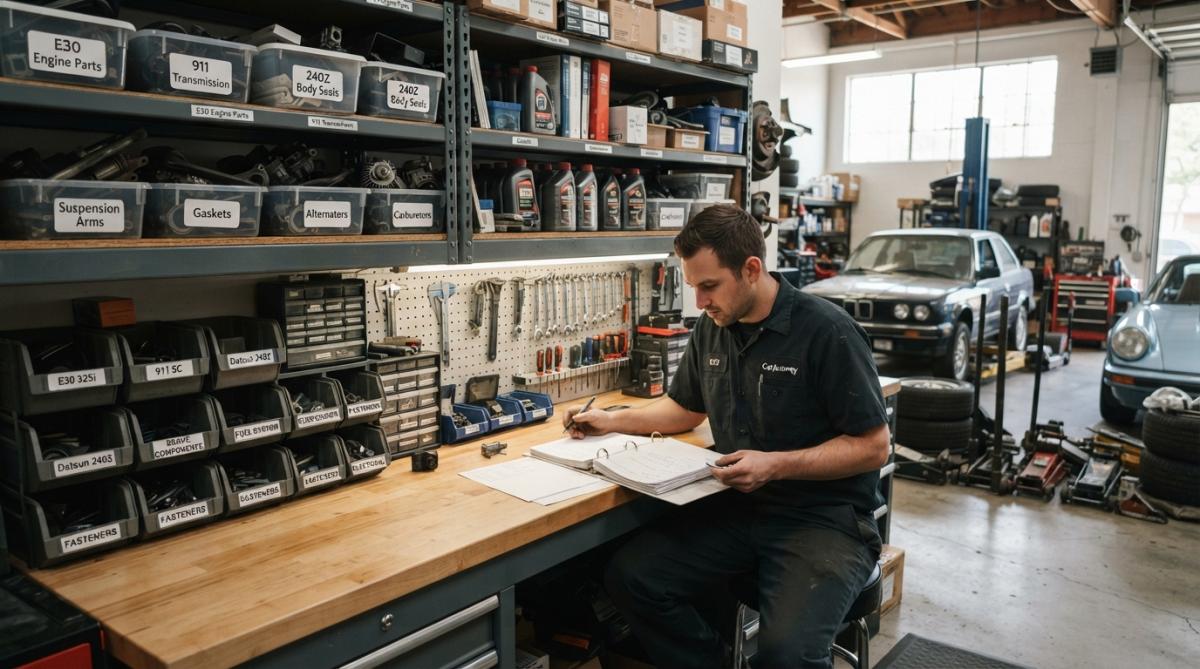
Never mix parts from different vehicles in the same container. Use a storage system where each car has its own dedicated space. This can be labeled shelves, bins, or a wall-mounted pegboard system.
For each vehicle, create a master parts list tracking part name, OEM part number, location, quantity, cost, and status (new, rebuilt, core charge owed). When you remove a part from a car, it goes into storage with a label indicating which vehicle it came from. When you order a new part, update the inventory immediately. When you install it, mark it as "on vehicle" and note the date.
For small fasteners and consumables, use labeled drawers for each vehicle. This prevents the situation where you're searching for a carburetor rebuild kit and can't remember where it is.
Labeling, Documentation, and Digital Asset Management for Cars
Documentation is where most multi-car restorers fail. Create a digital system for each vehicle with organized folders for photos, documentation, technical specs, and project timeline. Every receipt gets scanned and filed. Every photo gets dated and organized by phase. Every technical document gets saved to the appropriate folder.
Tools like CarJourney simplify this process by providing AI-powered logs that automatically organize your maintenance records, modification tracking, and documentation in one digital garage. You can upload receipts, photos, and notes directly to your vehicle's profile, making everything searchable and accessible from your phone or computer.
Maintain a written log for each vehicle. Every work session gets logged: the date, what you did, how long it took, what parts you used, what you spent, and what's next. Label everything physically, too. When you remove a part, wrap it in paper and write: "1987 Mustang - Driver's Side Door Panel - Removed 3/15/26." This takes five minutes per session and saves hours of confusion later.
Project Car Budget Spreadsheet: Financial Discipline Across Vehicles
Money is finite. Without tracking it, you'll overspend on one car and have nothing left for the others. A budget spreadsheet isn't about being cheap, it's about making intentional decisions instead of reactive ones.
Tracking Spending Per Vehicle and Project
Create a simple spreadsheet with columns for date, vehicle, category (engine, suspension, electrical, cosmetic, tools, etc.), description, amount, and running totals per vehicle and overall. Every receipt gets entered immediately. This gives you real-time visibility into how much you've spent on each car and where the money is going.
Set a monthly budget for each vehicle based on your total restoration budget and timeline. If you have $30,000 total and plan a 24-month restoration across three cars, that's roughly $1,250 per month per car. Knowing this number prevents you from spending $3,000 on one car in month one and having nothing left.
The 'One-In, One-Out' Rule for Parts and Projects
For every new part you buy, remove something from the project or sell it. This rule prevents your garage from becoming a parts warehouse, forces prioritization, and creates financial discipline where money spent on new parts comes from selling old ones.
If you buy a rebuilt carburetor for the Mustang, remove and sell the original carburetor you were going to restore. If you purchase a new wiring harness, remove and list the old one on eBay. The money from the sale partially offsets the new purchase.
Key Takeaway The one-in, one-out rule transforms your garage from a storage facility into a working restoration space. It also creates a small revenue stream that offsets project costs.Task Management Tools for Managing Multiple Project Cars
Software doesn't do the work, but it eliminates the mental overhead of remembering what needs to happen next. This frees you to focus on actual restoration.
Using Project Management Software Like Asana and Trello
Trello uses a card-based system. Create a board for each vehicle. Each card represents a task or milestone. Move cards from "To Do" to "In Progress" to "Done" as you work. This visual system makes progress tangible.
Asana is more structured. You can create a project for each vehicle, break it into sections (engine work, suspension, electrical), and list all tasks within each section with due dates and dependencies. The advantage of either tool is visibility. You open the app and immediately see which tasks are overdue, which are coming up, and which are blocked waiting for parts.
Both tools integrate with calendars and send reminders. Spend five minutes at the end of each work session updating task status. This small investment keeps your system accurate.
Tool Consolidation Strategies and Integration with Family Life
Consolidate your tools. Pick one primary tool for task management and make it your single source of truth. Everything flows through it: project milestones, task lists, budget tracking, and scheduling.
This consolidation also makes it easier to involve family members. If your spouse needs to know when you'll be in the garage, they check your task board. If you need to ask for approval to spend $500 on a part, the budget tracking is already visible. Many multi-car restorers find that family conflict decreases when the restoration timeline is transparent and agreed upon.
Common Mistakes When Managing Multiple Project Cars
Mistake 1: Not defining completion criteria. You start a restoration without deciding what "done" means. Define your target outcome upfront.
Mistake 2: Overestimating available time. You commit to 20 hours per week but your actual availability is 8 hours. Be conservative with time estimates.
Mistake 3: Mixing parts between vehicles. You store suspension parts from three cars in the same bin. Use dedicated storage for each vehicle.
Mistake 4: Skipping documentation. Document everything immediately. You won't remember later.
Mistake 5: Allowing scope creep. Define your minimum viable completion upfront so you can still finish if circumstances change.
Mistake 6: Not tracking spending. You run out of budget for cars two and three because car one consumed everything.
Mistake 7: Treating all cars equally. If you can only realistically finish one car every two years, prioritize and allocate resources accordingly.
Conclusion: Building a Sustainable Multi-Car Restoration System
Managing multiple project cars is manageable when you treat it like a system instead of a hobby. Define scope for each vehicle. Set realistic timelines. Allocate time and budget intentionally. Document everything. Use tools to track progress and prevent mental overhead.
The goal isn't perfection, it's sustained momentum. One car finished every two years is infinitely better than three cars 80% complete and abandoned.
CarJourney simplifies the documentation and tracking layer by consolidating your maintenance logs, modification records, and project timelines in one digital garage. Instead of managing scattered spreadsheets and photo folders, you maintain a complete, searchable history for each vehicle. The AI-powered logs automatically organize receipts and service records, and you can generate shareable build profiles that document your restoration progress.
Get started with CarJourney and transform scattered restoration notes into a professional project history that keeps multiple cars organized and on track.
| Element | Purpose | Update Frequency |
|---|---|---|
| Project scope document | Define completion criteria and prevent scope creep | Once at project start |
| Milestone timeline | Track major progress points across vehicles | Monthly review |
| Budget spreadsheet | Monitor spending per vehicle and category | After each purchase |
| Parts inventory | Know what you own and where it's stored | After each work session |
| Task management tool | Organize daily and weekly work | Daily or weekly |
| Digital documentation | Store receipts, photos, and technical specs | Immediately after work |
| Work session log | Record what was done and what's next | End of each session |
Frequently Asked Questions
What's the best way to manage multiple project cars without losing track?
Use a combination of task management software (like Asana or Trello) for workflow tracking, a spreadsheet for budgeting, and digital documentation for each vehicle's build history. Assign each project car specific time blocks and maintain clear milestones. Many automotive hobbyists also use dedicated maintenance tracking apps to log disassembly steps, parts sourcing, and service records, this prevents duplicated work and keeps restoration projects on schedule.
How do I create an effective project car budget spreadsheet?
Start by listing each vehicle separately and tracking all expenses by category: parts, tools, labor (if applicable), and storage. Update weekly to avoid surprises. Include a 'contingency' line (typically 15-20% of the total project budget). Implement the 'One-In, One-Out' rule, when you buy a new part, remove or sell an old one to control spending and garage clutter. This discipline prevents budget overruns and keeps project completion realistic.
How should I organize parts inventory for multiple restoration projects?
Use labeled bins or shelves organized by project car and component type (engine, suspension, interior, etc.). Create a digital inventory log with part numbers, locations, and condition. For disassembly and labeling, photograph components before removal and use color-coded tags or a spreadsheet to track where everything goes. Digital asset management, storing photos and documentation in a cloud system, prevents lost parts and makes reassembly faster. This is especially critical when managing multiple vehicles simultaneously.
What tools help manage multiple automotive projects effectively?
Task management platforms like Asana or Trello work well for milestone tracking and project prioritization across vehicles. Pair these with a simple budget spreadsheet and a dedicated automotive maintenance app for service records and modification tracking. Some automotive enthusiasts also use shared family calendars to integrate wrenching sessions with household schedules, reducing conflict. Tool consolidation, using one platform for multiple functions, prevents app fatigue and keeps your workflow organized without overwhelming complexity.
External Sources
[EXTERNAL_LINK: Automotive restoration community forums and best practices | reddit.com/r/projectcars]
[EXTERNAL_LINK: Project management best practices for personal projects | asana.com]
[EXTERNAL_LINK: DIY automotive documentation standards | diyforums.org]
This article was written using GrandRanker