 carjourney
From the CarJourney journal
Maintenance Reminders vs Calendar Alerts
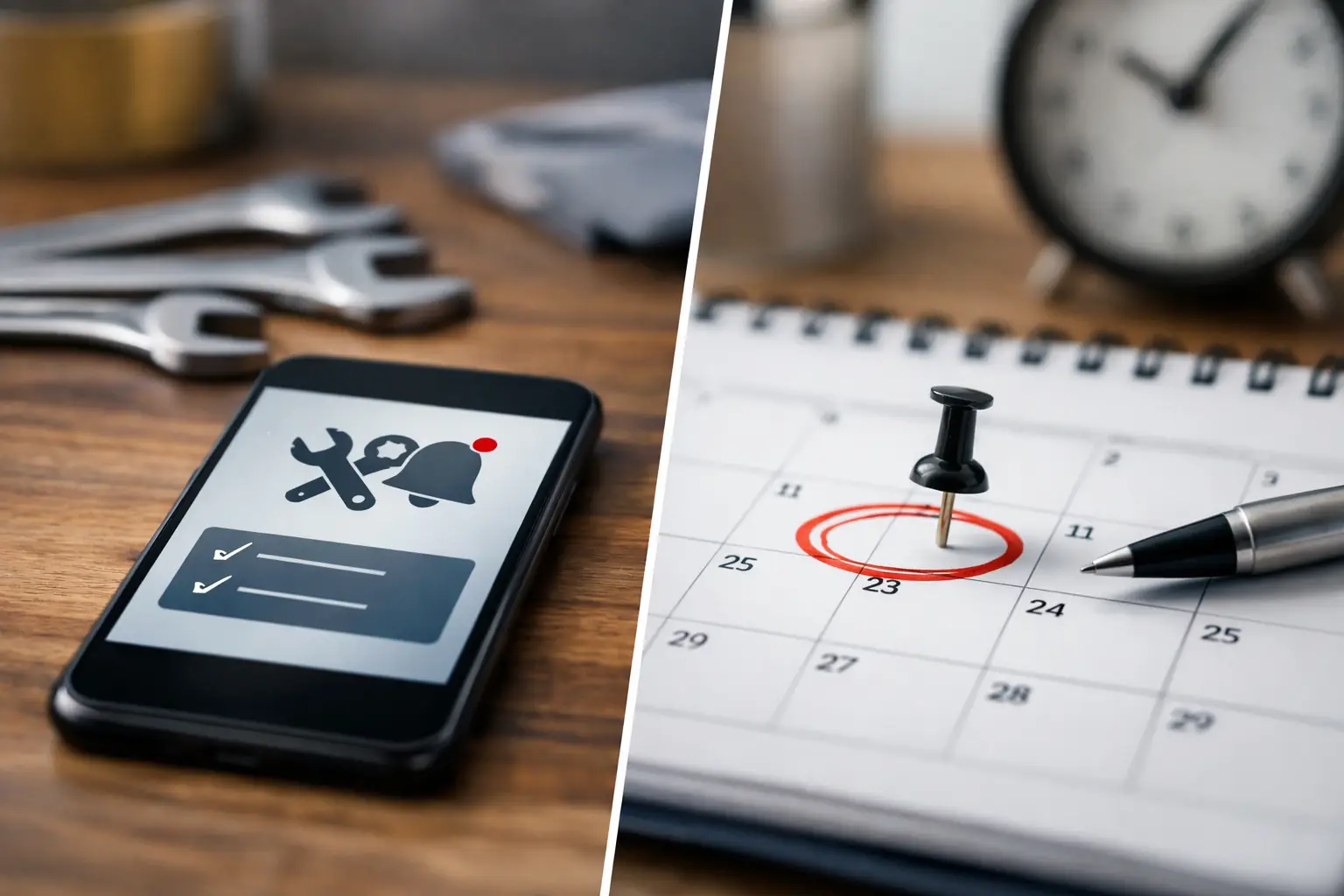
Your phone can remind you to change the oil on October 1. It cannot tell you whether that date still makes sense after a summer of road trips, a month parked in the garage, or an unexpected 4,000-mile cross-country run. That is the real difference in maintenance reminders vs calendar alerts: one is tied to your vehicle's actual needs, while the other is tied to a date you picked months ago.
For a car you care about, maintenance is not just another item on a to-do list. It affects reliability, operating costs, warranty coverage, and the story you can show the next owner. The right reminder system does more than create a notification. It gives you control over what was done, when it was done, why it was due, and what it cost.
Maintenance reminders vs calendar alerts: the real difference
Calendar alerts are general-purpose reminders. You create one that says "oil change" every six months, set a notification, and hope it appears at the right time. For simple annual tasks, that can work. A calendar is easy to use, already on your phone, and good at making sure you do not forget a registration renewal, insurance payment, or seasonal storage prep.
Maintenance reminders are vehicle-specific. They can be based on mileage, elapsed time, a previous service record, or a manufacturer-style interval. Instead of reminding you that it is April, they can remind you that your oil has reached its mileage limit, your brake fluid is due by age, or your tire rotation is approaching based on how much you have driven.
That distinction matters because cars do not wear on a calendar schedule alone. A weekend-only collector car and a daily-driven track build may both receive an oil change in January. By July, their maintenance needs could be completely different.
What calendar alerts do well
A calendar alert is not useless. It is often the fastest way to create a basic habit, especially for tasks with a firm date. Annual inspections, registration renewals, emissions testing, insurance renewals, battery tender checks, and winter tire swaps are all reasonable calendar items.
They also work well when you are managing a single vehicle with predictable use. If you drive roughly the same number of miles every month and follow a simple service routine, a recurring six-month reminder may get you close enough for routine oil changes.
The trade-off is that calendar alerts need manual upkeep. When you complete service early, late, or at a different mileage than expected, you have to edit the next event yourself. If you forget, your schedule slowly drifts away from reality. The reminder may still appear, but it no longer represents a useful service interval.
A calendar also has no context. It does not know what oil you used, which filter was installed, where the work was performed, or whether you replaced front pads, rear pads, or both. Once you dismiss the notification, the maintenance history is usually gone unless you record it somewhere else.
Where calendar alerts fall short for enthusiasts
Enthusiast ownership creates more variables than a basic recurring event can handle. A modified turbo car may need shorter oil intervals than the factory recommendation. A truck used for towing has different wear patterns than one used for commuting. A project car may spend six months apart in the garage, then accumulate miles rapidly after a major build is finished.
Mileage is the biggest gap. A calendar can tell you to rotate tires every six months, but it cannot recognize that you have already driven 7,500 miles since the last rotation. It cannot adjust after a track day, a long towing trip, or a period of hard driving that makes a fixed date less meaningful.
Documentation is another issue. Serious owners want to know more than that a service happened. They want the odometer reading, labor and parts cost, shop information, receipts, warranty details, and notes about what they found. That record protects you when diagnosing a recurring issue and helps prove responsible ownership when it is time to sell.
The same problem appears with modifications. If you install coilovers, upgrade brakes, tune the ECU, or add forced induction, those changes can affect your maintenance plan. A generic calendar has no way to connect the mod list to the service history. You are left piecing together old alerts, photos, receipts, spreadsheets, and memory.
What a useful maintenance reminder should track
A vehicle-focused reminder should start with the last completed service, not an arbitrary future date. When you log an oil change at 62,400 miles, the next reminder should calculate from that mileage and the interval you choose. If the service also has a time limit, such as brake fluid every two years, it should watch both conditions and notify you when either one is approaching.
That flexibility matters because not every task follows the same rule. Engine oil may be based on mileage and time. Coolant may be mostly age-based. Tires need rotation based on miles, while a garage-kept vehicle may need periodic battery and fluid checks even when the odometer barely moves.
A better system also keeps the reminder attached to the service record. When you receive a notification, you should be able to see the last service date, mileage, notes, and expense without hunting through old emails. After the work is complete, logging it should reset the interval automatically and preserve the proof.
This is especially valuable for multi-vehicle households. It is easy to remember the oil change on your daily driver. It is harder to remember the last differential service on the weekend car, the tire age on the SUV, or the inspection date on a vehicle that only comes out for shows. Separate vehicle histories prevent one car's maintenance from getting mixed into another's.
Choose the system that fits the job
Use calendar alerts for fixed-date ownership tasks and simple seasonal routines. They are quick, familiar, and perfectly capable of reminding you to renew registration or put the battery tender on before storage.
Use maintenance reminders when the task depends on mileage, time, service history, or the way the vehicle is used. That includes oil changes, tire rotations, transmission and differential fluid, brake fluid, spark plugs, filters, inspections, and any maintenance affected by your build or driving habits.
For many owners, the best answer is both. Keep legal and seasonal deadlines on your calendar. Keep the mechanical history in a system built around each vehicle. The key is to avoid treating a repeating calendar event as your only maintenance record.
Turn reminders into a vehicle history
The biggest benefit of a maintenance reminder is not the notification itself. It is what happens after you act on it. Every completed service becomes a timestamped part of your ownership history. Over time, that history shows how you maintained the vehicle, what you invested, and how thoughtfully you handled repairs and upgrades.
CarJourney is designed for that fuller picture. You can log maintenance with mileage, costs, notes, and documents, then set reminders that reflect how each vehicle is actually driven. The same garage can also hold modification records and photos, so the maintenance plan stays connected to the build rather than scattered across apps.
That connection pays off long before resale. When a warning light appears, you can check what was recently replaced. When you are planning a major service, you can see prior costs and parts used. When you are deciding whether a used part or upgrade makes sense, your own records give you a clearer baseline.
A calendar alert tells you to do something. A real maintenance system helps you understand your car. The next time you set a reminder, make it one that can keep up with the miles, the work, and the history you are building.