 carjourney
From the CarJourney journal
The Driver's Guide to Non-Disclosure Clauses for Modified Cars

Last Updated: November 19, 2026
Quick Summary
Non-disclosure clauses are policy provisions that let an insurer void coverage or reduce a payout when you fail to reveal facts that would have changed their decision to insure you. On a modified car policy, that usually means an undeclared tune, lift kit, or brake upgrade. The insurer may treat the policy as void or adjust your claim after an accident.
- Declare cosmetic, performance, and practical mods, including tow hitches, roof racks, and lift kits.
- Consequences range from a premium adjustment to full policy invalidation, depending on the mod and wording.
- Declaring a modification takes about fifteen minutes if your records are organized.
- Call your insurer before or immediately after installation, not at renewal, and get confirmation in writing.
- If you have an undeclared mod, disclose it before a claim rather than after.
Table of Contents
- What a Non-Disclosure Clause Actually Means on a Modified Car Policy
- Car Modifications to Declare to Insurance: Cosmetic, Performance, and Practical
- Consequences of Undisclosed Car Modifications: Premiums, Claims, and Cancellation
- How to Disclose Car Modifications to Your Insurer, Step by Step
- Modified Car Insurance Documentation: What to Keep and How to Store It
- Already Have an Undeclared Modification? What to Do Next
- Start Your Digital Garage Before You Call Your Insurer
- Frequently Asked Questions
What a Non-Disclosure Clause Actually Means on a Modified Car Policy
Non-disclosure clauses are the policy provisions that let an insurer void coverage or reduce a payout when you fail to reveal facts that would have changed their decision to insure you. On a modified car policy, that usually means an undeclared tune, lift kit, or brake upgrade.
Here's the part most drivers miss: the clause rarely says "we will cancel you." It says the insurer may treat the policy as void or adjust your claim.
General Duty to Disclose vs. a Specific Non-Disclosure Clause
The general duty to disclose is the baseline legal obligation to answer application questions honestly and completely, and non-disclosure clauses build on it.
Think of it as two layers. The application asks the questions; the clause enforces the answers. Insurers generally must show that the omitted fact was material, meaning it would have affected underwriting or the premium.
The distinction matters because a specific clause can be narrower than the general duty.
Car Modifications to Declare to Insurance: Cosmetic, Performance, and Practical
Any modification that raises your car's value, changes how it performs, or alters its risk profile belongs on your insurance application. That covers far more than engine work.
- Cosmetic: alloy wheels, body kits, spoilers, wraps, custom paint, tinted glass
- Performance: engine tuning, exhaust systems, lowered suspension, forced induction, brake upgrades
- Practical: tow hitches, roof racks, lift kits, auxiliary lighting, wheelchair ramps
The practical category trips people up most. A lift kit changes a vehicle's center of gravity. A tow hitch means you may pull a trailer.
A common mistake is assuming that because a part came from the factory as an option, it needs no declaration. If it wasn't on the original build sheet, treat it as a modification and ask.
Consequences of Undisclosed Car Modifications: Premiums, Claims, and Cancellation
The consequences of undisclosed car modifications range from a modest premium adjustment to full policy invalidation, depending on the modification and your insurer's policy wording. There is no single outcome.
At renewal, an insurer that discovers a declared mod may simply re-rate the premium. Mid-term, they may issue a cancellation or decline to renew.
For a deeper look at how DIY builds and insurer-backed builds diverge on coverage, see this comparison of DIY car mods versus insurer-backed builds.
How Non-Disclosure Plays Out in a Claim
Picture a total loss on a car with an undeclared suspension drop. The adjuster inspects, spots the aftermarket coilovers, and checks the application. No mention. Now the insurer can argue the vehicle they insured isn't the vehicle in the yard.
The outcome often hinges on materiality. Clear records can also help when comparing cover for a modified car, since BF Insurance Agency connects the same disclosure questions to the wider challenge of finding insurance as a non-standard driver.
How to Disclose Car Modifications to Your Insurer, Step by Step
Declaring a modification takes about fifteen minutes if your records are organized. Here's the sequence we recommend.
- List every change from factory spec, including parts, brands, and install dates.
- Gather proof: receipts, invoices, and install photos.
- Call your insurer before or immediately after installation, not at renewal.
- Ask specifically whether the mod affects eligibility, premium, or coverage limits.
- Get confirmation in writing, by email or portal message.
- Re-check at every renewal and after any further change.
If you're tracking a growing build, apps for logging mods and fitment research make step one far easier. Our roundup of the best apps for car modifications covers build logs and tuning tools worth a look.
Declaring a modification takes about fifteen minutes if your records are organized, and this is the sequence to follow.
| Step | What to do |
|---|---|
| 1 | List every change from factory spec, including parts, brands, install dates |
| 2 | Gather proof: receipts, invoices, and install photos |
| 3 | Call your insurer before or immediately after installation, not at renewal |
| 4 | Ask specifically whether the mod affects eligibility, premium, or coverage limits |
| 5 | Get confirmation in writing, by email or portal message |
| 6 | Re-check at every renewal and after any further change |
Modified Car Insurance Documentation: What to Keep and How to Store It
Keep receipts, install invoices, photos, and a dated modification log for every change, stored where you can retrieve them within minutes. Insurers rarely ask at purchase; they ask after a loss, when memory fails.
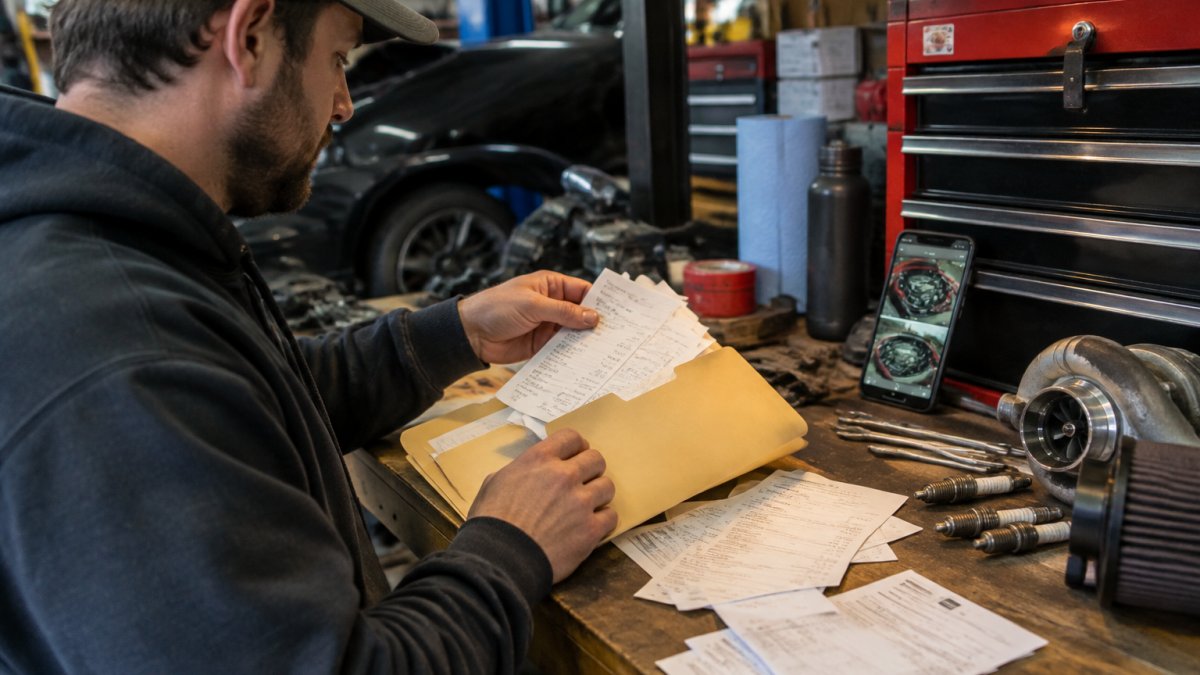
Store originals digitally and keep a cloud backup. Photograph each install from two angles and note the date. If you sell the car, that same file becomes a resale asset.
For a documented approach to keeping proof insurer-ready, this guide to best practices for documenting classic car mods is worth reading. And if you're weighing storage options, this breakdown of a digital garage versus a spreadsheet compares maintenance tracking, mod logs, and receipts side by side.
Already Have an Undeclared Modification? What to Do Next
Discovering an undeclared modification, whether you bought the car that way, inherited a build, or simply forgot to call, is common. The sequence you follow in the next few days matters more than the mistake itself. Voluntary disclosure before a claim almost always produces a better outcome than discovery after one.
Step 1: Stop driving on the current policy until you understand your position
This is the uncomfortable step most guides skip. If the modification is material, a tune, a lift, a brake upgrade, a swapped engine, you may be driving without effective coverage for a loss that occurs before you disclose. The safe move is to limit driving to what is necessary until the insurer confirms the vehicle is covered as built. If you must drive, keep the disclosure call as the first item on your list.
Step 2: Build the paper file before you call
Gather the receipts, install invoices, photos, and any dyno or alignment sheets. Note the date each part went on and the mileage at install. If you bought the car already modified, pull the listing, the bill of sale, and any build sheet the seller provided. The goal is to show the modification was not hidden, it was simply not yet reported.
Step 3: Call the insurer and disclose in plain language
Ask for the underwriting or policy-service team, not the claims line. State what the modification is, when it was installed, and that you want it added to the policy or the vehicle re-rated. Do not speculate about fault or coverage; just disclose. Ask specifically whether the mod affects eligibility, premium, or coverage limits, and whether an endorsement is required.
Step 4: Get the outcome in writing
Expect one of three responses: a premium adjustment with an endorsement adding the mod, a notice that the vehicle no longer fits underwriting and the policy will be cancelled or non-renewed, or a request for more information such as photos or a professional inspection. Ask for the response by email or portal message so you have a dated record. If the answer is cancellation, ask for the effective date and whether any return premium is due.
Step 5: Decide before you cancel
Watch out: cancelling first and shopping second can leave a gap in your claims history that raises your next premium and complicates proof of prior coverage. Disclose, get the insurer's answer in writing, then decide whether to stay, accept an endorsement, or move to a carrier that specializes in modified vehicles. If you move, disclose the modification to the new insurer on the application, the same clause follows you.
Step 6: Log the conversation and set a renewal reminder
Record the date, the representative's name, the reference number, and the outcome in your modification log. Re-check the declarations page at every renewal and after any further change. If the insurer later disputes the disclosure, that log is your evidence that you acted in good faith as soon as you knew.
Start Your Digital Garage Before You Call Your Insurer
The cleanest defense against a non-disclosure dispute is a complete, dated record of every modification you've made. That's the purpose CarJourney is designed for.
Start free and get your records in order before the next phone call. See what CarJourney Pro includes for unlimited vehicles and records, AI scans, and shareable build profiles.
The gap between a paid claim and a denied one is usually paperwork, not luck. CarJourney gives you AI-powered logs, VIN-based setup, and shareable build profiles so every modification is documented and defensible.
Frequently Asked Questions
Do I need to declare modifications to my car on my insurance?
Yes. Insurers base your premium and risk assessment on the car as described in your insurance application. Anything that changes the vehicle from factory spec, including alloy wheels, lowered suspension, an exhaust system, or engine tuning, is material information. If you do not declare it, the insurer can treat it as non-disclosure, which may reduce compensation, delay payment, or let them void the policy. Declare every modification, even cosmetic ones, and confirm in writing that it has been added to your policy terms and conditions.
Can an insurer deny a claim because I did not disclose a modification?
They can, and it happens. A non-disclosure clause lets the insurer reassess the risk you actually presented. If the undeclared modification would have changed their decision to insure you or the premium they charged, they may reduce the payout proportionally, exclude the modified parts, or void the policy entirely. The outcome depends on your policy wording and how material the modification was. If a claim is denied, ask the insurer to explain in writing which clause they relied on, then follow their formal complaints process.
Which car modifications should I tell my insurer about?
Declare anything that alters the vehicle from how it left the factory. That covers performance changes such as engine tuning, an aftermarket exhaust system, or lowered suspension; cosmetic changes such as alloy wheels, wraps, or body kits; and practical additions such as a tow hitch, roof rack, or upgraded audio. If you are unsure whether something counts, call the insurer and note the date, the person you spoke to, and what they said. Over-declaring costs you nothing; under-declaring can cost you a claim.
What happens if I discover an undeclared modification after I have already insured the car?
Contact your insurer as soon as you realize. Explain what the modification is, when it was fitted, and why it was missed. Most insurers will update the policy and adjust the premium rather than cancel it outright, especially if you raise it before any claim. Do this in writing so you have a record. Waiting until after an incident looks like concealment and gives the insurer far stronger grounds to apply the non-disclosure clause and reduce or refuse your claim.
How should I document modifications for my insurance company?
Keep a dated record for each modification: the receipt or invoice, the part number and brand, photos of the part fitted, and the name of the shop that did the work. Store copies somewhere you can access after an incident, such as a digital garage or cloud folder. This documentation supports your vehicle value figure if you need to claim for the parts and shows the insurer you disclosed accurately. It also makes renewal conversations faster when your mod list grows.
Will declaring modifications increase my premium?
Often, yes, because the insurer is pricing a different risk. Performance modifications, higher vehicle value, and expensive aftermarket parts can all raise the premium. Some practical additions have little or no effect. The increase is almost always smaller than the cost of a reduced or denied claim. Get the updated figure in writing before you agree, and compare it against the value of the parts you are protecting so you can decide whether the coverage limits still make sense.
 Add carjourney.io as a preferred source on Google →