 carjourney
From the CarJourney journal
7 Steps to Inflate Car Tires Properly and Safely
Last Updated: November 18, 2026
Quick Summary
To inflate car tires properly, check the cold pressure against the placard in the driver-side door jamb, then add air in short bursts and recheck with your own gauge. Stop slightly below target and top off in small increments, since station gauges are only a rough guide.
- Check pressure when tires are cold: sat three hours or driven under a mile.
- Use the placard PSI, not the maximum pressure molded into the sidewall.
- Press the air chuck on straight and add air in two- or three-second bursts.
- Never bleed air from a hot tire to hit the placard number.
- A tire losing a few PSI per week may have a slow leak worth checking.
Table of Contents
- Why Proper Tire Inflation Matters Before You Grab the Hose
- How to Check Tire Pressure Before You Inflate Car Tires
- How to Put Air in Tires at a Gas Station
- How to Put Air in a Car Tire With an Air Compressor
- How to Deflate Car Tires When You Overshoot
- Hot Tires, TPMS Lights, and Persistent Pressure Loss
- Log Every Inflation in CarJourney and Start Free
- Frequently Asked Questions
Why Proper Tire Inflation Matters Before You Grab the Hose
Learning how to inflate car tires properly starts with one habit: check before you fill. A tire that is already at its recommended pressure does not need air, and adding more can cause real problems.
Tire pressure affects three things you feel on every drive: how the car handles, how it brakes, and how quickly the tread wears. Underinflation lets the sidewall flex more than it should, which builds heat and shortens tire life. Overinflation makes the center of the tread carry the load, so the edges wear unevenly and the ride gets harsh.
Pressure checks often get skipped because nobody writes down the last one.
Before you touch a hose, know your target number. The next section shows you exactly where to find it.
How to Check Tire Pressure Before You Inflate Car Tires
Checking tire pressure is a two-minute job if you know where to look and what to read. For the full walkthrough, see how to check tire pressure correctly. Do it with the tires cold, meaning the car has sat for at least three hours or been driven less than a mile.
Reading the Placard and Owner's Manual
Your target PSI is printed on the vehicle placard, a sticker usually found in the driver-side door jamb. It lists the recommended pressure for front and rear tires, plus the spare if your car has one.
The owner's manual repeats the same numbers and adds load details, such as higher rear pressure when the trunk is full. Use the placard number, not the number molded into the tire sidewall. The sidewall figure is the tire's maximum pressure, not what your car needs.
Using a Tire-Pressure Gauge Correctly
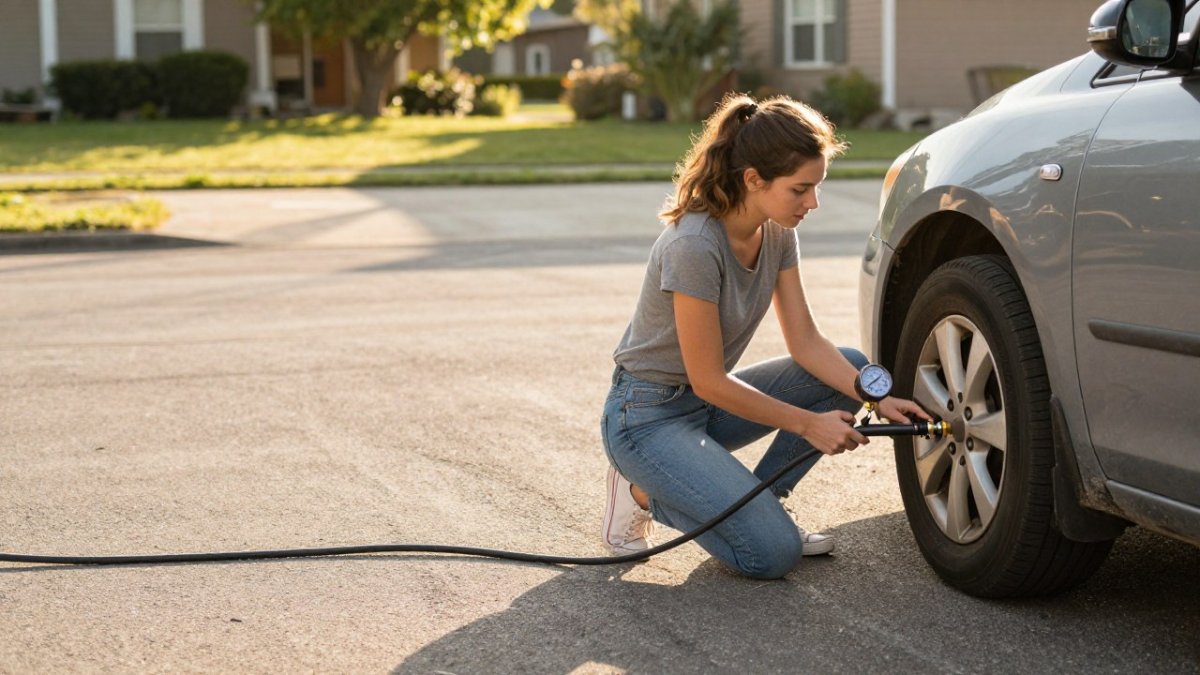
A tire-pressure gauge is the only reliable way to read pressure. Remove the valve stem cap, press the gauge squarely onto the valve stem, and hold it there for a second. Read the number, then put the cap back on.
- Check all four tires, not just the low one
- Check the spare every few months
- Compare your reading to the placard, not to a memory
Watch out: a cheap stick gauge can drift out of spec over time. If your readings look odd, compare against a second gauge before you add air.
How to Put Air in Tires at a Gas Station
Filling at a service station is the most common way to add air, and the process is simple once you have done it once. Most stations charge a small fee for the air dispenser, and some run it free with a fuel purchase.
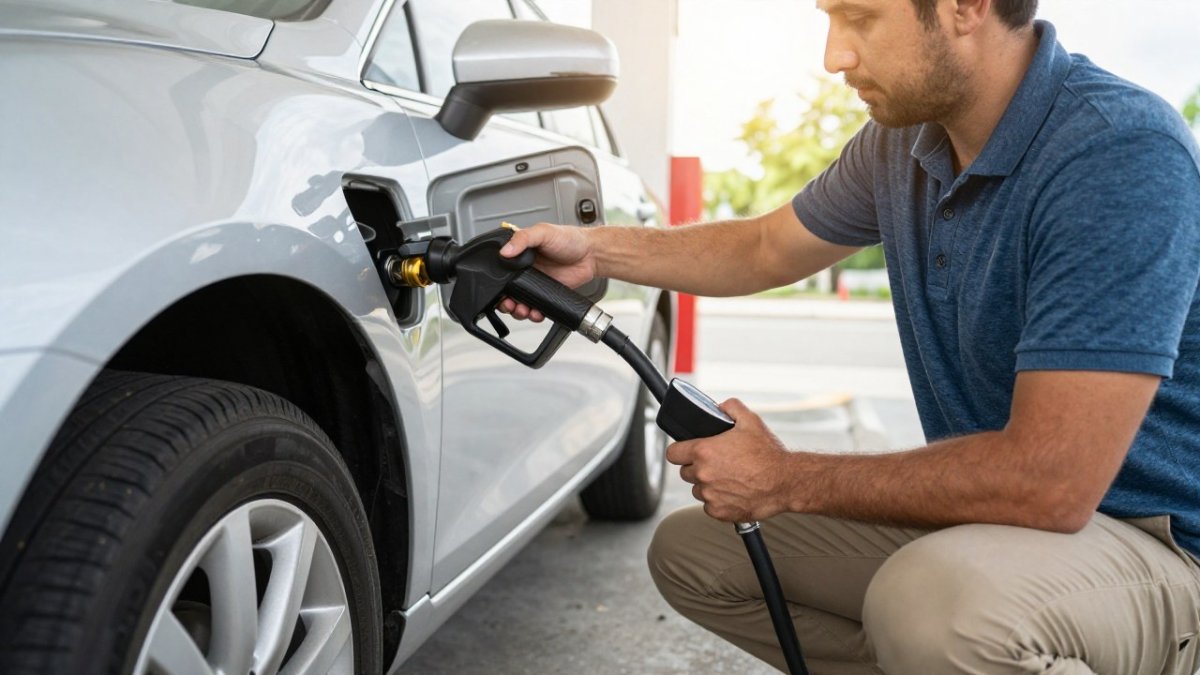
Here is the beginner-friendly walkthrough:
- Park close enough that the hose reaches all four tires. Pull forward or back up so the hose is not stretched tight or draped over the car.
- Pay at the machine if it requires payment, and confirm the display is awake before you pull the hose. Some units time out and shut off if you wait too long.
- Pull the hose to the first tire and remove the valve stem cap. Put the cap in your pocket so it does not roll away.
- Press the air chuck onto the valve stem until it seats. You should hear air moving when you squeeze the lever or trigger. If nothing happens, push the chuck on straighter and firmer.
- Squeeze the lever or trigger to release air in short bursts. Two or three seconds at a time is enough for most top-offs.
- Watch the built-in gauge while you fill, if the dispenser has one, but treat it as a rough guide.
- Stop slightly below target, then recheck with your own gauge. Add more in short bursts if needed.
- Move to the next tire and repeat, then replace every valve cap.
The hose and chuck do the work. You just need a steady hand and short bursts. If you are new to working on your own car, our DIY car maintenance checklist for beginners covers the other jobs worth learning alongside this one.
When the machine fights back. A few problems show up often enough to plan for:
- The chuck will not seal. Press it on straight rather than at an angle, and push until you feel it seat. A worn or bent chuck at the station may never seal well; move to another bay or another station rather than fighting it.
- The dispenser shows no pressure. Some units only display pressure while the trigger is held, and some do not display it at all. Use your own gauge for the real reading.
- The hose will not reach. Reposition the car rather than stretching the hose across a tire or over a curb.
- The machine shuts off mid-fill. Many units have a short cycle timer. Restart the cycle and continue in bursts.
- You forgot your gauge. Buy an inexpensive gauge before you rely on the station's built-in readout, which is often inaccurate.
A note on payment and time.
Reassurance for first-timers. Nothing here is fragile. Since checking tire pressure is one small part of routine care, Q3 Car & Truck Repair can also help you keep tire rotation in mind as you maintain even wear.
Here is the gas-station fill process at a glance, from parking to replacing the caps.
| Step | What to do |
|---|---|
| 1 | Park close enough that the hose reaches all four tires |
| 2 | Pay at the machine and confirm the display is awake |
| 3 | Pull the hose to the first tire and remove the valve stem cap |
| 4 | Press the air chuck onto the valve stem until it seats |
| 5 | Squeeze the lever in short bursts of two or three seconds |
| 6 | Watch the built-in gauge, but treat it as a rough guide |
| 7 | Stop slightly below target and recheck with your own gauge |
| 8 | Move to the next tire, repeat, then replace every valve cap |
How to Put Air in a Car Tire With an Air Compressor
An air compressor at home gives you the same result with more control. Portable units that plug into the 12-volt outlet are fine for topping off tires, and larger shop compressors fill faster.
How to Inflate Car Tires
Howcast
Set the compressor's regulator to a few PSI above your target so the fill goes quickly, then finish with short bursts. Connect the hose to the valve stem with the chuck, add air, and pull the chuck off cleanly so you do not lose pressure on the way out.
- Use the compressor's gauge as a rough guide only
- Finish with your hand gauge for the final reading
- Coil the hose loosely so it does not kink
If you enjoy jobs like this, our roundup of easy DIY repairs every enthusiast can handle lists more you can do at home without a lift.
How to Deflate Car Tires When You Overshoot
Overshooting happens to everyone, and the fix takes seconds. Press the tip of your gauge, or a small tool, into the valve stem to release air in short puffs. Recheck after each puff.
Do not hold the valve open and walk away. A few seconds can drop several PSI, and then you are filling again. Small releases, check, repeat.
If a tire is badly overinflated, let it down to the placard number before you drive. Handling gets twitchy and the center tread wears fast when pressure runs high.
Hot Tires, TPMS Lights, and Persistent Pressure Loss
Three situations trip up most drivers: hot tires, a warning light that will not quit, and a tire that keeps losing air. Each has a calm, specific response.
Hot tires. After highway driving, tires warm up and pressure reads higher than when cold. That is normal physics, not a problem to fix.
If a cold reading is not practical, the safest approach is to add air only if the hot reading is clearly below the placard number, and to add in small increments.
TPMS lights. The tire warning light means one or more tires is below the recommended pressure, or the system needs a reset after a rotation, a tire replacement, or a fill. If our guide to dashboard warning lights confirms it is the TPMS light and the pressures are correct, give the system time before assuming a sensor has failed.
Watch out: a flashing TPMS light is different from a steady one. A flash often indicates a system fault rather than low pressure, and it should be checked rather than ignored.
Persistent pressure loss. A tire that drops again within days has a slow leak, often at the valve stem, the valve core, the bead, or a nail in the tread. Keep a note of how fast it drops and get it checked.
- Check the valve core with a dab of soapy water; bubbles mean a leak.
- Look for a nail or screw in the tread, but do not pull it out yourself.
- Note whether the loss is on one tire or several; several suggests a gauge or inflation habit problem rather than a puncture.
Watch out: never ignore a tire that keeps losing air. A slow leak becomes a blowout at speed, and the warning signs are easy to miss until they are not.
Log Every Inflation in CarJourney and Start Free
The hardest part of tire care is not the filling. It is remembering when you last did it, and what the pressure was.
That is the gap CarJourney closes. CarJourney lets you keep maintenance and modification records in one digital garage. Reminders can be tied to time or mileage, and you can generate a shareable build profile to show your vehicle's history to potential buyers.
Tire pressure is one of the few maintenance jobs you can do in five minutes with almost no tools, yet it is the one most owners skip. Build the habit now: check cold, fill to the placard, and write it down. Start your free CarJourney log and let your records do the remembering.
Frequently Asked Questions
What is the proper way to inflate car tires?
Start with cold tires and look up the recommended PSI on the driver-side door placard, not the tire sidewall. Remove the valve stem cap, press the gauge on to get a reading, then add air in short bursts with an air chuck or compressor nozzle. Recheck with the gauge after each burst, and stop when you hit the recommended pressure. Replace the cap when you finish.
Is it better to have overinflated or underinflated tires?
Neither is safe, but they fail differently. Underinflation causes the sidewalls to flex more, which builds heat and speeds up tread wear on the edges. Overinflation makes the center of the tread carry more load, which reduces grip and makes the ride harsh. Both hurt handling and braking. Aim for the vehicle's recommended cold pressure and correct any overshoot right away.
How do I let air out of my tire if I put too much in?
Press the tip of the valve stem with a small tool, a key, or the back of your gauge to release air in short bursts. Pause, recheck with the gauge, and repeat until you reach the recommended PSI. A few seconds of release usually drops several PSI, so go slowly. Never hold the valve open and walk away, and always recheck before you put the cap back on.
Can I inflate a tire without a pressure gauge?
You can add air without one, but you should not trust the result. Gas station dispensers and portable compressors often have built-in gauges, and those readings can drift, so a separate handheld gauge is worth keeping in the glovebox. Without any gauge you risk overinflating, which is harder to notice by eye than a soft tire. Check pressure at least once a month and before long drives.