 carjourney
From the CarJourney journal
4 Documents U.S. Private Car Sellers Need, Plus State Rules
You need four things to close a private car sale legally: a signed title, a bill of sale, an odometer disclosure statement if the car is under 10 years old, and a lien release if you financed the vehicle. The moment cash changes hands, file your state’s release of liability or notice of sale. That single filing is what protects you if the buyer never registers the car.
TL;DR:
- Ensuring the title matches the seller’s name, VIN, and is free of liens is critical to avoid delays at the DMV and legal issues.
- A bill of sale must include key details such as VIN, sale price, date, and signatures from both parties for it to be legally valid and accepted in most states.
- Completing the odometer disclosure correctly and honestly is legally required for vehicles under 10 years old, with precise mileage and proper signing.
- Filing a release of liability immediately after the sale protects the seller from future tickets, tolls, or accidents associated with the vehicle.
- Buyers should verify the title is signed, the odometer is disclosed, and check the vehicle history report before completing the transfer to prevent scams or discrepancies.
Table of Contents
- What paperwork do you actually need for a private car sale?
- How do you close the sale and protect yourself as the seller?
- What does the buyer need to do to register the car?
- How do notarization rules and deadlines differ by state?
- How CarJourney helps sellers get paperwork right
- How do you verify a buyer or seller isn’t running a scam?
- What’s the correct way to fill out the odometer disclosure?
- How do you handle paperwork when you’re gifting a car instead of selling it?
- A seller’s honest checklist of what goes wrong
- Get a buyer-ready packet together with CarJourney
- Sources
What paperwork do you actually need for a private car sale?
Start collecting documents before you post the listing, not after someone shows up with cash. Here’s the priority order and what to check on each one.
- Signed title. Confirm your name matches exactly, check the lienholder box is blank or shows a released lien, and triple-check the VIN on the title against the VIN on the dashboard and door jamb. A mismatched digit here stalls everything at the DMV counter.
- Bill of sale. Roughly 12 states legally require one for title transfer, and every state accepts one as proof of the transaction. The seven fields that matter: VIN, sale price, date, buyer’s full name and address, seller’s full name and address, odometer reading, and both signatures. Cornell’s Legal Information Institute lists these same fields as the standard most state DMVs expect to see.
- Odometer disclosure. Federal law requires this for any vehicle under 10 model years old, and it’s usually built directly into the title’s back panel or a separate DMV form. NHTSA maintains the underlying federal odometer rules, and both buyer and seller sign it at the point of sale.
- Lien release. If you had a loan, your lender needs to send a lien release before the title is truly clean. Request it the day you decide to sell, since some lenders take a week or more to process paperwork.
- Duplicate title, if lost. Apply through your state DMV before you list the car. Don’t advertise a firm sale date until the replacement is in hand.
- Emissions or safety inspection certificate. Required in some states before registration; check your state’s rules, not the buyer’s home state.
- Proof of insurance and a temporary permit for the buyer’s drive home, especially if they’re crossing state lines.
The Uniform Commercial Code generally requires a written contract for goods sold at $500 or more, which is exactly why a handshake deal on a car is a bad idea even in states where a bill of sale isn’t mandatory.
How do you close the sale and protect yourself as the seller?
Getting paid is the easy part. Protecting yourself after the buyer drives off requires a specific sequence.
- Get paid safely. A cashier’s check verified at the issuing bank, or meeting the buyer inside your own bank to confirm funds clear in real time, beats accepting a personal check or cash in a parking lot.
- Sign the title correctly. Sign exactly where the state indicates, print your name if required, and if the title lists two owners joined by “and,” both must sign. Joined by “or” usually means either signature works. Double check the date matches your bill of sale.
- Complete the bill of sale. Add an “as-is” clause if you’re not offering any warranty. Contract law commentary is clear that an “as-is” sale only holds up if that language is written into the document, not just spoken at the handoff. Keep a signed copy for yourself.
- File your release of liability immediately. Every state has a version of this notice, and it removes you from responsibility for tickets, tolls, or accidents the new owner racks up before they register. Washington State’s DMV is a good example of how straightforward this filing usually is.
- Handle your plates and insurance. Most states want you to remove plates and transfer or cancel them yourself, not hand them to the buyer. Call your insurer the same day to drop coverage.
- Coordinate a lender payoff if there’s a loan. Paying off the balance isn’t enough by itself. The lender still has to record the release before the title is genuinely clear, so ask them for a payoff statement you can share with the buyer.
Pro Tip: If your lender is slow, ask about an escrow closing. Some banks will hold the buyer’s payment and release the title simultaneously, so nobody is exposed while paperwork catches up.
A handful of states, including Louisiana, Maryland, Montana, Nebraska, New Hampshire, West Virginia, and Wyoming, require notarized signatures on the title or bill of sale. Skip that step where it’s required and the DMV will bounce the paperwork right back to your buyer, with your phone ringing the same afternoon.
What does the buyer need to do to register the car?
Before any money changes hands, the buyer should physically confirm the title is signed and the odometer disclosure is filled out. A blank field on either document turns into their problem the moment they drive away.
- Bring the title and bill of sale to the DMV. Most states use these two documents plus a state-specific title application to process the transfer and registration together.
- Budget for sales tax and fees. States calculate sales tax off the purchase price listed on the bill of sale, so an unrealistically low number can trigger questions. Registration fees vary widely by state and sometimes by vehicle weight, so checking the state DMV’s fee schedule ahead of time avoids a surprise at the counter.
- Check inspection requirements early. States like California require a smog check before registration; plenty of others don’t. Buyers should confirm their state’s rule before assuming the car is ready to register.
- Use a temporary permit if needed. If the buyer can’t finish registration same day, most states issue a temporary operating permit so the drive home is legal.
- Watch for a lender still holding the title. If the seller’s loan isn’t fully paid off, the buyer may need to wait for the lien release or accept a temporary registration until the paperwork clears.
How do notarization rules and deadlines differ by state?
State rules diverge in ways that catch sellers off guard, and the state that issued the title, not the state where the sale happens, controls the process. Always confirm current rules on that state’s official DMV site before you finalize anything.
- Notarization: Required in states like Louisiana, Montana, and West Virginia; not required in most others.
- Release-of-liability deadlines: California gives sellers 5 days, New York allows 10 days, Texas allows 30 days. Confirm your own state’s window rather than assuming.
- Emissions inspections: Common in California and many Northeastern states; rare across much of the South.
- Duplicate titles: Processing can take one to several weeks depending on the state, so request a replacement well before you plan to list the car.
How CarJourney helps sellers get paperwork right
Chasing down old service records and modification receipts is where most sellers lose time. CarJourney’s document scanning compiles that history automatically, and pairing it with a private-sale prep guide gives buyers a printed record that builds trust and cuts down on post-sale disputes.

How do you verify a buyer or seller isn’t running a scam?
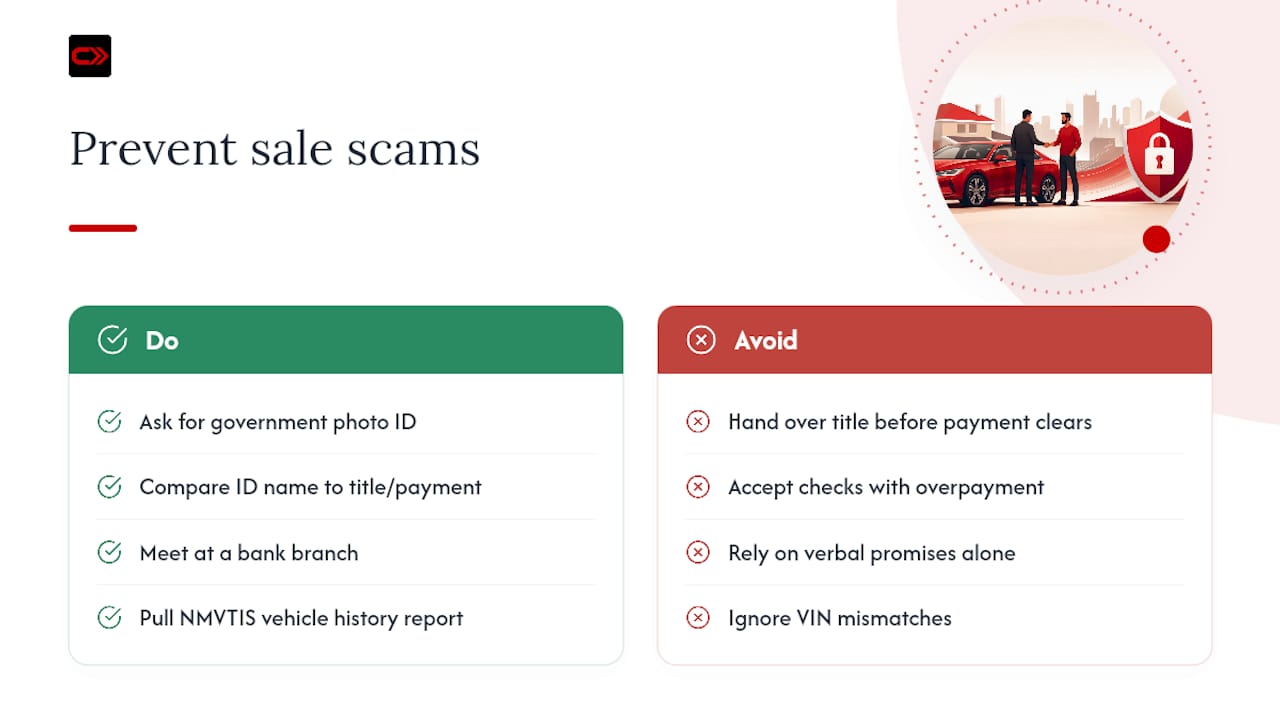
Private car sales attract fraud because cash, a title, and a stranger’s word all meet in one afternoon. Ask for a government-issued photo ID from the other party and compare the name against the title or the payment method. If a buyer’s ID doesn’t match the name on the cashier’s check, that’s a reason to pause, not proceed.
Meeting at the buyer’s or seller’s bank branch is one of the more effective habits sellers use, since it lets a bank teller confirm funds are real before anyone signs anything. It also puts the transaction on camera in a public space, which discourages the kind of last-minute switch some scammers attempt with counterfeit cashier’s checks.
Before you agree to a price, pull a vehicle history report through a resource like NMVTIS, the federal database that tracks salvage titles, odometer rollbacks, and other brand history that a seller might not disclose voluntarily. Sellers should extend the same caution toward buyers: never hand over a title before payment clears, and never accept a check for more than the agreed price with a promise to wire back the difference. That “overpayment refund” request is one of the oldest scams in private vehicle sales.
Cross-check the VIN on the title, the dashboard, and the door jamb sticker yourself. A title with a VIN that doesn’t match the physical car is either a paperwork error or a sign the vehicle isn’t what it claims to be, and either way it’s worth walking away until it’s resolved.
What’s the correct way to fill out the odometer disclosure?
The odometer statement is a federal document, so get every field right the first time rather than leaving it to guesswork at the DMV counter. Write the exact mileage shown on the odometer at the moment of sale, in whole miles, with no rounding.
Check the correct box indicating whether the mileage is accurate, exceeds the mechanical limits of the odometer, or is known to be inaccurate. Most private sellers check the first box, but if you know the odometer was ever replaced or the mileage doesn’t reflect actual use, disclosing that honestly matters more than any perceived hit to your sale price. NHTSA’s federal odometer rules exist specifically because rolled-back odometers used to be a widespread scam, and misrepresenting mileage can carry real legal consequences.
Both buyer and seller sign and date the disclosure, usually printed on the back of the title itself. If your state issues a separate odometer disclosure form instead, use that one and attach it to the title, not the bill of sale. Keep a copy of whichever version you use.
One common mistake: sellers write the mileage from memory instead of walking out to check the actual odometer reading that day. A mileage figure that’s off by even a few hundred miles from what the buyer sees when they pick up the car raises immediate suspicion and can delay their DMV visit while they sort out the discrepancy.
How do you handle paperwork when you’re gifting a car instead of selling it?
Gifting a car still requires a signed title and, in most states, a way to document that no money changed hands. Many state DMVs have a specific gift affidavit or a line on the title application where you declare the transfer as a gift rather than a sale, which usually affects the sales tax the recipient owes.
Even without a purchase price, the bill of sale (or a gift affidavit that replaces it) still needs the VIN, both parties’ names and addresses, the date, and the odometer reading. Write “$0” or “gift” in the price field rather than leaving it blank, since a blank price field can read as incomplete paperwork to a DMV clerk.
The odometer disclosure requirement doesn’t disappear just because money isn’t involved. Complete it the same way you would for a paid sale.
If a lien is still on the vehicle, gifting it doesn’t clear that lien. The lender still needs to release it before the recipient can get a clean title in their name. Sales tax treatment on gifted vehicles varies by state and sometimes by the relationship between giver and recipient, so it’s worth a quick check with your state DMV before assuming the transfer is tax-free. And on the federal side, sellers occasionally ask about tax exposure on a car sale. Ordinary private sales at a loss typically don’t create reportable income, though the IRS has separate guidance if you ever sell personal property for a gain.
A seller’s honest checklist of what goes wrong
Unsigned titles, missing lien releases, skipped release-of-liability filings, and mismatched VINs cause most delays. Scan every document, meet at a bank, check ID, keep copies.
— Chally
Get a buyer-ready packet together with CarJourney
Selling a car privately goes faster when you can hand a buyer more than a stack of loose receipts and a title. CarJourney is built for exactly that moment: it scans your service documents, links them to your car’s VIN, and compiles a printable history sheet you can hand over at the sale.

Instead of digging through glove-box paperwork the night before a buyer shows up, you get a clean record of oil changes, repairs, and modifications ready to print or share as a PDF. Buyers who see organized maintenance history tend to move faster and negotiate less, since the documentation answers most of their questions before they ask. Pair that packet with the checklist in this guide, start preparing your car for sale, and check out CarJourney to see how the document scanning works for your specific vehicle.
Sources
- What is a bill of sale for a car and why is it important? — iSeeCars
- Uniform Commercial Code — LegalMatch
- Vehicle recalls — NHTSA
- Bill of sale — Cornell Law School Legal Information Institute