
 carjourney
Vehicle Disclosure Forms: What They Are and What the Law Requires

A vehicle disclosure form is a signed, written statement a seller gives a buyer — and often the state — listing required facts about a vehicle at the point of transfer: VIN, odometer reading, known damage, warranty status, and any prior commercial use. Three legal anchors govern when and how these forms apply in the United States:
- FTC Buyers Guide (16 CFR Part 455): Licensed dealers must display this form on every used vehicle offered for sale to consumers. It covers warranty status, major systems, and required disclosure language.
- Federal odometer law (49 U.S.C. §32705): Both dealers and private sellers must provide a written mileage disclosure on qualifying ownership transfers. Knowingly false mileage statements are a federal violation.
- State damage/title forms (e.g., NC MVR-181): Most states require a separate damage disclosure when significant damage has occurred; these forms can trigger a branded title (salvage, rebuilt, flood).
Keep signed copies of every form. Signatures are evidence in a dispute, and a missing copy can leave you without recourse.
Key Takeaways
A vehicle disclosure form is a legally required document at most US vehicle transfers, and accuracy on every field is what keeps the title process moving and protects both parties after the sale.
| Point | Details |
|---|---|
| Federal law covers everyone | 49 U.S.C. §32705 requires a written odometer disclosure from both dealers and private sellers on qualifying transfers. |
| Dealers face additional FTC rules | Licensed dealers must display the FTC Buyers Guide (16 CFR Part 455) on every used vehicle before any sale conversation. |
| State damage forms vary | Forms like NC MVR-181 are state-specific; always download the current PDF from your state DMV, not a third-party template. |
| Errors cause rejection | Altered, erased, or illegible VIN and mileage entries are a leading cause of title-office rejection; start fresh rather than correct. |
| Carjourney simplifies the process | Carjourney’s AI-powered service log and mileage history give sellers exportable, date-stamped records that match disclosure form requirements. |
Table of Contents
- What types of vehicle disclosure forms might you encounter?
- Who must disclose, and when does the obligation kick in?
- What fields belong on a vehicle disclosure form?
- How do you fill out a vehicle disclosure form correctly?
- What happens if a required disclosure is missing, false, or altered?
- Where can you get official vehicle disclosure forms?
- Practical tips to reduce risk and speed the transfer
- How Carjourney helps you build a disclosure-ready record
- The honest case for full disclosure
- Carjourney makes disclosure prep less painful
- Sources
What types of vehicle disclosure forms might you encounter?
The term “vehicle disclosure form” covers several distinct documents. Knowing which one applies to your transaction prevents delays at the title office.
FTC Buyers Guide. Required for licensed dealers under 16 CFR Part 455.2, this window form states whether the vehicle is sold with a warranty or “as-is,” lists major systems, and includes required wording the FTC prescribes. Dealers must display it on the vehicle before any sale and give the buyer a signed copy.
Odometer/mileage disclosure statement. Required by federal law on most transfers of vehicles under ten years old. The seller states the exact mileage, certifies it is accurate, or notes that it is beyond the odometer’s mechanical limit or otherwise unknown. This statement often appears on the back of the title itself or as a separate form attached to the title application.
State damage disclosure statement. A structured yes/no form asking whether the vehicle has sustained major collision, flood, fire, or total-loss damage. North Carolina’s MVR-181 is a widely cited example. Repair-cost fields and seller signatures accompany the yes/no answers. States vary on the dollar threshold that triggers a branded title, comparing repair costs to the vehicle’s pre-damage value.
“As-is” sale acknowledgment. A buyer’s signed statement confirming they accept the vehicle without any implied warranty. Dealers use this when no warranty is offered; private sellers sometimes include it to document mutual understanding.
Commercial or rental-use disclosure. Some states and dealers require sellers to note whether the vehicle was previously used as a taxi, rental, police vehicle, or fleet unit, since prior commercial use affects wear patterns and resale value.
| Form | Who uses it | When provided | Typical legal effect |
|---|---|---|---|
| FTC Buyers Guide | Licensed dealers only | Displayed before sale; signed copy at sale | Sets warranty terms; FTC-enforceable |
| Odometer disclosure | Dealers and private sellers | At transfer; attached to title paperwork | Federal violation if falsified |
| State damage disclosure | Dealers and private sellers | At transfer or with title application | May trigger salvage/rebuilt brand |
| As-is acknowledgment | Primarily dealers | At point of sale | Limits implied warranty claims |
| Commercial-use disclosure | Dealers; some states require private sellers | At transfer | Informs buyer of prior use history |
Who must disclose, and when does the obligation kick in?
The FTC’s Used Car Rule creates a split regulatory landscape. Dealers face the most structured obligations; private sellers operate under federal odometer law and their state’s title rules rather than the FTC Buyers Guide.
Dealer obligations. Under the FTC Used Car Rule, a licensed dealer must post the Buyers Guide on the vehicle before offering it for sale — not at the moment of signing, but while the car sits on the lot. At the time of sale, the dealer provides a signed copy to the buyer and retains one. The form’s warranty section must reflect the actual terms offered; a dealer cannot hand over an “as-is” Buyers Guide and then verbally promise repairs.
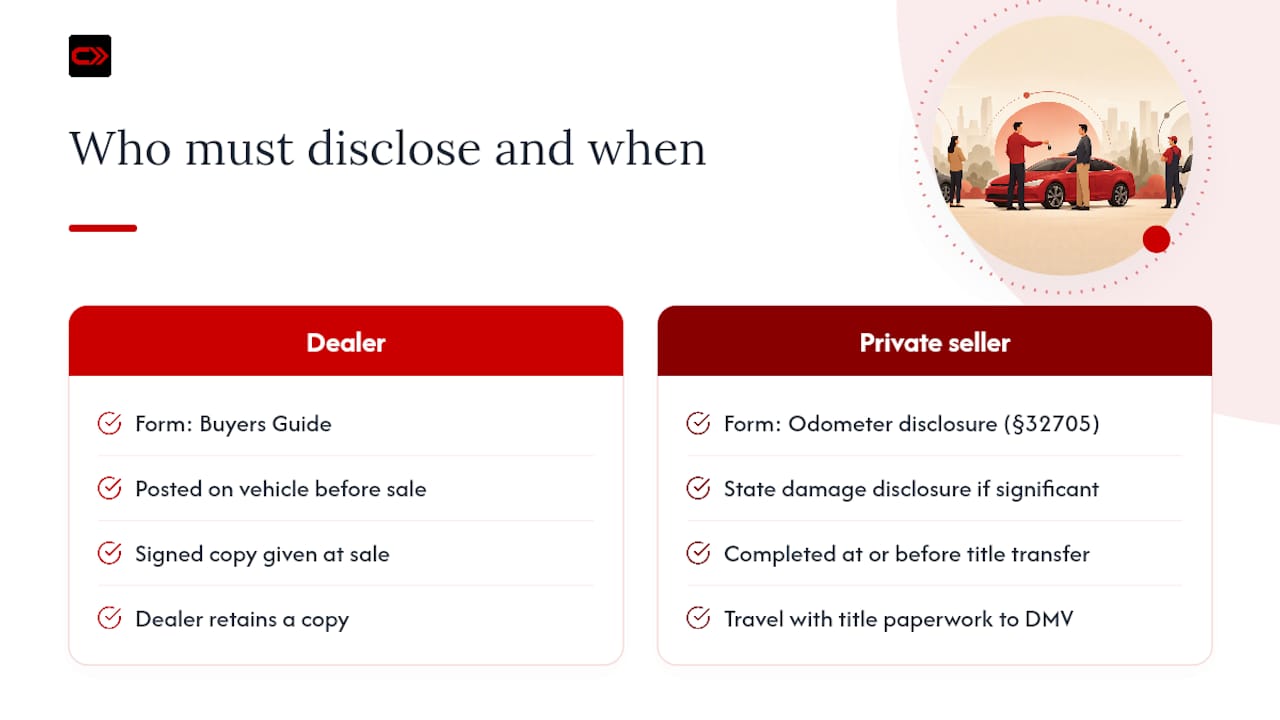
Private-seller requirements. A private individual selling a qualifying vehicle must complete a written odometer disclosure under 49 U.S.C. §32705. If the vehicle has sustained significant damage, most states require the seller to complete a state damage disclosure form at or before the title transfer. Some states, including New York, combine the odometer and damage statements into a single form attached to the title application.
Timing matters. The Buyers Guide goes on the vehicle before any sale conversation. The odometer statement and state damage disclosure travel with the title paperwork to the DMV. Missing the timing — say, handing over a damage disclosure after the buyer has already signed the title — can void the disclosure’s legal effect in some states.
Key point: The NY DMV’s buyer guidance notes that some states require a combined odometer-and-damage form submitted with the title application — check your state’s DMV site before the day of sale, not after.
What fields belong on a vehicle disclosure form?
Every disclosure, regardless of type, should capture a core set of facts. Missing even one field is a common reason title offices reject paperwork.
- Vehicle identification number (VIN): Copy it character-for-character from the dashboard plate or title. A single transposed digit causes rejection.
- Year, make, and model: Confirm these match the title exactly.
- Odometer reading: State the exact mileage at transfer. If the odometer has rolled over or is mechanically inaccurate, write “mileage exceeds mechanical limits” or “actual mileage unknown — odometer discrepancy” as appropriate under 49 U.S.C. §32705.
- Damage declaration: Yes/no answers to whether the vehicle has sustained major collision, flood, fire, or total-loss damage. If yes, include estimated or documented repair costs. The LegalClarity damage disclosure guide notes that states vary on salvage thresholds and generally require truthful statements plus documentation of repairs.
- Prior commercial use: Note if the vehicle served as a rental, taxi, fleet, or police unit.
- Warranty status: “As-is / no warranty,” or describe the warranty terms (duration, covered systems, deductible).
- Seller name, address, and signature: Must match the name on the title.
- Buyer name and address: Required on most state forms and on the Buyers Guide.
- Date of transfer: The date both parties sign.
Fields that travel to the title itself include the odometer statement and any damage brand indicators. Once a salvage or rebuilt brand is applied to a title, it follows the vehicle permanently through every subsequent transfer.
Pro Tip: When documenting modifications that affect a vehicle’s condition or value, a car modification documentation guide can help you capture the right details before filling out a disclosure.
How do you fill out a vehicle disclosure form correctly?
Errors on disclosure forms are one of the most common causes of title-transfer delays. The NY DMV’s guidance confirms that altered, erased, or crossed-out entries in VIN or mileage fields are frequent rejection triggers — and many DMV offices require a fresh, error-free form rather than a corrected one.
- Gather your documents first. Pull the title, your most recent repair invoices, service records, and the correct state-issued form before you sit down to write anything.
- Use black or blue ballpoint ink. Pencil and felt-tip markers are not accepted at most title offices.
- Print clearly in capital letters. Handwriting ambiguity — a “1” that looks like a “7,” a “B” that reads as an “8” — causes rejection.
- Enter the VIN from the dashboard plate, not from memory. Cross-check it against the title before writing.
- State the odometer reading as of the day of transfer. Do not round up or estimate.
- Answer every yes/no damage question. Leaving a field blank is treated as an incomplete form.
- Both parties sign and date in the presence of each other. Some states require notarization; check your state DMV’s instructions.
- Make two copies before anyone leaves. Photograph or scan the signed originals immediately.
- Submit with the title application. The disclosure travels to the DMV with the title paperwork, not separately.
Here is a short sample completed entry to illustrate correct form:
Sample odometer and damage disclosure entry VIN: 1HGCM82633A123456 Year/Make/Model: 2003 Honda Accord EX Odometer reading at transfer: 112,847 miles Odometer certification: I certify that to the best of my knowledge the odometer reading reflects the actual mileage. Major damage (collision, flood, fire, total loss): No Seller: Jane M. Doe, 4210 Oak Street, Richmond, VA 23220 — Signature: Jane M. Doe — Date: March 15, 2026 Buyer: Robert T. Kim, 891 Maple Ave, Roanoke, VA 24016 — Signature: Robert T. Kim — Date: March 15, 2026
What happens if a required disclosure is missing, false, or altered?
The consequences range from a rejected title application to federal criminal liability, depending on what was omitted or falsified.
- Federal odometer violations: Under 49 U.S.C. §32705, knowingly providing a false mileage statement on a transfer is a federal offense. Buyers who suffer financial harm from a false odometer disclosure can pursue civil damages.
- FTC Buyers Guide violations: A dealer who fails to display the Buyers Guide or uses incorrect wording faces FTC enforcement action. Practically, a missing or incorrect Buyers Guide can also affect the enforceability of the warranty terms the dealer intended to offer.
- Title rejection: As the NY DMV’s buyer guidance makes clear, altered, erased, or illegible disclosures cause non-acceptance at the title office. The seller must then produce a corrected form, which delays the transfer and can create disputes about the sale date.
- Title branding: If a damage disclosure reveals repair costs that exceed the state’s salvage threshold, the DMV applies a branded title (salvage, rebuilt, or flood). Once branded, the title carries that designation permanently. Sellers who conceal damage to avoid branding face rescission claims and potential fraud liability.
- Buyer remedies: A buyer who discovers a false disclosure after purchase can pursue rescission of the sale, compensatory damages, and in some states, statutory penalties. Keeping a signed copy of every disclosure form is the buyer’s primary evidence.
Pro Tip: State-level salvage thresholds vary. Keep repair invoices and a written estimate of the vehicle’s pre-damage value — these records determine whether a damage report leads to a branded title, and they protect you if a buyer later disputes the disclosure.
Where can you get official vehicle disclosure forms?
Use only state-issued or federally prescribed forms for any disclosure that will be filed with a title application. Third-party generic templates downloaded from random sites are not guaranteed to match your state’s current requirements.
- Your state DMV website: Search “[your state] motor vehicle damage disclosure form” or “[your state] odometer disclosure.” Every state DMV publishes current PDFs. North Carolina’s MVR-181, for example, is available directly from the NC DOT DMV downloads page.
- FTC Buyers Guide materials: The FTC’s dealer resource page explains the Buyers Guide requirements and links to the prescribed form layout under 16 CFR Part 455.2.
- The back of the title itself: Many states print the odometer disclosure directly on the title certificate. If your state does this, you do not need a separate odometer form — fill in the title’s own fields.
- Your state’s combined forms: New York’s MV-103 and similar combined forms handle both odometer and damage disclosure in one document. Check your state DMV’s title-transfer instructions to confirm which forms apply to your transaction.
To verify an official PDF: the URL should end in a .gov domain, the form should carry a state seal or agency header, and a form number (like MVR-181) should appear in the footer. If a form lacks these markers, get it directly from the DMV site.
A car ownership documents checklist can help you confirm you have the right paperwork before the day of transfer.
Practical tips to reduce risk and speed the transfer
Both sellers and buyers can take straightforward steps to avoid DMV rejections and post-sale disputes.
- Collect service invoices and repair records before listing the vehicle. These support your damage disclosure answers and give buyers confidence. A used car service records guide explains what buyers look for and why documented maintenance matters.
- Take dated photos of the vehicle’s condition. Photograph any existing damage before the sale. Timestamps establish the vehicle’s state at transfer.
- Use consistent odometer values across all documents. The mileage on your disclosure, the title, and any bill of sale must match. Discrepancies invite scrutiny.
- Avoid strike-throughs and corrections. If you make an error, start with a fresh form. Many DMV offices will not accept a form with visible corrections.
- Use black or blue ballpoint ink only. Felt-tip, pencil, and red ink are common rejection reasons.
- Get buyer acknowledgment in writing. Both parties should sign and date the disclosure in each other’s presence.
- Scan or photograph every signed document immediately. Store copies digitally. A vehicle document storage guide covers practical methods for keeping scanned records accessible.
- Consider notarization where your state recommends it. Some states require notarized odometer statements for high-mileage or older vehicles; others recommend it as a fraud deterrent.
Pro Tip: A thorough maintenance log and repair history can increase buyer trust and support a higher asking price. Sellers who disclose service records give buyers fewer reasons to negotiate down.
Electronic mileage evidence from a GPS tracker can also corroborate an odometer reading. Tamper-evident records from vehicle tracking hardware provide an independent mileage log that supports your disclosure if a buyer later disputes the stated reading.
How Carjourney helps you build a disclosure-ready record
Assembling the information a disclosure form requires — accurate mileage history, dated repair invoices, service intervals — is where most sellers run into trouble. Scattered receipts and memory-based mileage estimates are the exact conditions that produce errors on forms and disputes after the sale.
Carjourney addresses this directly. The app lets you:
- Import and scan service documents with AI, creating a searchable, date-stamped record of every repair and maintenance event.
- Log mileage at every service entry, so your odometer history is consistent and exportable rather than reconstructed from memory.
- Store repair invoices and photos tied to specific dates and mileage points — exactly the documentation that supports a damage disclosure and, if needed, a salvage-threshold determination.
- Export a clean service log you can hand to a buyer or attach to a title application, showing dates, mileage, service type, and invoice references.
A sample export entry might look like: March 3, 2025 — 98,412 miles — Transmission fluid replacement — Invoice #TXA-0042. That kind of specificity closes the gap between what a disclosure form asks and what you can actually prove.
Carjourney’s vehicle recordkeeping workflows are built for exactly this use case: sellers who want clean, verifiable records that hold up at the title office and in any post-sale conversation.
The honest case for full disclosure
The conventional wisdom treats disclosure forms as a legal hurdle — something to get through before the money changes hands. That framing gets it backwards.
A complete, accurate disclosure is the seller’s best protection. It establishes what you knew, what you said, and when you said it. A buyer who later claims the odometer was rolled back or the flood damage was hidden has a much harder case when a signed, dated disclosure sits in the file. The form is not just paperwork for the DMV. It is a contemporaneous record of the transaction’s terms.
Buyers benefit just as directly. A seller who fills out every field honestly — including the uncomfortable ones — is telling you something about how the car was maintained. Vague answers or blank fields on a damage disclosure are a signal worth taking seriously.
The used-car market runs on trust, and trust is built one honest form at a time. Digital records make that easier: when your service history is already logged and exportable, filling out a disclosure accurately takes minutes rather than a frantic search through a glove box.
Carjourney makes disclosure prep less painful
Pulling together accurate mileage history, dated repair invoices, and service records for a vehicle sale used to mean digging through a shoebox of receipts. Carjourney gives sellers a single place where all of that lives, organized and ready to export.
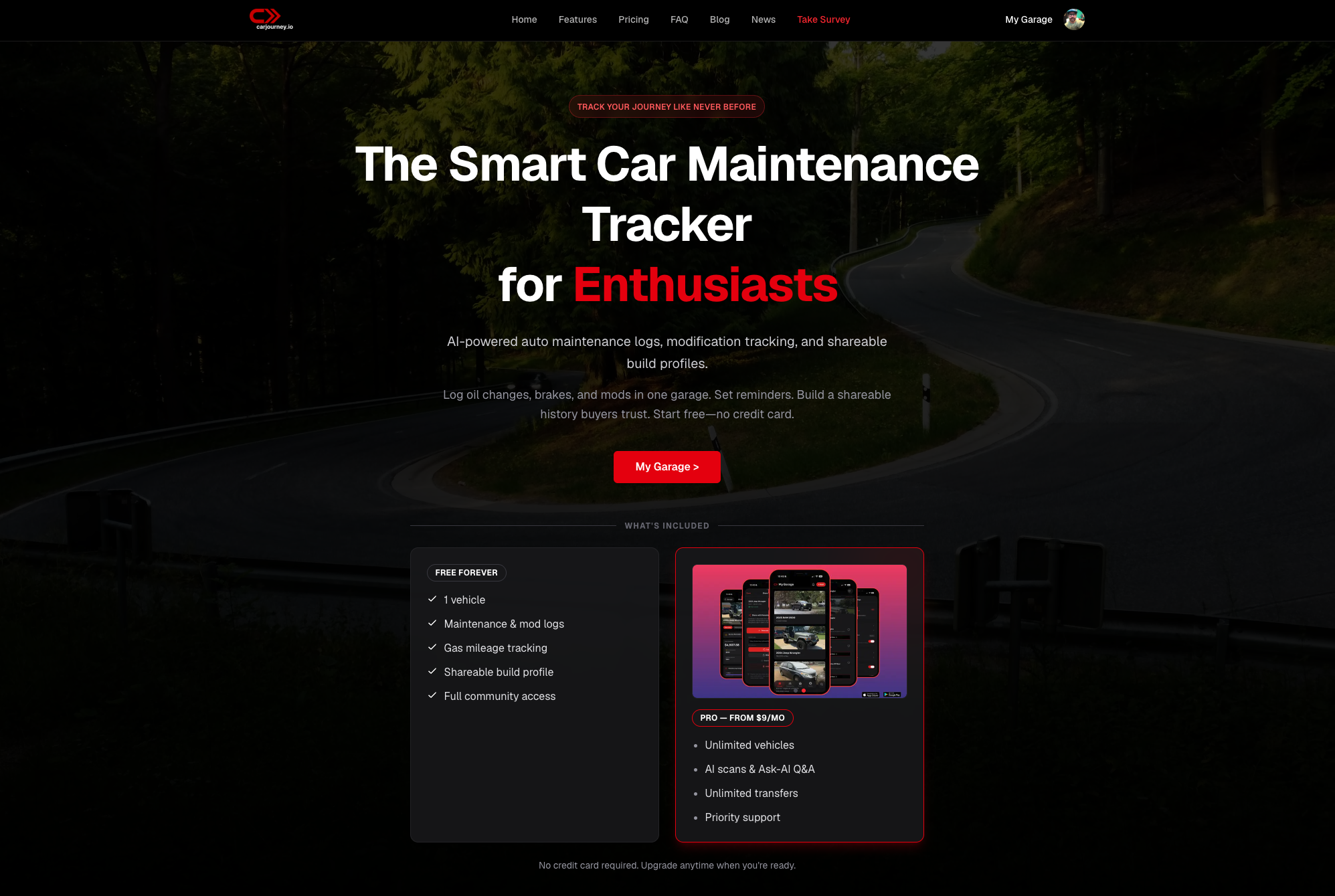
The app’s AI document scanner imports service records and repair invoices, logs mileage at every entry, and lets you export a clean, date-stamped history to share with a buyer or attach to a title application. No reconstructed mileage estimates. No missing repair dates. Just a verifiable record that matches what your disclosure form says.
If you are preparing to sell a vehicle and want your paperwork to hold up, start building your vehicle record on Carjourney before the day of sale — not after.
Sources
The following official sources were used to build this guide. Download forms directly from these pages to confirm you have the current version.
- Dealer’s Guide to the Used Car Rule | Federal Trade Commission
- § 32705. Disclosure requirements on transfer of motor vehicles
- § 455.2 Consumer sales—window form.
- MVR-181 Damage Disclosure Statement
- Let the Buyer Be Aware | NY DMV
- How to Fill Out and Submit a Used Vehicle Disclosure Form - LegalClarity
For state-specific requirements, go directly to your state DMV’s title-transfer page and search for the current odometer and damage disclosure forms. Requirements change; a form from three years ago may not match today’s title-office standards.
This article is general information, not a substitute for advice from a qualified lawyer. Consult a qualified legal professional about your own circumstances before acting on anything here.