 carjourney
From the CarJourney journal
DIY Car Maintenance Without a Garage: Complete Guide
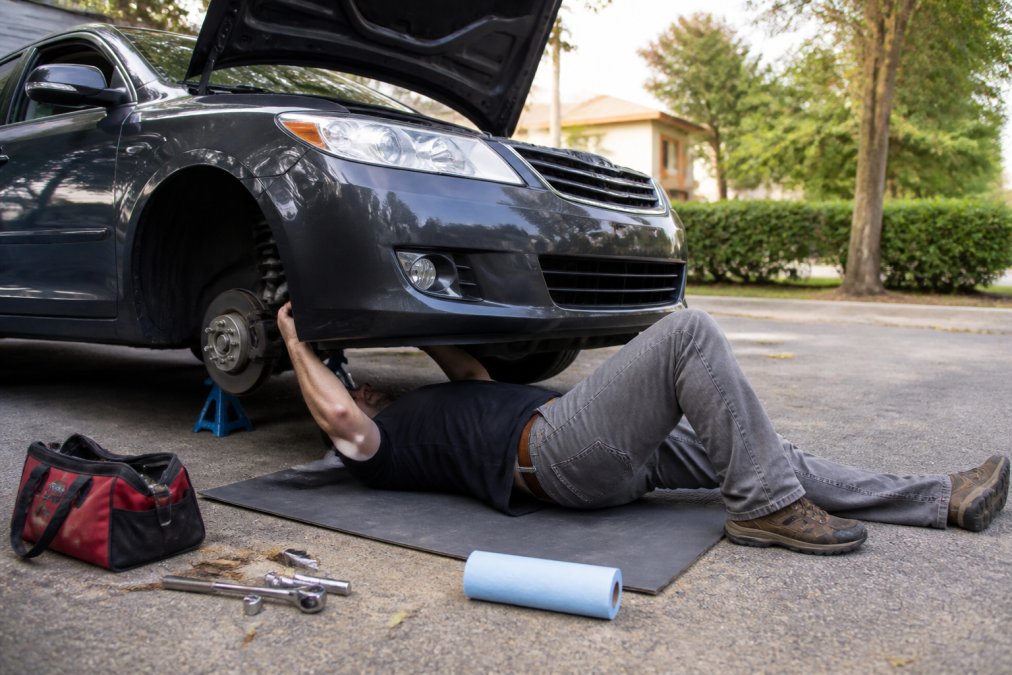
Table of Contents
- Why DIY Car Maintenance Without a Garage Is Increasingly Common
- Essential Mobile Mechanic Tools List for Outdoor Work
- Safe Jacking, Support, and Level Ground Techniques
- DIY Car Repair Safety Tips for Street and Driveway Work
- Routine Maintenance Tasks You Can Do Without a Garage
- How to Track Car Maintenance History Without a Physical Garage
- Legal Considerations for Street and Driveway Repairs
- Managing Waste Disposal and Urban Constraints
- Frequently Asked Questions
Last Updated: September 2, 2026
Why DIY Car Maintenance Without a Garage Is Increasingly Common
The U.S. automotive repair and maintenance service market reached $183.4 billion in 2023 and is projected to grow at 10.1% annually through 2032, according to Vertex AI Search's automotive repair market analysis. Yet car owners are increasingly taking maintenance into their own hands. Since 2020, the DIY automotive repair market has expanded at 5.96% annually, outpacing the traditional service segment at 4.29% (Haynes Manuals, 2025).
Vehicle repair costs jumped 28% over the past three years, and the average car is now 12.5 years old, well past warranty coverage. DIY car owners report saving an average of $3,993 annually through self-maintenance. Tools are cheaper and more accessible than ever, and information is abundant. For those without a traditional garage, the barrier is logistics, not capability.
This guide covers DIY car maintenance without a garage: essential tools, safety protocols, legal considerations, and specific maintenance tasks you can tackle in your driveway or street. By the end, you'll understand how to work on your vehicle safely and document those efforts so they matter, whether you're maintaining a daily driver or preparing to sell.
Essential Mobile Mechanic Tools List for Outdoor Work
Working on your vehicle without a garage requires a curated, portable toolkit designed for routine maintenance and diagnostics in any available space.
Vehicle Support and Safety Equipment
A floor jack and jack stands form the foundation of safe outdoor work. The floor jack lifts; jack stands hold. Never rely on the jack alone. A quality floor jack costs $100-$300; jack stands run $50-$150 per pair. For most sedans and light trucks, a 2.5-ton capacity suffices.
Wheel chocks ($20-$40) prevent rolling. Engage the parking brake before jacking. Work on level surfaces; even a slight slope compromises safety.
A drip pan ($15-$30) captures fluid during oil changes. Add absorbent material like oil dry ($10-$20 per bag) for cleanup and environmental compliance.
Safety glasses, work gloves, and a small ABC-rated fire extinguisher ($20-$40) complete the core safety layer.
Hand Tools and Diagnostic Equipment
A basic socket set with metric and standard sizes ($40-$100) handles most fasteners. Include a torque wrench ($30-$80) for brake work or tasks requiring specific tightness.
Wrenches, screwdrivers, pliers, and a hammer cost $50-$150 total. A basic OBD-II scanner ($25-$100) reads engine fault codes. According to TOPDON and Statista's DIY vehicle maintenance study, 97% of users with consumer diagnostic tools spot issues faster, and 94% report better vehicle understanding. Add a tire pressure gauge ($10-$30) and multimeter ($20-$60).
Portable LED work lighting ($30-$80) is essential for outdoor work, especially after dark.
| Tool Category | Essential Items | Typical Cost | Why It Matters |
|---|---|---|---|
| Vehicle Support | Floor jack, jack stands, chocks | $200-$500 | Prevents accidents and injuries |
| Hand Tools | Socket set, wrenches, screwdrivers | $50-$150 | Handles 90% of fastener work |
| Diagnostics | OBD-II scanner, tire gauge | $35-$130 | Identifies problems early |
| Safety & Cleanup | Gloves, glasses, drip pan, absorbent | $50-$100 | Protects you and the environment |
| Lighting | Portable LED work light | $30-$80 | Enables work after dark |
Safe Jacking, Support, and Level Ground Techniques
Improper jacking causes more DIY car injuries than any other mistake. A vehicle weighs 3,000-5,000 pounds; if support fails, that weight drops instantly.
Finding and Preparing Level Ground
Level ground is non-negotiable. A 5-degree slope changes how weight sits on the jack and stands. Inspect your work area before beginning. Concrete is ideal; asphalt works if not cracked or soft. On unprepared surfaces, place 3/4-inch plywood ($20-$40) under the jack and stands to distribute weight.
Test the surface by gently rocking the vehicle by hand. If it moves or feels unstable, find another spot. On a slope, position the vehicle perpendicular to the slope rather than parallel.
Proper Floor Jack and Jack Stands Usage
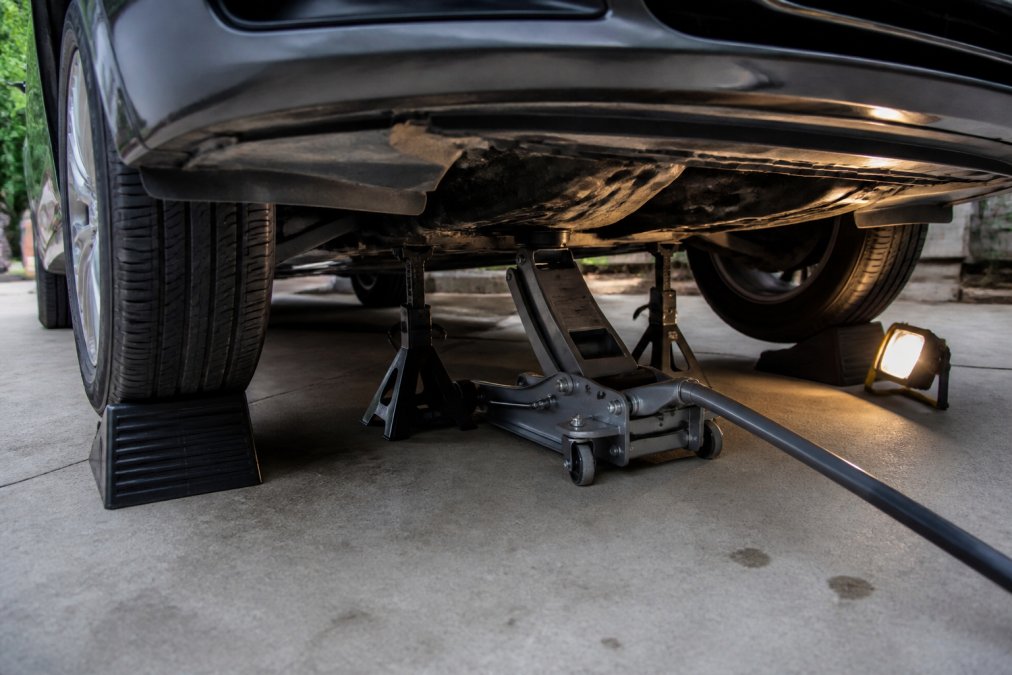
Engage the parking brake and place wheel chocks behind the rear wheels. Position the floor jack under a reinforced chassis point marked in your owner's manual. Never jack under the oil pan, transmission, or unsupported frame.
Raise the vehicle slowly. Once the wheel clears the ground, slide the first jack stand under a solid chassis point. Slowly lower the vehicle onto the stand. Install a second stand on the opposite side for stability. The jack stays in place as backup support.
DIY Car Repair Safety Tips for Street and Driveway Work
Working outdoors introduces variables absent in a garage: weather, traffic, visibility, and temperature swings.
Parking Brake, Chocks, and Vehicle Stability
Engage the parking brake before anything else. Test it by gently rocking the vehicle. On a slope, angle the front wheels toward the curb to create a secondary barrier.
Place wheel chocks behind the rear wheels if lifting the front, or in front of the front wheels if lifting the rear. Chocks should be snug against the tire. The combination of brake, chocks, and jack stands creates redundancy.
Weather, Lighting, and Environmental Hazards
Rain reduces friction and visibility. Reschedule if rain is forecast. Cold thickens oil and makes fasteners harder to loosen; apply penetrating oil 10-15 minutes before removal.
Darkness hides hazards. Position your work light to eliminate shadows. A clip-on lamp or tripod-mounted light ($40-$80) beats a handheld flashlight.
On busy streets, set up warning triangles or flares and wear a high-visibility vest ($15-$30). Position the vehicle as far from traffic as possible.
Wait at least 30 minutes after running the engine before opening the coolant system or draining oil; engine coolant and oil become dangerously hot.
Routine Maintenance Tasks You Can Do Without a Garage
Most vehicle owners never need complex repairs. Routine maintenance is accessible to anyone with basic tools and patience.
Oil Changes and Fluid Maintenance
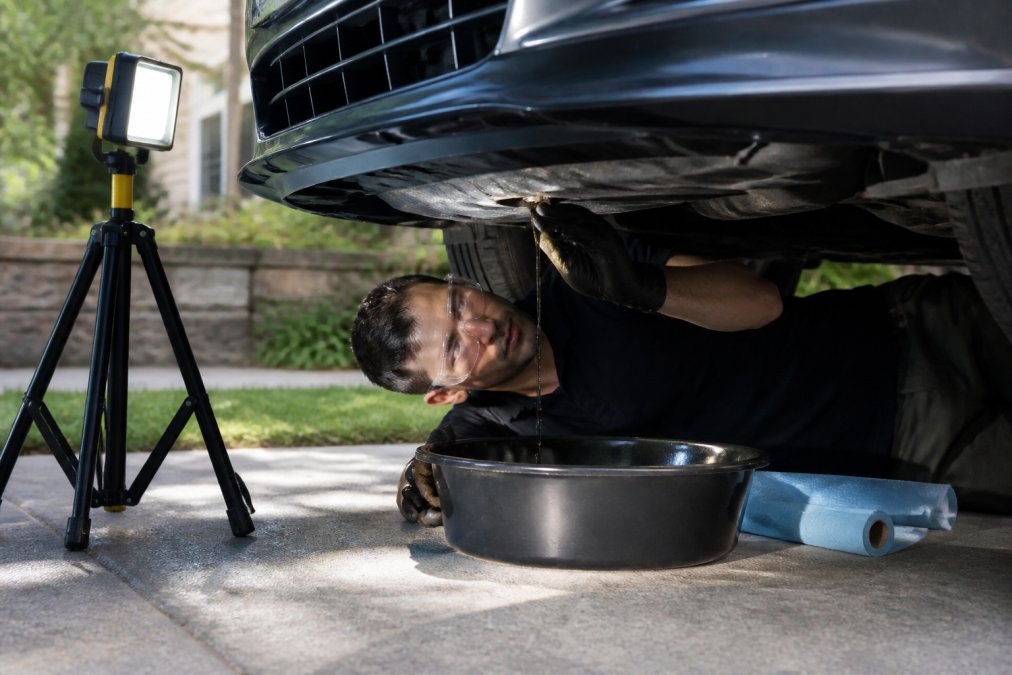
An oil change requires an oil drain pan, wrench, oil filter wrench, new filter, and correct oil. The process takes 20-30 minutes once the vehicle is safely jacked.
Locate the drain plug underneath the engine. Position the drain pan below it. Loosen the plug, let oil drain completely (5-10 minutes), wipe the plug clean, replace the washer if needed, and reinstall it. Tighten snugly but not hard.
Use an oil filter wrench to loosen the filter. Apply a thin layer of new oil to the rubber gasket on the new filter, then screw it on hand-tight until the gasket contacts the engine, then turn an additional three-quarter turn. home auto detailing.
Fill the engine with the correct amount and grade of oil. Start the engine for 30 seconds, turn it off, wait a minute, and check the dipstick. Top off if needed.
Other fluids follow similar logic. Coolant, brake fluid, and power steering fluid have reservoirs with min/max marks; top them off when low. Transmission fluid is more complex; consult your manual. Windshield washer fluid is trivial: pop the cap and pour.
Brake Inspections, Filters, and Electrical Work
Brake pad inspection is visual and takes 10 minutes. Jack the vehicle, remove the wheel, and check pad thickness. If pads are less than 1/4 inch thick, replacement is due.
Air filters come in two types: engine and cabin. The engine air filter sits in a plastic box under the hood. Pop the clips, lift the lid, and slide out the dirty filter. A new one costs $10-$20 and takes 30 seconds to install.
Basic electrical work is manageable. Replacing a blown fuse is trivial: locate the fuse box, identify the blown fuse (darkened or broken inside), and swap in a new one of the same amperage. Battery terminal corrosion can be cleaned with a wire brush and baking soda solution ($5 in materials).
Bulb replacement varies by vehicle but usually takes 10-20 minutes. Check your manual for the procedure.
According to Auto Care Association's DIY maintenance survey, the top three motivations for DIY work are saving money (72%), self-reliance (48%), and convenience (42%).
Key Takeaway Oil changes, filter replacements, and fluid top-offs account for 80% of routine maintenance. Master these three and you've covered the bulk of what keeps a vehicle healthy.How to Track Car Maintenance History Without a Physical Garage
Documentation matters when you sell your vehicle. A service history proves proper maintenance, justifying a higher price and attracting serious buyers. When troubleshooting recurring issues, records show what you've already tried.
Digital tracking solves the limitations of scattered receipts and photos. Tools like CarJourney let you log every maintenance task with dates, mileage, costs, and photos. The platform's AI-powered system automatically sets reminders based on your vehicle's maintenance schedule, and you can generate shareable build profiles that prove your vehicle's care history to potential buyers.
After each maintenance task, snap a photo, note the date and mileage, record what you did and what parts you used, and upload it. Over time, you build a comprehensive record. This is especially valuable for DIY work because it demonstrates that you maintained your vehicle properly, just did it yourself rather than paying a shop.
CarJourney's VIN-based setup automatically populates your vehicle's maintenance schedule, so you know what's due next. This is particularly valuable for older vehicles where you may not have original service records.
Legal Considerations for Street and Driveway Repairs
Most municipalities allow routine maintenance and repairs in your own driveway without restriction. Changing oil, replacing brakes, and swapping filters are universally permitted. However, some local ordinances limit work duration, restrict commercial activity, or require permits for extensive work.
Fluid Disposal: Proper disposal of used oil, coolant, and other fluids is legally mandated. Used oil cannot go down storm drains or into the ground. Many auto parts retailers (AutoZone, Advance Auto Parts, O'Reilly) accept used oil for free. Some municipalities have hazardous waste collection events. Violating fluid disposal laws can result in fines.
Noise and Disturbance: Most jurisdictions have "quiet hours" (typically 10 PM to 7 AM on weekdays). Respect these. Schedule loud work (grinding, drilling, impact tools) during daylight hours on weekdays.
Street Parking: Check local regulations if working on a street-parked vehicle. Some cities require permits for extended street parking or prohibit work on street-parked vehicles. A call to your local code enforcement office clarifies the rules.
Liability: Check your homeowner's or renter's insurance policy. If you're working on someone else's vehicle, liability becomes more complex. Keep this in mind if helping a friend.
Managing Waste Disposal and Urban Constraints
Urban and apartment living creates distinct challenges with limited space, no dedicated parking, and restrictions on outdoor work.
Space Management: Work in phases if space is tight. Jack the vehicle, complete one task, lower it, and move to the next. Use a portable workbench or cart ($50-$150) to organize tools.
Noise and Neighbor Relations: Use hand tools instead of power tools where possible. Avoid early mornings and late nights. A conversation with neighbors beforehand prevents complaints.
Waste Disposal Logistics: Identify local hazardous waste facilities or auto parts retailers that accept used materials before you start work. Plan the disposal route as part of your maintenance plan.
Weather Protection: A pop-up canopy ($40-$100) provides temporary shelter. A tarp and rope ($15-$30) can cover the vehicle if work extends over multiple days.
Parking Restrictions: Confirm that leaving your vehicle jacked up or partially disassembled overnight complies with local rules. Plan your work schedule to avoid overnight jacking if possible.
DIY car maintenance without a garage is entirely feasible when you approach it systematically. Invest in proper safety equipment, understand the legal landscape where you live, and document your work. CarJourney helps transform scattered receipts and photos into a verifiable service history that proves your vehicle's care to future buyers. Start with routine tasks like oil changes and filter replacements, build confidence, and expand into more complex work as your skills develop. The $3,993 annual savings that DIY owners report is real, but only if you work safely and track what you've done.
Frequently Asked Questions
What car maintenance can I DIY without a garage?
Oil changes, air filter replacements, wiper blade installation, battery replacement, bulb changes, and basic brake inspections are all feasible without a garage. You can also handle tire pressure checks, washer fluid top-ups, and cabin filter replacements. More complex work like transmission fluid changes or brake system repairs require proper support equipment and controlled conditions. A floor jack and jack stands are essential for any work requiring under-car access. Start with simple tasks to build confidence before progressing to more involved maintenance.
What safety protocols should I follow for DIY car repair safety tips?
Always engage the parking brake and place wheel chocks behind the rear wheels for stability. Use a floor jack on level ground, then secure the vehicle with jack stands before working underneath. Wear safety glasses and work gloves to protect against spills and sharp edges. Ensure adequate lighting with a portable work light, and never work alone if possible. Allow the engine to cool before touching components, and disconnect the negative battery terminal before electrical work. Keep a spill containment kit and drip pan ready for fluid disposal, and maintain a clear workspace free of tripping hazards.
How do I safely perform oil changes on the street or driveway?
Park on level ground, engage the parking brake, and place chocks behind the rear wheels. Warm the engine briefly to thin the oil, then turn it off and wait 5 minutes. Use a floor jack to lift the vehicle, then secure it with jack stands. Position a drip pan under the drain plug, unscrew the plug carefully, and let oil drain completely. Replace the drain plug and tighten it with a socket set to the manufacturer's torque specification. Remove the old filter, clean the mounting surface, and install the new filter hand-tight. Lower the vehicle, add the correct amount of new oil, and check the level with the dipstick.
What are the best portable tools for mobile car maintenance?
A quality floor jack and jack stands are non-negotiable for safety. A basic socket set, wrenches, screwdrivers, and pliers cover most maintenance tasks. Add a torque wrench for critical fasteners, a multimeter for electrical diagnostics, and a tire pressure gauge. Portable work lights are essential for visibility, and a drip pan plus spill containment kit are mandatory for fluid work. Consider a magnetic work mat to prevent losing small parts, and keep safety glasses and work gloves accessible. A diagnostic scanner can help identify warning light codes, saving time and money on unnecessary repairs.
What legal restrictions exist for working on cars in public spaces?
Local ordinances vary significantly by jurisdiction. Many municipalities prohibit commercial repair work on public streets, but allow residents to perform maintenance on their own vehicles on private driveways. Some areas restrict the duration of work or require permits for extended projects. Fluid disposal is regulated under EPA guidelines, never dump oil, coolant, or other fluids into storm drains or soil. Check with your local city or county code enforcement office before starting major work. Apartment dwellers should review lease agreements and HOA rules, as many prohibit mechanical work in parking lots or designated areas.
Start freeThis article was written using GrandRanker