 carjourney
From the CarJourney journal
How to Create a Vehicle Maintenance Schedule
Table of Contents
- Why a Vehicle Maintenance Schedule Matters
- Step 1: Gather Your Vehicle Information and Owner's Manual
- Step 2: Understand Manufacturer Recommended Maintenance Intervals
- Step 3: Build Your Car Maintenance Schedule Template
- Step 4: Create a 30-60-90 Mile Maintenance Checklist
- Step 5: Track Your Maintenance with a Vehicle Maintenance Log App
- Step 6: How to Track Car Service History for Resale and Warranty
- Common Maintenance Tracking Mistakes to Avoid
- Frequently Asked Questions
Last Updated: October 3, 2026
Why a Vehicle Maintenance Schedule Matters
A vehicle maintenance schedule is your roadmap to keeping your car running smoothly and protecting your investment. Without one, you'll miss critical service intervals, damage your engine, void your warranty, and tank your resale value.
The Financial Case for Preventative Maintenance
Routine maintenance costs (annual average):
- Oil changes (3-4 per year): $150-$200
- Tire rotation and balance: $100-$150
- Air filter replacement: $50-$100
- Fluid top-ups and checks: $0-$50
- Total: $300-$500 per year
Emergency repair costs (when maintenance is skipped):
- Engine damage from missed oil changes: $2,000-$5,000+
- Transmission failure from low fluid: $3,000-$7,000+
- Brake system failure: $1,500-$3,000+
- Timing belt failure: $1,000-$2,500+
A single catastrophic failure can cost 5-15 times what annual preventative maintenance would have cost.
Resale Value Protection
A vehicle with a complete service history can help justify a higher asking price than one with the same mileage but no records.
Warranty Preservation
Manufacturer warranties require proof of scheduled maintenance. If you skip recommended services and a covered component fails, the dealer can deny the claim. Maintaining your schedule protects warranty coverage worth thousands of dollars.
Peace of Mind and Reliability
A solid maintenance schedule means your vehicle starts every morning and you avoid breakdowns, missed work days, and unexpected repair bills.
Step 1: Gather Your Vehicle Information and Owner's Manual
Your owner's manual contains everything the manufacturer recommends for your specific vehicle.
Start by collecting:
- Your vehicle's VIN (Vehicle Identification Number)
- Make, model, and year
- Current mileage
- Your owner's manual (physical or digital)
- Any existing service records
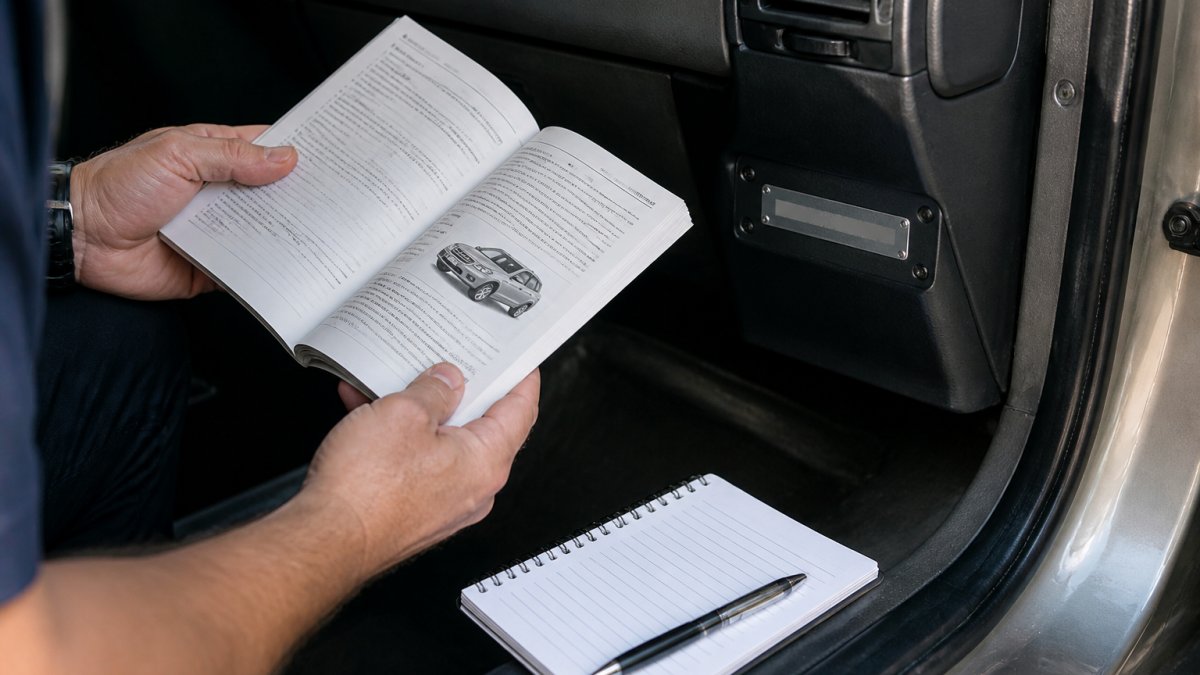
Your VIN is a 17-character code that identifies your exact vehicle configuration. You'll find it on your dashboard, inside the driver's door jamb, or on your registration. Many platforms use VIN-based setup to automatically populate your vehicle's specs and recommended service intervals.
If you've lost your physical manual, search online for "[Your Year Make Model] owner's manual PDF." Most manufacturers provide free digital versions.
Step 2: Understand Manufacturer Recommended Maintenance Intervals
Your manufacturer has engineered specific service intervals based on thousands of hours of testing. These intervals define when you should change oil, rotate tires, inspect brakes, and service other systems.
Vehicle Mileage & Maintenance Service Schedule | Google Sheet Template w/ Conditional Formatting
Ashley N Cameron
Manufacturers typically provide two types of intervals:
- Severe service schedules (for frequent short trips, towing, or extreme conditions)
- Normal service schedules (for typical driving)
Choose the schedule that matches your actual driving. Short trips around town fall under severe service; highway miles fall under normal service.
Mileage-Based Service vs. Time-Based Service
Mileage-based service is triggered by miles driven (e.g., "Change oil every 5,000 miles"). Time-based service is triggered by calendar time (e.g., "Change oil every 6 months"), which matters for vehicles that sit unused since oil degrades over time.
Many vehicles use both: "Change oil every 10,000 miles or 12 months, whichever comes first." Always use whichever interval comes first.
Step 3: Build Your Car Maintenance Schedule Template
A simple spreadsheet or dedicated app keeps everything organized.
Your template should include these columns:
- Service type (oil change, tire rotation, brake inspection, etc.)
- Recommended interval (from your owner's manual)
- Last service date
- Last service mileage
- Next due date
- Next due mileage
- Notes (shop used, cost, parts replaced)
List all recommended services with their intervals, then calculate when each is due based on your current mileage and date.
For example:
| Service | Interval | Last Done | Last Mileage | Next Due Date | Next Due Mileage |
|---|---|---|---|---|---|
| Oil Change | 10,000 miles or 12 months | Sept 2025 | 45,200 | Sept 2026 | 55,200 |
| Tire Rotation | 7,500 miles | Sept 2025 | 45,200 | May 2026 | 52,700 |
| Air Filter | 15,000 miles | March 2025 | 38,500 | Sept 2026 | 53,500 |
| Brake Inspection | 12 months | Sept 2025 | 45,200 | Sept 2026 | , |
This visual approach makes it easy to see what's due next and plan your budget.
Step 4: Create a 30-60-90 Mile Maintenance Checklist
A 30-60-90 mile maintenance checklist breaks routine services into three tiers, helping you prioritize and spread costs across the year.
30-mile services (every month or 1,000 miles):
- Check tire pressure and condition
- Inspect fluid levels (oil, coolant, brake fluid, power steering)
- Test all lights (headlights, brake lights, turn signals)
- Check windshield wipers
60-mile services (every 6 months or 5,000-7,500 miles):
- Rotate tires
- Inspect brake pads for wear
- Check battery voltage and terminals
- Examine belts and hoses for cracks
90-mile services (annually or 10,000-15,000 miles):
- Change engine oil and oil filter
- Replace cabin air filter
- Inspect suspension components
- Check alignment
This staggered approach prevents surprise expenses by spreading maintenance across the year. Digital tools automate reminders tied to both time and mileage.
Step 5: Track Your Maintenance with a Vehicle Maintenance Log App
Manual tracking works, but it's easy to forget. The question isn't whether to track, it's how. You have three main options: dedicated apps, spreadsheets, or physical logbooks. Each has trade-offs.
Digital Apps vs. Spreadsheets vs. Physical Logs
Dedicated Vehicle Maintenance Apps
Pros:
- Automatic reminders based on both time and mileage
- Receipt capture via photo (OCR extracts details automatically)
- Cloud sync across devices (phone, tablet, computer)
- Searchable service history
- Shareable maintenance reports for resale or warranty claims
- VIN-based setup auto-populates manufacturer intervals
- Categorizes services automatically
Cons:
- Requires smartphone or regular internet access
- Monthly or annual subscription fees (typically $3-$10/month)
- Data privacy concerns (your service history is stored on external servers)
- Learning curve for non-tech-savvy users
Spreadsheets (Google Sheets, Excel)
Pros:
- Free and familiar
- Fully customizable to your needs
- Works offline
- Can add formulas to auto-calculate next due dates
- Easy to share via email or link
Cons:
- No automatic reminders (you must check manually)
- Requires discipline to update consistently
- Easy to lose or overwrite accidentally
- No mobile-friendly interface (clunky on phones)
- No receipt storage or photo integration
- Difficult to prove authenticity to buyers or dealers
Physical Logbook or Notebook
Pros:
- Zero cost
- No technology required
- Tangible proof of maintenance (some buyers trust handwritten records)
- Works anywhere, anytime
Cons:
- Easy to lose or damage
- No reminders, you must remember when services are due
- Handwriting can be illegible
- Difficult to search for past services
- Not shareable digitally
- Buyers may question authenticity
Which System Works Best?
For most owners, a dedicated app is the best choice because it eliminates the biggest maintenance failure point: forgetting. Automatic reminders tied to both mileage and time ensure you never miss a service. The subscription cost is negligible compared to the cost of a single missed maintenance interval. Consistent adherence to these digital alerts transforms routine upkeep into a reliable habit of preventative maintenance that preserves the long-term integrity of heavy-duty equipment.
If cost is a concern, a spreadsheet with calendar reminders (set manually in your phone's calendar app) is a solid middle ground. You get the structure of a template without subscription fees, though you'll need discipline to update it after each service.
Physical logbooks are rarely recommended for modern vehicles because digital records are more reliable, searchable, and easier to present to buyers or dealers.
What a Good App Should Include
If you choose a dedicated app, look for these features:
- VIN-based setup: Automatically loads your vehicle's manufacturer-recommended intervals
- Dual reminders: Alerts based on both calendar time and mileage
- Receipt capture: Photo upload with automatic data extraction
- Service categorization: Auto-tags services (oil change, tire rotation, etc.) for easy filtering
- Cloud backup: Your data is safe if you lose your phone
- Shareable reports: Generate a maintenance timeline to show buyers or dealers
- Multi-vehicle support: Track multiple vehicles if you own more than one
- Offline access: View your history even without internet
Apps like CarJourney include all of these features. You snap a photo of your receipt after service, and the app extracts the date, mileage, service type, and cost automatically. No manual data entry. Your vehicle's recommended intervals are pre-loaded based on your VIN. Reminders arrive before you're due, so you can schedule service at your convenience instead of scrambling when something breaks.
The Resale Advantage
When you sell your vehicle, potential buyers want proof of maintenance. A complete digital service history builds trust and can justify a higher asking price. A well-documented vehicle can command a higher asking price than one with identical mileage but no records. A shareable maintenance report (generated by most modern apps) makes that proof instant and professional. A handwritten logbook or scattered receipts raise questions and often reduce buyer confidence.
Step 6: How to Track Car Service History for Resale and Warranty
Your service history is valuable. It proves you cared for your vehicle. When you sell, it increases buyer confidence and can justify a higher price.
Keep records of:
- Every oil change and filter replacement
- Tire rotations and replacements
- Brake service (pads, fluid, bleeding)
- Fluid flushes and top-ups (coolant, transmission, power steering, brake)
- Battery replacement
- Filter replacements (engine, cabin, fuel)
- Spark plug service
- Any warranty work performed
For each service, document:
- The date and mileage
- What was done
- The shop or technician
- The cost
- Any parts replaced
- Photos of the work (optional but helpful)
This documentation proves you followed the manufacturer's recommended maintenance intervals. It protects your warranty claims. If something fails and you need warranty service, you can show the dealer that you maintained the vehicle properly.
When selling, organize this history in a clear format. A shareable build profile (like CarJourney offers) lets potential buyers see your complete maintenance timeline. Transparency builds trust. Trust closes sales.
Common Maintenance Tracking Mistakes to Avoid
Many owners sabotage their own maintenance efforts. Here are the traps to skip.
Mistake 1: Ignoring the owner's manual. The manual isn't a suggestion. It's engineered for your specific vehicle. Skipping recommended services voids warranties and damages your engine.
Mistake 2: Mixing up service intervals. Don't assume all vehicles follow the same schedule. A 2015 sedan has different needs than a 2024 truck.
Mistake 3: Tracking only major services. Oil changes matter, but so do fluid checks, tire rotations, and filter replacements. Miss the small stuff and you'll have big problems later.
Mistake 4: Losing receipts. Without documentation, you can't prove maintenance was done. Keep digital copies of everything. A photo of the receipt is enough.
Mistake 5: Waiting until something breaks. Preventative maintenance costs less than reactive repair. Don't skip services hoping they're not necessary.
Mistake 6: Choosing the cheapest shop. Budget shops sometimes cut corners. Use reputable mechanics who follow manufacturer specs. Quality work protects your vehicle long-term.
Mistake 7: Relying on memory. You won't remember when your last tire rotation was. Use a tracking system. Digital reminders prevent missed services.
Mistake 8: Ignoring seasonal needs. Winter driving requires different maintenance than summer. Check your manual for climate-specific recommendations.
Creating a vehicle maintenance schedule takes effort upfront, but it pays dividends. You'll keep your car reliable, protect your warranty, and maximize resale value.
Frequently Asked Questions
What is the 30-60-90 rule for car maintenance?
The 30-60-90 maintenance checklist refers to critical service intervals at 30,000, 60,000, and 90,000 miles. At 30,000 miles, check air filters and inspect brakes. At 60,000 miles, replace engine air filters and inspect transmission fluid. At 90,000 miles, perform spark plug replacement and transmission fluid service. These intervals vary by vehicle make and model, so always check your owner's manual for manufacturer-specific recommendations to maintain warranty coverage.
How do I create a maintenance schedule for my specific vehicle?
Start with your owner's manual, which lists manufacturer recommended maintenance intervals for your exact make, model, and year. Note both time-based (every 6 months) and mileage-based (every 5,000 miles) services. Create a template listing oil changes, tire rotations, brake inspections, fluid level checks, and filter replacements. Use a vehicle maintenance log app or spreadsheet to track completion dates and mileage. Update it after every service to maintain an accurate service history.
Should I use a digital tracker or paper log for car maintenance?
A vehicle maintenance log app offers significant advantages over paper: automatic reminders based on mileage or time, searchable service history, photo storage for receipts, and easy sharing with mechanics or buyers. Digital logs sync across devices and prevent lost records. However, choose a system you'll actually use consistently. Many car owners find that a combination works best, digital tracking for primary records with paper backups for receipts and documentation.
What are the most important items to include in a car maintenance log?
Essential items include service date, current mileage, service type (oil change, tire rotation, brake inspection), parts replaced, cost, mechanic name, and any issues noted. For resale value, photograph receipts and service records. Track synthetic versus conventional oil type, tire rotation patterns, and battery voltage checks. Include warranty-related services and any diagnostic checks performed. This comprehensive history demonstrates vehicle reliability and helps you identify recurring issues early.
Start free