 carjourney
From the CarJourney journal
Track Project Car Costs: A Step-by-Step Guide
Table of Contents
- Why Tracking Project Car Modification Costs Matters
- Categorizing Your Modification Expenses
- How to Document Project Car Builds with a Spreadsheet Template
- Step-by-Step Process for Tracking Build Progress
- Managing Scope Creep and Unexpected Repairs
- How to Document Project Car Builds for Resale and Insurance
- Tools and Systems for Build Documentation
- Common Mistakes to Avoid When Tracking Costs
Last Updated: August 27, 2026
Why Tracking Project Car Modification Costs Matters
Keeping tabs on modification spending reveals where your money actually goes. Young car enthusiasts aged 16-24 spend an average of $7.2 billion annually modifying their cars, according to the Specialty Equipment Market Association, yet most lack clear expense visibility. One YouTube car enthusiast documented his Honda S2000 modifications and discovered he'd spent $10,620 on upgrades alone, more than the car's initial cost.
Without a tracking system, expenses blur together. By project completion, you've lost track of what drove the budget up and which decisions were worth it. Builders who document spending from day one make better decisions, sell faster, and avoid constant cost surprises.
Pro Tip The real cost of any modification is rarely the sticker price. Add installation labor, custom fabrication, tune adjustments, and unexpected repairs, and your actual out-of-pocket figure is often 50-80% higher than budgeted.Categorizing Your Modification Expenses
Project car expenses break down into distinct categories, each with different patterns and implications for your build timeline and resale value.
Performance upgrades and drivetrain modifications
Performance upgrades represent the largest segment of the modification market. According to a 2026 market analysis by Modification Insights, performance upgrades accounted for 44.8% of all car modification spending in 2025. This includes engine tuning, exhaust systems, intake kits, transmission enhancements, and suspension work.
Performance upgrades rarely come as standalone expenses. You install a catback exhaust, then discover your fuel map needs adjustment. One automotive enthusiast documented this: "The sticker on the part is almost never the real number. By the time it's hung from the car, the tune has been paid for, the dyno time booked, and the actual out-the-door figure is closer to $2,200."
When tracking performance upgrades, create subcategories for:
- Engine modifications (turbo kits, superchargers, engine rebuilds)
- Exhaust systems (headers, catalytic converters, mufflers, custom piping)
- Intake and fuel systems (cold air intakes, fuel injectors, fuel pumps)
- Transmission and drivetrain (transmission swaps, differential upgrades, driveshaft work)
- Tuning and dyno time (ECU tuning, custom tunes, baseline and final dyno runs)
- Labor for performance work (specialized technicians often charge premium rates)
Cosmetic enhancements and exterior work
Cosmetic modifications improve appearance without affecting performance: body kits, paint work, wheels and tires, interior upgrades, and lighting modifications. Cosmetic work tends to be more predictable than performance upgrades, but can still surprise you.
Tire pricing has shifted dramatically. The average tire price in 2024 was nearly 50% higher than in 2019, according to Circana's 2025 market data, making wheel and tire packages significant line items.
Track cosmetic expenses under:
- Wheels and tires (purchase price, mounting, balancing, tire protection)
- Paint and body work (prep, paint, clear coat, custom colors, specialty finishes)
- Body kits and aerodynamics (fiberglass or carbon fiber components, installation labor)
- Interior upgrades (seats, steering wheels, gauge clusters, custom trim)
- Lighting (LED headlights, underglow, custom tail lights, installation)
- Detailing and protection (ceramic coating, PPF, wax, ongoing maintenance)
Labor costs and shop rates
Labor is where project budgets often spiral. A general mechanic might charge $85-$150 per hour, while a specialist tuner might charge $150-$250+ per hour. Custom fabrication work runs even higher.
When tracking labor, record the shop name and hourly rate, type of work performed, actual hours spent, any parts the shop supplied separately, and warranty on the work. A realistic labor estimate should include a 20-30% buffer for diagnostic time, rework, and setup time for specialized equipment.
How to Document Project Car Builds with a Spreadsheet Template
A spreadsheet is the most flexible tool for tracking project car costs. You control the structure, customize it to your build, and own the data.
Setting up your tracking columns
Your spreadsheet needs at minimum these core columns:
| Column | Purpose | Example |
|---|---|---|
| Date | When the expense occurred | 2026-03-15 |
| Category | Type of modification (Performance, Cosmetic, Labor, Tools) | Performance |
| Subcategory | Specific type within the category | Exhaust System |
| Description | What was purchased or done | Catback exhaust system, stainless steel |
| Vendor | Where the purchase was made | PerformanceParts.com |
| Cost | Amount paid | $1,200 |
| Labor Hours | If applicable, hours spent or paid for | 3.5 |
| Receipt Attached | Yes/No or link to digital receipt | Yes |
| Notes | Any additional context | Includes installation hardware |
Add optional columns based on your priorities: Shipping Cost, Warranty, Resale Value Impact, Completion Status, or Before/After Photos links.
The key is consistency. Use the same vendor names every time. Use the same category names. This makes filtering and analysis possible later.
Watch Out Many builders skip the "Receipt Attached" column and regret it later. When selling the car or filing an insurance claim, you need proof of purchase. Digital photos of receipts stored in a linked folder save hours of searching.Recording receipts and invoices
Receipts prove your modifications are legitimate and protect you if a part fails. Create a system for storing receipts: photograph physical receipts immediately, save email confirmations from online orders, request itemized invoices from shops, and store all images in a folder organized by date or category.
Link these receipts in your spreadsheet. In Google Sheets, add a hyperlink in the "Receipt Attached" column that opens the photo or PDF. For shop work, insist on an itemized invoice that breaks down labor hours, hourly rate, parts supplied by the shop, parts you supplied, and any warranty on the work performed.
Step-by-Step Process for Tracking Build Progress
Tracking costs is a process, not a one-time event. You need a system simple enough that you log expenses within a day or two of incurring them.

Step 1: Establish your total build budget
Before buying a single part, decide how much you're willing to spend. This number is your guardrail. Costs typically run 30-50% higher than initial estimates once you account for tuning, custom fabrication, and unexpected repairs.
Write this budget down in your spreadsheet as a reference point. Create a running total and "remaining budget" column. Seeing your available funds shrink focuses decision-making fast.
Step 2: Create expense categories and subcategories
Customize your category structure to your specific build. The goal is to make filtering and analysis possible.
Step 3: Log every purchase with date and vendor
Log purchases immediately. Record the date, what you bought, how much you paid, and where you bought it. Include shipping costs if applicable. This keeps your data accurate and forces you to confront spending in real time.
Step 4: Track labor hours and shop rates
Record the shop name, hourly rate, and actual hours worked. If you're doing the work yourself, decide whether to track your time using a reasonable hourly rate.
Step 5: Document scope creep and hidden expenses
Create a "Scope Creep" note column. When you discover a new expense that wasn't in your original plan, log it and note why. A realistic project budget includes a 15-20% buffer for unknowns.
Pro Tip Track the "cost to completion" separately from the "cost to date." Many builders discover their original budget was realistic, but they underestimated remaining work. Seeing the projected final number forces you to make hard choices about which remaining modifications matter.Managing Scope Creep and Unexpected Repairs
Scope creep isn't a failure, it's the nature of project car building. Separate "planned additions" from "unexpected discoveries." Planned additions are modifications you decided to add after the initial plan. Unexpected discoveries are problems you found while working on something else.
For planned additions, ask: Does this modification align with the original vision? For unexpected discoveries, ask: Is this a safety issue? If yes, fix it immediately. Is this a performance blocker? If the discovery prevents your planned modifications from working properly, you must address it. Is this optional? If optional, decide whether it's worth the cost and delay.
Document every scope creep decision in your spreadsheet. This history becomes invaluable when explaining your build to a future buyer or analyzing what went wrong with your budget.
How to Document Project Car Builds for Resale and Insurance
Your build documentation serves two critical purposes: proving the quality and authenticity of your modifications to a potential buyer, and providing evidence for insurance purposes.
Building a verifiable maintenance history
A maintenance history proves you've cared for the car and that modifications were done properly. Your spreadsheet is the foundation, but a verifiable history includes receipts and invoices for every modification and service, before and after photos of major work, dyno sheets showing baseline and final power numbers, warranty documentation for parts and labor, service records from shops, and a narrative timeline showing the progression of the build.
When ready to sell, compile this into a document or digital package. The goal is to make it easy for a buyer to verify that modifications are real and properly executed.
Insurance valuation for modified cars
Standard insurance policies don't cover modifications. Your spreadsheet and receipts are exactly what an insurance company needs. When getting a quote for modification coverage, provide a summary of total modification costs by category, receipts for major modifications, photos of the modifications, and any professional assessments of value. The more documentation you have, the better the coverage you'll receive.
Tools and Systems for Build Documentation
Your spreadsheet is powerful, but a complete documentation system includes storage for receipts, photos, and a way to organize everything.
Digital platforms vs. spreadsheets
A spreadsheet gives you flexibility and control. The downside is that you're responsible for maintaining it, and your data lives in isolation, receipts in one folder, photos in another, spreadsheet somewhere else.
Digital platforms designed for car builds integrate all of this. CarJourney, for example, uses AI-powered logs to automatically organize maintenance and modification records, generates shareable build profiles for resale transparency, and ties everything together with your VIN. For most builders, a hybrid approach works best: a spreadsheet for financial tracking and a digital platform like CarJourney for documentation and organization.
Organizing photos and receipts
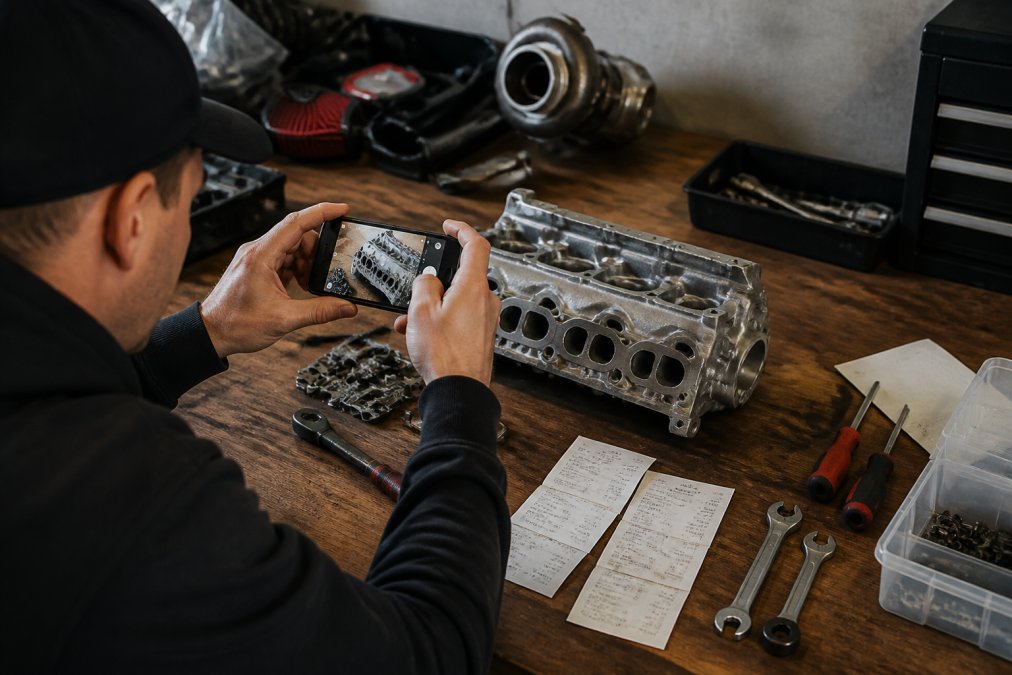
Photos are your visual proof that modifications were actually done. Before and after shots show the transformation. Progress photos document the timeline. Detail shots prove quality of work.
Organize photos by date (YYYY-MM-DD format makes sorting automatic), category (Engine, Suspension, Interior, etc.), and type (Before, After, Detail, Installation). Store receipts digitally by photographing physical receipts immediately, then filing them away. Link photos and receipts to your spreadsheet entries. This creates a complete audit trail.
Common Mistakes to Avoid When Tracking Costs
Waiting too long to log expenses. Log everything immediately or details will slip your mind.
Mixing personal and project expenses. Decide whether tools are project costs or personal investments and be consistent.
Ignoring labor costs. Even if you're doing the work yourself, track your time. It shows the true value of modifications.
Not separating parts from labor. Break down shop invoices into parts cost and labor cost separately.
Forgetting about taxes and fees. Sales tax, shipping fees, and shop surcharges add up. Include them in your tracking.
Losing receipts. Photograph or scan every receipt the day you get it.
Building without a budget. Without an upper limit, scope creep becomes inevitable. Decide your limit upfront, then make decisions within that constraint.
Tracking project car modification costs is fundamentally about respect, for your budget, your time, and your passion for building. A spreadsheet, a folder for receipts, and the discipline to log expenses consistently gives you complete visibility into your build.
When ready to sell, that documentation becomes your competitive advantage. Buyers trust a builder who can prove every modification with receipts and photos. When you need insurance coverage, your records make the process straightforward. For your own satisfaction, you'll understand exactly what drove your final number.
Start tracking today with CarJourney. Build a complete digital record of your modifications, organize your receipts and photos in one place, and generate a shareable build profile that proves your car's story to potential buyers. A project car built with documentation is a project car built right.
Frequently Asked Questions
Why is it important to keep receipts for car modifications?
Receipts provide proof of purchase, warranty information, and documentation for insurance claims. They establish the cost basis for your modifications, which is critical when calculating your total investment and proving vehicle value to insurers or future buyers. Detailed receipts also help you track which parts came from which vendors, making warranty claims easier if a component fails.
How do I create a budget for a project car build?
Start by researching typical costs for your target modifications using forums and community builds. Allocate funds across categories: engine work, suspension, cosmetic upgrades, and labor. Add 20-30% contingency for unexpected repairs and scope creep. Document your budget in a spreadsheet alongside actual spending to monitor progress. Remember that hidden costs like tools, workspace rental, and tuning sessions often exceed initial estimates by 50% or more.
Does tracking modification costs help with insurance valuation for modified cars?
Yes. Detailed expense records and documentation prove the quality and authenticity of your modifications to insurers. When you track project car builds with receipts, photos, and service history, you create a verifiable record that supports higher valuations for performance upgrades or custom work. This documentation is essential when filing claims or negotiating agreed-value coverage for heavily modified vehicles.
What should I include in a project car build spreadsheet template?
Your spreadsheet should include columns for: date purchased, part name, category (engine, suspension, cosmetic), vendor, cost, labor hours (if applicable), shop rate, total expense, and notes. Add a running total column to track cumulative spending. Include separate sections for parts sourcing, labor costs, and unexpected repairs. This structure helps you categorize expenses, identify spending patterns, and calculate your total investment accurately.
Start freeThis article was written using GrandRanker