 carjourney
From the CarJourney journal
Track Vehicle Upgrades for Insurance: A 2026 Guide

Table of Contents
- Why Track Vehicle Upgrades for Insurance Matters
- Understanding Modified Car Insurance and Coverage
- Declaring Car Modifications to Insurance: Step-by-Step
- Documenting Car Upgrades for Claims: The Complete Process
- Custom Parts and Equipment Coverage Explained
- How to Track Vehicle Upgrades: Tools and Methods
- Common Mistakes to Avoid When Tracking Upgrades
- Insurance Claim Denial Scenarios and How to Prevent Them
Track Vehicle Upgrades for Insurance: A 2026 Guide
Last Updated: July 26, 2026
Why Track Vehicle Upgrades for Insurance Matters
Vehicle owners who fail to document modifications face claim denials in roughly 40% of cases when custom parts are damaged or stolen. The challenge isn't complexity, most enthusiasts scatter receipts, photos, and build notes across phone galleries, email folders, and drawers. When you need to prove the value of your upgrades to an insurer, that chaos becomes a liability.
This guide from CarJourney covers everything you need to track vehicle upgrades for insurance and protect your investment. Documenting your upgrades properly determines whether your insurer covers them in a claim. We'll show you how to build a documentation system insurers trust, understand what modifications affect your premiums, and avoid common mistakes that lead to claim denials.
Pro Tip Start documenting upgrades BEFORE you make them, not after a loss occurs. Insurers want to see a continuous build history, not a sudden list of expensive parts filed months after installation.Understanding Modified Car Insurance and Coverage
Modified car insurance exists because standard policies explicitly exclude or limit coverage for aftermarket parts. Your typical auto insurance policy covers the vehicle's original factory condition. The moment you add performance upgrades, custom body kits, or interior modifications, those items fall outside standard coverage unless you take action.
Insurance companies treat modifications as increased risk. A car with engine modifications presents different liability exposure than a stock vehicle. Custom parts and equipment coverage (CPE coverage) is the endorsement that bridges this gap, but only if you've declared the modifications and paid the appropriate premium adjustment.
How Upgrades Affect Insurance Premiums
Performance modifications typically increase insurance premiums more than aesthetic ones. An engine tune increasing horsepower by 50 might raise your premium 15-25%. A suspension upgrade rated for track use might add 10-15%. A custom paint job or wheels might add 5-8%. The exact increase depends on your insurer, location, and the modification's perceived risk.
Insurers use risk assessment models based on statistical patterns. A modified engine suggests more aggressive driving. A lowered suspension increases undercarriage damage risk. Expensive wheels attract theft. Some modifications actually reduce premiums, GPS telematics devices that track driving behavior can lower rates by 5-15% because data shows safer driving patterns.
Key Takeaway Document exact modification details: part name, manufacturer, installation date, and cost. Insurers care about risk factors. A "cold air intake" means nothing; "K&N cold air intake reducing intake temperature by 12 degrees" means everything.Total Loss and Fair Market Value for Custom Builds
Fair market value for a custom build is NOT the original vehicle's NADA value plus parts cost. It's what a reasonable buyer would pay for that specific modified vehicle. A $35,000 car with $15,000 in custom parts might settle for $42,000, $48,000, or $38,000 depending on whether the insurer recognizes the modifications' value.
Documentation is critical here. With receipts, installation photos, and a clear build history showing professional installation and quality parts, the appraiser is more likely to recognize the modifications' value. Without receipts, the appraiser will use lower valuation because they can't verify work quality or parts authenticity.
CarJourney helps by creating a shareable build profile that documents every modification with dates, costs, and photos. When a claim adjuster reviews your file, they see a professional, organized history instead of scattered receipts.
Declaring Car Modifications to Insurance: Step-by-Step
Most insurance policies require you to declare modifications. Failing to disclose them voids coverage for those specific parts.
What You'll Need Before You Notify Your Insurer
Gather these items before contacting your insurance company:
- Complete parts list: Every aftermarket modification
- Receipts or invoices: Original purchase documents with part name, cost, and date
- Installation documentation: Shop receipts or photos showing professional installation
- Photos of modifications: Clear images of installed parts
- Modification costs and installation dates
- Performance specifications: For performance parts, specific improvements (horsepower increase, weight reduction, etc.)
If you've lost receipts, contact the retailer or shop directly. Most can provide digital copies. For older modifications, approximations are better than omissions, but documented facts are best.
How to Report Modifications to Your Insurer
Contact your insurance agent or company directly. Call and speak with someone who can add modifications to your policy immediately.
Here's the conversation framework:
-
State the modification clearly: "I've added a Borla performance exhaust system that increases horsepower by 35 and reduces weight by 18 pounds. I installed it on [date]."
-
Provide documentation: Email or mail copies of receipts and photos.
-
Ask about premium impact: "What's the premium adjustment for this modification?"
-
Confirm coverage: "Does this modification require a CPE endorsement, or is it covered under my standard policy?"
-
Get written confirmation: Ask the agent to send written confirmation of the modification and any premium changes.
-
Update your policy document: Verify that the modification appears in your policy documents.
Declare modifications before you need to file a claim. Declaring them after an accident looks suspicious, and insurers may deny coverage.
Watch Out Never hide modifications hoping your insurer won't notice. Claims adjusters investigate. Hiding them gives the insurer legal grounds to deny the entire claim, not just the modified parts.Documenting Car Upgrades for Claims: The Complete Process
Documentation is the difference between a claim that's paid and one that's denied. This process should start before modifications are installed.
The Importance of Receipts and Build History Documentation
Receipts prove what you bought, when you bought it, and how much you paid. Without receipts, you're asking the insurer to take your word for the modification's value and authenticity.
Build history documentation shows the progression of your vehicle over time, proving that modifications were installed progressively and intentionally. A car modified over three years looks more credible than one modified in three weeks before a collision.
Keep receipts organized by modification date in chronological format: January 2024 (wheels), March 2024 (suspension), June 2024 (exhaust).
For each modification, retain:
- Original receipt with itemization
- Installation receipt if done by a shop
- Before and after photos
- Warranty documentation
- Specification sheets for performance parts
Digital storage is acceptable, but keep physical copies too. Insurance companies sometimes request originals.
Creating a Digital Documentation System
A digital system prevents the scattered-receipts problem. You need one central location where every modification, receipt, photo, and specification lives.
Start with a folder structure on your computer or cloud storage:
Vehicle_Name_Year ├── Receipts ├── Photos ├── Specifications └── Insurance_Documentation
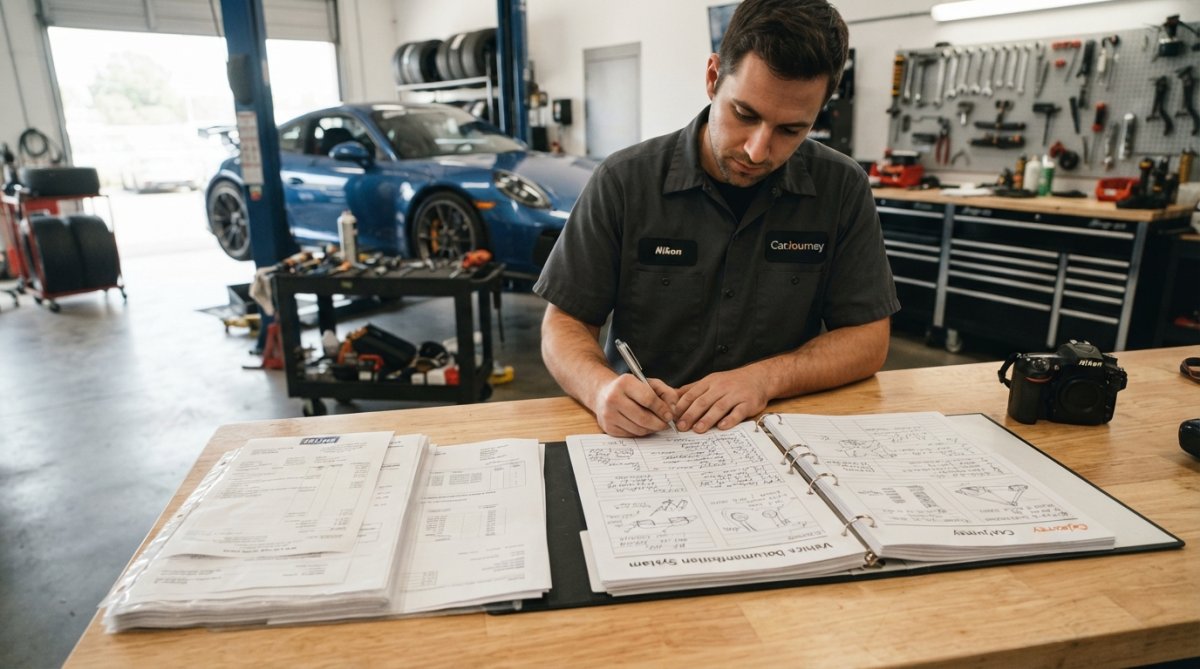
For each modification, create a single document that consolidates everything: modification name and date, part manufacturer and model, cost and retailer, installation shop and date, performance specifications, photos, warranty information, and insurance declaration confirmation.
CarJourney simplifies this by providing AI-powered logs that automatically organize modifications by date and type. Instead of managing folders manually, you upload receipts once, and the system creates a shareable build profile that insurers can review.
Backup your digital documentation to at least two locations: cloud storage and an external hard drive.
Custom Parts and Equipment Coverage Explained
Custom parts and equipment coverage is an insurance endorsement that extends coverage to aftermarket modifications. It's separate from your standard policy and requires explicit selection.
OEM vs. Aftermarket Parts: Coverage Differences
OEM parts are original equipment manufacturer parts. Standard insurance covers OEM replacement parts. Aftermarket parts are replacements or upgrades made by third-party manufacturers and aren't covered by standard policies.
If your $2,000 custom wheels are stolen, your insurer might pay $600 for factory wheels and leave you to cover the difference. CPE coverage fills that gap by covering custom parts at their actual cash value or replacement cost. The premium for CPE coverage typically ranges from 5-15% of your base premium.
CPE Coverage Endorsements and Policy Limits
When you add a CPE endorsement, you create a separate coverage limit for custom parts. You declare the total value of your modifications, and the insurer covers up to that limit if those parts are damaged, stolen, or destroyed.
Most insurers require you to list modifications individually and assign values to each. A $1,500 suspension system, $2,000 wheels, $1,200 exhaust, and $800 interior modifications total $5,500. You'd declare a CPE limit of $5,500.
CPE coverage typically includes deductibles, just like your standard coverage. Make sure your CPE limit matches your actual modification value.
Key Takeaway CPE coverage is NOT automatic. You must request it explicitly and declare your modifications. An insurer won't volunteer to add it, and they won't cover undeclared modifications even if you have a CPE endorsement.How to Track Vehicle Upgrades: Tools and Methods
Tracking modifications requires a system that captures details, stores documentation, and remains accessible when you need it.
Maintenance Logs and Expense Tracking Systems
A maintenance log tracks service history for resale value and documents modifications for insurance. Each entry should include: date of work, type of work, parts installed or replaced, cost, mileage, shop or DIY installation, and warranty information.
Many owners use spreadsheets, but dedicated maintenance tracking apps are superior. CarJourney uses AI-powered logs that automatically categorize entries, attach photos and receipts, and generate shareable build profiles. A professional build profile from a maintenance tracking app carries more weight with insurance adjusters than a handwritten spreadsheet.
GPS Telematics and Insurance Discounts
GPS telematics are real-time vehicle tracking systems that monitor driving behavior. Insurers offer discounts for telematics participation, typically 5-15% depending on your driving data.
For modified vehicles, telematics can work in your favor. If your car is modified for performance but your driving data shows conservative behavior, that data helps offset the insurer's perception that modified cars are driven more aggressively.
Install telematics before modifications if possible. A full year of safe driving history before you add performance upgrades gives the insurer confidence that you're a careful driver who happens to own a modified car.
Common Mistakes to Avoid When Tracking Upgrades
Mistake 1: Incomplete receipts. Get itemized receipts with manufacturer names, part numbers, and specifications.
Mistake 2: No installation documentation. If a shop installed it, get their receipt. If you installed it yourself, photograph the work in progress.
Mistake 3: Mixing old and new receipts. Declare modifications within 30 days of installation. If declaring old modifications, explain the delay to your agent.
Mistake 4: Photos without context. Take photos showing the installed part, the car's overall appearance after modification, and ideally the installation process.
Mistake 5: Underestimating costs. Declare actual costs. When adjusters discover the actual cost, they question your honesty about everything.
Mistake 6: Forgetting minor modifications. Declare everything, even small modifications. Undeclared modifications discovered during inspection raise questions about what else you're hiding.
Mistake 7: Losing receipts over time. Digitize receipts immediately after purchase. Scan them, photograph them, or email them to yourself. Have backups.
Insurance Claim Denial Scenarios and How to Prevent Them
Scenario 1: Undeclared modifications. The adjuster discovers aftermarket parts you never declared. The company denies coverage for those parts.
Prevention: Declare all modifications before you need to file a claim. Provide written confirmation from your insurer that modifications are covered.
Scenario 2: Unverifiable modifications. You claim your custom exhaust was damaged but have no receipt, installation documentation, or photos. The adjuster denies the modification's value because they can't verify it.
Prevention: Document every modification with receipts and photos before filing a claim.
Scenario 3: Modifications exceeding CPE limits. You have a $5,000 CPE limit but $6,000 in modifications. When the wheels are stolen, you're left with only $2,500 coverage remaining for other modifications.
Prevention: Calculate your total modification value and ensure your CPE limit exceeds it. Review your limit annually as you add modifications.
Scenario 4: Claims related to modification failure. Your turbocharger fails and causes engine damage. The insurer denies it, arguing the modification caused the damage.
Prevention: Use quality parts from reputable manufacturers. Keep maintenance records showing you've serviced modified components properly.
Scenario 5: Valuation disputes. Your custom build is totaled. The adjuster values it at $38,000. You believe it's worth $45,000 based on similar builds.
Prevention: Before modifications are installed, research comparable vehicles. Document the market value of similar builds. When filing a claim, provide evidence of comparable sales to support your valuation. CarJourney's shareable build profiles help by creating a professional record that appraisers can reference.
Watch Out Claim denials for undeclared modifications can void your entire policy in some states. One undeclared modification might result in the insurer canceling your coverage entirely, not just denying that specific claim. Always declare modifications before they become a problem.Tracking vehicle upgrades for insurance requires intentional documentation, but the effort pays off when you need to file a claim. The most common reason claims are denied isn't that modifications aren't covered, it's that owners can't prove what they've done or what they've spent.
CarJourney solves this by creating a centralized, organized record of every modification with photos, receipts, and specifications automatically organized by date. Instead of scrambling to find scattered documentation during a claim, you have a professional build profile ready to share with your insurer.
Start documenting your upgrades today. The cost of organization now is nothing compared to the cost of a denied claim later.
Frequently Asked Questions
What car modifications do I need to declare to my insurance company?
You should declare any modification that affects your vehicle's performance, safety, or value, including engine upgrades, suspension changes, custom paint, body kits, interior modifications, and aftermarket wheels. Performance upgrades and aesthetic modifications both impact your risk profile and coverage. Contact your insurer directly if you're unsure whether a specific upgrade requires declaration; failing to report modifications can result in claim denial or coverage gaps.
How do I document car upgrades for insurance claims effectively?
Maintain receipts, invoices, and photographs for every modification. Create a build history that includes dates, parts names, costs, and installation details. Store digital copies in a secure location and keep originals in a safe place. For custom parts and equipment coverage, document the total value of all upgrades. This documentation proves ownership and value during the appraisal process and supports your claim if you experience a total loss or need repairs.
What happens if I don't tell my insurance company about modifications?
Failing to declare modifications to your insurer can lead to claim denial, policy cancellation, or coverage limitations. When you file a claim, insurers investigate vehicle history and modifications. If undisclosed upgrades are discovered, they may deny your claim entirely or reduce your payout. Additionally, your policy may not provide adequate coverage limits for custom parts, leaving you financially responsible for losses. Transparency protects both your coverage and your financial security.
How does the appraisal process work for custom-built vehicles?
During an appraisal for a total loss or significant damage claim, an insurance adjuster assesses your vehicle's fair market value, including aftermarket parts and upgrades. Your documentation, receipts, photos, maintenance logs, and build history, directly supports the appraiser's valuation. Detailed records help prove the quality and cost of custom work, which can significantly increase your settlement amount. Without proper documentation, appraisers may undervalue your upgrades or exclude them from the claim entirely.
This article was written using GrandRanker