 carjourney
From the CarJourney journal
Why Clear Check Engine Light Before Sale: Seller's Guide

Why Clear Check Engine Light Before Sale: Seller’s Guide
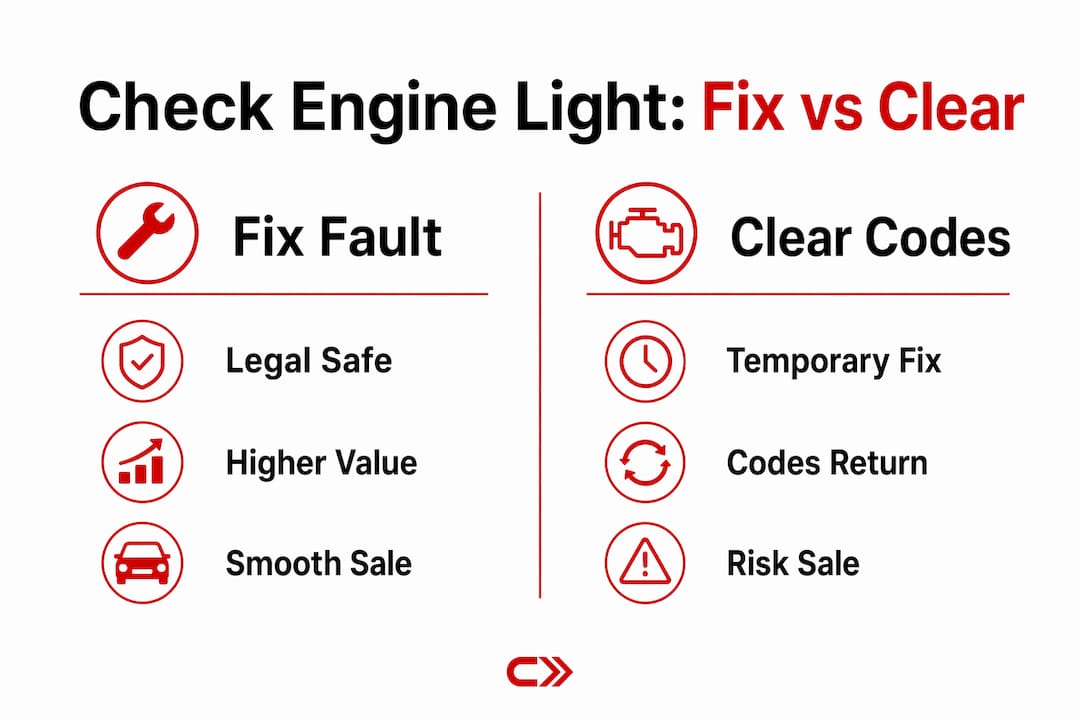
Clearing a check engine light before selling your car is one of the riskiest moves you can make as a seller. The malfunction indicator lamp, known in the industry as the MIL, signals stored OBD-II diagnostic trouble codes (DTCs) that document exactly what is wrong with your vehicle. Simply erasing those codes without fixing the underlying fault exposes you to fraud liability, reduces your resale value by up to $500 to $2,000, and gives informed buyers an immediate red flag. Understanding why you should address the root cause, not just the warning light, is the difference between a clean sale and a legal dispute.
Why clearing the check engine light before sale does not fix the problem
Clearing engine trouble codes resets the MIL but leaves the fault completely untouched. The OBD-II system, which has been federally mandated on all vehicles sold in the United States since 1996, continuously monitors dozens of engine and emissions components. When a sensor detects a problem, it stores a DTC along with freeze-frame data, a snapshot of engine conditions at the exact moment the fault occurred.
Clearing codes deletes that freeze-frame data, making future diagnosis harder and more expensive for whoever owns the car next. A mechanic who would have spotted the fault in minutes now has to start from scratch. That extra diagnostic time costs money, and it often comes back to the seller through post-sale disputes.
The light will return. Sellers who clear codes without repairing the fault see the MIL reappear within 1–3 drive cycles if the problem persists. That is typically less than 50 miles of normal driving. A buyer who drives the car home and watches the light come back on within a day has every reason to call you.
Permanent DTCs cannot be cleared by simply disconnecting the battery or using a basic scan tool. These codes stay stored until the vehicle completes multiple successful drive cycles with the fault fully resolved. If you sell a car with an unresolved permanent DTC, the light is coming back regardless of what you did before the sale.
Pro Tip: Before listing your car, plug in an OBD-II scanner yourself. Knowing exactly which codes are stored lets you make an informed decision about repair versus disclosure, rather than guessing.
Financial and legal consequences of hiding engine codes before sale
The financial hit from an active check engine light is real and immediate. Buyers who spot the light, or who scan for codes themselves, discount their offers by $500 to $2,000 to cover perceived repair risk. That discount often exceeds the actual cost of fixing the fault. A loose gas cap or a faulty oxygen sensor might cost $50–$200 to repair. Ignoring it and selling with the light on costs you far more in negotiating leverage.

The cost escalation risk is even sharper when you delay. A simple $200 repair left unchecked can escalate to a $1,500–$3,000 catalytic converter replacement within six months. Buyers know this. When they see a check engine light, they assume the worst-case repair cost, not the best case.
The legal exposure is the part most sellers underestimate. Intentionally clearing a check engine light to hide defects before sale can constitute fraud, opening you to lawsuits and financial liability. This is not a theoretical risk. Courts have sided with buyers in cases where sellers cleared codes to conceal known defects.
Hiding a check engine light defect without disclosure is classified as fraudulent misrepresentation under legal frameworks in many U.S. states. Sellers who clear codes to conceal faults can face civil liability, forced refunds, and in some cases, criminal fraud charges.
State-level consumer protection laws add another layer of exposure. An active check engine light causes automatic emissions test failure and can block vehicle registration in many states. A buyer who cannot register the car they just purchased from you has a strong legal claim. Disclosure is not just ethical. It is the legally safer path.
Key legal and financial risks sellers face when hiding engine codes:
- Civil fraud liability if a buyer proves you knowingly concealed a defect
- Post-sale repair demands backed by consumer protection statutes
- Emissions test failure that blocks the buyer from registering the vehicle
- Forced refunds or rescission of the sale in states with strong lemon-law protections
- Damage to your reputation if you sell privately or through a dealer network
When and how to handle a check engine light before selling
The right approach depends on what the code actually says. Not every check engine light signals an expensive repair. Many sellers discover the fault is a loose gas cap, a worn oxygen sensor, or a minor evaporative emissions leak. These repairs are cheap, fast, and pay for themselves immediately in preserved resale value.
Follow these steps before listing your car:
- Scan the codes yourself. A basic OBD-II scanner costs $25–$50 at any auto parts store. Read every stored DTC before you do anything else.
- Research the repair cost. Look up the specific code. Many faults cost under $200 to fix. Compare that to the $500–$2,000 discount you will face if you sell with the light on.
- Fix minor faults before listing. A clean bill of health from a mechanic, paired with a receipt, is one of the strongest selling tools you have. Disclosing service records to buyers builds confidence that no amount of verbal reassurance can match.
- Disclose what you cannot fix. If the repair is genuinely beyond your budget, tell the buyer exactly what the code is. Print the diagnostic report and hand it over. Transparency about minor faults preserves more value than hiding them, according to general sales managers who work in automotive retail.
- Never clear codes just to hide them. If you clear codes without repairing the fault, the light returns within days, the buyer loses trust, and you gain legal exposure. There is no scenario where this strategy ends well for the seller.
- Get a pre-sale inspection. A third-party mechanic’s report that documents the fault and its severity gives buyers objective information. It also protects you legally by proving you disclosed the issue.
Pro Tip: Pair your diagnostic report with a full service history when you list the car. Buyers who can see documented maintenance are far less likely to lowball you over a minor warning light.
How code clearing affects the buyer experience and sale outcome
Buyers in 2026 are more technically aware than ever. A significant portion of private-party buyers bring their own OBD-II scanner to a test drive, or they pay for a pre-purchase inspection that includes one. OBD-II readiness monitors reset when codes are cleared, requiring 100–200 miles of varied driving to return to a “Ready” state. A car that shows multiple “Not Ready” monitors is an immediate red flag to any informed buyer or inspector.
The “Not Ready” state tells a buyer three things at once: codes were recently cleared, the car has not been driven enough to confirm the fault is gone, and the seller may be hiding something. That suspicion is hard to overcome once it is planted. Even if your intentions were innocent, a “Not Ready” readiness monitor reading signals deception to a buyer who knows what they are looking at.
Honest disclosure, by contrast, changes the entire dynamic of the negotiation. Buyers who receive a printed diagnostic report and a repair estimate before they ask for one tend to trust the seller. That trust translates directly into faster sales and stronger offers. Here is what buyers and inspectors look for during a pre-purchase check:
- Readiness monitor status across all OBD-II systems (fuel, oxygen sensor, catalyst, evap, and others)
- Stored and pending DTCs that the seller may not have mentioned
- Freeze-frame data that reveals how long a fault has been present
- Permanent DTC flags that confirm an unresolved fault exists regardless of code clearing
Car selling tips from automotive retail professionals consistently point to documentation and transparency as the two factors that most reliably close private-party deals at asking price. A seller who hands over a diagnostic printout and a repair receipt is not showing weakness. They are showing that they have nothing to hide.
Key Takeaways
Fixing the underlying fault before selling is always the better financial and legal choice compared to simply clearing the check engine light.
| Point | Details |
|---|---|
| Clearing codes is not a fix | The MIL returns within 1–3 drive cycles if the fault is unresolved. |
| Financial cost of hiding the light | Buyers discount offers by $500–$2,000 when a check engine light is present. |
| Legal risk is real | Hiding defects through code clearing can constitute fraud under state consumer protection laws. |
| Readiness monitors expose clearing | Buyers with OBD-II scanners detect recent code clearing through “Not Ready” monitor states. |
| Disclosure builds value | Sharing diagnostic reports and repair receipts builds buyer trust and supports asking price. |
The uncomfortable truth about selling with a check engine light
I have seen sellers go through the same mental calculation dozens of times. Clear the codes, hope the light stays off long enough to close the deal, and deal with the fallout later. It almost never works out the way they plan.
The buyers who get burned by this approach are not naive. They are the ones who trusted a seller’s word over their own scan tool. And the sellers who try to hide a check engine light rarely save money. They lose it, either through a forced price cut when the buyer’s inspector finds the “Not Ready” monitors, or through a post-sale dispute that costs far more than the original repair would have.
What I find consistently true is that sellers who invest $150 in a diagnostic and repair, and then hand the buyer a receipt, close faster and closer to asking price than sellers who try to present a “clean” car with cleared codes. The receipt is worth more than the repair itself. It signals that you are the kind of seller who takes care of things.
The vehicle resale history you build through documented repairs and honest disclosure is your strongest negotiating asset. Buyers pay for certainty. Give them certainty, and they stop negotiating on price.
— Chally
Carjourney helps sellers go into every sale with confidence
Selling a car with a documented maintenance history is a completely different experience from selling one with a glove box full of loose receipts and unanswered questions.

Carjourney is built for exactly this situation. The platform lets you log every repair, diagnostic visit, and service record in one place, so when a buyer asks about that check engine light, you have a timestamped, organized answer ready. Carjourney’s AI scans your service documents and helps you understand your vehicle’s full history before a buyer’s inspector does. Start building your vehicle maintenance record with Carjourney before you list, and walk into every negotiation with proof, not promises.
FAQ
Does clearing a check engine light before sale count as fraud?
Clearing codes to hide a known defect can be classified as fraudulent misrepresentation under consumer protection laws in many U.S. states. Sellers who knowingly conceal defects face civil liability and potential forced refunds.
Will a buyer’s OBD-II scan detect that I cleared the codes?
Yes. OBD-II readiness monitors reset to “Not Ready” when codes are cleared, and they require 100–200 miles of driving to return to a ready state. Any buyer or inspector with a scanner will see this immediately.
How much does a check engine light reduce my car’s resale value?
An active check engine light typically reduces resale value by $500 to $2,000, depending on the perceived severity of the fault and the buyer’s risk tolerance.
Should I fix the check engine light or just disclose it?
Fix it if the repair cost is less than the likely discount buyers will demand. If the repair is too expensive, disclose the specific DTC and provide a repair estimate. Transparency consistently produces better sale outcomes than concealment.
What is a permanent DTC and why does it matter for sellers?
A permanent DTC is a fault code that cannot be erased by standard code clearing methods. It stays stored until the vehicle completes multiple successful drive cycles with the fault fully repaired, meaning the check engine light will return even after you clear it.