 carjourney
From the CarJourney journal
AI Car Maintenance: How Smart Diagnostics Actually Work
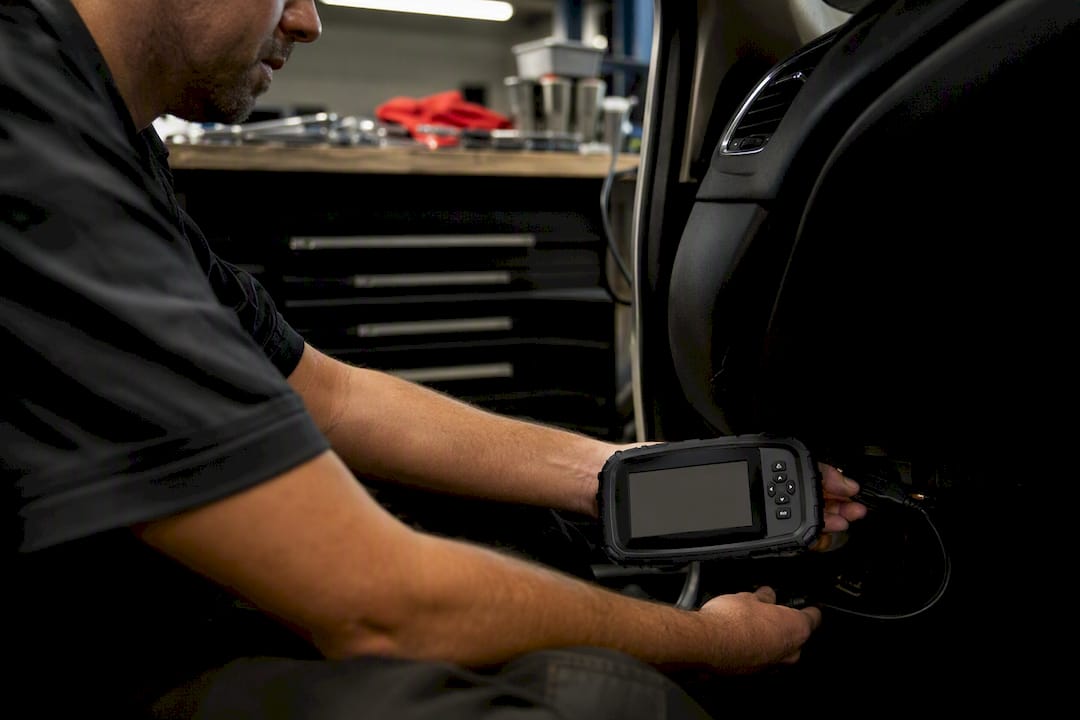
AI car maintenance combines diagnostic reasoning with vehicle-specific scheduling: you feed it OBD2 codes, symptoms, or service history, and it returns a ranked explanation of what’s wrong and what to fix next. It shines at cutting through check-engine-light guesswork and catching maintenance you’d otherwise skip. It’s not a replacement for a lift, a scan tool in trained hands, and a mechanic who can physically verify a brake line or airbag sensor.
TL;DR:
- Accurate AI diagnostics depend on integrating vehicle-specific records, service history, and manufacturer bulletins, not just OBD2 codes.
- AI tools that ground recommendations in real documents and telemetry improve accuracy and reduce diagnostic time by up to 40 percent.
- Preventative maintenance driven by AI detection can lower overall costs by catching issues early and avoiding unnecessary repairs.
- Reliability requires human verification for high-stakes repairs, and tools should provide source documentation to avoid false positives.
- Effective use involves gathering detailed vehicle data, continuously logging repairs and mileage, and cross-checking AI suggestions with qualified mechanics.
Table of Contents
- What Is AI Car Maintenance, and Why Does It Matter?
- How Do These Systems Turn Data Into Accurate Recommendations?
- What Do Consumer AI Car Maintenance Tools Actually Deliver?
- What Are the Limits of AI Diagnostics, and How Do You Judge Reliability?
- How Do You Actually Use AI Tools to Maintain Your Car?
- How Carjourney Reduces the Data Problems That Trip Up AI Diagnostics
- What’s Next for AI in Car Maintenance?
- AI Car Maintenance vs. Traditional Diagnostic Methods
- Does AI Car Maintenance Actually Save You Money?
- The Real Value Is in the Data, Not the Chatbot
- Get Vehicle-Specific AI Recommendations With Carjourney
- Sources
What Is AI Car Maintenance, and Why Does It Matter?
Strip away the marketing and AI car maintenance boils down to two jobs: reading your vehicle’s signals and telling you what to do about them. On the diagnostic side, it interprets OBD2 trouble codes alongside plain-language symptoms (“rattling at idle, worse when cold”) to narrow down a root cause instead of leaving you with a cryptic P0420 code and a Google rabbit hole. On the maintenance side, it builds a schedule tuned to your actual vehicle instead of a generic 30,000-mile checklist.
That distinction matters because factory intervals assume average conditions. A turbocharged daily driver in stop-and-go traffic wears differently than the same engine on a highway commute. Consumer-facing tools now track maintenance across 20 or more makes and monitor upward of 16 individual service items, from oil and brake pads to spark plugs, transmission fluid, and coolant. That granularity is what lets an owner catch a failing component before it becomes a tow bill.
Practical everyday uses include:
- Resolving check-engine ambiguity before you pay a diagnostic fee at the shop
- Flagging unnecessary “recommended services” upsold at routine appointments
- Tracking fuel economy trends that hint at a developing mechanical issue
- Reminding you about maintenance tied to mileage, time, or driving conditions
The cumulative effect is lower total ownership cost, not because AI fixes anything itself, but because it catches problems while they’re still cheap.
How Do These Systems Turn Data Into Accurate Recommendations?
Accuracy depends entirely on what the system feeds itself. The strongest tools pull from OBD2 telemetry, scanned service records (parsed with optical character recognition), photos of visible wear or damage, historical repair patterns, and manufacturer technical service bulletins or recall notices. A system working from OBD2 codes alone is guessing at context; one that cross-references your actual service history and known TSBs for your exact model year is reasoning from evidence.
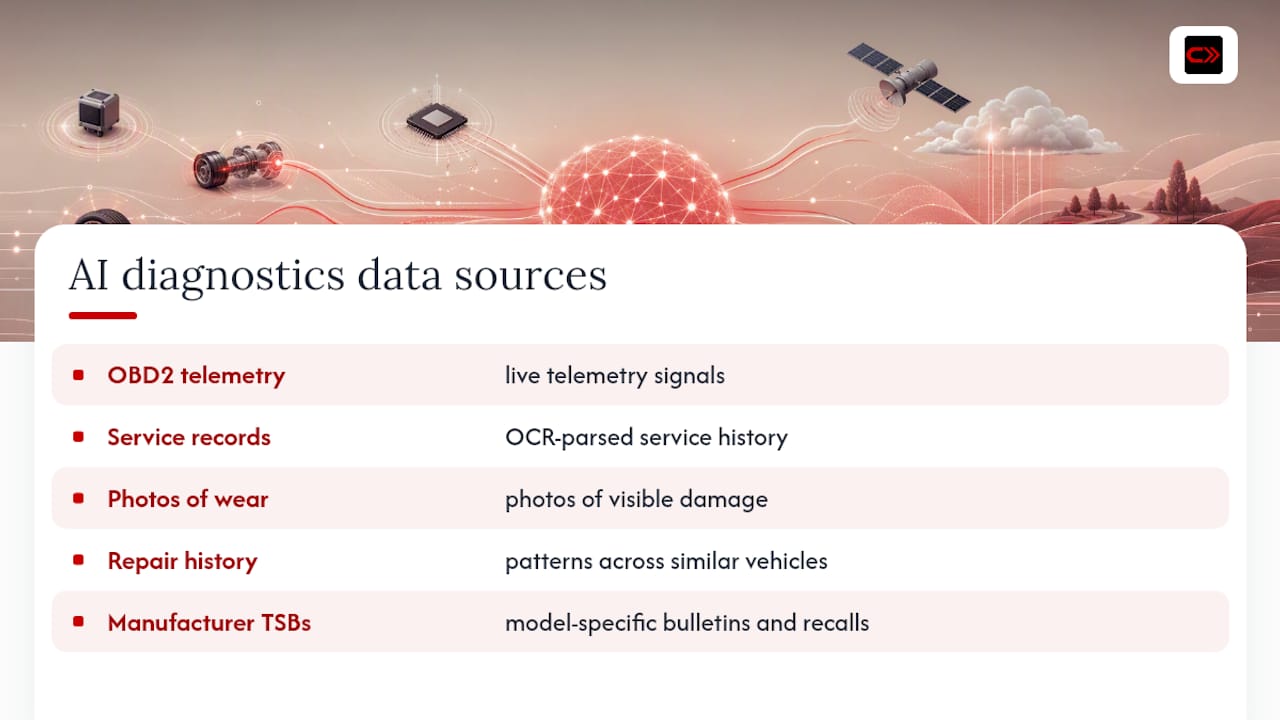
The architecture behind that reasoning has evolved fast. Retrieval-augmented generation, or RAG, grounds an AI’s answer in real documents rather than letting it improvise from general training data. Knowledge graphs normalize the chaos of maintenance records, since your dealership might log “60k service” while your independent shop logs “major service interval,” and a graph structure links those as the same event. Research on maintenance plan matching found that knowledge graph and embedding-based approaches can push matching accuracy up to roughly 90%, a meaningful jump from keyword-based lookups.
Machine learning models layered on top handle failure prediction and remaining-useful-life estimation, essentially forecasting how many miles a component has left based on wear patterns across similar vehicles. None of this works without field verification, though. Deployed agentic AI systems that ground reasoning in structured records and live telemetry rather than open-ended chat have shown 25 to 40% faster diagnostics and fewer unplanned downtime events in industrial asset management. The car maintenance version of that principle is simple: an AI tethered to your real records beats one guessing from a symptom description alone.
What Do Consumer AI Car Maintenance Tools Actually Deliver?
Most tools on the market today cluster into four functional categories, regardless of brand. Knowing these categories helps you evaluate any app on its merits rather than its marketing copy.
- Diagnostic outputs. You get a decoded trouble code, a ranked list of probable root causes, and often a severity or safety rating so you know whether to pull over now or schedule a visit next week.
- Guided troubleshooting. Step-by-step checks walk you through testing a battery, inspecting a belt, or reading live sensor data, sometimes incorporating photo-based triage where you snap a picture of a leak or a worn part for assessment.
- Convenience and reporting. Parts lookups, ballpark cost estimates, and printable inspection reports turn a vague problem into something you can hand to a mechanic or use to negotiate a repair quote.
- Predictive services. Maintenance scheduling, remaining-useful-life alerts, and multi-vehicle dashboards let owners with more than one car, or small fleet operators, track everything from a single view instead of juggling separate spreadsheets.
Open-source predictive maintenance projects have already demonstrated the building blocks behind these features, including anomaly detection and standard-procedure retrieval modules that scale down neatly into consumer-grade apps. The technology isn’t experimental anymore. It’s a matter of which combination of these four categories a given app executes well.
What Are the Limits of AI Diagnostics, and How Do You Judge Reliability?
AI diagnostics fail in predictable ways. Inconsistent historical records confuse a system that expects clean data. Thin training examples for less common vehicles produce shakier confidence scores. Noisy sensor readings, especially from aftermarket parts or aging wiring, can generate false-positive fault codes that send an AI chasing the wrong problem entirely.
There are real legal and safety stakes here too. Never follow software-generated instructions for brake, airbag, steering, or emissions-related repairs without a qualified shop validating the diagnosis first. Coding or calibration changes made without proper verification can knock a vehicle out of emissions compliance or void a factory warranty, and that’s a cost far higher than a diagnostic subscription.
Before trusting any AI maintenance tool, run it through a short checklist:
- Does it ground answers in real service documents and TSB lookups, or just generate plausible-sounding text?
- Is there a human-in-the-loop review step for higher-stakes recommendations?
- Does it keep an audit log you can hand to a mechanic showing how it reached a conclusion?
- Has the underlying model been validated against real vehicles, not just simulated data?
Pro Tip: If an app can’t show you the source document or TSB behind a recommendation, treat that answer as a hypothesis, not a diagnosis, and verify it before spending money.
How Do You Actually Use AI Tools to Maintain Your Car?
Getting reliable output starts before you open the app. Follow this sequence and you’ll get sharper, safer recommendations every time.
- Gather your inputs. Pull your VIN, recent service receipts, photos of the problem area, and any OBD2 logs you have. The more context, the less guessing.
- Pick your connection method. Decide between a Bluetooth OBD2 adapter for live data, a manual document upload for service records, or dealer data import if your system supports it. Set privacy permissions to allow the telemetry the tool actually needs.
- Run guided diagnostics and cross-check anything risky. Follow low-risk fixes, like replacing a cabin air filter, directly. For anything touching brakes, steering, or emissions, take the AI’s output to a shop or check it against an OEM technical service bulletin before acting.
- Log the outcome. Record what the fix was, what it cost, and whether it solved the problem. This closes the loop and sharpens future recommendations, both for you and, in aggregate, for the model itself.
A habit of logging service receipts and mileage in a vehicle maintenance app pays off precisely at the moment you need a fast, accurate diagnosis. If you’re setting up OBD2 data logging for the first time, start simple: capture codes and basic sensor readings before adding more advanced telemetry streams.
How Carjourney Reduces the Data Problems That Trip Up AI Diagnostics
Most AI maintenance tools stumble on the same issue: messy, incomplete records. Carjourney tackles that directly by scanning your service documents with AI, extracting structured data instead of leaving you with a folder of unsorted PDFs, and building maintenance schedules verified against your car’s exact specs rather than generic intervals. A community layer adds real-world signals from other owners of your same build, catching quirks that a purely model-driven system might miss.

This approach mirrors the OCR-plus-retrieval pattern AWS has documented for generating grounded maintenance recommendations from equipment service reports: extract the data cleanly, ground the answer in real documents, and keep a human checkpoint in the loop. Chally, who covers automotive technology and ownership costs for Carjourney, focuses on where AI genuinely changes outcomes for daily drivers versus where the claims outrun the evidence.
What’s Next for AI in Car Maintenance?
The near-term shift is toward agentic assistants: systems that don’t just diagnose a problem but propose a validated work order, check parts availability, and schedule the appointment automatically. Public demos combining retrieval-augmented generation, multi-agent coordination, and vehicle simulation already show how these pieces link telemetry to conversational diagnosis, and that pattern will keep migrating from industrial settings into consumer apps.
On the shop floor, expect robotic assistance to take over repetitive tasks like tire mounting and fluid exchanges, improving consistency more than replacing technicians. For owners, the practical takeaway is to watch for two signals before trusting a new tool: whether it discloses field validation against real vehicles, and whether it keeps a human reviewing higher-stakes recommendations rather than auto-executing them.
AI Car Maintenance vs. Traditional Diagnostic Methods
The traditional path to diagnosing a car problem runs through a shop visit, a diagnostic fee, and a wait for a technician to connect a scan tool and interpret results based on experience and, often, a printed repair manual. It works, but it’s slow, and pricing for the same diagnostic often varies wildly between shops.
AI-driven diagnostics compress that timeline. You get an initial read on a problem in minutes, often before you’ve left your driveway, by feeding in a code and a symptom description. That doesn’t eliminate the shop visit for anything mechanical, but it changes what happens before you get there: you arrive with a narrowed list of likely causes instead of a vague complaint, which tends to shorten the technician’s diagnostic time and, by extension, your bill.
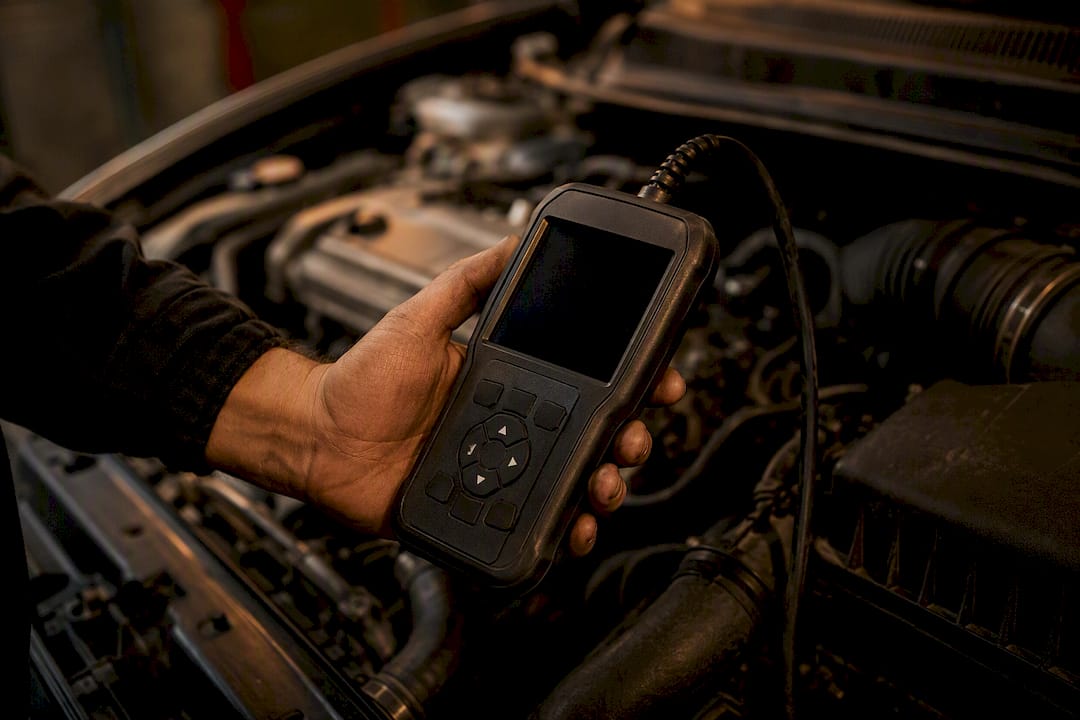
The gap shows up most clearly on ambiguous problems. A traditional approach might require multiple visits to isolate an intermittent electrical fault, since the technician can only test what’s happening in front of them. An AI system with access to your historical sensor data and known TSBs for your model can flag a pattern across weeks of readings that a single shop visit would never capture. The tradeoff runs the other way for anything requiring physical inspection, like a suspension noise. No app can put its hands on a wheel and check for play. The two methods aren’t competitors so much as complements: AI narrows the search, and a shop does the hands-on verification traditional diagnostics has always required.
Does AI Car Maintenance Actually Save You Money?
The savings show up in three places: fewer diagnostic fees, less unnecessary work, and earlier catches on developing problems. A shop visit purely to identify a check-engine code often costs money before a single part gets replaced. Walking in with an AI-narrowed diagnosis can reduce or eliminate that fee entirely at shops willing to work from your findings.
The unnecessary-work savings are less visible but arguably bigger over time. Service upsells, the “you should really replace this while we’re in there” conversation, are easier to evaluate when you have your own maintenance history and a second, AI-generated opinion on whether a part is actually due. That’s not about distrusting your mechanic; it’s about walking in informed instead of guessing.
The biggest financial upside is prevention. Catching a failing water pump through a trend in temperature readings, rather than after it strands you on the highway, is the difference between a routine repair bill and a tow plus a rental car plus a much bigger repair bill. With more than 200,000 auto repair and maintenance shops operating across the country, pricing and quality vary enormously, and an AI-informed owner is simply better equipped to know when a quote sounds reasonable. None of this replaces budgeting for routine maintenance. It just shifts spending from emergency repairs toward planned ones, which is almost always cheaper.
The Real Value Is in the Data, Not the Chatbot
The industry loves to talk about AI car maintenance as if the breakthrough is the chatbot interface. It isn’t. The breakthrough, where there is one, is in getting messy vehicle data into a shape a model can actually reason over. A chat window answering questions from a well-grounded knowledge base is useful. The same chat window improvising from a vague prompt with no service history behind it is a liability wearing a helpful tone.
Conventional advice tells owners to “just ask the AI” about a check-engine light, full stop. That undersells the setup work that makes the answer trustworthy: clean records, real telemetry, and a system that shows its sources instead of asserting conclusions. Owners who treat AI tools as an oracle get burned eventually, usually on a diagnosis that sounded confident and wasn’t grounded in their actual vehicle’s history.
Prioritize the boring part first. Get your service records digitized and your VIN-specific data connected before you worry about which app has the flashiest interface. The recommendation quality follows the data quality, every time, with no exceptions worth betting a repair bill on.
— Chally
Get Vehicle-Specific AI Recommendations With Carjourney
Carjourney is the alternative to guessing your way through maintenance decisions with generic mileage charts or a folder of loose receipts. It suits owners who actually want to know their vehicle, not just drive it: enthusiasts tracking modifications, daily drivers who want to stop overpaying for services they don’t need, and anyone tired of losing paperwork right when a warranty claim or resale conversation needs it.
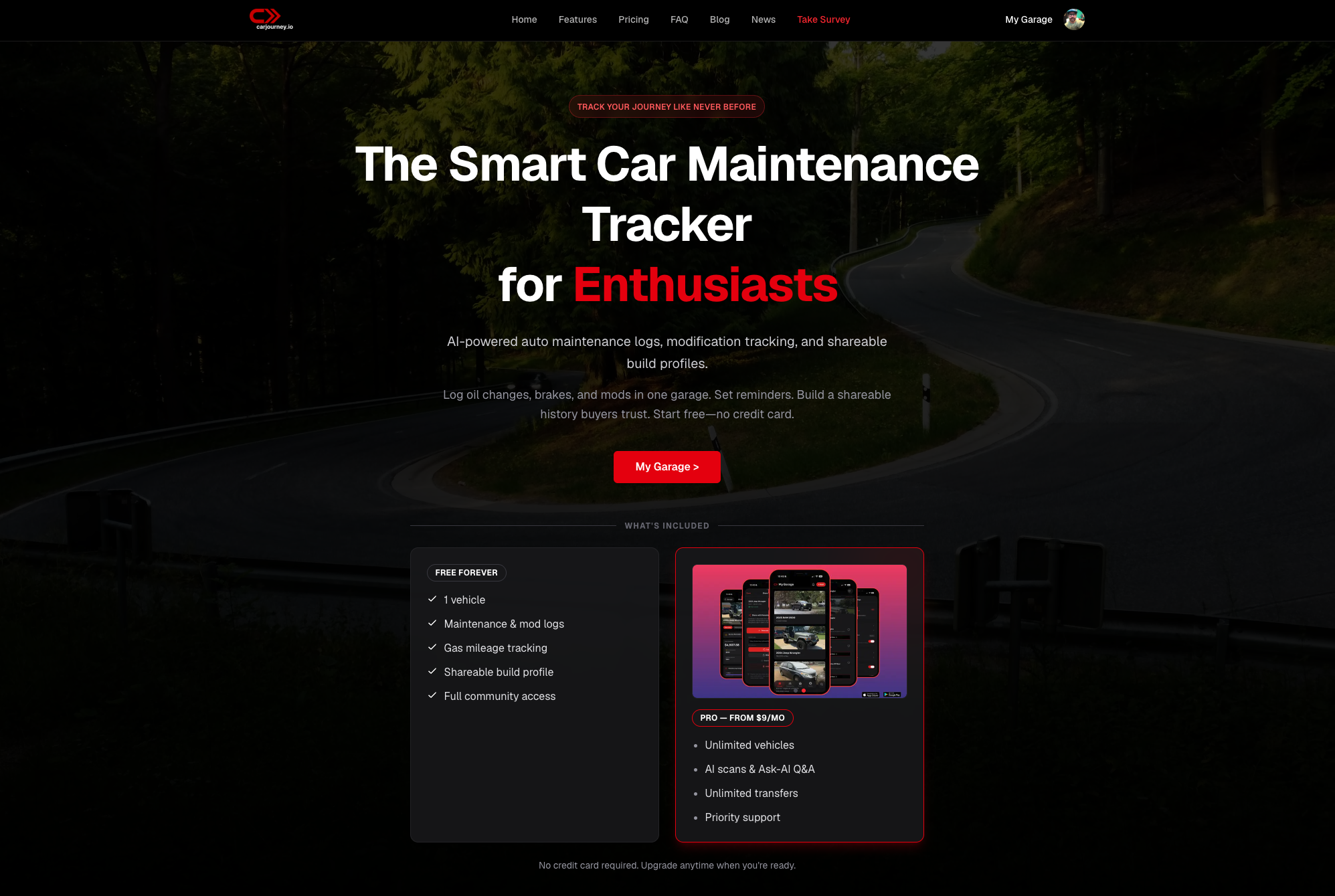
If this article convinced you that data quality drives diagnostic accuracy, that’s exactly the gap Carjourney was built to close. Scan your service documents, get maintenance schedules built around your exact make and model, and tap into a community of owners solving the same problems on the same builds. If you’re dealing with drivetrain-specific service questions, pairing your Carjourney records with a resource like this AWD system service guide rounds out the picture for all-wheel-drive owners. Start a free account at Carjourney and get your first vehicle-specific recommendation before your next oil change is due.
Sources
- Deployed AI Agents for Industrial Asset Management: CodeReAct Framework for Event Analysis and Work Order Automation
- Use generative AI in Amazon Bedrock for enhanced recommendation generation in equipment maintenance
- Number of auto repair and maintenance shops in the United States