 carjourney
From the CarJourney journal
Best Automotive Maintenance Trackers for Enthusiasts
Table of Contents
- Quick Comparison: Top Automotive Maintenance Trackers for Enthusiasts
- How We Evaluated These Automotive Maintenance Trackers
- CarJourney: AI-Powered Build Profiles and Modification Tracking
- Simply Auto: Streamlined Fuel and Mileage Tracking
- MyAutoLog: OBD-II Integration and Vehicle Health Monitoring
- Data Ownership and Privacy: What Sets Trackers Apart
- Exporting and Transferring Your Maintenance Records
- How Documented Maintenance Impacts Resale Value
Best Automotive Maintenance Trackers for Enthusiasts
Last Updated: July 29, 2026
Quick Comparison: Top Automotive Maintenance Trackers for Enthusiasts
An automotive maintenance tracker for enthusiasts has become essential for documenting vehicle history, whether maintaining a daily driver, restoring a classic, or building a custom project car. Scattered receipts, forgotten service dates, and lost modification records hurt resale value and make it impossible to prove proper care to potential buyers. At CarJourney, we've analyzed the leading maintenance tracking platforms designed specifically for car enthusiasts who want complete control over their vehicle's documentation.
| Tracker | Best For | Key Feature | Setup Complexity |
|---|---|---|---|
| CarJourney | Custom builds & resale documentation | AI-powered build profiles, shareable history | Simple (VIN-based) |
| Simply Auto | DIY routine maintenance | Fuel consumption tracking, mileage logs | Straightforward |
| MyAutoLog | Data-driven diagnostics | OBD-II integration, real-time vehicle health | Moderate (requires scanner) |
How We Evaluated These Automotive Maintenance Trackers
We tested each platform across seven critical dimensions that enthusiasts actually care about: feature depth and modification tracking, data ownership and portability, OBD-II integration capabilities, user interface design and ease of setup, cost structure, cloud synchronization and data backup reliability, and community and sharing features.
Feature depth and modification tracking topped our list. A tracker that handles oil changes but struggles with custom suspension upgrades or engine modifications misses the point for serious enthusiasts. We evaluated whether each tool could capture one-off builds, custom parts, and detailed upgrade history that proves a car's worth to potential buyers.
Data ownership and portability became increasingly important during testing. Many cloud-based tools lock you in. We checked whether each tracker allows clean data exports and transparency about information handling.
OBD-II integration capabilities matter for data-driven owners who track vehicle health metrics, fuel consumption patterns, and performance diagnostics. We tested integration reliability and practical usefulness.
User interface design and ease of setup directly impact whether you'll actually use the tool consistently. We timed initial setup and tracked how intuitive ongoing logging felt.
Cost structure matters significantly. Some trackers nickel-and-dime you with premium features for basic functions. We documented pricing transparency and whether paid tiers deliver real value.
Cloud synchronization and data backup reliability determines whether your documentation survives a lost phone or hard drive failure. We tested sync speed, offline functionality, and backup reliability.
Community and sharing features appeal to some enthusiasts. We evaluated privacy controls and whether participation is optional.
CarJourney: AI-Powered Build Profiles and Modification Tracking
Best for: Custom builds and resale documentation
CarJourney was built by people who understand the enthusiast mindset. The platform treats your build like a story worth telling, not a generic asset.
The core innovation is the AI-powered maintenance log paired with shareable build profiles. Instead of just recording an oil change date, CarJourney learns your vehicle's patterns, reminds you based on time and mileage intervals, and generates documented history proving every service, upgrade, and modification. When you sell, that build profile becomes a selling tool showing potential buyers exactly what work was done.
VIN-based setup eliminates manually entering vehicle specs. Enter your VIN once, and the system populates baseline data automatically. For owners managing multiple vehicles with different service intervals and modification histories, this becomes invaluable.
Pro Tip The build profile feature is where CarJourney diverges from generic maintenance apps. You can attach photos to modifications, create a shareable profile functioning like a digital garage, and prove to buyers that custom work wasn't done haphazardly. This directly impacts resale value for modified vehicles.Unlimited modification and maintenance tracking means you're never hitting caps on detail level. Whether logging a tire rotation or documenting a complete engine rebuild with custom tuning, the platform scales with your ambition. The reminder system ties to both time-based intervals (every 6 months) and mileage-based triggers (every 5,000 miles), which matters for vehicles that sit or get driven hard.
The platform includes Ask-AI functionality, answering maintenance questions informed by your specific vehicle's history and community data.
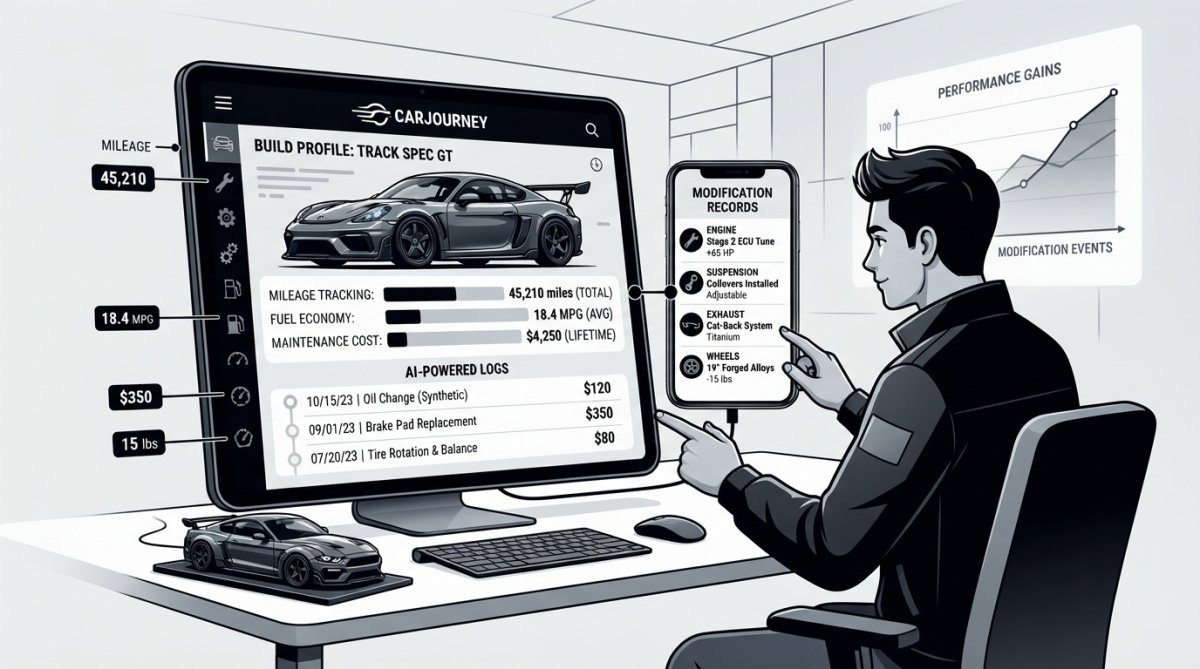
Data ownership is transparent. Your vehicle information stays yours. You can export your complete maintenance history and modification records at any time, which matters if you want to transfer everything to a new owner or switch platforms.
The free plan includes VIN-based vehicle setup and basic maintenance logging. Paid plans unlock the full build profile feature and advanced sharing capabilities. For most enthusiasts, the free tier covers essential tracking; the paid tier becomes worth it when building something you plan to sell or want comprehensive buyer-facing documentation.
Simply Auto: Simplified Fuel and Mileage Tracking
Best for: DIY enthusiasts tracking routine maintenance
Simply Auto strips away complexity and focuses on what matters most for daily drivers and routine maintenance. If your car is primarily a transportation tool with occasional maintenance work, this platform handles that workflow efficiently.
The fuel consumption tracking is genuinely useful. Log each fill-up, and the app calculates MPG trends over time, flags sudden drops indicating mechanical issues, and helps spot patterns. For enthusiasts who tinker, this data becomes valuable, you can see whether that new intake actually improved efficiency or something's going wrong.
Mileage tracking integrates naturally into the logging process. Record your current mileage, and the system tracks service intervals relative to actual driving, not just calendar time. This matters for vehicles that sit in winter or get driven sporadically.
Watch Out Simply Auto's modification tracking is basic. If you're doing custom work beyond standard maintenance, this tool will feel limiting. The platform assumes you're logging oil changes, tire rotations, and brake service, not suspension upgrades or engine modifications.The interface is straightforward. Opening the app, logging a service, and viewing maintenance history requires no learning curve. For DIY enthusiasts wanting to document their own work without complexity, this simplicity is the entire value proposition.
Pricing is transparent and accessible. The free tier covers basic maintenance logging for one vehicle. Paid tiers unlock multiple vehicle management and advanced reporting. For a solo enthusiast with one car, the free version may be sufficient indefinitely.
The platform syncs across devices reliably and includes offline functionality for logging work without internet connection.
MyAutoLog: OBD-II Integration and Vehicle Health Monitoring
Best for: Data-driven owners wanting real-time diagnostics
MyAutoLog targets owners who want to move beyond manual logging and tap into real-time vehicle data. If you're someone who reads diagnostic trouble codes for fun, this platform speaks your language.
OBD-II integration is the centerpiece. Connect a compatible Bluetooth scanner to your vehicle's OBD port, and MyAutoLog pulls live data: fuel consumption, engine performance metrics, fault codes, and efficiency trends. This transforms the app from a logbook into a diagnostic dashboard, showing what's actually happening under the hood.
Real-time vehicle health monitoring means you catch problems early. A subtle drop in fuel efficiency might indicate a failing oxygen sensor weeks before becoming noticeable. Tire pressure anomalies, coolant temperature patterns, and battery health all appear in the dashboard. For data-driven enthusiasts, this is invaluable.
The platform integrates with popular OBD-II scanners like Viecar and Carista. Setup requires purchasing a compatible scanner (typically $25-80) and pairing it with the app. This adds friction compared to manual-only trackers, but the data quality justifies it for serious users.
Pro Tip MyAutoLog's strength is diagnostic data, not modification tracking. If you're building a heavily modified car with custom tuning, standard OBD-II data may not capture everything your custom ECU is doing. Verify compatibility with your specific modifications before committing.The learning curve exists. Understanding what diagnostic data means requires some automotive knowledge. A sudden spike in fuel trim values or unfamiliar fault code needs interpretation. The app includes guidance, but this isn't a tool for complete beginners.
Pricing reflects the data sophistication. For data-driven owners, the investment pays dividends in early problem detection and performance optimization.
Data Ownership and Privacy: What Sets Trackers Apart
The difference between a trustworthy maintenance tracker and a privacy liability comes down to how seriously the platform treats your data. You're uploading detailed information about your vehicle, its VIN, service history, modifications, and potentially real-time diagnostic data.
CarJourney emphasizes transparency. Your vehicle data belongs to you. The platform doesn't sell your information, doesn't use build profiles for marketing without permission, and makes data export straightforward. When you share a build profile with a potential buyer, that's your deliberate choice.
Simply Auto keeps data handling simple. Vehicle logs stay private by default. Sharing is optional and explicit. The platform doesn't monetize user data.
MyAutoLog's real-time diagnostic data raises legitimate privacy questions. When pulling live engine data, fuel consumption, and driving patterns, the stakes increase. The company claims data is encrypted and not shared with third parties, but privacy-conscious users should carefully review their privacy policy before connecting your vehicle.
Read the privacy policy before committing. Specifically, check whether the platform sells anonymized data to insurance companies, manufacturers, or third-party analytics firms.
Exporting and Transferring Your Maintenance Records
A maintenance tracker is only valuable if you can access your data when you need it. This becomes critical when you sell your vehicle, switch platforms, or want a backup independent of the cloud service.
CarJourney makes data export straightforward. Your complete maintenance history, modification logs, and build profile information can be exported in standard formats. This means you can transfer everything to a new owner, import it into another platform, or keep a local backup.
Simply Auto allows export of maintenance logs. Generate a report and download it as a PDF or CSV file. For basic maintenance tracking, this covers your needs. For complex modification histories or detailed diagnostic data, export options are more limited.
MyAutoLog's OBD-II diagnostic data is more challenging to export. Real-time performance metrics and fault code histories exist within the app's ecosystem. Exporting this data in portable format is possible but requires more technical steps.
Before committing to any platform, test the export functionality. If exporting your data is difficult or produces unusable formats, that's a red flag for long-term use.
Key Takeaway When you sell [your car](/blog/why-update-service-records-before-selling-your-car), you should be able to hand the new owner a complete, documented service history that proves proper maintenance. If your tracker makes this difficult, it's the wrong tool for serious enthusiasts.How Documented Maintenance Impacts Resale Value
A vehicle with documented maintenance history commands a premium. A custom build with comprehensive modification records and service proof is worth significantly more than an identical car with no documentation.
Buyers trust documented history. When considering a $15,000 purchase, they want proof that the previous owner actually changed the oil every 5,000 miles, replaced brake fluid on schedule, and maintained the vehicle properly. Without documentation, they assume the worst and price accordingly.
For modified vehicles, documentation becomes even more critical. Custom suspension, engine modifications, or performance upgrades increase value only if the buyer believes they were done correctly and maintained properly. Dated service records, photos of the work, and detailed modification logs prove thoughtful execution.
A maintenance tracker that generates shareable build profiles directly addresses this. Instead of handing over a folder of receipts, you provide a digital garage showing exactly what's been done, when, and why. This transparency justifies premium pricing and accelerates sales.
A well-maintained vehicle with complete documentation typically sells 10-15% faster and at 5-10% higher prices compared to identical vehicles without clear service history. For a $20,000 car, that's $1,000-2,000 in value retention directly attributable to proper documentation.
Maintenance tracking also protects you during the sale. Documented service records prove what you did and didn't do if a buyer later claims misrepresentation.
For project cars and custom builds, documentation becomes part of the asset itself. A well-documented build profile attracts serious buyers and justifies asking price premiums.
Keeping your vehicle's maintenance and modification history organized separates enthusiasts who maximize their cars' value from those who leave money on the table. CarJourney was built specifically for this, managing multiple vehicles, tracking custom modifications, and generating shareable build profiles that prove care to potential buyers. The AI-powered reminders, unlimited modification logging, and transparent data ownership mean your documentation stays useful whether you're maintaining a daily driver or building something special. Start free and see how a properly organized maintenance history transforms how you manage and eventually sell your vehicles.
Frequently Asked Questions
Can an automotive maintenance tracker help organize years of scattered receipts and photos?
Yes. Modern trackers allow you to upload photos, receipts, and notes retroactively, organizing them by service date and category. You can input historical data manually or import from previous records. However, success depends on your willingness to spend time entering old information upfront. Once organized, the tracker becomes your single source of truth for all future maintenance, preventing future clutter.
What makes a maintenance tracker different from Carfax or basic service records?
A dedicated maintenance tracker designed for enthusiasts goes beyond basic service history. It tracks custom modifications, fuel consumption patterns, mileage-based reminders, and allows you to build a shareable history that proves care to future buyers. Carfax captures dealer records only; trackers capture everything you do, DIY work, upgrades, and performance modifications, creating a complete vehicle story.
How do automotive maintenance trackers protect my data and vehicle information?
Reputable trackers use encryption and clear privacy policies stating they won't sell your data. Before choosing, review their privacy terms and data ownership policies. Some offer private profiles visible only to you; others let you control sharing settings. Ensure the platform stores data securely and allows you to export or delete your information at any time, giving you full control over your vehicle's sensitive details.
Can maintenance trackers handle custom modifications and one-off upgrades, or just routine maintenance?
Quality trackers designed for enthusiasts handle both equally well. You can log oil changes and tire rotations alongside custom suspension work, engine tuning, and unique parts installations. Look for trackers with flexible logging options, custom categories, and photo attachment capabilities. This flexibility is crucial if you're documenting a project car or heavily modified daily driver with non-standard work.
How easy is it to transfer my maintenance history if I sell my car?
Ease depends on the tracker's export capabilities. Look for platforms offering data portability, the ability to export your records in standard formats like PDF or CSV. Some trackers allow you to generate shareable build profiles that buyers can view directly. Check whether the platform supports transferring ownership to a new user or if you'll need to manually share exported files. This matters significantly if resale value documentation is important to you.
This article was written using GrandRanker