 carjourney
From the CarJourney journal
Track Fuel Efficiency for Daily Drivers: A 2026 Guide
Table of Contents
- Why Track Fuel Efficiency for Your Daily Driver
- How to Calculate MPG Manually
- Best Gas Mileage Tracker Apps and Tools
- Tips to Improve Fuel Efficiency and Reduce Costs
- Organizing Your Fuel Data and Building a Service History
- Conclusion
Last Updated: August 6, 2026
Why Track Fuel Efficiency for Your Daily Driver
Tracking fuel efficiency transforms how you understand your vehicle's performance and operating costs. When you monitor MPG and fuel consumption patterns, you gain visibility into what's actually happening with your car, not what you assume is happening. Many drivers find that once they start logging data, they discover unexpected consumption spikes tied to specific driving habits, maintenance issues, or seasonal changes.
For daily drivers especially, fuel efficiency tracking serves multiple purposes. It helps you catch maintenance problems early (a sudden drop in MPG often signals tire pressure loss, engine issues, or fuel system problems). It documents your vehicle's service history, which becomes invaluable if you're preparing to sell. And it creates a baseline for measuring the impact of modifications, maintenance, or driving behavior changes.
CarJourney simplifies this process by consolidating fuel logs alongside maintenance records in one organized digital garage. Instead of scattered receipts and mental notes, you build a verifiable history that buyers trust and that helps you stay proactive about vehicle care.
The practical benefit is straightforward: drivers who track fuel efficiency typically spend less on fuel over time because they identify and fix inefficiencies before they become expensive problems.
How to Calculate MPG Manually
The most direct way to calculate MPG is the fill-to-fill method, which requires only an odometer reading and fuel pump data. This approach gives you an accurate snapshot of your vehicle's real-world efficiency over a specific driving period.
Step-by-Step Manual Calculation Process
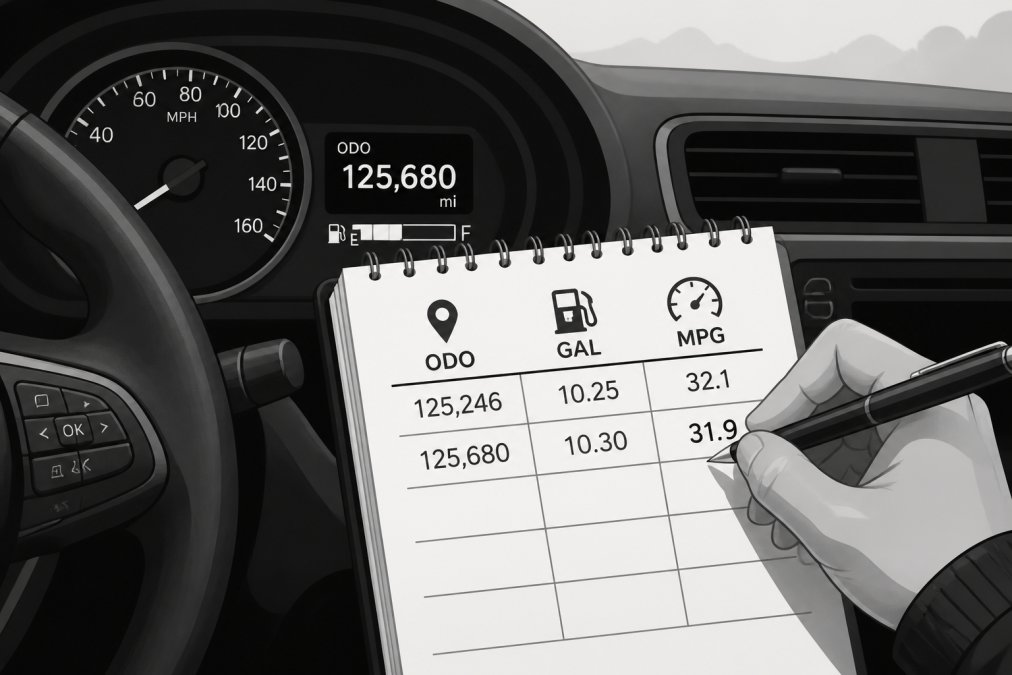
The calculation itself takes less than a minute once you have the numbers. Start by filling your tank completely at the pump. Note the odometer reading at that exact moment, record it in a notebook, phone, or fuel tracking app. Drive normally for several days or weeks until you're ready to refuel.
When you return to the pump for your next fill-up, fill the tank completely again and immediately record the new odometer reading. Subtract your first odometer reading from the second reading to get total miles driven. Then divide those miles by the number of gallons needed to refill the tank. The result is your MPG for that period.
Example: You fill up at 45,200 miles and record it. Two weeks later, you fill up again at 45,680 miles. You pump 15 gallons to reach full. The calculation: (45,680 - 45,200) ÷ 15 = 480 ÷ 15 = 32 MPG.
Record this data consistently. Monthly calculations give you a reliable trend line. Many drivers maintain a simple spreadsheet or use a fuel tracking app to build a historical record. Over time, you'll see seasonal variations (winter driving typically shows lower MPG due to cold engine operation and denser air), maintenance impacts, and driving habit effects.
Common Mistakes When Calculating Fuel Economy
The most frequent error is topping off the tank inconsistently. If you fill to the brim on the first fill-up but only partially on the second, your gallon count will be inaccurate. Always use the same fill-to-fill method, either top off completely each time or use the pump's automatic shutoff consistently.
Another mistake is recording the odometer reading at the wrong moment. Record it immediately after the pump stops, not minutes later. Waiting introduces driving miles that don't belong to that fuel purchase.
Some drivers skip the first fill-up, thinking they can use their previous tank's endpoint. This creates a gap in your data and makes calculations unreliable. Always start fresh with a complete fill and a clear odometer snapshot.
Temperature and fuel grade changes can also skew short-term calculations. A single tank of premium fuel or one cold-weather drive might show different MPG than your normal pattern. This is why tracking over multiple fill-ups (at least 3-5 tanks) reveals your actual efficiency rather than one-off anomalies.
Best Gas Mileage Tracker Apps and Tools
Modern fuel tracking splits into two categories: mobile apps that rely on manual data entry and hardware devices that capture data automatically through your vehicle's onboard diagnostic system.
Mobile Apps for Real-Time Fuel Monitoring
Mobile apps offer simplicity and cost-effectiveness. Most popular options allow you to log fuel purchases, track MPG calculations automatically, and build a history of your efficiency over time. These apps typically cost nothing or a modest subscription fee, making them accessible for any driver.
Common features include automatic MPG calculation once you enter odometer and gallon data, expense tracking that shows cost per mile, trip logging that ties fuel consumption to specific routes, and visual charts that reveal trends. Many apps also send reminders when your vehicle is due for routine maintenance based on mileage intervals.
The main limitation is that they depend on your discipline to log data consistently. If you forget to record a fill-up or mistype numbers, your trend data becomes incomplete. However, for drivers willing to spend 30 seconds per fuel stop, apps provide excellent visibility into efficiency patterns.
CarJourney integrates fuel logging directly into your vehicle's maintenance history, eliminating the need to switch between separate apps. You track fuel consumption alongside oil changes, tire rotations, and modifications in one organized digital garage. This consolidated approach means your fuel data connects to maintenance events, so when you notice an MPG drop, you can immediately check whether it coincides with a service interval being due.
OBD-II Devices for Automated Data Logging
OBD-II (On-Board Diagnostics) devices connect to your vehicle's diagnostic port and capture real-time engine data without manual input. These devices range from simple plug-and-play hardware to more sophisticated systems that communicate with smartphone apps.
The advantage of OBD-II monitoring is automation. The device continuously logs fuel consumption, engine efficiency, idle time, and driving patterns. You don't record anything manually, the data flows directly from your vehicle's computer to your phone or cloud account. This real-time visibility lets you see efficiency metrics instantly rather than waiting until your next fill-up.
OBD-II devices excel at identifying specific inefficiencies. They show idle time (which burns fuel without moving), acceleration patterns, and engine load data. If your vehicle idles for 5 minutes at every traffic light, the device will quantify that waste. If aggressive acceleration spikes fuel consumption, you'll see it in real-time.
The trade-off is cost and complexity. OBD-II hardware typically ranges from budget options to premium devices, and they require smartphone compatibility and app setup. For drivers who want hands-off tracking and detailed diagnostic insights, the investment pays off. For occasional drivers or those focused on basic MPG awareness, manual tracking or a simple app may suffice.
Tips to Improve Fuel Efficiency and Reduce Costs
Fuel efficiency improvements fall into two categories: driving behavior changes and vehicle maintenance. Both directly impact your MPG, and both are measurable through consistent tracking.
Eco-Driving Techniques That Lower Fuel Consumption
Smooth acceleration and gradual deceleration reduce fuel consumption significantly compared to aggressive driving. Rapid acceleration forces your engine to work harder and burn more fuel. Gentle, steady acceleration uses less fuel while still reaching your destination at the same time.
Maintaining steady highway speeds also matters. Driving at 55 mph typically uses less fuel than 70 mph because aerodynamic drag increases dramatically at higher speeds. On a long highway drive, dropping your speed by 10 mph can improve fuel economy by 10-15%.
Idling is pure waste. Modern engines consume fuel while stationary. If you're waiting in a drive-through line or at a railroad crossing for more than 30 seconds, turning off the engine saves fuel. Some vehicles have automatic stop-start systems that do this automatically.
Route planning reduces unnecessary mileage. Combining errands into one trip instead of multiple short trips uses less fuel overall. Short trips are particularly inefficient because engines consume more fuel when cold. One consolidated drive with a warm engine beats three separate cold-start trips.
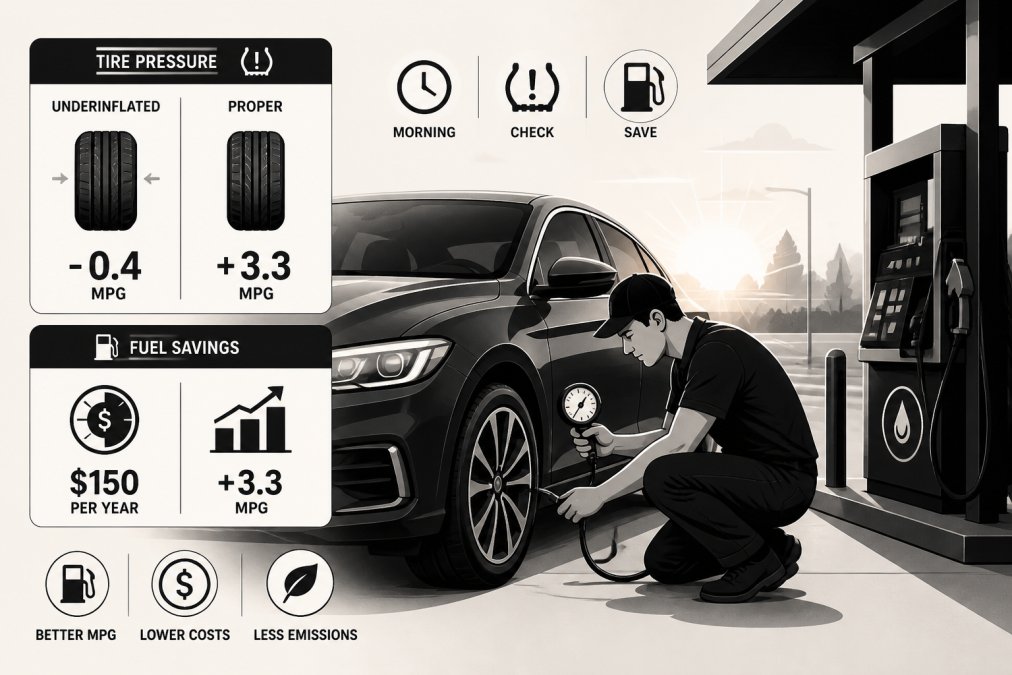
Tire pressure directly affects rolling resistance. Under-inflated tires increase friction and force your engine to work harder. Checking tire pressure monthly and maintaining the manufacturer's recommended PSI (found on a sticker inside your driver's door) can improve efficiency by 3-5%. This is one of the easiest wins available.
Vehicle Maintenance and Tire Pressure Impact
Regular engine maintenance directly supports fuel efficiency. A clean air filter allows your engine to breathe properly. A dirty filter forces the engine to work harder, burning more fuel. Replacing an air filter is inexpensive and typically improves efficiency by 1-3%.
Fuel system cleanliness matters too. Over time, fuel injectors accumulate deposits that affect spray pattern and combustion efficiency. A fuel system cleaning service can restore efficiency, though it's not needed frequently, typically every 50,000 miles or when you notice efficiency decline.
Wheel alignment affects rolling resistance. If your wheels aren't properly aligned, your tires drag slightly, increasing friction and fuel consumption. An alignment check during routine service ensures your vehicle rolls straight without resistance.
Synthetic motor oil reduces friction in your engine compared to conventional oil. Some drivers report modest efficiency improvements after switching to synthetic, though the effect varies by vehicle. The benefit is typically 1-2%, but synthetic oil offers other advantages like extended change intervals.
Tire choice influences efficiency. Low-rolling-resistance tires are designed to minimize friction. If you're replacing tires anyway, choosing a model rated for low rolling resistance can improve efficiency by 3-5% without affecting performance.
Organizing Your Fuel Data and Building a Service History
Fuel consumption data becomes most valuable when it's connected to your broader vehicle history. When you can see that your MPG dropped two weeks after a specific service, or improved after a tire rotation, you understand cause and effect.
Start by establishing a consistent logging method. Whether you use a simple spreadsheet, a mobile app, or a dedicated vehicle management platform, consistency matters more than complexity. Record the date, odometer reading, gallons pumped, and cost. Optional but useful: note driving conditions (highway vs. city), weather, or any vehicle work done recently.
Review your data monthly. Look for trends rather than single fill-ups. A single tank showing lower MPG might be normal variation. Two or three consecutive tanks showing a 3-5 MPG decline signals a problem worth investigating.
Connect fuel data to maintenance records. If your efficiency drops and you notice it's been 10,000 miles since your last oil change, or your tire pressure has drifted low, you've identified the likely cause. This connection is exactly what vehicle management systems like CarJourney enable, your fuel logs sit alongside maintenance records, so patterns become visible.
Build a timeline of significant events: new tires, engine service, filter replacements, and modifications. Over months, you'll see which changes actually improved efficiency and which had no measurable impact. This data-driven approach beats guessing.
When you're ready to sell your vehicle, this organized history becomes a powerful asset. Potential buyers see documented proof that you maintained the vehicle properly and tracked its performance responsibly. A complete fuel consumption record plus maintenance receipts demonstrates that the car was cared for, which justifies your asking price.
| Tracking Method | Setup Time | Ongoing Effort | Data Accuracy | Best For |
|---|---|---|---|---|
| Manual spreadsheet | 5 minutes | 1 minute per fill-up | High (if consistent) | Budget-conscious drivers |
| Mobile app | 10 minutes | 30 seconds per fill-up | High (if logged promptly) | Drivers wanting automatic calculations |
| OBD-II device | 20 minutes | Zero (automatic) | Very high (real-time) | Drivers wanting detailed diagnostics |
| CarJourney platform | 15 minutes | 30 seconds per fill-up | High (integrated with maintenance) | Drivers building complete vehicle history |
Tracking fuel efficiency for your daily driver reveals inefficiencies before they become expensive problems. Whether you calculate MPG manually, use a mobile app, or invest in OBD-II hardware, the key is consistency. CarJourney consolidates your fuel logs alongside maintenance records in one digital garage, so you see the complete picture of how your vehicle performs and what impacts efficiency. Start free and build a documented history that protects your investment and proves vehicle care to future buyers.
Frequently Asked Questions
How do I manually calculate my MPG?
Fill your fuel tank completely and note the odometer reading. Drive normally until your next fill-up, then record the new odometer reading. Divide the miles driven by the gallons needed to refill the tank. For example, if you drove 300 miles and used 10 gallons, your MPG is 30. Repeat this process over several fill-ups to get an accurate average, as a single calculation may not reflect typical driving patterns.
What's the best gas mileage tracker app for daily drivers?
The best app depends on your needs. Mobile apps offer real-time fuel monitoring and automatic data logging through your smartphone, while OBD-II devices provide detailed vehicle performance metrics. Look for apps that integrate with your vehicle's trip computer, sync across devices, and include cost-per-mile analysis. CarJourney, for example, combines fuel tracking with comprehensive maintenance logging, letting you document both fuel consumption and service history in one place.
Does tracking fuel efficiency actually save money?
Yes. Tracking reveals inefficient driving habits, maintenance issues like low tire pressure, and helps you identify when vehicle performance changes. Studies show drivers who monitor fuel consumption reduce it by 5-15% through behavioral adjustments alone. Combined with proper maintenance scheduling and eco-driving techniques, documented tracking typically pays for itself within weeks through reduced fuel costs and prevented expensive repairs.
What driving habits drain gas the most?
Excessive idling, rapid acceleration, speeding, and aggressive braking significantly increase fuel consumption. Tire pressure below manufacturer recommendations increases rolling resistance and fuel use. Carrying unnecessary weight and roof racks create aerodynamic drag. Short trips without allowing the engine to reach operating temperature waste fuel. Real-time monitoring through apps or OBD-II devices helps you identify these patterns and adjust habits immediately for measurable savings.
Start freeThis article was written using GrandRanker