 carjourney
From the CarJourney journal
Synthetic Oil Explained: What It Is and Why It Matters

Synthetic oil is a chemically engineered motor oil built from tailored base stocks and a precisely formulated additive package, designed to outperform conventional oil in temperature extremes, engine protection, and service life. AAA lab testing found that synthetic oils outperformed conventional oils by an average of 47% across multiple standardized tests. For most car owners, that gap shows up in three practical ways:
- Temperature stability: Synthetic oil flows reliably at cold starts and resists thermal breakdown at high operating temperatures, where conventional oil can thin out or oxidize.
- Engine protection: Its uniform molecular structure maintains a stronger oil film between metal surfaces, reducing wear on bearings, camshafts, and cylinder walls.
- Longer service life: Consumer Reports notes that synthetic oil can extend change intervals to long distances in many cases, compared to the 3,000–5,000-mile conventional standard.
If your owner’s manual specifies an API, ILSAC, or SAE viscosity grade, the oil you choose — synthetic or conventional — must meet that spec. A tool like Carjourney can store those specs and remind you when your next change is due, so you never have to guess.
Table of Contents
- What synthetic oil is actually made of
- Synthetic vs. conventional oil: a side-by-side look
- The real advantages of synthetic oil, and the honest drawbacks
- Full synthetic vs. synthetic blend vs. conventional: which type fits your car?
- How long does synthetic oil actually last?
- Can you switch from conventional to synthetic oil?
- When does synthetic oil make the most sense?
- How to pick the right oil for your specific car
- Key Takeaways
- Synthetic oil and the maintenance habit that actually protects your engine
- Keep your oil changes on track with Carjourney
- Authoritative sources for oil specifications
What synthetic oil is actually made of
Motor oil has two components: a base stock and an additive package. The base stock does the heavy lifting — it provides the lubricating film. The additives handle everything else: detergents that clean deposits, antioxidants that slow breakdown, viscosity modifiers that keep the oil from thinning too much when hot, and anti-wear agents that protect metal surfaces.
The American Petroleum Institute (API) classifies base stocks into five groups. Groups I and II are conventional mineral oils, refined from crude oil with limited processing. Group III is where things get interesting: these base stocks are produced by severe hydrocracking, a process that strips away most impurities and restructures the molecules to behave much more like a true synthetic. Group IV base stocks are polyalphaolefins (PAOs), built by chemically synthesizing molecules from scratch. Group V covers everything else — esters, polyalkylene glycols, and other specialty chemistries often blended in for specific performance properties.
The label “full synthetic” does not guarantee PAO chemistry. Following industry precedents and NAD rulings, many widely sold full synthetics are built on Group III base stocks rather than Group IV PAOs. Both can deliver excellent performance, but they differ chemically. When you see “full synthetic” on a bottle, you are buying a performance claim, not a specific molecular recipe.
Machinery Lubrication explains that the key advantage of synthetic base oils is molecular uniformity. Conventional mineral oil contains a mix of hydrocarbon chain lengths and structures, which means its viscosity and behavior are less predictable under stress. Synthetic base stocks, whether PAO or severely hydrocracked Group III, produce far more consistent molecules. That consistency translates directly into predictable viscosity, better shear stability, and lower volatility across a wider temperature range.

Synthetic vs. conventional oil: a side-by-side look
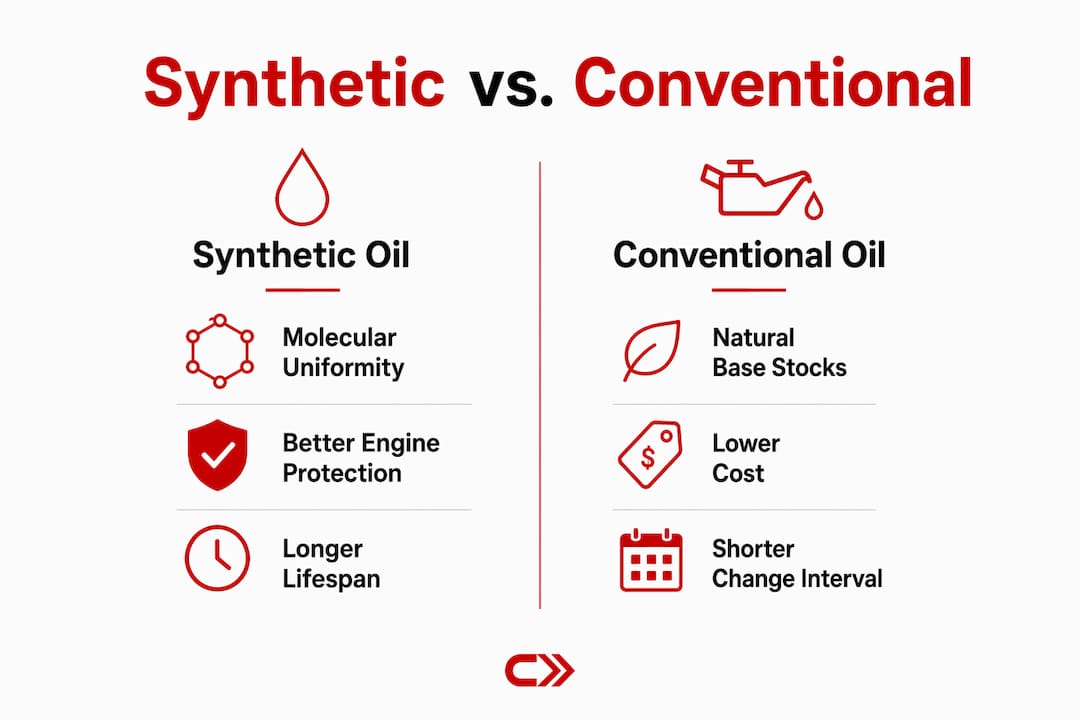
The performance gap between synthetic and conventional oil is real and measurable, but it plays out differently depending on which dimension you care about most.
| Dimension | Synthetic oil | Conventional oil | Practical takeaway |
|---|---|---|---|
| Engine protection / wear | Stronger oil film; uniform molecules maintain viscosity under stress | Adequate for low-stress engines; film breaks down faster under heat or high RPM | Choose synthetic for turbocharged, high-RPM, or tightly toleranced engines |
| Thermal stability / high-temp | Resists oxidation and breakdown at high temps; less sludge | Oxidizes faster; sludge risk rises with heat | Synthetic is the safer choice for stop-and-go or towing |
| Cold-start / low-temp flow | Flows quickly at sub-zero temps; reduces cold-start wear | Thickens more in cold; slower to reach critical surfaces | Synthetic matters most in cold climates |
| Volatility / oil consumption | Lower NOACK volatility; less oil burns off between changes | Higher volatility; more top-off needed | Synthetic keeps oil level more stable |
| Shear stability | Resists viscosity loss under mechanical shear | Viscosity modifiers can shear and thin the oil | Synthetic holds its grade longer |
| Typical change interval | Up to 10,000 miles or more (OEM-dependent) | 3,000–5,000 miles (traditional guidance) | Follow your owner’s manual, not a blanket rule |
| Seal / compatibility | Modern formulations compatible with common seal materials | Also compatible; some older seals may have adapted to conventional | Monitor for leaks when switching a high-mileage engine |
The AAA research that found the 47% performance advantage measured wear protection, deposit formation, and high-temperature performance — the three areas where the molecular differences matter most. The cost gap is real but narrower than it looks once you account for fewer changes per year.
Pro Tip: Look for the API donut on the back of the bottle. The top half shows the SAE viscosity grade (e.g., 5W-30). The center confirms API service category (e.g., SP for current gasoline engines). The ILSAC starburst on the front means the oil also meets fuel-economy and emissions standards. Match those marks to what your owner’s manual specifies — not just the viscosity.
The real advantages of synthetic oil, and the honest drawbacks
What synthetic oil does well
Synthetic oil’s advantages are most visible in demanding conditions, but they show up in everyday driving too:
- Better cold-start protection: Synthetic flows to engine surfaces faster at low temperatures, cutting the period when metal-on-metal contact is highest.
- Cleaner engine internals: Synthetic oil resists sludge and deposit formation, keeping oil passages and piston rings cleaner over time.
- Longer drain intervals: Fewer changes per year means less labor, less waste oil, and possibly lower long-term cost despite the higher per-quart price.
- Lower volatility: Less oil burns off between changes, so you top off less often and maintain a more consistent oil level.
- Stronger shear stability: The oil holds its viscosity grade longer under mechanical stress, which matters in high-RPM engines and transmissions.
Where synthetic oil falls short
- Higher upfront cost: A shop synthetic oil change costs more upfront compared to conventional oil changes, according to AAA survey data. DIY narrows that gap but doesn’t eliminate it.
- Marketing confusion: “Full synthetic” covers both PAO (Group IV) and Group III base stocks. You may pay a premium for a product that is chemically closer to a high-quality conventional than to a true PAO.
- Not always required: Many older, low-mileage engines running in mild climates on short trips do fine with conventional oil. Paying for synthetic when your OEM doesn’t require it is not harmful, but it may not be necessary.
Myth vs. fact
Myth: Switching to synthetic will cause your engine to leak. Fact: This fear comes from early synthetic formulations that were incompatible with some seal materials. Modern synthetics are generally compatible with the rubber seals used in engines built in the last few decades. The Mobil guidance on this is clear: cautious monitoring after switching a high-mileage or neglected engine is smart, but the risk of leaks from the oil chemistry itself is minimal with current formulations.
Myth: Once you go synthetic, you can never go back. Fact: Mixing or switching between synthetic and conventional is safe. You won’t damage seals or cause chemical reactions. The only downside is losing some of the performance benefits of full synthetic.
Full synthetic vs. synthetic blend vs. conventional: which type fits your car?
These three product categories cover most of what you’ll find on a shelf, and they’re not interchangeable for every driver.
- Full synthetic: Built entirely from synthetic base stocks (Group III, IV, or V) plus an additive package. Best for turbocharged engines, vehicles with tight manufacturing tolerances, extreme climates, and anyone running extended drain intervals. Consumer Reports notes that full synthetic is now the factory fill for a growing share of mainstream vehicles, not just performance cars.
- Synthetic blend: A mix of synthetic and conventional base stocks. Costs less than full synthetic while offering better protection than straight conventional. A reasonable choice for light trucks, SUVs under moderate loads, or drivers who want a step up from conventional without the full price jump. You can find a deeper look at different oil types on the Carjourney blog.
- Conventional: Refined directly from crude oil with minimal restructuring. Still appropriate for older engines with looser tolerances, low-mileage vehicles in mild climates, and budget-conscious owners whose OEM specs don’t require synthetic.
Is synthetic oil 100% synthetic? Not always. As covered in the composition section, most “full synthetic” products on the market use Group III base stocks produced by severe hydrocracking rather than chemically synthesized PAO. The performance is often comparable, but the chemistry is different. If true PAO matters to you, look for products that explicitly state Group IV base stocks on the technical data sheet.
How long does synthetic oil actually last?
The honest answer: it depends on your engine, your driving habits, and your climate. The 10,000-mile figure you see on synthetic oil bottles is a reasonable benchmark for many modern vehicles under normal conditions, but it’s not universal.
| Oil type | Typical interval | Extended-performance claims | Key caveat |
|---|---|---|---|
| Conventional | 3,000–5,000 miles | N/A | Traditional guidance; many modern OEMs allow longer |
| Synthetic blend | 5,000–7,500 miles | Some products claim up to 7,500 miles | Varies by formulation and OEM |
| Full synthetic | Up to 10,000 miles or more | Some formulations marketed up to 25,000 miles | OEM spec and driving conditions take precedence |
| Castrol notes that some extended-performance formulations advertise intervals as long as 25,000 miles, but those claims are product-specific and depend on using the matching filter and driving under the conditions the product was tested for. The factors that shorten any interval: |
- Turbocharged engines: Higher heat and pressure degrade oil faster.
- Frequent short trips: The engine never fully warms up, so moisture and fuel dilution accumulate in the oil.
- Extreme climates: Very cold or very hot ambient temperatures stress the oil more.
- Towing or hauling: Higher engine loads accelerate thermal breakdown.
- Older or high-mileage engines: More blow-by and contaminants enter the oil.
The safest rule: follow your owner’s manual interval, not the bottle. If your OEM says 7,500 miles with full synthetic, that’s your number. Extending beyond it to chase the marketed maximum is a gamble with your engine warranty and wear protection. A car oil change schedule guide can help you map the right interval for your specific vehicle.
Can you switch from conventional to synthetic oil?
Yes, and it’s generally straightforward. Modern synthetic formulations are chemically compatible with conventional oil and with the seal materials used in most engines built after the mid-1990s. You don’t need to flush the system or do anything special for the first change.
What to do when switching
- Check your owner’s manual first. If the OEM specifies a particular viscosity grade or API/ILSAC spec, match it. Don’t switch to a different viscosity just because you’re going synthetic.
- Use the correct spec. Switching from 5W-30 conventional to 5W-30 full synthetic that meets the same API category is a clean swap.
- Inspect for existing leaks before you switch. Synthetic oil’s detergent properties can loosen deposits that were sealing a minor leak. If the engine already has a slow seep, fix it first.
- Check the oil level after the first 500–1,000 miles. Not because synthetic causes leaks, but because any oil change is a good opportunity to confirm the drain plug and filter are sealed properly.
- Don’t panic if you see slightly darker oil faster. Synthetic’s cleaning properties can suspend existing deposits, which temporarily darkens the oil. That’s the oil doing its job.
Edge cases to watch
Very old engines (pre-1990s) or severely neglected engines with heavy sludge buildup deserve more caution. The cleaning action of synthetic oil can dislodge sludge deposits rapidly, potentially clogging oil passages. For these engines, some mechanics recommend a conventional oil change with a flush additive first, then switching to synthetic once the engine is cleaner. Understanding why proper oil changes matter is especially relevant here — neglected intervals make any switch riskier.
Mixing synthetic and conventional is safe if you need to top off between changes. You’ll dilute the synthetic’s performance properties slightly, but you won’t cause chemical damage.
When does synthetic oil make the most sense?
Not every car needs full synthetic, but for some engines and driving situations, it’s the clear choice. Work through this checklist:
- Turbocharged or supercharged engine. Forced-induction engines run hotter and at higher pressures than naturally aspirated ones. Synthetic’s thermal stability and film strength are not optional here — they’re what engine design trends have been moving toward for exactly this reason.
- Extreme cold climates. If you’re regularly starting a cold engine at 0°F or below, synthetic’s low-temperature flow properties reduce the critical seconds of metal-on-metal contact at startup.
- Extreme heat or frequent towing. High ambient temperatures and sustained heavy loads push oil temperatures well above normal operating range. Synthetic resists oxidation and viscosity breakdown far better under those conditions.
- Frequent short trips. Engines that never fully warm up accumulate moisture and fuel dilution in the oil faster. Synthetic’s chemical stability handles that contamination better than conventional.
- Long service intervals. If your OEM specifies 10,000-mile changes, conventional oil simply isn’t formulated to last that long reliably. Synthetic is the right tool for the interval.
- High-performance or track use. High RPM, sustained load, and elevated temperatures all favor synthetic’s shear stability and thermal resistance.
- Your owner’s manual requires it. Many modern vehicles from manufacturers including BMW, Mercedes-Benz, and GM specify full synthetic as the factory fill. If the manual says synthetic, use synthetic.
Three-step decision flow:
- Open your owner’s manual and find the oil specification (SAE viscosity + API/ILSAC category).
- Assess your driving conditions against the checklist above.
- Choose an oil that meets or exceeds the OEM spec — and if your conditions hit two or more items on that checklist, full synthetic is worth the price difference.
The oil change cost difference between synthetic and conventional narrows considerably when you factor in fewer changes per year and the reduced risk of wear-related repairs.
How to pick the right oil for your specific car
The owner’s manual is the single most authoritative source for oil selection. Everything else — bottle marketing, shop recommendations, forum advice — is secondary to what the manufacturer tested and specified for your engine.
Step-by-step
- Find your OEM spec. It’s in the owner’s manual under “engine oil” or on a sticker inside the oil filler cap. Look for an SAE viscosity grade (e.g., 5W-30) and an API or ILSAC category (e.g., API SP, ILSAC GF-6A).
- Understand the viscosity numbers. The first number (5W in 5W-30) is the cold-temperature rating — lower means better cold-start flow. The second number (30) is the high-temperature viscosity. Don’t substitute a different viscosity without OEM approval.
- Match the API/ILSAC category. The API donut on the back of the bottle shows the service category. The ILSAC starburst on the front confirms fuel-economy compliance. Some European vehicles require ACEA ratings instead — check the manual.
- Verify the oil meets or exceeds the spec. “Meets API SP” on a bottle means it passed the tests for that category. “Exceeds” means it passed higher-tier tests. Either is acceptable; neither is a reason to pay more than the spec requires.
- Follow OEM interval guidance. Per AAA research, the owner’s manual interval is the primary determinant — not the bottle’s marketed maximum, not the old 3,000-mile rule.
Pro Tip: Carjourney lets you store your vehicle’s exact OEM oil spec, scan service receipts with AI, and set interval reminders tied to your specific make and model. Instead of hunting through a glove box or relying on memory, your spec and service history are in one place.
Keeping your vehicle maintenance records organized also matters when it comes to warranty claims and resale value. A documented oil-change history with the correct spec on file is worth more than a verbal assurance.
Key Takeaways
Synthetic oil outperforms conventional oil by a significant margin in standardized lab tests, lasts significantly longer between changes, and is now the factory-specified choice for a growing share of modern vehicles.
| Point | Details |
|---|---|
| What synthetic oil is | A chemically engineered lubricant with uniform base stocks and additives that outperform conventional oil in heat, wear, and longevity. |
| Performance advantage | AAA lab tests found synthetics outperformed conventional oils by an average of 47% across standardized measures. |
| Longer intervals | Synthetic oil typically supports extended intervals; always defer to your owner’s manual over bottle claims. |
| When to choose synthetic | Turbocharged engines, extreme climates, towing, frequent short trips, and long OEM-specified intervals all favor full synthetic. |
| Carjourney for oil tracking | Carjourney stores your OEM oil spec, scans service documents, and sends interval reminders so the right oil change happens at the right time. |
Synthetic oil and the maintenance habit that actually protects your engine
The debate over synthetic vs. conventional oil tends to focus on chemistry, but the bigger variable is consistency. An engine running conventional oil changed every 4,000 miles will outlast one running synthetic that gets neglected to 15,000 miles. The oil type matters. The habit matters more.
What I find underappreciated in most synthetic oil coverage is the interval question. Manufacturers have been quietly extending OEM-specified intervals for years as synthetic formulations improve, and most drivers have no idea their manual now says 10,000 miles instead of 5,000. They’re either changing too early (wasting money) or ignoring the interval entirely (risking wear). Neither outcome has anything to do with whether the oil is synthetic.
The practical fix is simple: know your spec, set a reminder, and stick to it. A maintenance tracker removes the cognitive load entirely. Carjourney was built for exactly this — not to replace your mechanic, but to make sure you never lose track of what your car actually needs. For overall vehicle care, pairing a solid oil maintenance routine with a regular detailing schedule keeps both the engine and the exterior in better shape long-term.
The chemistry of synthetic oil is genuinely impressive. But the oil that’s in your engine right now, changed on schedule, is always better than the perfect oil you forgot to put in.
Keep your oil changes on track with Carjourney
Knowing what synthetic oil is and which spec your car needs is half the job. The other half is actually remembering to change it on time, with the right product, every time.

Carjourney is a free vehicle maintenance tracker built for car owners who want to stay ahead of service, not catch up after something goes wrong. Store your exact OEM oil spec, scan service receipts with AI so every change is logged automatically, and get reminders tied to your specific vehicle’s interval. Whether you’re running a turbocharged daily driver or a weekend project car, Carjourney keeps your service history clean and your next oil change on the calendar. Start tracking your vehicle free and stop relying on the sticker in the windshield.
Authoritative sources for oil specifications
When you need to verify specs, intervals, or product claims, go to primary sources rather than relying on bottle marketing or forum consensus.
- Your owner’s manual: The definitive source for SAE viscosity grade, API/ILSAC category, and OEM-specified interval. Check the index under “engine oil” or “lubrication.”
- AAA Engine Oil Research: Lab-tested performance comparison of synthetic vs. conventional across wear, deposits, and high-temperature stability. One of the most cited independent studies on the topic.
- Consumer Reports: Practical consumer guidance on synthetic oil, interval recommendations, and when synthetic makes financial sense.
- API (American Petroleum Institute): Sets the service category standards (SP, SN, etc.) that appear on oil bottles. The API website lists which categories are current and which are obsolete.
- SAE International: Defines the viscosity grading system (SAE J300). If you want to understand what 0W-20 vs. 5W-30 actually means in engineering terms, SAE publications are the primary source.
- OEM technical documentation: For vehicles with proprietary specs (BMW Longlife, Mercedes-Benz 229.5, VW 502.00, etc.), the manufacturer’s own technical documentation or dealer service portal lists approved products.
- Product TDS/MSDS sheets: The technical data sheet for any specific oil product lists its actual base-stock group, NOACK volatility, HTHS viscosity, and the specifications it meets. Available on the manufacturer’s website, usually under “product data.”