 carjourney
From the CarJourney journal
EV Maintenance Schedule: What to Check and When
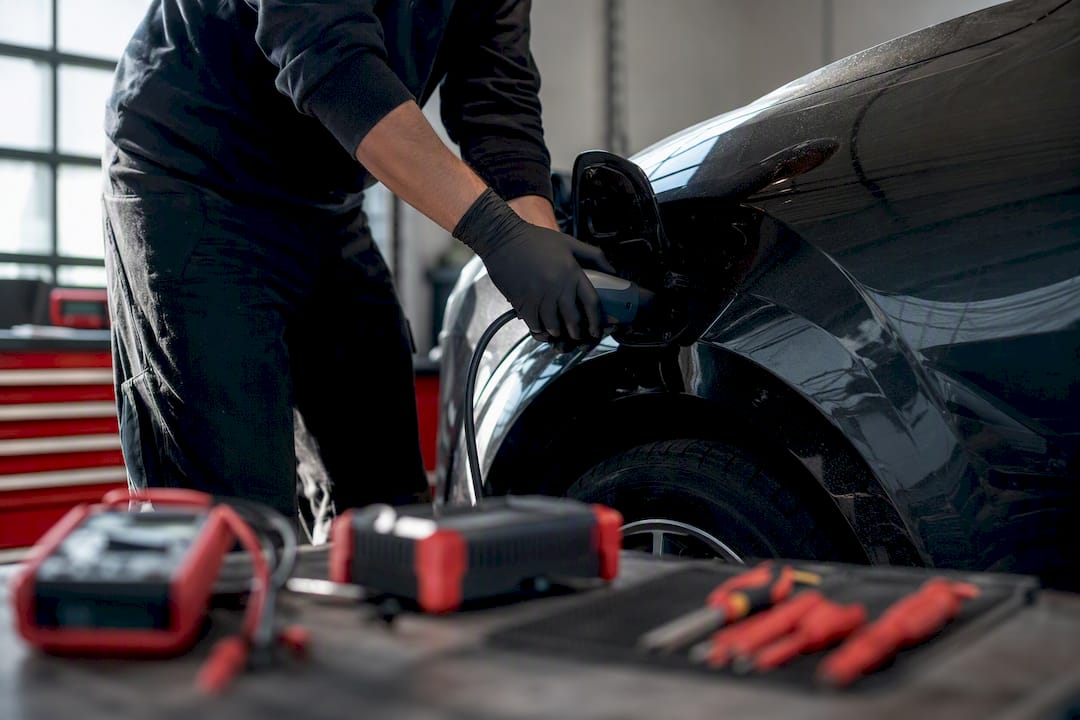
An EV maintenance schedule breaks down into four bands: monthly, every 6,000 to 7,500 miles, once a year or 10,000 to 15,000 miles, and every two to five years. Electric vehicles skip the oil changes, spark plugs, and timing belts that fill a gas car’s service history, but they still need scheduled attention to tires, brakes, filters, coolant, and the 12-volt system that quietly keeps everything running.
Here’s the quick version before we get into the why:
- Monthly: Check tire pressure, top off washer fluid, and glance at the dashboard for any active alerts.
- Every 6,000 to 7,500 miles (about every six months): Rotate the tires and eyeball the brakes and wipers.
- Annually or every 10,000 to 15,000 miles: Get a full multi-point inspection covering suspension, steering, brakes, and coolant, plus a cabin filter swap if it’s due.
- Every 2 to 4 years: Test and likely replace the brake fluid.
- Every 3 to 5 years: Service the battery coolant if your model uses it, replace the 12V battery, and swap the HVAC filter.
Most of these are quick, cheap tasks you can knock out yourself. The multi-year items belong on your calendar, not just in your memory.
Key Takeaways
A well-maintained EV depends on consistent tire, brake, and 12V system checks far more than on any battery-specific service, since those three areas cause the most preventable failures.
| Point | Details |
|---|---|
| Follow the four-tier schedule | Monthly checks, 6,000 to 7,500 mile tire rotations, annual/10,000 to 15,000 mile inspections, and 2 to 5 year fluid and filter services. |
| Charge in the moderate zone | Keep daily charging between roughly 20% and 80%, and save DC fast charging for trips, not routine use. |
| Watch calipers in salted climates | Have calipers cleaned and lubricated annually where roads are salted to prevent seizing behind low-wear regenerative brakes. |
| Don’t ignore the 12V battery | Test it annually after year four; a dead 12V battery can strand an otherwise healthy EV. |
| Personalize your schedule | Carjourney maps manufacturer intervals to your specific vehicle and sends reminders based on your real service history. |
Table of Contents
- EV Maintenance Schedule Timeline You Can Save or Print
- How Should You Manage Battery Charging and Coolant Service?
- Why Do EV Tires Wear Out Faster Than Gas Car Tires?
- Do EV Brakes Need Less Maintenance or Just Different Maintenance?
- What Fluids and Filters Still Need Regular Replacement?
- How Should You Adjust Charging for Longer Battery Life?
- How Do You Know When to Call a Professional?
- Should You Worry About Long-Term EV Storage?
- How Do Cold and Hot Weather Change Your Maintenance Routine?
- What Tells You an EV Needs New Tires Sooner Than Expected?
- What EV Owners Get Wrong About Maintenance
- Sources
EV Maintenance Schedule Timeline You Can Save or Print
The table below groups everything by frequency so you can match it against your own mileage and skip the guesswork.
| Frequency | Tasks | Who Handles It |
|---|---|---|
| Monthly | Tire pressure check, washer fluid top-off, dashboard/app alert review, visual walkaround | Owner |
| Every 6,000–7,500 miles (~6 months) | Tire rotation, visual brake inspection, wiper and light check | Owner or shop |
| Every 10,000–15,000 miles / annually | Multi-point inspection (suspension, steering, brake system), coolant check, cabin filter if due | Certified shop |
| Every 2–4 years | Brake fluid test and replacement | Certified shop |
| Every 3–5 years | Battery coolant service (where applicable), HVAC/HEPA filter, 12V battery test and likely replacement | Certified shop |
A few things shift this timeline. Owners in salted, snowy regions should push brake and caliper checks to an annual cadence regardless of mileage, since road salt accelerates corrosion. Hot, dusty climates tend to clog cabin filters faster, so don’t be surprised if yours needs replacing closer to the 12,000 mile mark than the 30,000 mile mark. Most manufacturers build a baseline inspection around 12 months or 10,000 miles, and that number is a reasonable default if your owner’s manual doesn’t spell out something more specific. For a broader look at how this compares to a traditional gas vehicle’s upkeep, Carjourney’s maintenance recommendations guide walks through the full inspection list system by system.
How Should You Manage Battery Charging and Coolant Service?
Your charging habits matter more than almost anything else you do to the car. Keeping the battery parked at 0% or 100% for extended stretches stresses the cells, so most owners are better off charging to somewhere in the 20% to 80% range for daily driving and saving a full charge for road trip days.
- Use Level 2 home or workplace charging for routine top-ups. It’s gentler on the pack than fast charging and costs less per mile.
- Reserve DC fast charging for trips, not habit. Frequent fast charging generates more heat cycling, which speeds up degradation over time.
- Check your owner’s manual for battery coolant service intervals. Some packs need periodic coolant checks or replacement; others are sealed for the vehicle’s life.
- Install software updates as soon as they’re available. Over-the-air patches frequently adjust battery management system behavior and can improve both range and longevity.
The Department of Energy notes that EVs sidestep most of the mechanical wear that shortens a gas engine’s life, but the tradeoff is that battery health now depends heavily on how you charge, not just how often you service the car.
Why Do EV Tires Wear Out Faster Than Gas Car Tires?
Electric vehicles are heavier than their gas counterparts, often by several hundred pounds because of the battery pack, and they deliver full torque the instant you press the accelerator. That combination puts more shear force on the tread than a comparable gas engine ever would, which is why EV owners tend to notice wear sooner if they’re not staying on top of rotations.
- Check tire pressure at least monthly and always before a long trip. Underinflated tires wear unevenly and cost you range.
- Rotate tires every 6,000 to 7,500 miles, following the car maintenance schedule by mileage if your vehicle has specific guidance.
- Get an alignment check about once a year, or immediately after hitting a curb or pothole hard.
- Buy tires rated for your EV’s weight and torque output rather than a generic all-season swap, and replace them once tread depth approaches the legal minimum.
Skipping rotations on an EV tends to produce faster, more visible wear patterns than the same habit on a gas car. Carjourney’s guide on tracking tire rotations covers how to keep this on schedule without relying on memory.
Do EV Brakes Need Less Maintenance or Just Different Maintenance?
Regenerative braking does most of the slowing down in daily driving, which means EV brake pads can last two to three times longer than a gas car’s. That’s the good news. The catch is that pads that rarely engage also rarely scrub rust off the rotors, and calipers that sit unused for long stretches are more prone to seizing, especially in climates that salt the roads in winter.
- Have a technician inspect rotors and calipers visually at least once a year.
- In salted regions, budget for caliper cleaning and lubrication annually, or roughly every 12,500 miles, a service interval some manufacturers call out explicitly.
- Test brake fluid periodically and replace it as needed when moisture content gets too high, since brake fluid absorbs water over time and that water corrodes internal components.
Pro Tip: If you live somewhere winters mean road salt, don’t wait for a squeal or a pull to the side before checking your calipers. A seized caliper often shows up first as slightly reduced range, because a dragging brake creates constant resistance the motor has to fight.
What Fluids and Filters Still Need Regular Replacement?
EVs cut the list of consumables way down, but they don’t cut it to zero. A handful of parts still wear out on a schedule, and skipping them causes the same problems it would in any car.
- Cabin air filter: Typically every 12,000 to 30,000 miles, or every 1 to 2 years. Some models use HEPA-style filters rated closer to 2 to 3 years.
- Battery thermal coolant: Every 3 to 5 years on models that use active liquid cooling, though check your manual since some newer packs use a sealed, “lifetime” fill.
- Wiper blades and washer fluid: Replace as needed, and include them in your annual inspection walkaround.
- HVAC refrigerant: Have it checked during your annual service, since a slow leak reduces both cabin comfort and cold-weather range.
Why the 12V Battery Deserves More Attention Than It Gets
Your EV’s high-voltage pack runs the motor, but a small 12V battery still powers the contactors, infotainment, and other electronics. When it dies, the car won’t start, even if the main battery is at 90%.
- Test the 12V battery annually starting around year four.
- Expect to replace it somewhere in the 4 to 7 year window, depending on climate and use.
- Install every OTA and dealer software update promptly, since updates can adjust BMS behavior and fix safety issues.
- Watch for unexpected shutdowns or accessory failures. Both point to a 12V problem that needs immediate diagnosis.
How Should You Adjust Charging for Longer Battery Life?
The clearest way to protect your battery is to treat DC fast charging as a tool for trips, not a daily habit. Here’s a simple set of rules that balances convenience against wear:
- Charge at home or work on a Level 2 charger for routine use, and set a charge limit around 80% if your vehicle allows it.
- Save DC fast charging for road trips or days when you genuinely need the speed. Occasional fast charging won’t hurt much; doing it every day accelerates degradation.
- Before any trip, run through a quick pre-departure check: tire pressure, any active dashboard warnings, brake feel, and pending software updates.
- Plan charging stops in advance on longer routes so you’re not relying on whatever fast charger happens to be nearby and lightly used.
Chevrolet’s own guidance for EV owners echoes this: moderate daily charging, limited fast-charging use, and OEM-certified service for anything involving the high-voltage system.
How Do You Know When to Call a Professional?
Plenty of EV maintenance is genuinely DIY friendly. Checking tire pressure, topping off washer fluid, swapping a cabin filter, and doing a visual walkaround all take a few minutes and no special tools.
- Anything involving the high-voltage battery, coolant service on the pack itself, or major diagnostic work belongs with a certified technician.
- Before booking a shop, ask three questions: What’s your specific training on EVs? Have you worked on this model before? Do you follow warranty-safe, manufacturer-approved procedures?
- Treat vague answers as a warning sign. A shop that can’t describe its high-voltage safety protocol, or that flatly says “we don’t work on EVs,” isn’t the right call for anything beyond a tire rotation.
A Note on Where This Advice Comes From
This guide draws on manufacturer service documentation, Department of Energy guidance on EV upkeep, and published OEM maintenance pages from brands including Ford and Chevrolet. It was written by Chally for Carjourney,. Carjourney’s own approach uses AI to scan service documents and cross-check recommended intervals, mapping generic OEM guidance to your car’s actual configuration rather than a generic template. Your owner’s manual remains the final authority; a personalized scheduler just makes it easier to act on.
Should You Worry About Long-Term EV Storage?
Parking an EV for weeks or months, whether it’s a second car, a seasonal vehicle, or a trip away from home, calls for different prep than leaving a gas car in the driveway. A depleted lithium-ion battery sitting untouched degrades faster than one stored at a moderate charge.
Aim to store the vehicle with a state of charge between roughly 20% and 80%, not full and not empty. A battery left at 100% for weeks accelerates chemical wear, while one left near 0% risks dropping into a deep discharge that can damage cells or, in extreme cases, brick the pack entirely.
If the car has a setting for storage mode or a scheduled charge limit, use it. Many EVs let you cap charging automatically, which is useful if you’re leaving for an extended trip and won’t be around to unplug the car manually.
Check on the vehicle periodically if the storage period runs longer than a month. Modern EVs draw a small amount of power even when parked, called vampire drain, to keep the battery management system and security features active. A car left completely alone for several months can drift down toward a low state of charge without anyone noticing.
Keep the 12V battery in mind too. It can drain during long storage periods just like the main pack, and a dead 12V battery will strand an otherwise perfectly healthy EV. If you’re storing the car for the season, plug it into a charger periodically, or leave it connected to a trickle charger on the 12V side if your model supports one.
How Do Cold and Hot Weather Change Your Maintenance Routine?
Temperature swings hit EVs differently than gas cars, and both extremes ask for a bit of extra attention.
Cold weather slows the chemical reactions inside a lithium-ion battery, which temporarily reduces both range and charging speed. Preconditioning the battery and cabin while still plugged in, rather than after you unplug and start driving, uses grid power instead of pack power to warm things up. It’s a free habit that meaningfully softens winter range loss. Winter also means more road salt, which is exactly why caliper inspections and lubrication matter more in northern climates.

Summer heat brings a different set of concerns. High ambient temperatures push the battery’s cooling system harder, so a coolant check becomes more important heading into the hottest months, especially on models that rely on active liquid cooling rather than passive air cooling. Frequent DC fast charging during a heat wave compounds the stress, since fast charging already generates heat and the pack has less room to dissipate it when the outside air is already hot.
Tire pressure also needs a seasonal glance. Cold mornings drop pressure measurably compared to a warm afternoon, and correct inflation matters more on an EV because the added weight of the battery makes underinflation wear tires faster than it would on a lighter gas car. A quick pressure check at the start of each season, on top of your monthly routine, catches the swings before they become a wear problem.
What Tells You an EV Needs New Tires Sooner Than Expected?
EV-specific tire wear looks a little different than what gas car owners are used to, mostly because of the weight and torque differences covered earlier. Knowing the signs helps you replace tires before they become a safety issue rather than after.
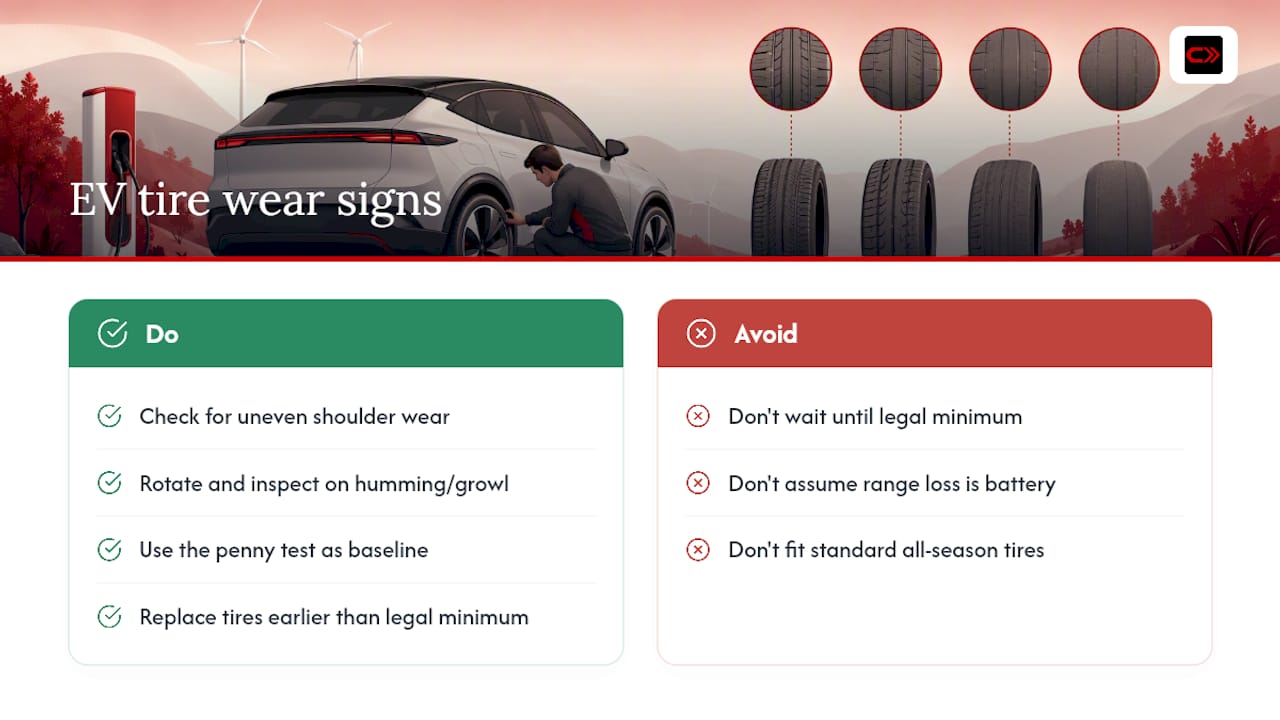
Watch for wear that’s uneven side to side or concentrated on the shoulders of the tread, a pattern more common on EVs because instant torque puts extra stress on the outer tread blocks during hard acceleration. This shows up faster than the gradual, even wear pattern many gas car owners expect.
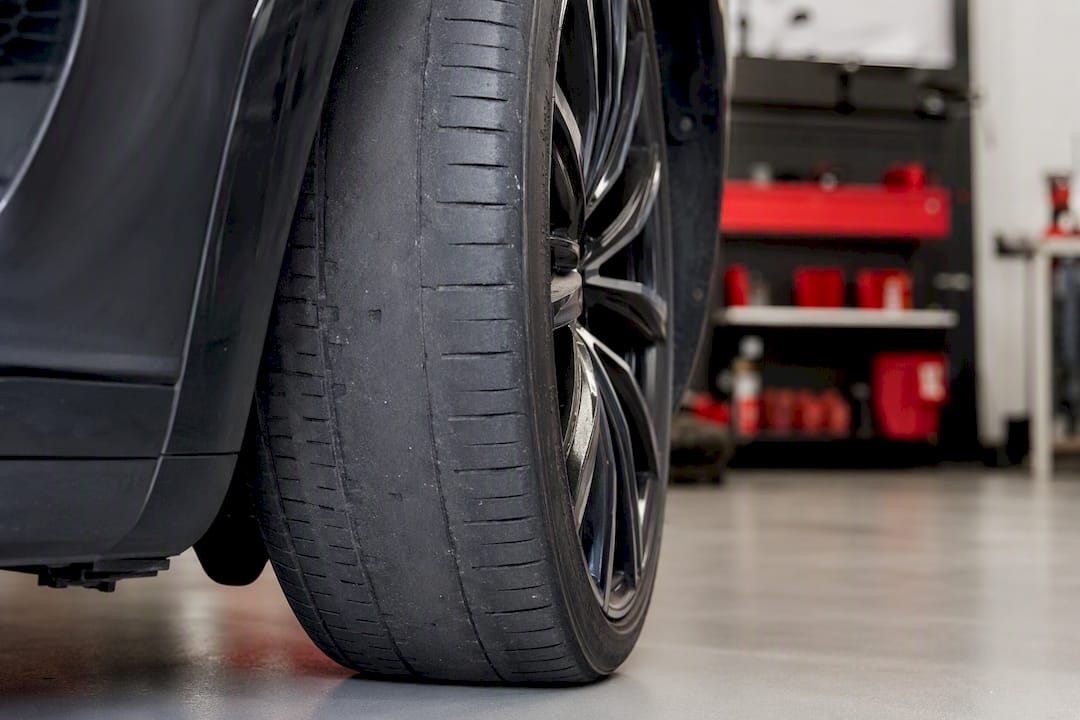
Use the classic penny test as a baseline, but don’t wait until tread depth is at the legal minimum. Given the added weight of an EV, stopping distances lengthen more noticeably as tread wears down, so many technicians recommend replacing EV tires a bit earlier than you would on a comparable gas vehicle.
Reduced range that shows up gradually, without any other explanation, is sometimes a tire problem rather than a battery problem. Worn or underinflated tires increase rolling resistance, and rolling resistance eats into range in a way that’s easy to blame on the battery when the real culprit is sitting at the curb.
Finally, pay attention to noise. A humming or growling sound that gets louder with speed often signals uneven wear, and it’s worth a rotation and inspection before it turns into a full replacement. Sticking to EV-rated tires designed for the extra load, rather than swapping in a standard all-season replacement, tends to close the wear gap noticeably.
What EV Owners Get Wrong About Maintenance
The biggest misconception isn’t that EVs need constant service. It’s the opposite: owners assume “less maintenance” means “no schedule,” and that’s where small problems turn into expensive ones. A seized caliper doesn’t announce itself. Neither does a 12V battery on its way out or a coolant system running low. These are quiet failures, and quiet failures are exactly the kind that get missed when there’s no oil-change sticker reminding you to pay attention.
Conventional advice tends to over-index on battery degradation and under-index on the mechanical basics: tires, brakes, and the 12V system. Those three cause more roadside headaches than a battery ever will, and they’re also the cheapest problems to catch early. A tire rotation costs a fraction of a tow bill.
If you take one thing from this article, prioritize the multi-year items you can’t see and won’t remember on your own. Set the brake fluid test, the 12V check, and the coolant service on a calendar the moment you buy the car, not two years in when you’re trying to reconstruct what’s already overdue. That’s less a maintenance philosophy than a bet on your own memory, and it’s a bet most owners lose.
— Chally
Let Carjourney Handle the Scheduling for You
Keeping every one of these intervals straight across tires, brakes, coolant, and the 12V system is exactly the kind of thing that falls off a busy owner’s radar. Carjourney is built to close that gap: it scans your service documents, pulls out what’s already been done, and maps your manufacturer’s intervals onto your specific vehicle so you get reminders that reflect your actual mileage and service history instead of a generic template.
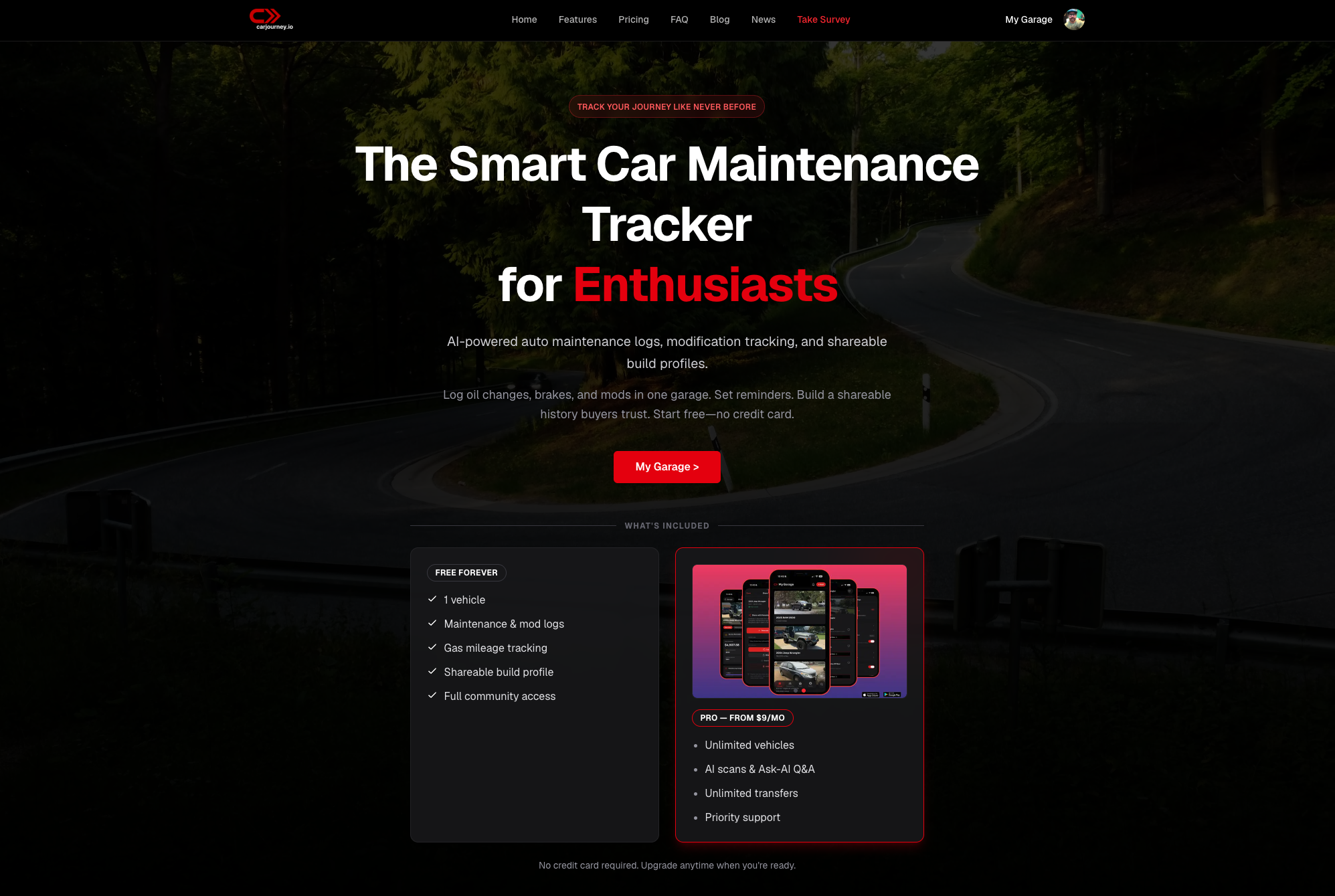
Instead of trying to remember whether you’re due for a brake fluid test or a caliper check, you set it up once and let the reminders come to you. The app also connects you with other EV owners tracking similar builds, which is useful the first time a warning light shows up and you want a second opinion before booking a shop visit. Head to Carjourney to add your vehicle and see your personalized schedule.
Sources
- Ford owner/service guidance (manufacturer service intervals)
- U.S. Department of Energy — electric vehicle maintenance overview
- Car and Driver — electric car maintenance
- Jalopnik — what EV owners need to know about maintenance