 carjourney
From the CarJourney journal
Winter Car Prep Checklist: Get Road-Ready for Cold Weather
Before the first hard freeze hits, your car needs more than a full tank of gas. A solid winter car prep checklist covers everything from battery health and tire pressure to emergency supplies and exhaust system integrity. NHTSA, AAA, and Consumer Reports all point to the same core categories, and skipping any one of them is how a routine commute turns into a roadside emergency.
Here is the full checklist at a glance:
- Battery: Test charge and cranking power; replace if older than a few years
- Tires: Check tread depth, inspect for cracks, verify pressure regularly
- Lights: Inspect headlights, brake lights, turn signals, and emergency flashers
- Wipers: Switch to winter-rated blades; fill reservoir with freeze-resistant fluid
- Coolant: Confirm a 50/50 antifreeze-to-water ratio; check for leaks
- Engine oil: Use a winter-grade oil with a “W” rating suited to your climate
- Heating and defrost: Test both front and rear defrosters before temperatures drop
- Fuel: Keep the tank sufficiently full throughout winter
- Brakes: Listen for grinding or pulling; get a full inspection if anything feels off
- Door and window seals: Lubricate with silicone spray to prevent freezing
- Exhaust system: Check for leaks that could allow carbon monoxide into the cabin
- Emergency kit: Blankets, ice scraper, jumper cables, flashlight, first aid kit, sand or kitty litter, phone charger, snacks
That list is your baseline. The sections below break down each category with the specifics that actually matter.
1. Why your battery is the first thing to check
Cold weather is brutal on a 12-volt battery. At freezing temperatures, a battery retains significantly less cranking power than it does in warm conditions, and a gasoline or diesel engine simultaneously demands more power to start. That combination is why so many drivers find themselves stranded on the coldest morning of the year.
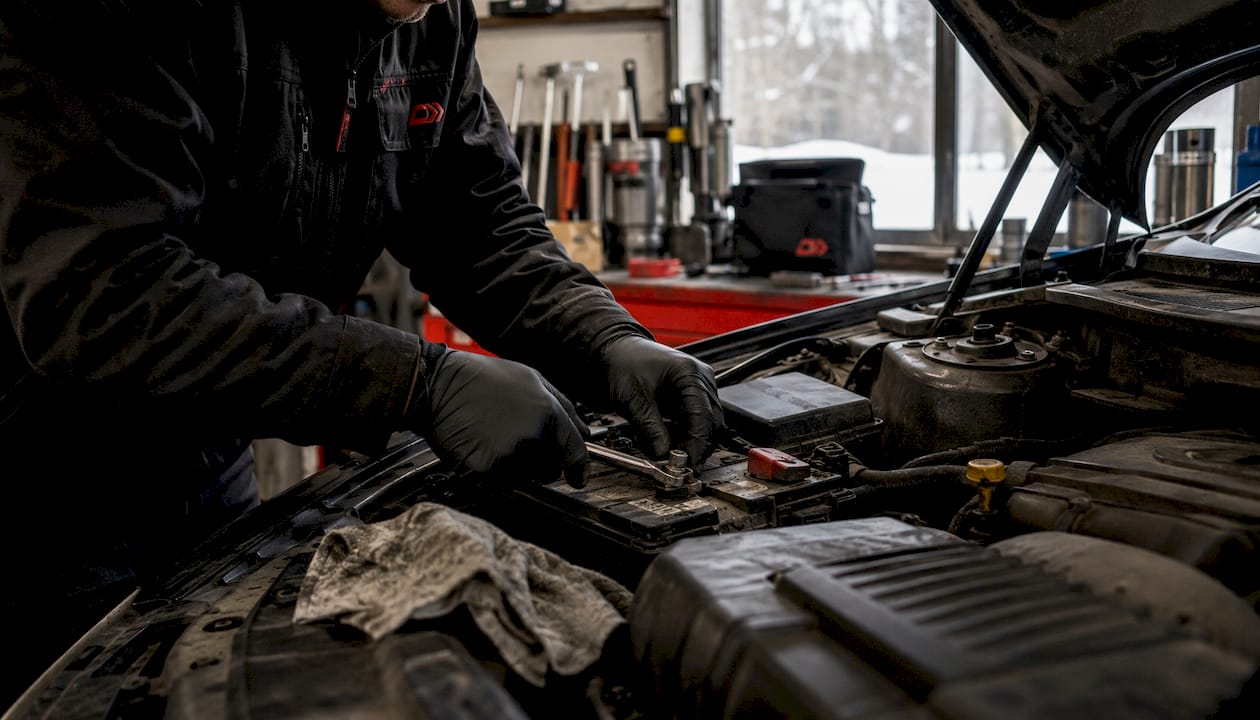
NHTSA recommends having a mechanic check your battery, charging system, and belts before winter sets in. If your battery is older than a few years, replace it before the season starts rather than gambling on whether it will hold. Cold weather does not kill a healthy battery; it exposes one that was already weakening.
A few specific things to address:
- Clean the terminals. Corrosion on battery posts increases resistance and reduces starting reliability. A wire brush and a baking soda solution handle most buildup.
- Check the charging system. A failing alternator will drain even a new battery.
- Inspect belts. Cracked or fraying drive belts can leave you without a charging system mid-drive.
- Consider a portable jump starter. Compact lithium jump packs are now reliable enough to fit in a glove box and start most passenger vehicles.
- Battery warmers are worth the investment if you live somewhere that regularly sees temperatures below 0°F. They wrap around the battery and maintain internal chemistry overnight.
Pro Tip: Test your battery at an auto parts store before winter. Most will do it free, and the printout tells you exactly where the battery stands on cold cranking amps.
2. Tire condition and pressure: what cold weather actually does
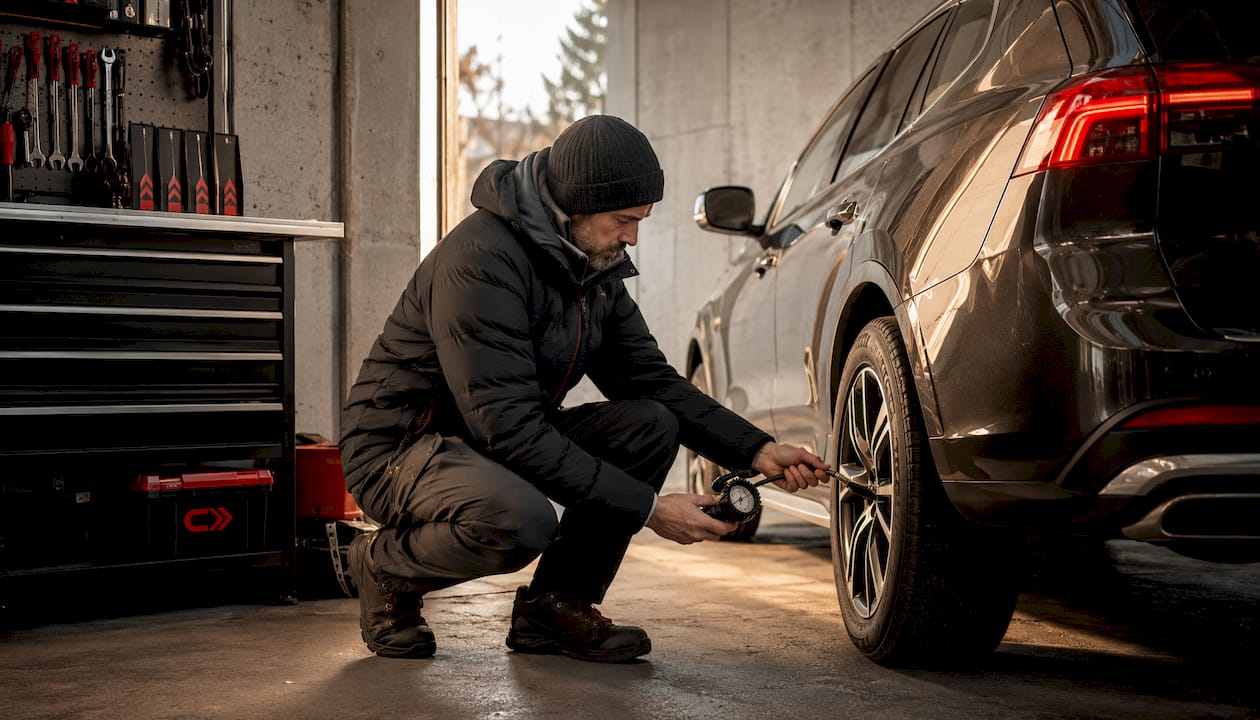
Tire pressure drops predictably in cold weather. AAA data shows that tire pressure typically drops about 1 PSI for every 10°F decrease in ambient temperature. If your tires were properly inflated at 75°F and the temperature falls to 25°F, you could be running about 5 PSI low without realizing it.
Underinflated tires cause uneven tread wear and reduce vehicle stability, which is the last thing you want on a snow-covered road. Check pressure monthly during winter, always when the tires are cold (meaning the car has not been driven for at least three hours). The correct pressure is on the sticker inside your driver’s door frame, not on the tire sidewall.
Beyond pressure, inspect the tires themselves:
- Tread depth: NHTSA recommends at least 2/32 of an inch on all tires. For winter driving, more is better. A quarter inserted into the tread groove with Washington’s head facing down should disappear up to his hairline.
- Sidewall condition: Look for cuts, bulges, cracks, or scrapes. Any of those means replacement.
- Winter tires vs. all-season: If you live in a region with consistent snow and ice, dedicated winter tires outperform all-season tires in cold conditions. The rubber compound stays pliable below 45°F where all-season rubber stiffens.
- Replace all four at once. Mixing new and worn tires creates handling imbalances, especially on slick surfaces.
- Tire chains: If you drive mountain passes or live in a region with chain laws, keep a set that fits your tire size and practice installing them before you need them in the dark.
3. Lights, windshield wipers, and visibility equipment
Visibility is the first thing winter compromises. Short days, snowstorms, and fogged glass all work against you, and none of it is manageable if your lights or wipers are already marginal.
NHTSA’s winter prep guidance calls for checking headlights, brake lights, turn signals, emergency flashers, and interior lights before winter. Walk around the car with a helper, or use a reflective surface like a garage door, to confirm every light is working and clean. Snow and road grime can cut light output dramatically even when the bulb is fine.
Windshield wipers deserve their own attention. Standard wiper blades have exposed metal joints that ice over and lose contact with the glass. Winter-specific wiper blades use a protective rubber boot that covers those joints, preventing ice buildup and maintaining consistent blade-to-glass contact through snow and sleet. Michelin’s guidance on winter wipers is straightforward: if you live where it snows, make the switch before the first storm.
Additional visibility checks:
- Washer fluid: Standard summer fluid freezes in the reservoir and lines. Fill with a winter-rated fluid rated to at least -20°F, and carry a spare jug.
- Rear defroster: Test it before temperatures drop. The heating elements are fragile and easy to damage with stickers or rough cleaning.
- Clear snow completely: Before driving, clear all glass, lights, mirrors, and the roof. Snow sliding off the roof onto your windshield at highway speed is a genuine hazard and is illegal in several states.
- Headlight leveling: Vehicles with automatic headlight leveling need professional calibration checks. Misaligned headlights blind oncoming drivers and reduce your own sight distance.
Pro Tip: Turn on the AC while running the defroster. The AC dehumidifies the cabin air, which clears fog from the windshield faster than heat alone. Most drivers do not know this and sit waiting for the glass to clear.
4. Fluid levels and heating system checks
Engine oil behaves differently in cold weather. Conventional oil thickens as temperatures drop, making it harder to circulate at startup, which is when most engine wear actually occurs. The “W” in an oil rating like 5W-30 stands for winter, and the number before it indicates how the oil flows in cold temperatures. A lower number means better cold-weather flow. Check your owner’s manual for the manufacturer’s recommended winter-grade oil, and change the oil and filter before the season starts if you are due.
Coolant is equally critical. A 50/50 mixture of antifreeze and water protects the cooling system from freezing and prevents internal corrosion. Most manufacturers recommend flushing and replacing the coolant every two years. If you cannot remember the last time it was done, do it now. A refractometer, available at any auto parts store for under $20, lets you test the freeze point of your coolant in about 30 seconds.
Other fluid and system checks to complete:
- Heating system: Run the heater on full blast and confirm it reaches operating temperature quickly. A heater that blows lukewarm air often signals a low coolant level or a failing thermostat.
- Fuel level: Keeping the tank at least half full during winter reduces moisture condensation inside the tank, which can cause fuel line freezing. It also keeps you prepared for unexpected delays or detours.
- Brake fluid: Moisture-contaminated brake fluid has a lower boiling point and can affect pedal feel in hard stops. If it has been more than two years, flush it.
- Door and window seals: Rubber seals dry out and crack in cold weather, letting in drafts and moisture. Wipe them down with a silicone-based lubricant before winter to prevent freezing and sticking. A frozen door seal can tear when you force the door open.
A yearly maintenance schedule that accounts for seasonal changes makes it much easier to stay on top of all of these fluid intervals without relying on memory.
5. Emergency supplies and essential safety gear
A breakdown in summer is an inconvenience. In winter, it can become dangerous within an hour. The supplies you keep in the car determine how that situation plays out.
Consumer Reports recommends a roadside emergency kit that includes blankets, extra clothing, first aid supplies, food, and tools like a shovel and ice scraper. NHTSA’s list adds jumper cables, warning flares or emergency markers, a flashlight, a cell phone charger, water, and any necessary medications. Both organizations treat this as non-negotiable winter preparation.
Build your kit around these categories:
- Warmth: Wool or fleece blankets, a hat, gloves, and an extra pair of socks. Hypothermia can set in faster than most people expect when a car is not running.
- Traction: A bag of sand or kitty litter gives you something to spread under spinning tires. A compact folding shovel handles snow packed around the wheels.
- Tools: Jumper cables or a portable jump starter, an ice scraper with a brush, and a multi-tool or basic socket set.
- Visibility: Flares or LED emergency triangles, and a flashlight with fresh batteries.
- Communication: A fully charged portable phone charger. Dead phones in cold weather are a genuine emergency.
- Food and water: Non-perishable snacks and a bottle of water. If you are stuck for several hours, you will want both.
- First aid: A kit that includes a tourniquet, bandages, and any personal medications.
Keep roadside assistance contact information in your glove box, not just saved in your phone. Know whether your auto insurance, credit card, or vehicle warranty includes roadside coverage before you need it.
6. Expert tips on advanced winter vehicle preparation
The standard checklist covers the basics. These details separate a car that handles winter reliably from one that surprises you at the worst moment.
Battery warmers are one of the most underused cold-weather tools. They wrap around the battery case and plug into a standard outlet, maintaining the battery’s internal temperature overnight. If you park outside in a climate that regularly drops below 10°F, a battery warmer pays for itself the first time it prevents a no-start.
Electronic safety sensors on newer vehicles, including lane-keep assist cameras, radar-based adaptive cruise control, and automatic emergency braking sensors, can be affected by snow, ice, and road salt. A professional inspection before winter confirms these systems are calibrated correctly and that the sensors are clean and unobstructed. Disabling or degrading these systems without realizing it removes safety features you may be counting on.
Winter wiper blade technology has improved considerably. The rubber boot design that Michelin advocates for winter blades prevents ice from forming at the blade joints, which is the specific failure point that causes streaking and skipping in freezing conditions. Lift the blades away from the glass when parking overnight in freezing temperatures to prevent them from bonding to the windshield.
Pro Tip: Use a refractometer to test your coolant’s freeze point directly. It takes 30 seconds, costs less than $20, and tells you exactly how much protection your cooling system has. Most drivers skip this step and assume the coolant is fine.
Cold weather reduces battery cranking power at the same time engines demand more power to start, making battery preparation the single highest-impact item on any winter vehicle maintenance list. Address it first.
Carjourney’s AI-driven platform can scan your service history, flag overdue maintenance items, and surface community-verified advice specific to your vehicle’s make, model, and build. For winter prep, that means knowing exactly which oil weight your engine needs, when your coolant was last flushed, and what other owners of your specific vehicle have found works in cold climates. Visit Carjourney to put your winter prep on a schedule that actually fits your car.
7. Checking and maintaining the exhaust system
The exhaust system is the most overlooked item on a winter driving safety checklist, and it carries the highest personal risk. A cracked exhaust manifold, a rusted pipe, or a damaged muffler can allow carbon monoxide to seep into the cabin. Carbon monoxide is odorless and colorless, and the symptoms of exposure, including drowsiness and confusion, are easy to mistake for fatigue on a long winter drive.
NHTSA specifically warns drivers to check that the exhaust pipe is clear of snow before running the engine, particularly when stopped or stalled. Snow packed around or into the tailpipe can force exhaust gases back into the vehicle. If you are stuck in a snowdrift and need to run the engine for warmth, clear the tailpipe first and crack a window.
Beyond the immediate safety concern, winter accelerates exhaust system corrosion. Road salt attacks metal pipes and joints, and the freeze-thaw cycle stresses welds and hangers. Have a mechanic inspect the full exhaust system before winter, looking for:
- Cracks or holes in the manifold, pipes, or muffler
- Loose or broken hangers that let the system contact the undercarriage
- Rust-through at joints or bends, which are the first places to fail
- Any unusual exhaust smell inside the cabin, which warrants immediate attention
A full car maintenance checklist that includes exhaust inspection as a seasonal item catches these problems before they become dangerous. Do not wait for a smell or a noise to investigate.
Key Takeaways
A complete winter car prep checklist addresses battery health, tire pressure, lights, wipers, fluids, emergency supplies, and exhaust integrity before cold weather arrives.
| Point | Details |
|---|---|
| Battery first | Cold weather cuts cranking power; replace batteries older than 3–4 years before winter. |
| Tire pressure drops about 1 PSI per 10°F | Check pressure monthly in cold weather using the door-frame sticker, not the tire sidewall. |
| Winter wipers and fluid matter | Switch to winter-rated wiper blades with rubber boots and fill the reservoir with freeze-resistant fluid. |
| Keep the tank half full | A fuller tank reduces moisture condensation and prevents fuel line freezing in extreme cold. |
| Exhaust leaks are a safety emergency | Carbon monoxide from a cracked exhaust can enter the cabin silently; inspect the system before winter. |