 carjourney
From the CarJourney journal
Car Staging Explained: Definition, Process, and Tips
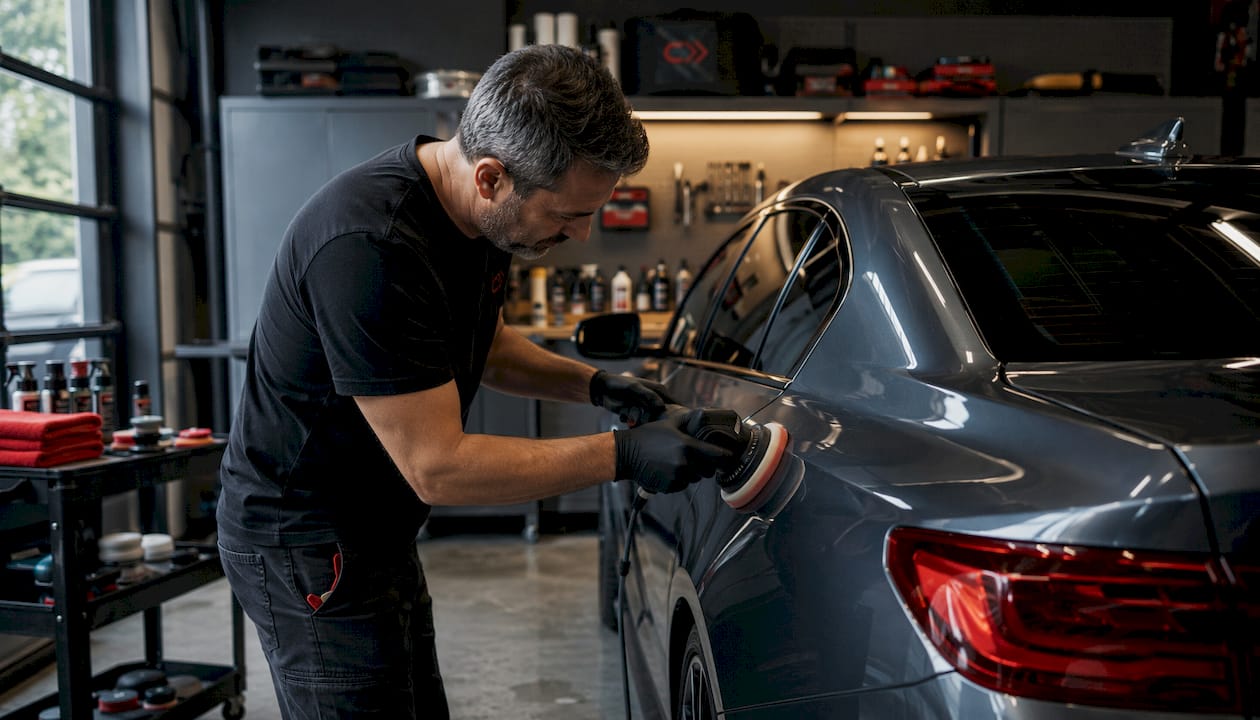
Car staging means three distinct things depending on where you are: in the driveway, it’s the process of preparing a vehicle to showroom condition before listing it for sale; on the drag strip, it’s positioning your car at the starting line and activating the Christmas Tree sensors; in a logistics yard, it’s organizing vehicles by destination and transport mode before loading. Knowing which context applies changes everything about what you do next.
- Resale staging: professional detailing, paint correction, minor cosmetic repairs, odor removal, photo merchandising, and paperwork assembly to maximize perceived value and listing click-through.
- Motorsport staging: rolling the front tires through pre-stage and stage infrared beams on the Christmas Tree, then choosing a shallow or deep position based on reaction-time strategy.
- Logistics/yard staging: intake logging, grouping vehicles by destination and transport mode, and using RTLS or GPS to maintain visibility before shipment to dealers.
If you’re a seller documenting a build, a racer logging launch strategy, or a fleet buyer tracking auction purchases, the staging process directly affects your outcome.
Table of Contents
- Why staging matters more than most sellers realize
- How to stage a car for sale: a practical checklist
- What staging means in drag racing
- How vehicle staging works in logistics yards
- How to document staging work so buyers can verify it
- What staging actually costs and how long it takes
- Pre-listing photo and paperwork checklist
- Common staging mistakes and how to fix them
- How staging affects the final sale price
- Environmental and safety considerations during staging
- Staging approaches differ by vehicle type
- Key Takeaways
- The part of staging most enthusiasts underestimate
- Carjourney turns your staging work into buyer-ready evidence
Why staging matters more than most sellers realize
Staged listings outperform unstaged ones by a wide margin. Industry data from CarPixAI shows well-staged listings can generate 40–50% more clicks than comparable listings with inconsistent or low-quality photos. More clicks mean more inquiries, more negotiating leverage, and a faster sale.
Staging is the foundation of high-performing online listings. Consistent shot order, proper lighting, and removal of personal items signal quality and build buyer trust before a single word of copy is read.
On the drag strip, staging is a tactical decision with real consequences. Shallow staging gives you slightly more rollout distance before the timing beam, which can improve elapsed time. Deep staging moves the car closer to the line, potentially sharpening reaction time, but it raises the risk of a red-light disqualification. The wrong choice for your skill level can end a race before it starts.
In logistics, staging reduces loading errors and shortens the time between a vehicle arriving at a yard and reaching the dealer’s frontline. Best-in-class dealers target a short time-to-line (T2L) of a few days. Yards that skip structured staging routinely miss that window by days or weeks.
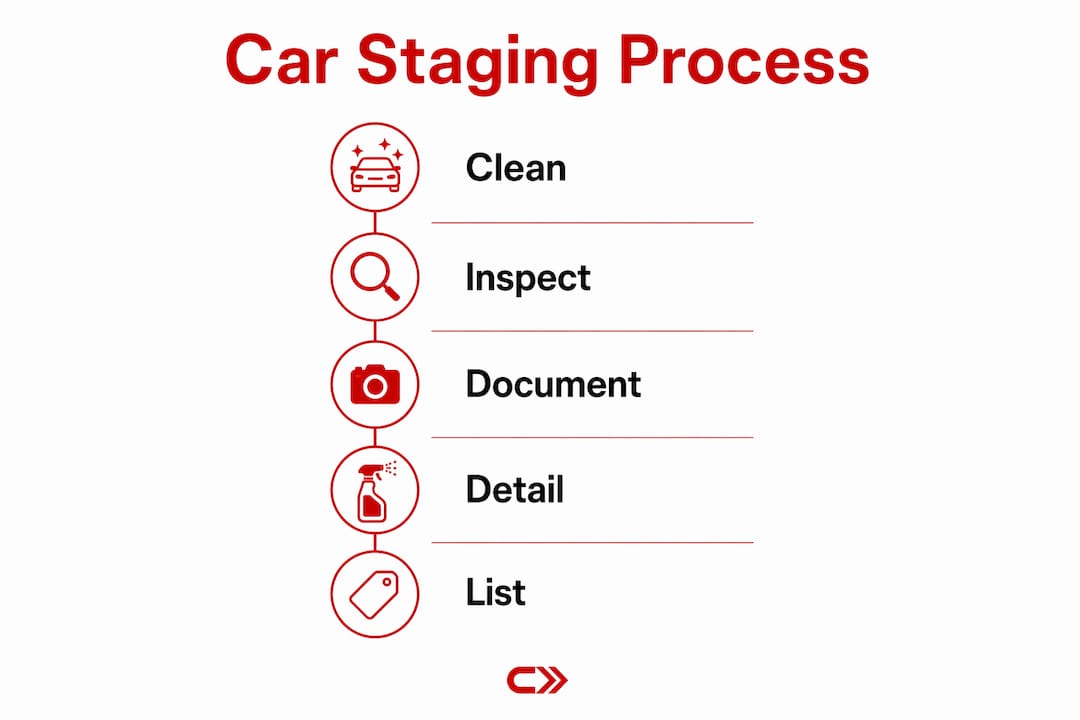
How to stage a car for sale: a practical checklist
The goal is simple: a buyer who has never seen your car should trust it before they arrive. Here’s the order that matters.
- Intake and service logging. Pull every receipt, note the current odometer, and log the vehicle’s condition in your tracking app before touching anything. This baseline matters for ROI calculations later.
- Mechanical check. Address any warning lights, fluid levels, tire pressure, and brake condition. Buyers notice the basics; skipping them signals neglect.
- Paint and cosmetic repair. Fix chips, scratches, and scuffs. Headlight restoration is one of the highest-ROI fixes you can do for under $30.
- Deep detail. Full exterior wash, clay bar, polish, and wax. Interior vacuum, surface wipe-down, and glass cleaning inside and out. Interior care at this stage sets the tone for every photo that follows.
- Odor removal. Ozone treatment or enzyme-based cleaners for persistent smells. Air fresheners mask; they don’t fix.
- Photo staging. Move the car to a clean, neutral background. Shoot in consistent lighting (overcast is ideal). Follow a fixed shot order: hero 3/4 front, full rear, driver side, passenger side, full interior, odometer, engine bay, trunk, wheels, and any documented flaws.
- Documentation assembly. Gather service records, recent receipts, modification list, title status, and any warranty paperwork. Attach everything to your Carjourney build profile for export.
- Final QA. Walk the car as a buyer would. Check for missed spots, streaks on glass, and anything that looks out of place in photos.
Pro Tip: Wheel presentation is underrated. A set of clean, dressed tires against a freshly washed car adds perceived value that costs nothing but time. Log the detail date and products used in Carjourney so you can show buyers exactly when it was done.
What staging means in drag racing
In drag racing, staging is a precise mechanical procedure, not just pulling up to the line. The Christmas Tree is a vertical light board with two sets of infrared photocells. As you roll forward, your front tires break the first beam and the pre-stage bulb lights up. Roll a few more inches and the second beam activates the stage bulb. At that point, you’re officially staged and the starter can initiate the countdown sequence.
The rollout between the two beams is a few inches, allowing for strategic positioning. That distance is where strategy enters.
Shallow staging stops as soon as both lights are on, preserving maximum rollout distance. Deep staging rolls forward until the pre-stage light goes out, moving the car closer to the finish line and potentially cutting reaction time — but one inch too far and you’re red-lit before the tree drops.
For enthusiasts logging performance runs, record your staging approach (shallow or deep), your reaction time, and your 60-foot time together. Patterns across multiple runs reveal whether your staging choice is helping or hurting your consistency.
How vehicle staging works in logistics yards
Yard staging in automotive logistics is a queuing and sorting operation. When vehicles arrive at a distribution yard, they’re logged at intake, grouped by destination, and sorted by the transport mode that will carry them out — rail, truck, or roll-on/roll-off vessel. That grouping is what makes loading efficient.
The technologies behind it:
- RTLS (Real-Time Location Systems) and GPS track vehicle positions within the yard without manual scanning.
- Inventory system integration connects physical location data to order management and dealer delivery schedules.
- Checkpoint logging at each stage maintains quality control visibility before vehicles ship.
T2L (time-to-line) is the KPI that captures how long a vehicle sits between arrival and frontline readiness. The biggest bottleneck is rarely the physical work. Administrative approvals, missing paperwork, and parts authorization delays are what push T2L past the 3–5 day benchmark. Yards that digitize approvals and integrate their inventory systems cut those delays significantly.
How to document staging work so buyers can verify it
A staged car without documentation is just a clean car. Buyers want proof, and the right artifacts make the difference between a quick sale and a drawn-out negotiation.
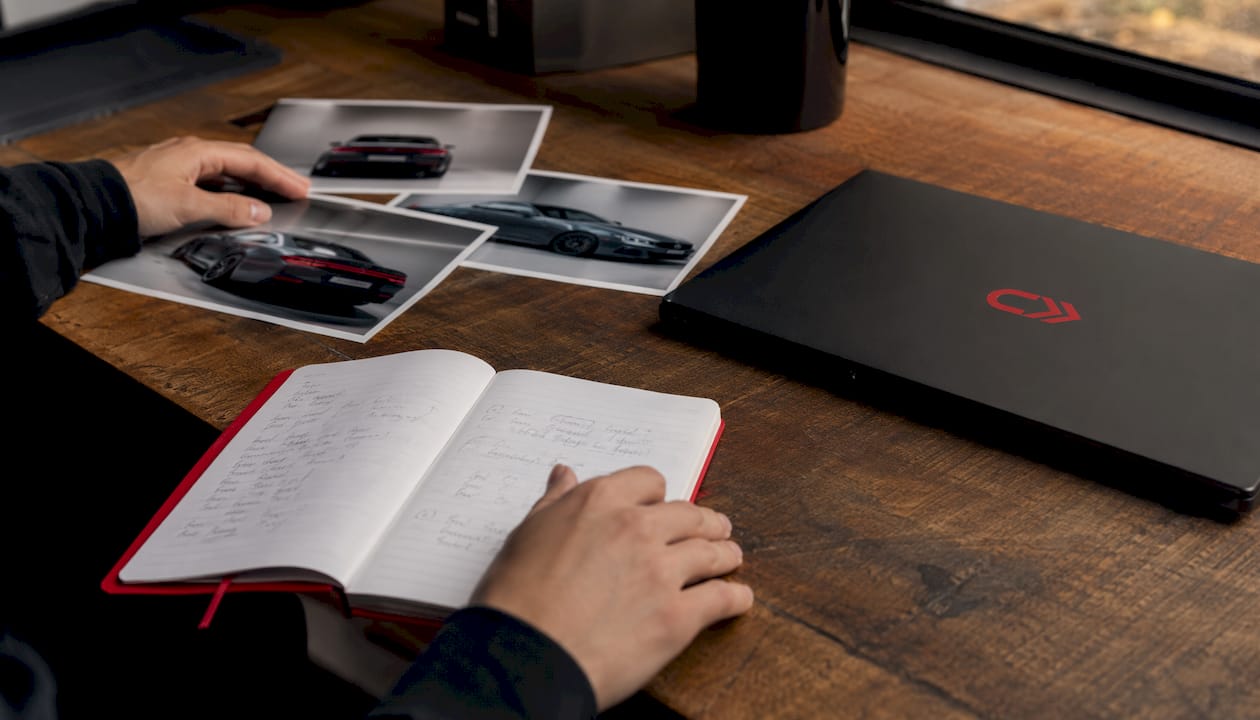
The exact items buyers ask for: dated photos with consistent lighting and shot order, scanned service receipts, an odometer image at the time of staging, signed inspection notes, and a modification list with sourced parts. Service history presented as a single organized dossier carries far more weight than a folder of loose receipts.
In Carjourney, log each staging activity as a service entry with the date, cost, and photos attached. Tag modifications separately so they appear in the build profile. When you’re ready to list, export the full build PDF and attach it directly to your listing or share the link with buyers. That single document answers most buyer questions before they ask.
Pro Tip: Standardize your shot order in Carjourney’s photo log so every vehicle you sell has the same sequence. Buyers who’ve seen one of your listings will immediately recognize the format on the next one, which builds personal seller credibility over time.
What staging actually costs and how long it takes
Cost and timing vary by how much work the car needs, but the buckets are consistent.
| Intervention | Typical cost range | Estimated time |
|---|---|---|
| DIY wash, vacuum, minor cosmetic fixes | — | 4–8 hours |
| Professional detail, light paint correction | — | 1–2 days |
| Body/paint repair, mechanical recon | — | 3–5 days |
| Full recon to frontline-ready (dealer standard) | Varies | 3–5 days best-in-class |
A short time-to-line (T2L) benchmark applies to professional dealer reconditioning. Private sellers doing their own staging typically spread the work over a weekend. The cost-to-return math usually favors at least a professional detail: the resale ROI on a $200 detail often exceeds the cost several times over on a well-documented listing.
Note: Cost ranges above are estimates for planning purposes. Actual costs vary by market, vehicle condition, and service provider.
Pre-listing photo and paperwork checklist
Before your listing goes live, run through this checklist.
Photos:
- Hero 3/4 front shot (clean background, good light)
- Full rear, driver side, passenger side
- Full interior (front and rear seats)
- Odometer reading
- Engine bay
- Trunk/cargo area
- All four wheels and tires
- Any documented flaws (scratches, chips, wear)
Listing copy:
- Honest condition summary
- Documented modifications with part names and install dates
- Recent service highlights (oil, brakes, tires)
- Link to exported Carjourney build dossier
Paperwork to attach or scan:
- Clean title status
- Current registration
- Recent service invoices
- Any inspection certificates or warranty documents
Listings that include a build dossier link alongside photos consistently generate more serious inquiries. Buyers who can verify history before contacting you arrive with fewer objections and more confidence to commit.
Common staging mistakes and how to fix them
The most expensive mistake is skipping documentation. A beautifully staged car with no service records leaves buyers guessing, and guessing buyers lowball. Fix it by logging every receipt and service entry before you list, not after a buyer asks.
Inconsistent photos are the second-biggest problem. Shooting half the car in shade and half in direct sun, or using different backgrounds across shots, signals carelessness. Standardize your shot order and shoot everything in the same session under the same light.
Masking problems instead of fixing them is a trust-killer. Air fresheners over smoke smell, touch-up paint over rust, or a fresh wash over a leaking gasket will surface during inspection. Buyers who discover masked issues during a test drive walk away and tell others. Disclose known issues in the listing and price accordingly.
Finally, overpricing after staging is common. Staging improves presentation and click-through, but it doesn’t change the car’s mechanical condition or market comparables. Use an AI valuation tool to check current market pricing after staging so your ask is grounded in data, not optimism.
How staging affects the final sale price
The click-through uplift from well-staged listings (40–50% more clicks versus unstaged) translates directly into more offers and stronger negotiating position. More competing buyers means less pressure to accept the first offer.
Beyond clicks, documentation quality affects the price ceiling. A car with a complete service history, a modification log, and dated staging photos commands a premium because it removes buyer risk. Buyers pay for certainty. A documented service log is one of the clearest signals that a car has been cared for, and that signal has real dollar value at negotiation.
The math works in reverse too. Missing records, inconsistent photos, and undisclosed issues give buyers ammunition to negotiate down. Every gap in documentation is a discount a buyer will ask for.
Environmental and safety considerations during staging
Chemical products used in staging — degreasers, paint correction compounds, interior cleaners, and odor treatments — require proper handling and disposal. Many are flammable or contain VOCs (volatile organic compounds). Work in a ventilated space, store chemicals in their original containers, and dispose of used cloths and compounds according to local hazardous waste guidelines.
Ozone generators used for odor removal are effective but require the car to be unoccupied and the area to be ventilated afterward. Ozone at high concentrations is harmful to breathe. Follow the manufacturer’s time recommendations and air the vehicle out completely before anyone sits inside.
For paint correction work, eye protection and nitrile gloves are standard. Polishing compounds and clay bar lubricants can cause skin irritation with prolonged contact. If you’re using a dual-action or rotary polisher, keep the pad moving to avoid burning through clear coat.
Staging approaches differ by vehicle type
Classic cars require a lighter touch. Aggressive polishing on original paint can remove patina that collectors value. Document the car’s originality carefully: matching numbers, original interior, and unrestored panels often command premiums that a full detail would undermine. Photography for classics should emphasize authenticity, not showroom gloss.
Luxury vehicles demand professional-grade detailing and a higher documentation standard. Buyers in the luxury segment expect complete service records from authorized dealers, and any gap raises questions. Ceramic coating, leather conditioning, and professional glass treatment are expected, not optional. Valuing modifications on a luxury car requires careful sourcing to avoid over-improving for the market.
Daily drivers benefit most from the basics done well: a thorough clean, fresh tires if worn, and honest disclosure of high-mileage wear. Buyers in this segment are practical. They want to know the car runs reliably and has been maintained. A clean Carjourney service log showing consistent oil changes and scheduled maintenance often matters more than a showroom shine.
Key Takeaways
Car staging across all three contexts, done with consistent documentation, is what separates listings that attract serious buyers from ones that sit.
| Point | Details |
|---|---|
| Three distinct meanings | Car staging covers resale prep, motorsport starting procedure, and logistics yard sorting — context determines the process. |
| Staged listings get more clicks | Well-staged listings generate 40–50% more clicks, which directly increases offers and negotiating leverage. |
| T2L is the recon benchmark | Best-in-class reconditioning targets 3–5 days to frontline-ready; administrative delays, not labor, cause most overruns. |
| Documentation seals the deal | Dated photos, service records, and a modification log remove buyer risk and support a higher asking price. |
| Carjourney centralizes the evidence | Log service entries, attach photos and receipts, and export a build PDF to attach to any listing or share with buyers. |
The part of staging most enthusiasts underestimate
There’s a tendency to treat staging as a one-time cleanup before selling. That framing misses the point. The sellers who get the best prices aren’t the ones who detail the car the week before listing — they’re the ones who’ve been logging receipts, photographing modifications, and maintaining a service record for months or years before the sale. By the time they list, the documentation practically writes the listing for them.
The same logic applies on the track. Racers who log their staging approach, reaction times, and 60-foot splits across multiple runs see patterns that casual competitors miss. Shallow staging might be costing you two hundredths of a second every run. You won’t know unless you track it.
What Carjourney’s team of gearheads and engineers built is exactly this: a place where the documentation habit becomes automatic. Scan a receipt, tag a modification, attach a photo, and the dossier builds itself. When a buyer asks for proof of maintenance, you’re not scrambling through a glove box. You’re sending a link.
The gap between a staged car and a well-documented staged car is where the real money is.
Carjourney turns your staging work into buyer-ready evidence
Most sellers stage the car and then scramble to find proof it was done. Carjourney flips that. Every service entry, receipt scan, modification record, and photo you log builds a shareable build dossier automatically, so when a buyer asks for documentation, you’re ready in seconds, not hours.
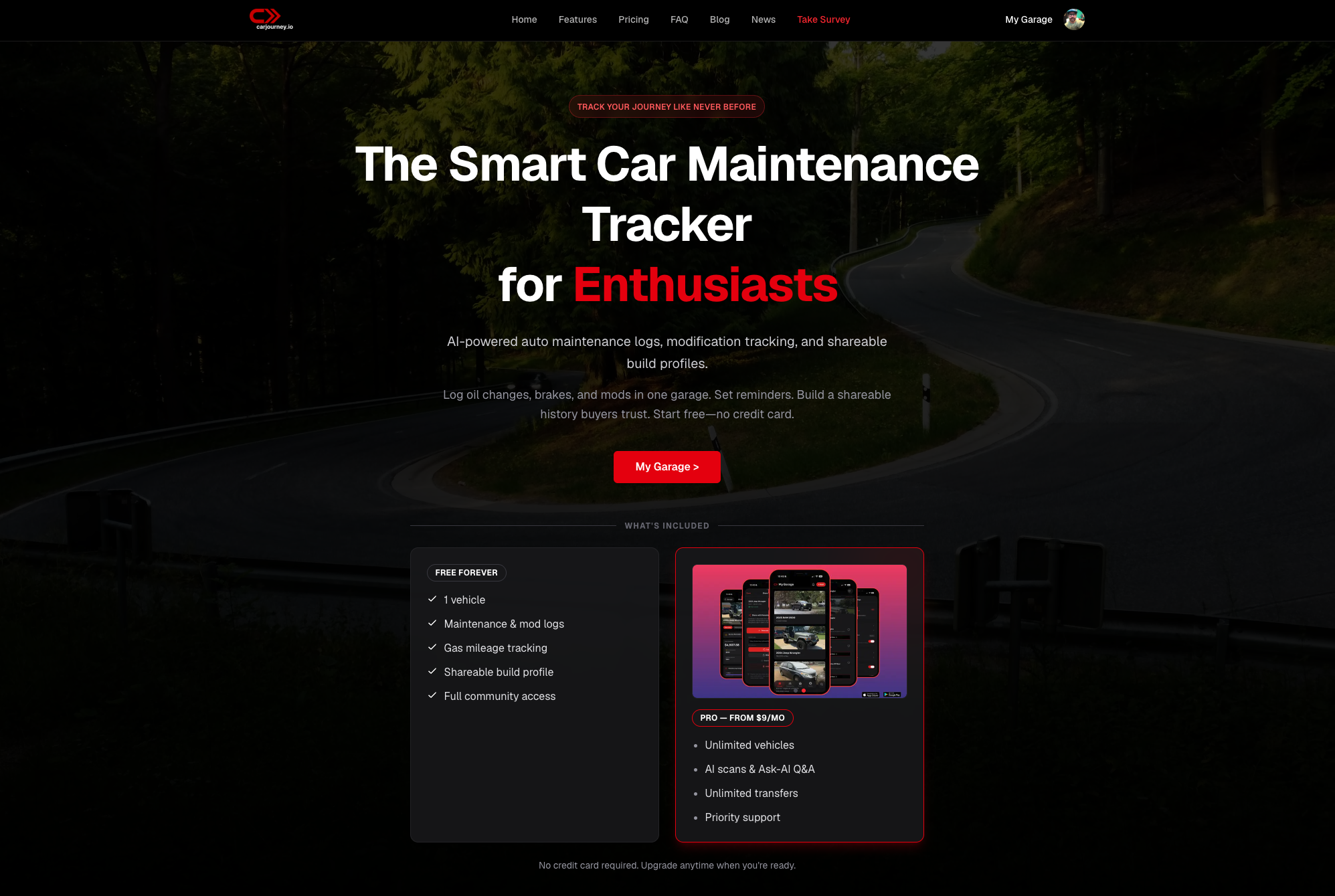
The features that matter for staging: service logs with date and cost fields, photo attachments per entry, modification records with part sourcing, AI-powered document scanning for old receipts, and one-click PDF export for listings. Reminder scheduling keeps your T2L tight by flagging what’s due before it becomes a delay.
If you’re serious about getting top dollar for your next sale, start your free Carjourney account and log your first staging entry today.